
Ankur’s elder brother got married 10 years ago. This summer, Ankur is going to meet his brother after a decade. As a token of love, he plans to buy clothes for his brother’s kids.
From what is remembered, Ankur's brother has two children, and it is known that one of the children is a boy, and that boy was born on a Tuesday.
Assume:
- Each child is equally likely to be a boy (B) or a girl (G).
- Each child is equally likely to be born on any of the 7 days of the week, independent of sex.
What is the probability that both of Ankur’s brother’s children are boys, given that at least one of them is a boy born on a Tuesday?
Check if you were right - full answer with solution below.
Solution:
Without any conditions, two children can have four equally likely gender combinations. However, since we know that at least one of the children is a boy born on a Tuesday, we eliminate the (GG) case because there must be at least one boy.
We are now left with three cases:
- BB (both boys),
- BG (older boy, younger girl),
- GB (older girl, younger boy).
Step 1: Count favorable outcomes for BB
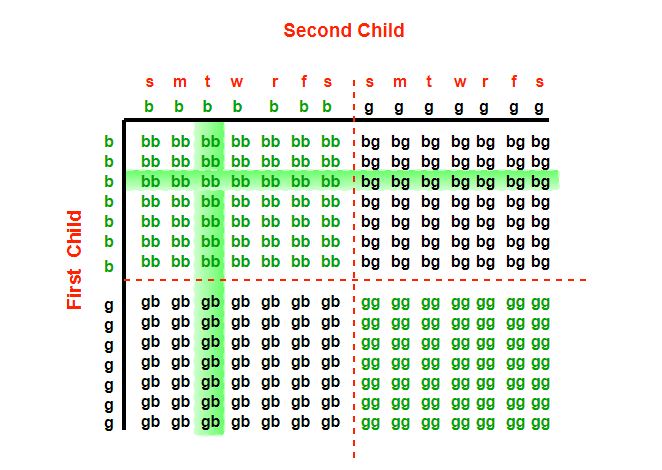
Now, each child can also be born on any of 7 days, so we need to count combinations where at least one boy is born on Tuesday.
For the BB case (both children are boys), there are two ways that at least one of them is born on Tuesday:
- The first boy is born on Tuesday, and the second boy is born on any of the 7 days (7 possibilities).
- The second boy is born on Tuesday, and the first boy is born on any of the 7 days (7 possibilities).
However, the pair (Tuesday, Tuesday) gets counted twice, so we subtract 1. Favorable outcomes: 13.
Step 2: Count favorable outcomes for BG and GB
In both cases, only the boy can satisfy the Tuesday condition. The boy is fixed to Tuesday, and the girl can be born on any of 7 days. Favorable outcomes: 7 each.
Step 3: Calculate the probability
The total number of favorable outcomes is 13 from the BB case, 7 from the BG case, and 7 from the GB case. Thus, 13 + 7 + 7 = 27.
The probability that both children are boys, is the ratio of the number of favorable outcomes for the BB case (13) to the total number of favorable outcomes (27):
Probability = 13/27