
2D Mensuration is the branch of mathematics that deals with the measurement of various flat geometric figures and shapes. This includes calculating areas and perimeters of two-dimensional shapes like squares, rectangles, circles, and triangles.
This mathematical discipline primarily involves determining:
- Perimeter: The total boundary length of shapes.
- Area: The surface coverage of plane figures.
Mensuration Terminologies
Here are the terms you will come across in 2D mensuration. We have provided the term, abbreviation, unit, and definition for easy understanding.
| Terms | Abbreviation | Unit | Definition |
|---|---|---|---|
| Area | A | m2 or cm2 | The surface that the closed form covers is known as the area. |
| Perimeter | P | cm or m | A perimeter is the length of the continuous line that encircles the specified figure. |
Mensuration Formula For 2D Shapes
The following table provides a list of all mensuration formulas for 2D shapes:
| Shape | Area (Square units) | Perimeter (units) | Figure |
|---|---|---|---|
| Square | a2 | 4a | 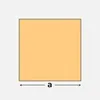 |
| Rectangle | l × b | 2(l + b) | 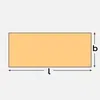 |
| Circle | πr2 | 2πr | 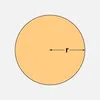 |
| Scalene Triangle | √[s(s-a)(s-b)(s-c)], Where, s = (a+b+c)/2 | a + b + c | 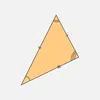 |
| Isosceles Triangle | ½ × b × h | 2a + b | 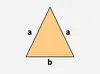 |
| Equilateral Triangle | (√3/4) × a2 | 3a | 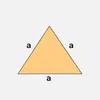 |
| Right Angle Triangle | ½ × b × h | b + hypotenuse + h | 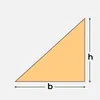 |
| Rhombus | ½ × d1 × d2 | 4 × side | 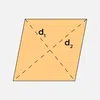 |
| Parallelograms | b × h | 2(l + b) | 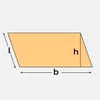 |
| Trapezium | ½ h(a + c) | a + b + c + d | 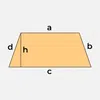 |
Mensuration 2D - Questions and Answers
Q1 : Find the perimeter and area of an isosceles triangle whose equal sides are 5 cm and height is 4 cm.
Solution:
Applying Pythagoras’ theorem,
(Hypotenuse)2 = (Base)2 + (Height)2
=> (5)2 = (0.5 x Base of isosceles triangle)2 + (4)2
=> 0.5 x Base of isosceles triangle = 3
=> Base of isosceles triangle = 6 cm
Therefore, perimeter = sum of all sides = 5 + 5 + 6 = 16 cm
Area of triangle = 0.5 x Base x Height = 0.5 x 6 x 4 = 12 cm2
Q2 : A rectangular piece of dimension 22 cm x 7 cm is used to make a circle of the largest possible radius. Find the area of the circle formed.
Solution:
In questions like this, the diameter of the circle is lesser in length and breadth.
Here, the breadth Diameter of the circle = 7 cm
=> Radius of the circle = 3.5 cm
Therefore, area of the circle = π (Radius)2 = π (3.5)2 = 38.50 cm2
Q3 : A pizza is to be divided into 8 identical pieces. What would be the angle subtended by each piece at the center of the circle?
Solution:
By identical pieces, we mean that area of each piece is the same.
=> Area of each piece = (π x Radius2 x θ) / 360 = (1/8) x Area of circular pizza
=> (π x Radius2 x θ) / 360 = (1/8) x (π x Radius2)
=> θ / 360 = 1 / 8
=> θ = 360 / 8 = 45
Therefore, the angle subtended by each piece at the center of the circle = 45 degrees
Q4 : Four cows are tied to each corner of a square field of side 7 m. The cows are tied with a rope such that each cow grazes the maximum possible field and all the cows graze in equal areas. Find the area of the ungrazed field.
Solution:
For maximum and equal grazing, the length of each rope has to be 3.5 cm.
=> Area grazed by 1 cow = (π x Radius2 x θ) / 360
=> Area grazed by 1 cow = (π x 3.52 x 90) / 360 = (π x 3.52) / 4
=> Area grazed by 4 cows = 4 x [(π x 3.52) / 4] = π x 3.52
=> Area grazed by 4 cows = 38.5 m2
Now, area of square field = Side2 = 72 = 49 m2
=> Area ungrazed = Area of field – Area grazed by 4 cows
=> Area ungrazed = 49 – 38.5 = 10.5 m2
Q5 : Find the area of the largest square that can be inscribed in a circle of radius ‘r’.
Solution:
The largest square that can be inscribed in the circle will have the diameter of the circle as the diagonal of the square.
=> Diagonal of the square = 2 r
=> Side of the square = 2 r / 21/2
=> Side of the square = 21/2 r
Therefore, area of the square = Side2 = [21/2 r]2 = 2 r2