
The main objective of preparing a financial statement is to know about the financial position of a company and find out the profit earned or loss suffered during the accounting period. The former objective is achieved by preparing a Trading A/c and a Profit & Loss A/c, which are also known as 'Income Statement' and the latter by preparing a Balance Sheet, also known as 'Position Statement'. The reason why Trading and Profit & Loss A/c is called Income Statement is that it gives information about the Income of the Company i.e., Gross Profit and Net Profit, while the Balance sheet of any enterprise tells about the position of the company related to its Assets and Liabilities. Thus, Financial Statement consists of the following:
- Trading Account
- Profit & Loss Account
- Balance Sheet
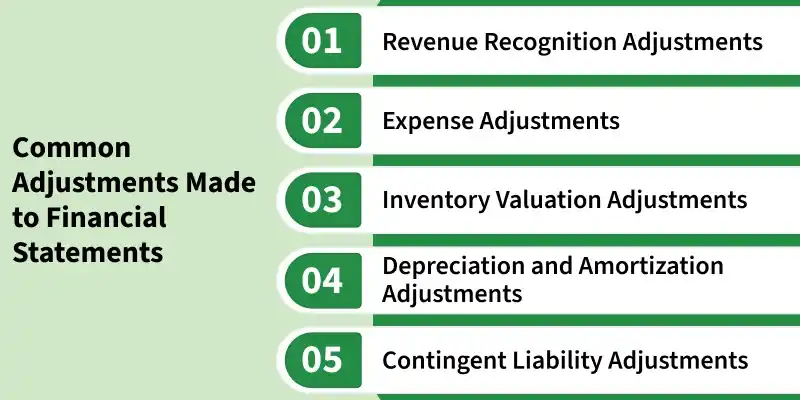
Adjustments in Financial Statement:
Adjustments in financial statements are necessary changes made at the end of the accounting period to ensure that income and expenses are recorded in the correct period. These adjustments follow the accrual concept and matching principle of accounting. For example, if we want to prepare profit and loss a/c for the year ending 31st March 2022, then it becomes mandatory to record all the income and expenditure of that year starting from 1st April 2021 in the profit and loss a/c. But some of the incomes which are a part of this financial year, have not been actually received (Accrued Income) ,along with some expenses which are a part of this financial year have not actually been paid (Outstanding Expenses). So in such cases, it becomes essential to add all the Accrued Income in the current year's profit and deduct all the Outstanding Expenses. A greater emphasis is made on finding all the accounting items and information that are related to the current financial year and passing entries accordingly.
So, all the accounting items which are related to the current financial year but not recorded in the books due to any reason should be taken into consideration to find out the actual profit or loss and accurate financial position of the organization, and accounting entries for such transactions are called adjustment entries or simple adjustments.
Objectives and Needs of Adjustments
- To find the actual Profit or Loss – Adjustments ensure that all incomes and expenses related to the current year are recorded, giving the true profit or loss.
- To show the true financial position – They help present correct values of assets and liabilities in the Balance Sheet.
- To rectify errors – Adjustment entries help correct mistakes or omissions made in the books of accounts.
- To complete incomplete transactions – They record any transactions that were partially or completely omitted.
- To provide for depreciation and other provisions – Adjustments ensure assets and liabilities are not overvalued or undervalued.
- To include accrued income – Income earned but not yet received is added to show the correct income of the year.
- To include outstanding expenses – Expenses incurred but not yet paid are recorded to calculate true profit.
- To record income received in advance – Unearned income is deducted to avoid overstating profit.
- To record prepaid expenses – Expenses paid in advance are adjusted to avoid understating profit.
Effect of Adjustment
Some points must be considered at the time of adjustment:
- Accounting for items mentioned in the trial balance will be carried out only once i.e., in one account only, whether in the Trading A/c, Profit and Loss A/c, or Balance Sheet.
- Accounting for items given outside the trial balance in adjustments will be carried out twice or at two places or in two accounts.