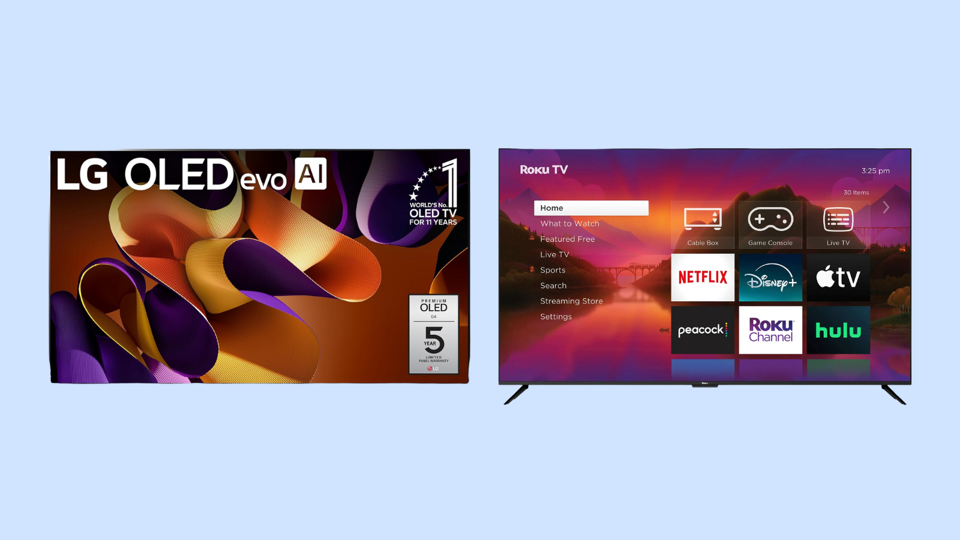
Sometimes when you’re watching your favorite movies and TV shows, or playing a bombastic game, a smaller TV can really take away from the experience. The best 75-inch TVs hit that sweet spot of giving you a huge, immersive picture without feeling like it’s overwhelming a large living room—and they don’t all have to be super expensive. Our recommendation for the best 75-inch TV is the LG OLED Evo G4, a great blend of price and value, offering a bright, gorgeous OLED picture for any space.
The LG G4 and the Roku Plus are two of the best 75-inch TVs you can add to your home.
Illustration: Forbes / Photos: Retailers
Its more modest sibling, the LG OLED Evo C4 77-inch, is our favorite TV for gaming at this size, but premium picks like the Sony Bravia 9 also have high brightness, incredible contrast, fast gaming responsiveness and powerful and intuitive streaming platforms. Whether you’re looking for OLED or Mini-LED, something premium and bold or more affordable and eye-catching, below are the best 75-inch TVs in 2024. And if you decide to go even bigger, we’ve also got expert recommendations for the best 85-inch TVs.
The LG G4 is the latest generation of LG’s iconic flagship OLED TV, and it really pulls out all the stops. It isn’t technically a 75-inch TV, but those two extra inches are worthwhile if you have the available wall real estate. It uses enhanced Micro Lens Array technology, which redirects pixel light lost in the back of the panel to your viewing area, and makes this TV brighter than ever. LG doesn’t publish nits numbers directly, but claims it can be up to 150% brighter than its predecessor, the G3. Reviewers cite particularly high SDR brightness, but it can reportedly reach close to 1,500 nits in HDR mode, which makes this OLED TV far more capable of looking great in brightly lit rooms. It also means HDR highlights really shine bright on this screen and make for a more vivid image.
Like all OLED TVs, the G4 also showcases the inkiest of blacks, making it look stunning in dark rooms, too. It’s also incredibly fast, with a near-zero input lag and a response time that’s under 0.1ms. The refresh rate has also been boosted this generation, and it can now achieve up to 144Hz for gaming PCs, while consoles can still enjoy up to 4K 120Hz for high speed gaming on Xbox or PlayStation.
What our editors say: Forbes Vetted’s consumer tech editor Rebecca Isaacs tested the LG G4 TV for her full review, and says, “As a gaming TV, the LG OLED Evo G4 4K knocks it out of the park. One of the first games I booted up was Assassin’s Creed Valhalla via Amazon Luna and paired the TV with my Amazon Luna Controller. A gaming TV should be easy to pair devices with and quick to load, with low input lag, virtually zero buffering and no ghosting. This TV ticks all these boxes and then some.”
Want to save this story for later?
No need to bookmark—get it straight to your inbox.
The S95D is arguably the best TV Samsung has ever made, and there’s a very good argument that it’s the best TV ever made, period. While we’d argue that at this larger size, the LG G4 steals the top spot, the S95D is very competitive and offers a compelling alternative—and also technically measures 77 inches. It features OLED technology, so delivers that double whammy of gorgeous high-contrast OLED with dark, inky blacks, and the incredible color vibrancy of quantum dots. This TV doesn’t get as bright as the LG option, though.
Beyond the panel itself, Samsung has updated the S95 model this year with a new matte coating. It’s not quite akin to its The Frame TVs, but it does cut down on reflections, helping this TV look much more visible and vibrant in brightly lit rooms and less problematic if you switch on a lamp or light a candle in a darker room. It supports HDR Pro and HDR10+, has impressive sound with Dolby Atmos support and includes a 70W 4.2.2 speaker system that gives this TV impressive audio right out of the factory.
What our editors say: During her hands-on, Isaacs said, “The Samsung S95D TV showcases a gorgeous contrast. Samsung Tizen OS feels intuitive for streaming and gaming, with easy access to all my apps as well as the built-in Samsung Gaming Hub and Ambient Mode, too.”
Best 75-inch TV For Gaming
High-Performance Gaming Within Reach
Best Buy
LG OLED Evo C4 4K
Display type: OLED | Refresh rate: 144Hz | Smart TV OS: LG webOS | HDR: HDR10, Dolby Vision, HLG
Pros:
Affordably priced for a big OLED
Incredible contrast and colors
Brighter than the previous generation
Cons:
Lacks peak brightness of the G4
The 77-inch LG C4 isn’t quite the pinnacle of LG TVs, but it’s very close. It uses the same high-end OLED panel as its top TVs, with incredible contrast, amazing colors and a higher brightness than the last generation. It’s not even that expensive when compared with the flagship TVs from most manufacturers, making this the best high-end OLED TV for most people.
It also supports a range of excellent gaming features, including a 144Hz refresh rate for gaming PCs, or up to 120Hz on consoles for 4K 120Hz play. Thanks to its use of OLED technology, its input lag and response time are almost instantaneous, so you needn’t feel falling behind the competition in competitive play. It also has several HDMI 2.1 ports for connecting all your high-end gaming systems, and works really well with cloud gaming if you’re a subscriber to Nvidia’s GeForce Now or Microsoft’s Xbox Game Pass. It also has full support for G-Sync and Freesync.
Best Budget 75-Inch TV
Impressive Specs And Size For Less
Walmart
Roku Plus Series QLED 4K
Display type: QLED | Refresh rate: 60Hz | Smart TV OS: Roku | HDR: HDR10, HDR10+, Dolby Vision, HLG
Pros:
Affordable price for its size
Impressive HDR support
Roku interface is fast and responsive
Cons:
Lacks HDMI 2.1
Limited to 60Hz refresh rate
Big TVs used to cost thousands of dollars, but now you can get a truly impressive big-screen TV from Roku for comparatively little. For less than $1,000, you can get a 4K 75-inch TV with quantum dots that make your favorite movies and TV shows look stunning. The Roku Plus Series TV has impressive HDR support, offering both Dolby Vision and HDR10+ support—something that neither the top LG or Samsung TVs can offer. It’s limited to a 60Hz refresh rate, and there aren’t any HDMI 2.1 ports—but at a lower refresh rate you couldn’t use them to their full capacity, anyway. You can still enjoy fast and responsive gaming on PC and consoles at 4K resolution with gorgeous colors.
Brightness is not super impressive on this TV, but it’s good enough for most spaces and HDR does give it a little more punch. It has an impressively low input lag and fast response time, making it a solid TV for gaming, and with the Roku operating system baked in, it has all the most important smart and streaming features you’d want. It’s fast and responsive, and the included remote is functional and easy to use.
What our editors say: Isaacs also tested this TV. In her full review, she says, “Because this TV has Roku OS built-in, setup only took about 15 minutes after powering it on, and I could start watching my shows. And, because it operates on this system, I could build out the apps to the way I liked, including adding Spotify, PBS Passport and more. Roku OS also makes it easy to shift the app tiles around to group them at the top for easier access.”
The TCL 75-Inch QM8 comes with all the trimmings, despite its gigantic size, and an impressively affordable price tag. This is a QLED TV with a refresh rate of 120Hz, with a capability to reach 144Hz with some PC cards. It’s got support for all the important HDR standards, a high brightness, smart home assistant support and a game mode that lowers latency and supports all the variable refresh rate modes. Its Google TV operating system supports all the best streaming platforms, too.
This TCL’s 2,000 nits of brightness is comparable to some of the very best TVs from the top manufacturers. The onboard upscaling algorithm does work well at making 1080p look closer to 4K, though some reviewers did report that it had a tendency to make images look too sharp.
If you want a super bright TV like the Sony Bravia 9, but don’t want to pay that premium price tag, the Hisense U9N is an excellent alternative. It isn’t cheap by any measure, but it’s cheaper, and when you’re talking thousands of dollars, often that’s enough. For that reduced price you still get an incredible TV, with a brightness that rivals some of the best—it can hit close to 5,000 nits in HDR and over 3,000 nits in SDR. That makes this TV stellar for bright and vibrant content, and it works fantastically well in bright rooms where it might have to deal with direct sunlight or other light sources.
Its’s super fast for gaming, with a high refresh rate and low input lag, and it supports all the major HDR standards. The build quality is strong, with a slimline frame that is modern and elegant, and the Dolby Atmos speakers offer a basic 4.1.2 channel audio setup that reviewers suggest is surprisingly effective.
Incredible, next-generation brightness and local dimming support
Exclusive PlayStation 5 optimization options
Impressive upscaling technologies
Cons:
Expensive
Sony software can require some finagling for gamers
Sony’s Bravia 9 is being hailed as the OLED killer, for its incredible contrast, super nuanced HDR and sky-high brightness. It has a brightness that Sony claims is 50% higher than the X95L, which would put it at around 2,500 nits. Despite that super high brightness and the use of Mini LEDs rather than OLEDs, this TV still sports some of the best contrast anyone has ever seen in a TV.
With over 2,000 local dimming zones, the Bravia 9 has some of the most nuanced control of that high brightness and strong contrast, too, almost completely eliminating blooming according to our hands-on time with the TV. It manages all this thanks to a redesign of Mini LEDs and a new dimming engine with a new Sony processor. Since this is a Mini LED TV, it also doesn’t have to worry about burn in. It’s very fast for gaming, too, and in our hands-on time, we noted some really impressive viewing angle uniformity, so everyone gets a great picture, not just those seated right in the center of the display.
What our editors say: During her hands-on, Isaacs said, “A lot of times, OLED panels have the upper edge because of their strong contrast and vivid imagery. The Sony Bravia 9 packs a punch for vivid colors across the screen. Reds came off especially well on-screen when contrasted against blues.”
If you want to get a truly next-generation 75-inch TV, then look no further than the Samsung QN900D. It has a truly cutting-edge design, with support for up to 8K resolution. There isn’t a lot of native 8K content you can watch just yet, but what is available on YouTube and some other streaming platforms is truly stunning, especially at a size like this. Still, for everything else you want there’s upscaling, and this TV does an excellent job at that, ensuring that the 4K and 1080p content you watch looks better than ever.
It’s got strong HDR support, too, with HDR10+ providing dynamic metadata scene by scene in supporting movies and TV. It’s also super fast for gaming, with a high refresh rate, low response time, and low input lag, helping you to play even competitive games at a high level. It is expensive, but then you’re getting a real next-generation TV design way ahead of everyone else, and the 8K content roll out is just over the horizon.
What our editors say: In her hands-on time with the QN900D, Isaacs was blown away by how good it looks: “As technology improves and new TV lineups launch each year, you’ll find that pretty much all devices have a really good picture. But when testing the Samsung Neo QLED 8K QN900D, I felt this TV knew exactly what it was meant to do: show a gorgeous, future-proof picture. ”
Best Budget 75-Inch TV For Gaming
Sky-High Refresh Rate At Bargain Pricing
Best Buy
Hisense QD7 QLED 4K
Display type: QLED | Refresh rate: 144Hz | Smart TV OS: Google TV | HDR: HDR10, HDR10+, Dolby Vision, HLG
Pros:
Very fast refresh rate and low input lag for gaming
Supports variable refresh rate and auto low latency mode
Very affordable price
Cons:
Lacks full array LEDs
Getting any modern 75-inch TV for under $700 is a great deal, but especially so if you’re a gamer looking to level up your gaming experience for less. The Hisense QD7 comes with an impressive array of gaming features, including two HDMI 2.1 ports giving you full support for 4K 120Hz gameplay on consoles. For PC gamers, you can take advantage of the refresh rate up to 144Hz, unlocking buttery smooth gameplay. It supports all major HDR standards, including HDR10+ and Dolby Vision, so no matter how your movie or game is mastered, it’ll look its best.
It also supports variable refresh rates to thwart screen tearing, and its auto low latency mode keeps you competitive in high-paced games. It has direct backlighting rather than full-array LED lighting, so isn’t as bright, and no dimming zones, so its HDR isn’t the most nuanced and can cause some blooming, but it still gets bright enough to provide vibrant and rich colors. There’s also AI upscaling that can make your movies and live TV look even better than they were recorded at, giving you extra detail in the content you love the most.
Forbes Vetted contributor Jon Martindale is a tech journalist with a background rooted in PC hardware. He enjoys sharing his passion for the latest tech by reviewing hardware and accessories, including guides on the best Windows laptops and 4K monitors.
This article and its updates are overseen by consumer tech editor Rebecca Isaacs. Isaacs has worked as a tech journalist for five years and regularly attends trade shows and tech conferences to report on the latest products to hit the market.
To keep our advice up to date, we routinely update this guide. It was last reviewed and refreshed in October 2024 by Martindale, who included a few new models.
How We Chose The Best 75-Inch TVs
When compiling our list of the best 75-inch TVs, we relied on our firsthand testing experience and expertise in the TV space. We also dove deep into research and consumer reviews.
We looked at top brands, including Sony, LG, Samsung and more to see what models stood out from the pack.
We relied on our own rigorous testing, including of the LG G4, the Samsung S95D and the Sony Bravia 9. Almost every TV on our list includes hands-on testing conducted by Isaacs.
We extensively researched each model on this list. Features we reviewed include screen type, refresh rate, operating system and smart features. To make the cut, each pick had to present an excellent value, balancing features and cost.
Furthermore, we extensively examined customer reviews to ensure the majority of buyers were happy with their purchase. We only included top-rated models.
We also made sure to include a variety of price points and specifications to offer a solid 75-inch model suitable for every type of TV watcher or gamer.
Frequently Asked Questions (FAQs)
All of these models, at 75 inches to 77 inches, are very sizable TVs and, in small rooms or placed too close to where you’re sitting, may well feel too big for the space. However, for larger rooms or a more cinema-like experience, 75 inches can be a fantastic size for your TV.
But 75 inches isn’t even the largest size TV you can buy. There are some manufacturers that sell many of these same great models at 85 inches, and some even bigger than that. If you want to go beyond 100 inches, consider a projector.
A 75-inch TV is great in larger rooms, typically those that are at least 10 feet wide and allow a viewing distance of around 6 to 10 feet. This ensures you get the full benefit of the screen size without overwhelming the space—or straining your eyes. The key is to have enough room for an immersive experience while keeping your viewing angle comfortable.
Most 75-inch TVs today support 4K resolution, providing great detail and sharpness. Some premium models also offer 8K resolution for even more clarity. Both 4K and 8K resolutions enhance your picture quality, but the difference is more noticeable on larger screens, making 8K a great choice for a 75-inch TV. However, 8K content is still very limited, so 4K is currently the more practical—and less costly—option.
OLED TVs provide deep blacks and superior contrast by individually lighting each pixel, making them great for dark rooms. Comparatively, QLED TVs use quantum dots to enhance brightness and color accuracy, and so they do well in bright, sunny spaces. LED TVs, while a great budget-friendly option, use a backlight that delivers good picture quality but it usually can’t match the depth and color range of OLED or QLED models.
Want to save this story for later?
No need to bookmark—get it straight to your inbox.
We added the Best Value 75-Inch TV For A Bright Room and the Best Budget 75-Inch TV For Gaming, which are both from Hisense. We also elaborated on our process for assembling this list of recommendations.