While Ring’s new Search Party feature aims to help pet owners quickly locate lost dogs using AI-based technology to scan footage across its outdoor camera network, some critics aren’t so sure they’re comfortable with it. Search Party was released last fall, but a Super Bowl ad showcasing it during Sunday’s big game, prompted a flood of privacy concerns. Here’s what you need to know about Ring’s Search Party feature, what it means for your home security, privacy and pets—and how to turn it off.
Ring Search Party, Explained
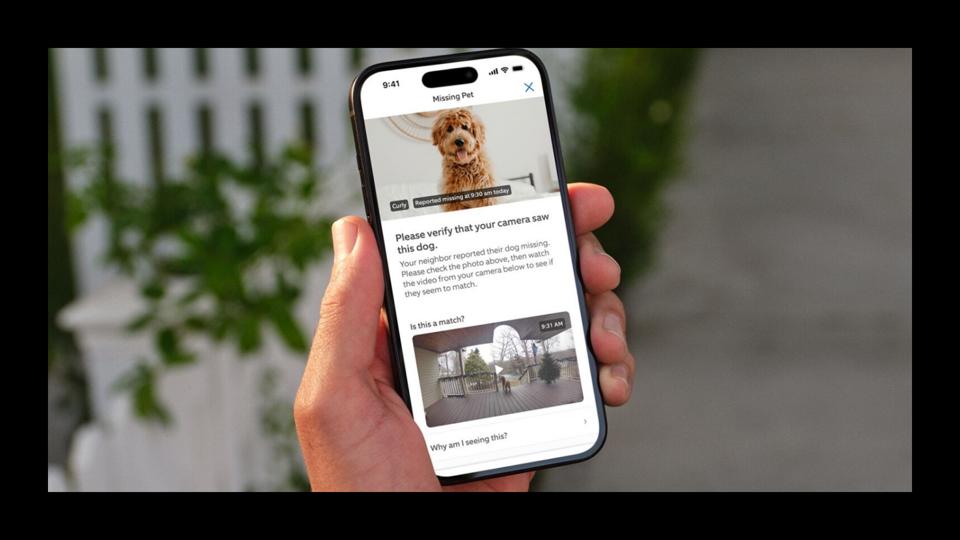
Search Party was built with lost dogs in mind, according to Ring, which is owned by Amazon, and makes a variety of home security cameras and video doorbells. (The Ring Floodlight Cam Wired Pro is our tech team’s pick for the best home security camera overall.) If your dog escapes your property, you can upload a photo of your dog to the app and report your dog missing to activate Search Party. The feature then uses AI to scan nearby Ring cameras’ footage and accounts to detect your dog.
Once the AI finds video footage that resembles your dog, it can pinpoint its most recent location. It alerts the Ring camera owner if a pet is seen on their camera and offers them the opportunity to share the footage or otherwise connect with that pet owner. However, the Ring camera owner has the option to not share the video with the pet owner, too. The Ring camera owner must check a consent box before proceeding, too. Your messages and phone numbers remain private during any ensuing conversations, according to Ring.
Andy Jassy, CEO of Amazon, says Ring trained its AI software using tens of thousands of dog videos to identify different breeds, sizes and more. “Privacy stays in your control,” he said in a post on X.com, adding, “you decide each time whether to help.”
With arguably the whole country more attuned to surveillance tactics in recent months, some say it’s a serious privacy concern and masquerades as surveillance software. “Another example of blatant privacy overreach,” said one X.com user. Senator Ed Markey of Massachusetts commented on the same channel that it isn’t, “about dogs—it’s about massive surveillance.”
Ring didn’t respond to my request for a comment before publication, but its founder and CEO Jamie Siminoff expressed surprise at the privacy concerns during an interview with ABC News on Tuesday, Feb. 10. He said that Ring is “not integrated to Flock at this time" when asked about the concerns that its technology could be used to identify and search for people—not just dogs. “The system is custom built just for dogs,” Siminoff said. The next thing the company is working on is trying to help ID lost cats, he said.
Security Concerns Surrounding Search Party
Ring says it isn’t automatically sharing your pet footage and instead giving camera owners the right to share. “If the AI scan identifies a potential match, it notifies the owner of the Ring camera, providing the owner the ability to share (or not share) the video,” adds Caitlin Fennessy, vice president and chief knowledge officer of IAPP, a privacy, AI governance and digital-focused nonprofit. That’s where the opt-in and consent specifically come into play, she adds. “With this setup, the ‘opt-in’ consent is being applied at the point of sharing the video as opposed to the point when AI scans the video, which is opt-out.”
The software uses previously saved videos stored on the Ring cloud. If someone starts a Search Party and one of your videos appears to be a match, you’ll receive a notification. It “places the onus on the homeowner to decide whether sharing a video that captures individuals or other objects alongside a potential missing pet would violate a neighbor’s privacy,” Fennessy says, and compared it to sharing photos and videos on social media.
Fennessy says current U.S. privacy laws add another layer of protection. “U.S. state consumer privacy laws include heightened protections for biometric data when used to identify people, and some also impose enhanced obligations for automated decision-making in limited contexts,” she says.
Still, many—as evidenced by all the Reddit, X and TikTok posts and media attention—see this as an overreach and are worried about how this technology might be used in the future and whether or not footage could be handed over to federal or local officials against their (or passersby) wishes. If you have lingering privacy concerns, I recommend turning the feature off altogether.
For those with escape artist pups or new puppies, you might also consider microchipping or one of these GPS dog trackers.
How To Turn Off Ring’s Search Party Software
If you own a Ring device that automatically saves to cloud storage, the software automatically opts you into Search Party. To opt out and turn it off, follow these steps:
- Open the Ring app and find the main dashboard.
- Tap the menu icon, and enter the Control Center.
- Find and select Search Party.
- For each camera, you can turn the “Search for Lost Pets” feature on or off.