As regional elections approach, Jana argues that Germany’s traditional parties face difficult choices that could reshape the country’s political landscape, while Jörg discusses what the AfD’s rise means for Germany. A “firewall” has kept mainstream parties from cooperating with the far right in the post-war period—but Jörg reflects on the strain this is under, and whether the AfD’s first taste of regional power could transform German politics.
Together, Mark, Jörg and Jana assess the prospects for Merz’s leadership, the future of the CDU and whether Germany’s political centre can withstand such pressure. Are established parties capable of renewing themselves? What happens if the AfD makes gains at the regional level? And what would prolonged instability in Berlin mean for Europe?
This podcast episode was recorded on August 12th 2026.
Bookshelf
The Names, by Florence Knapp
The Nights Are Quiet in Tehran, by Shida Bazyar
The Invite, by Olivia Wilde
Recycling is no longer just an environmental obligation. It has become a geoeconomic imperative directly linked to Europe’s energy security and industrial competitiveness. The European Commission’s Critical Raw Materials Act reflects this change—it has set an ambitious target to source at least 25% of the EU’s annual consumption of strategic raw materials from recycling by 2030.
Europe, however, is making little progress. A recent European Court of Auditors’ report suggests that seven of 26 energy-transition-related minerals have recycling rates between 1% and 5% in the EU. This means, for example, that Europe is recovering just three tonnes from every 100 tonnes of natural graphite contained in batteries. According to the report, there are another ten minerals that Europe does not recycle at all, including lithium, gallium and silicon metal.
As such, recycling battery materials warrants far more attention. This valuable source of critical minerals could lower the continent’s dependence on Chinese mineral value chains; recycling battery materials is also much quicker than relying on the development of mines elsewhere that produce the same materials. However, fragmentation, red tape and unfavourable economics are hampering Europe’s recycling efforts, in part due to a regulatory framework that still treats battery materials as hazardous waste rather than a source of strategically important minerals.
Europeans need to focus on battery materials regulation with an industrial policy lens and pursue strategic partnerships with African countries to make gains in material recovery.
Using black mass and EVs
Recovered minerals from Europe’s waste—including end-of-life electric vehicle (EV) batteries, wind turbines, industrial parts and electrical wiring—are insufficient to meet all of Europe’s mineral needs. However, they can substitute for a share of primary minerals from mining, which would help Europeans derisk from Chinese mineral supply chains far quicker than new mines can come into production.
Europe will have relatively significant EV battery feedstock for recycling in coming years. Europeans were early adopters of EVs and European countries are global leaders in terms of EV sales as a share of total car sales: in Sweden, Denmark and the Netherlands, for example, EVs account for 58%, 56% and 48% of passenger-vehicle sales respectively, while fully electric vehicles comprise 22.6% of cars registered in the EU. High EV adoption means Europe should have a solid supply of EV battery feedstock for recycling facilities, provided it keeps this within the EU for recycling.
In March 2025, the EU re-classified “black mass” (the shredded EV battery waste processed to recover critical minerals) and end-of-life lithium-based, nickel-based and zinc-based batteries as “hazardous waste”. Black mass is important because it contains valuable critical minerals; if Europeans can process this within its borders, it can feed recovered minerals into European industry. This new classification prohibits export of black mass to non-OECD countries, while requiring that shipments within the EU and the OECD have prior notification and consent from the import, export and transit countries involved.
Europe currently exports around 80% of its black mass for refining elsewhere, mostly in Asia; South Korea’s OECD status and cheap recycling capacities make it a key destination, for example. The reclassification of black mass raises bureaucratic barriers to exporting out of the EU, contributing to efforts to prevent recycling feedstock leaking out. However, black mass is now more difficult to move within Europe, too, which makes aggregating feedstock for recycling within the EU a challenge. While Europe has some battery shredding (or pre-treatment) capacity to produce black mass, its refining capacity to recover minerals from black mass has lagged significantly.
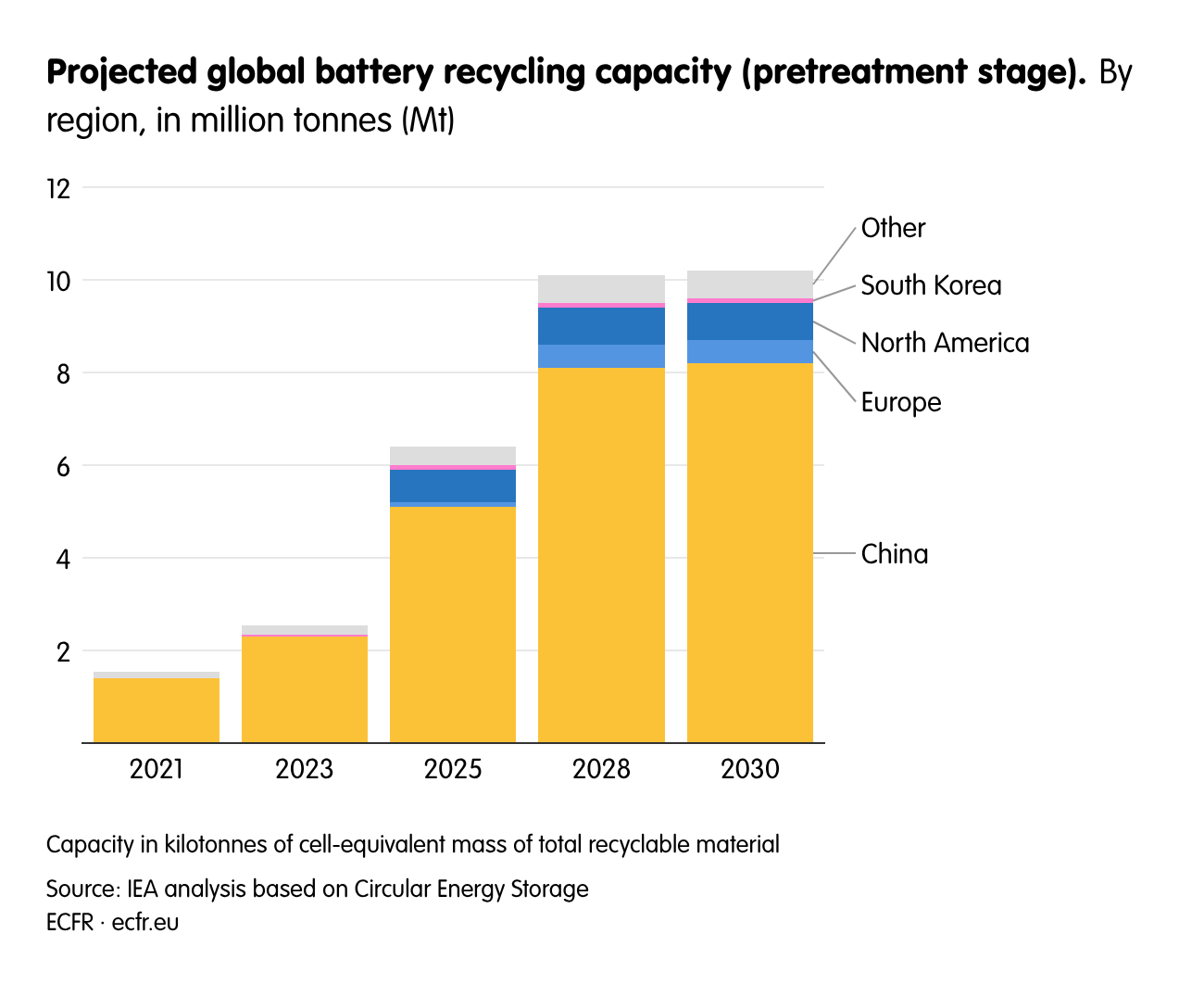
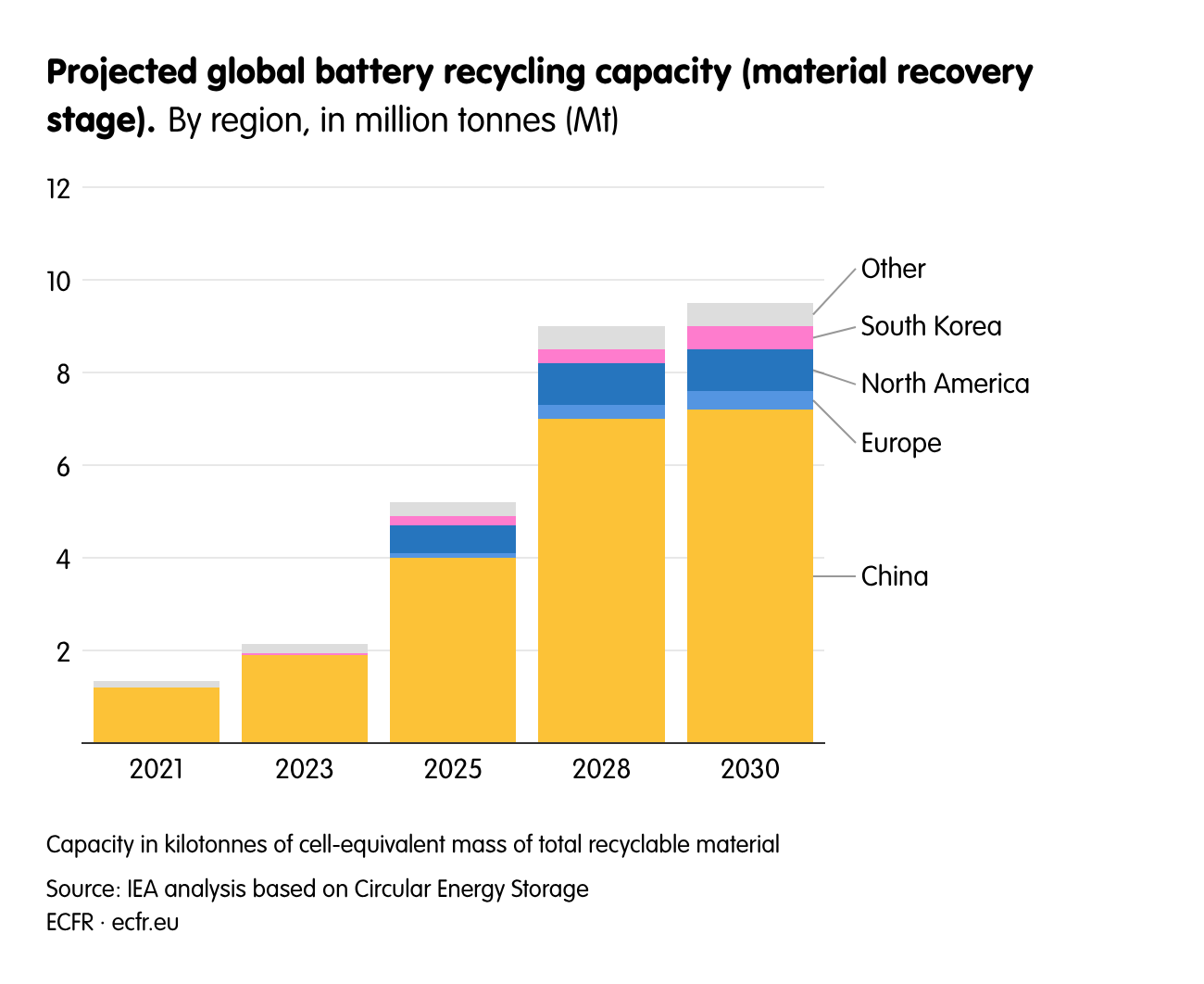
Although forecasts suggest that Europe will slightly raise its material-recovery capacity in the coming years, it remains a minor player. China’s dominant share in global battery recycling capacity for the shredding and material recovery stages, which exceeded 80% in 2025, is set to continue.
Recent analysis estimates that the costs of hydrometallurgical recycling for nickel manganese cobalt (NMC) and lithium iron phosphate (LFP) batteries are respectively 70% and 67% higher in France than in China due to higher labour, energy, environmental compliance, dismantling and transport costs in Europe. China’s scale of feedstock—domestic supply of end-of-life batteries, scrap metal from the local automobile industry, and imported batteries and black mass—has further lowered their recycling costs.
Making battery recycling happen in Europe
The EU can take three clear steps to increase recycling black mass in Europe.
First, Europeans should implement stricter export restrictions on black mass and batteries to fully close off exports and retain the products for material recovery domestically.[1] The US took this position in July 2026, with President Donald Trump empowering federal officials to block exports of end-of-life batteries and electronic waste to contain these products for recycling within the US.
Second, Europeans need to urgently build more recycling capacity to refine black mass: Europe’s hydrometallurgical recycling capacity is less than 3,000 tonnes, which is around one-sixtieth of China’s. Estimates suggest that Europe needs the capacity to recycle 120,000–135,000 tonnes of black mass per year by 2030.
Third—and perhaps most challenging—Europeans need to ensure recycling in Europe becomes more economically viable. Failing this, tough export restrictions will lead to battery waste being stockpiled rather than recycled.
To achieve the above, Europeans need to develop new financing mechanisms—such as building recycling costs into the purchase price of products and using public finance to help offset recyclers’ higher costs in Europe—to make recycling more economically viable. This would be particularly timely as battery technology shifts from NMC to LFP batteries: since the latter are comprised of less valuable minerals, recyclers earn less from the sale of recovered minerals, necessitating support for project viability.
The provision of public finance, preferably at both the EU and member-state level, would help in the development of new technologies and processes that lower recycling costs by reducing energy requirements and improving recovery rates. Patent filings in battery recycling are growing significantly, with 2026 figures showing a 103% growth in filings (adjusted for lag). China leads in patent applications, although US and European companies—notably Belgium’s Umicore—are also active. To make Europe more globally competitive in recycling, Europe must increase its investments in innovation using public finance support.
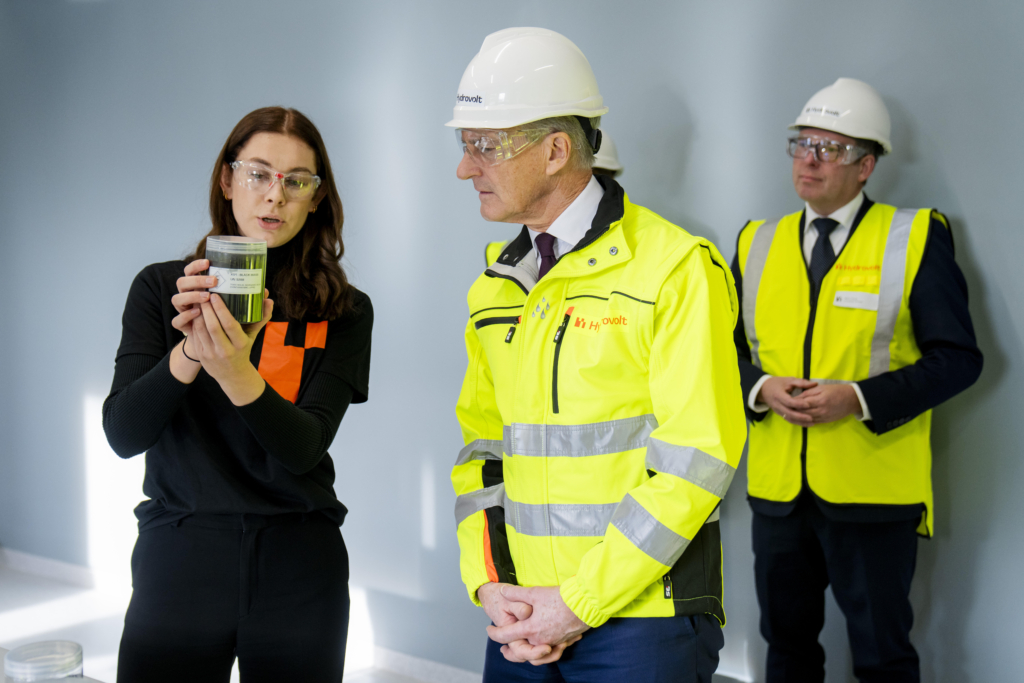
Europeans also need to establish a strong domestic value chain. European battery recyclers, such as Germany’s Cylib and Tozero and Norway’s Hydrovolt, should identify and establish commercial agreements with EU-based offtakers for the minerals they recover—after all, if Europe has to export recovered minerals outside its borders for want of domestic offtakers, gains in recycling will be for nothing. Specifically, this requires European industry that uses recovered minerals (alongside primary source minerals from mining) to refine precursor cathode active material (pCAM) and cathode active material (CAM) stages for EV batteries.
Pursuing EU-Africa partnerships
Europeans should also look internationally to ensure recycling can feasibly reduce existing mineral supply chain dependencies. The EU needs to tap into other recycling feedstock markets and diversify its mineral supply chains by establishing recycling partnerships with OECD and non-OECD countries.
Indeed, the EU has explicitly included recycling within the remit of some strategic partnerships on critical minerals that it has signed with partner countries, including several African countries such as Namibia. By locating recycling and mineral-processing facilities in African countries, they can tackle the cost disadvantages Europeans face with regard to energy, land and labour costs on home soil. Namibia and Kenya are ideal partners: both have transport corridors and port infrastructure that make them well positioned to aggregate regional battery and electronic waste (e-waste); they can harness their abundant renewable energy resources can power material recovery facilities.
EU-Africa cooperation on recycling would also be advantageous to African countries. Joint operations create jobs, expand African mineral processing capabilities and link African mineral supply chains with European industry. Africa-based recycling facilities could also manage the growing quantity of end-of-life batteries and e-waste generated by African countries, notably from solar panels, energy-storage batteries and EV batteries from smaller two- and three-wheeler vehicles.
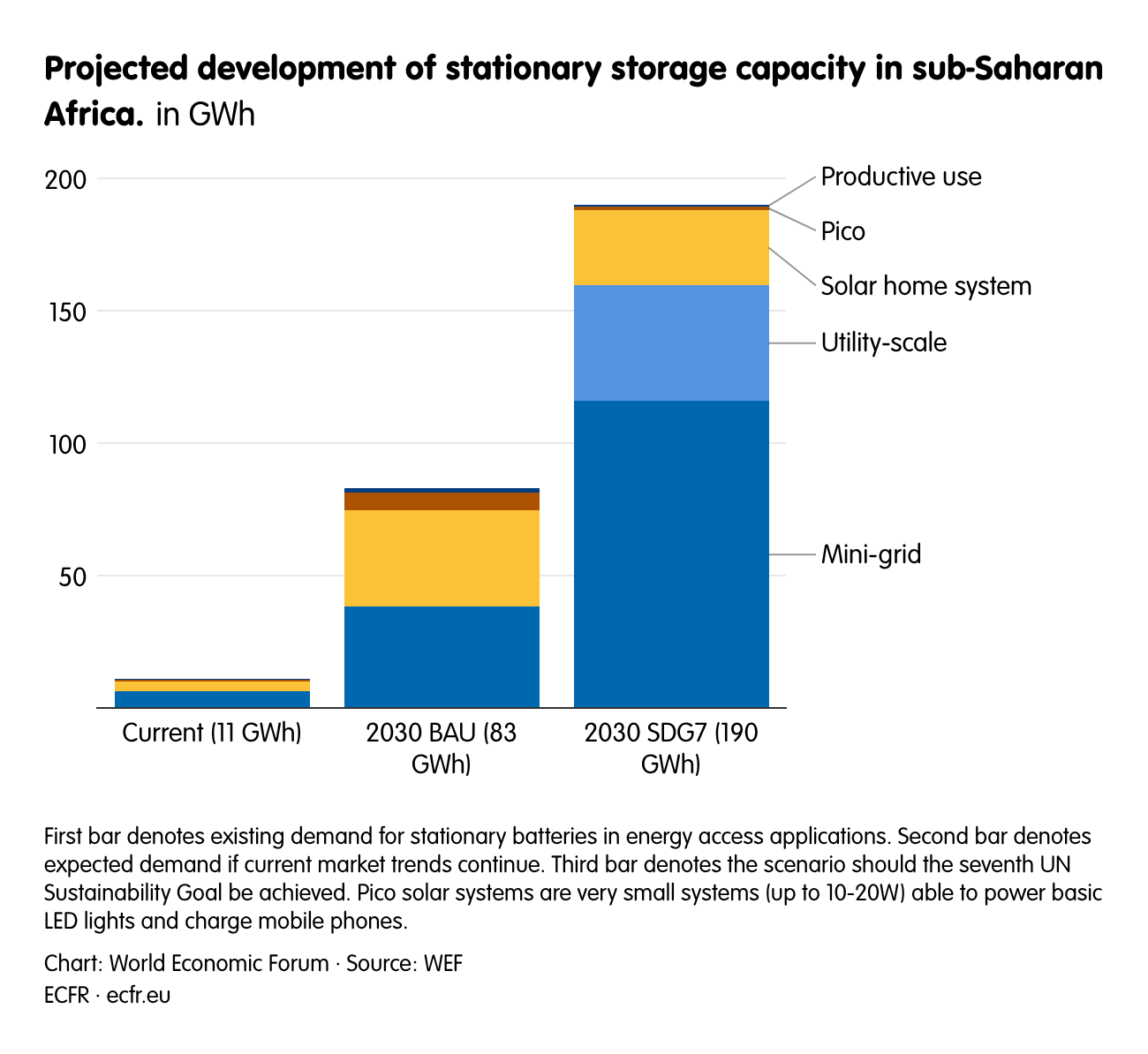
Sub-Saharan Africa’s projected growth in stationary storage capacity alone is significant: following current market trends, it will expand dramatically by 2030, with a storage capacity increase from 11 GWh to 83 GWh. If the region achieves universal access to electricity (SDG7), demand could more than double that, reaching a storage capacity of 190 GWh.
Europe’s road ahead
More recycling facilities are required to handle Africa’s growing volume of end-of-life battery feedstock. This presents an opportunity for growth both in Africa-based recycling, and in Africa-Europe recycling cooperation. However, this is not straightforward. Africa-Europe recycling partnerships need to invest in formalising supply chains for collection and storage; they need to build facilities for shredding batteries and e-waste; and they need to ensure that they can refine black mass to recover valuable materials. They would also need to develop the workforce skills and local-firm capabilities needed for efficient, environmentally-sound operations throughout the supply chain.
For African countries like Namibia and Kenya, such cooperation creates jobs and builds recycling capacity and expertise while integrating African mineral industrialisation into EU mineral supply chains. Recycling operations could also serve as anchor customers for increasing electricity generation and transmission investments in African countries, while local populations also benefit from improved electricity availability. Additionally, recycling in African countries helps address the continent’s growing e-waste management challenges.
For Europe, the increased recovery of critical minerals both domestically and through recycling partnerships with African countries offers greater supply chain diversification, access to minerals from non-OECD black mass and de-risking from Chinese mineral supply chains. All of this will happen faster than if Europeans continue to rely on global mine development. Europeans need to extend their strategic thinking beyond their borders, advancing recycling cooperation through critical minerals partnerships.
[1] Interview with a representative of a mineral analytics company, February 19th, 2026.
]]>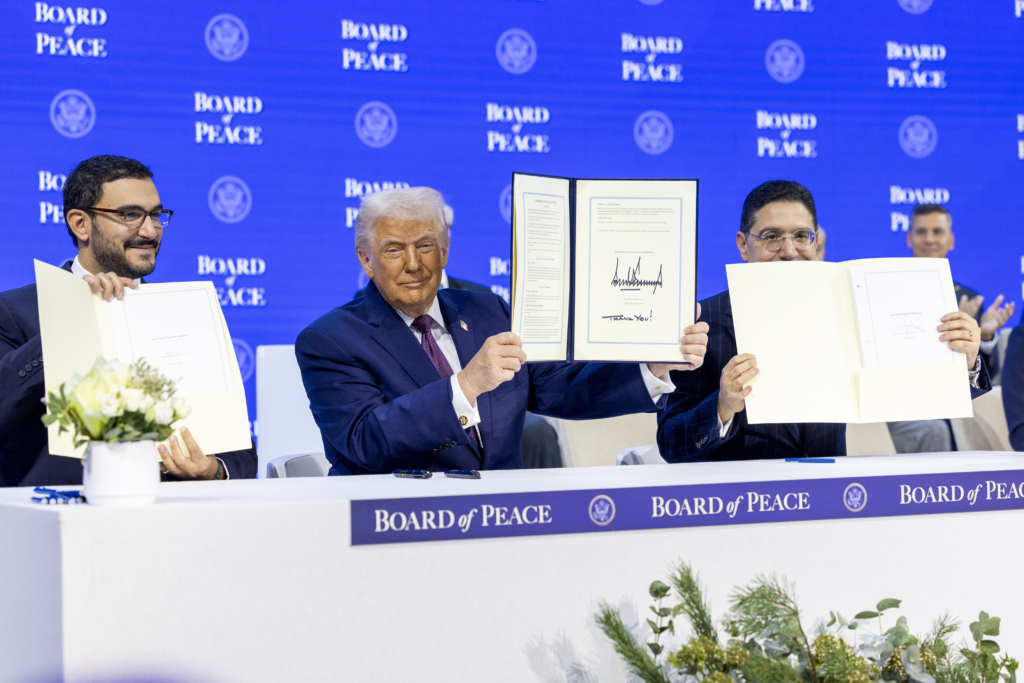
Many—perhaps most—Trump administration foreign policy initiatives find ways to make money for people selected by Trump officials. These deals unjustly enrich a chosen few.
They can also create facts on the ground that could bequeath problems to the next US administration. For example, grants of property rights to friends and family by the Trump-controlled Board of Peace could decide who has land and money in Gaza. This would limit the discretion of any approach that aims to increase Palestinians’ role in the place they live in. Other peace deals contain similar long tails.
To address this threat to peace around the world, the next US administration should introduce anti-corruption sanctions from its first day in office. The new administration could bar non-US persons or institutions involved in such transactions from the US itself and from the American financial system. To do this, the administration would use the Global Magnitsky Act and related executive orders, including the Trump-issued executive order 13818.
Europeans can help this along even now. They can begin to declare their expectations that a new US administration will break from the practice of enriching chosen insiders. Such statements will influence preparations for the new administration. Over the next two years, Europeans can also preserve information about US insider dealing while publicly refusing to support or finance such deals where European interests are involved, including in the south Caucasus, Western Balkans, Gaza, Russia and Ukraine. And they can shore up their own sanctions and anti-corruption regimes.
Starting discussions about sanctions now will also send a message about the importance of professional, thorough investigations by journalists, civil society, and especially by congressional committees if Democrats take control of the House or Senate. This information can inform decisions about sanctions. Clear signalling from American and European political leaders now may deter potential foreign partners of the current administration from entering into corrupt deals over the remaining two years of the administration.
What sanctions can and cannot do
Sanctions will not provide complete answers in any situation, and they may not be appropriate in some instances. An understanding of how they work will clarify their importance and some of their limitations.
Executive order 13818 authorises sanctions against any “foreign person” (that is, not a US citizen or person) who participated in:
corruption, including the misappropriation of state assets, the expropriation of private assets for personal gain, corruption related to government contracts or the extraction of natural resources, or bribery
The commercial aspects of President Donald Trump’s foreign policy appear to fall squarely into this framework. Even if not every instance is found to involve corruption, a close look is warranted. For example, Kazakh authorities were reportedly pressed to award a valuable mineral concession to a specific American company (associated with US political insiders, including the president’s family) while the administration considered financing for the development and export of the minerals. This was not an effort to promote a fair process in which American companies could compete—a staple of US government advocacy in any administration—but an attempt to short-circuit the normal process. It appears to involve the essence of the behaviour targeted by the Magnitsky act and executive order.
In Bosnia and Herzegovina, a specific American company was newly created by two US citizens with no relevant experience but with a track record of supporting the president (and one of whom is the brother of a senior official in the first Trump administration). The US lobbied for this company to receive a lucrative concession for a natural gas pipeline, and the US demanded the resignation of a reluctant international official.
American sanctions apply only to non-American citizens. It may seem unfair to leave US beneficiaries of a scheme out of a US response. But the administration’s power to require foreign persons or institutions to provide all relevant information about suspect transactions could impede the activities that unjustly enrich American insiders.
Further, by the end of the Trump administration, many insiders (and possibly some foreign persons) are likely to be covered by presidential pardons. This could make it difficult, if not impossible, to proceed with US criminal investigations, at least not without extensive litigation while the US justice system recovers from Trump’s attacks on its capacity. This could make a new administration look feckless, and foreign partners may expect that Trumpian practices will return in future administrations. Crucially, sanctions are not subject to the pardon power, and their emphasis on non-US persons and institutions will provide some protection against charges that they are part of a partisan agenda.
Another concern may be that sanctions have generally been adopted after careful review by relevant US agencies, including the Justice Department. Given the amount of information available, a reasonable basis for a decision on sanctions can be prepared for day one of a new administration. This decision can be accompanied by a provision that reviews will follow as new information becomes available and US government agencies rebuild enough capacity to conduct them.
The investigative resources of European governments, the US Congress (or parts controlled by Democrats after the 2026 midterms), civil society and independent journalism will provide an ample, well-documented basis for sanctions in many instances. By inviting those who might be subject to sanctions to provide information, the effort will gather more information, more quickly, aiding in decisions about priorities for further sanctions or investigations by congressional or law enforcement authorities.
Significantly, early sanctions may be necessary for a new administration to deliver on promises it makes on issues of foreign and domestic policy. For example, the Trump administration is seeking to have rights to minerals critical to US industrialisation granted to its preferred partners, including in Central Asia, Ukraine and eastern Congo. Individuals holding these rights would be important stakeholders in any policy shifts, even though they may have obtained the rights through insider dealing and could be opposed to the direction a new administration would like to take on policy.
The leverage provided by a policy of using sanctions may be a key instrument of foreign policy
The same situation could occur in other locations. In addition to the examples of Gaza and the Western Balkans noted above, in Venezuela, if a democratic government emerges, it may face challenges from Trump-affiliated companies accustomed to working with Maduro-regime holdovers kept in place by Trump and Marco Rubio. Control of a key trade route from Central Asia to global markets, along with a US-taxpayer funded investment vehicle, is said to be in the process of being placed under the control of a Trump-associated individual. In each instance, more knowledge about what deals are in place and how they came to be will improve both policy and decisions on sanctions. The leverage provided by a policy of using sanctions may be a key instrument of foreign policy.
The list goes on. Even before his second inauguration, a Trump-owned business accepted a $500m investment from a fund controlled by a member of the United Arab Emirates’ ruling family; within weeks the UAE received an exemption to purchase high-end computer chips. A Chinese businessman purchased $50m in a Trump-owned crypto business (part of the president’s $1.2bn windfall from crypto in 2025); weeks later his US criminal problems were resolved by the president.
If other jurisdictions like the EU and Britain join new American sanctions efforts, the costs to the non-US individuals and institutions affected will be real. To do this, the EU might consider how its rule of law initiatives, including its investigative bodies such as OLAF or the European Public Prosecutor’s Office, could prepare to work alongside US sanctions authorities. It could propose that the EU and the US return to coordinating assistance programmes to reinforce public procurement reforms. Various European states have national anti-corruption sanctions programmes; more should consider adopting them.
Some will worry that rapid deployment of sanctions may distract from a new administration’s positive agenda. This will depend on the strength of that agenda. Europeans can help make clear that they regard this as a false choice: a break from the insider dealing of the Trump administration should be part of a new, positive plan for government. This will make it easier for a new administration to adopt sanctions policy as part of leaving Trump practices firmly in the past.
There will, of course, be difficult decisions around the application of sanctions. Not every example of insider dealing will be proven to be corrupt. Some potential targets of sanctions may be important to other US administration initiatives, and if the new administration defers sanctions it may be subject to accusations of hypocrisy. Other countries may object strongly to seeing their institutions or citizens named in sanctions documents. A new administration will face many choices like this; people who want to exercise power from Washington therefore need to prepare now and confront the choice early. It is better to start with a strong tool like sanctions rather than to disarm everywhere pre-emptively in order to avoid hard choices in a few places.
Wise observers of democratic transitions have said that democrats taking power after corrupt regimes should seek to be quick, effective and legal; but that they can be only two of the three. But sanctions might get a new administration closer to three out of three. They provide a legal tool that will help the next administration be quick and effective in stopping the insider enrichment typical of Trump foreign policy while coming with limits (no targeting of US citizens) and with the ability to adjust quickly. By taking up this tool, it will free itself of shackles that would come from those who seek to control the land and property important to peace in many parts of the world. But this will come to pass only if people begin to talk about it now. European leaders have the ability to help make sure that happens.
]]>Jorge explains why China’s role is varied across the region, arguing that Mexico and much of Central America remain deeply constrained by their economic ties to the US. Adriana discusses Brazil’s long tradition of strategic autonomy, describing how policymakers engage with China as both an economic partner and a source of ideas on development, technology and global governance.
Together, Mark, Adriana and Jorge explore how intensifying US-China competition is reshaping the region’s choices. Can Latin American countries balance relations with both powers? Is China a model, a market or simply another partner in a multipolar world? And what does strategic autonomy look like in an increasingly coercive geopolitical environment?
This podcast episode was recorded on July 31st 2026.
Bookshelf
Latin American Foreign Policies in the New World Order: The Active Non-Alignment Option, by Carlos Ominami, Jorge Heine and Carlos Fortín
Manifesto Antropófago (Cannibal Manifesto), by Oswald de Andrade
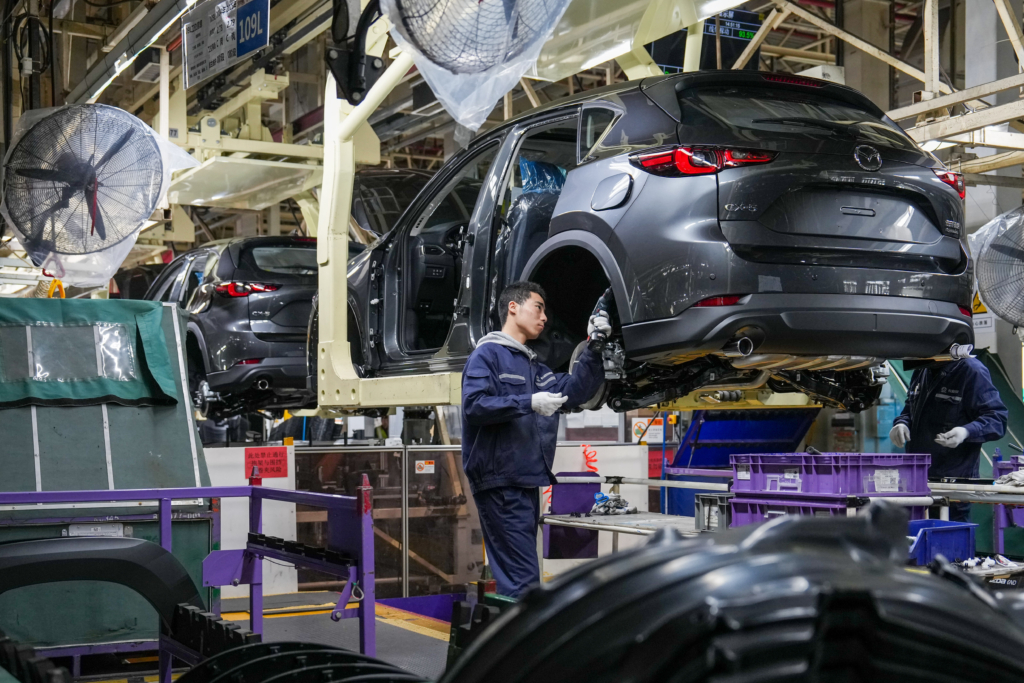
Reluctance among German decision-makers has long stopped Berlin taking a tougher economic approach towards China. When France, Italy, Lithuania, the Netherlands and Spain recently pressed the European Commission for tougher measures and faster trade defence action against China, Germany not only declined to join, it even called for stronger industrial ties with Beijing.
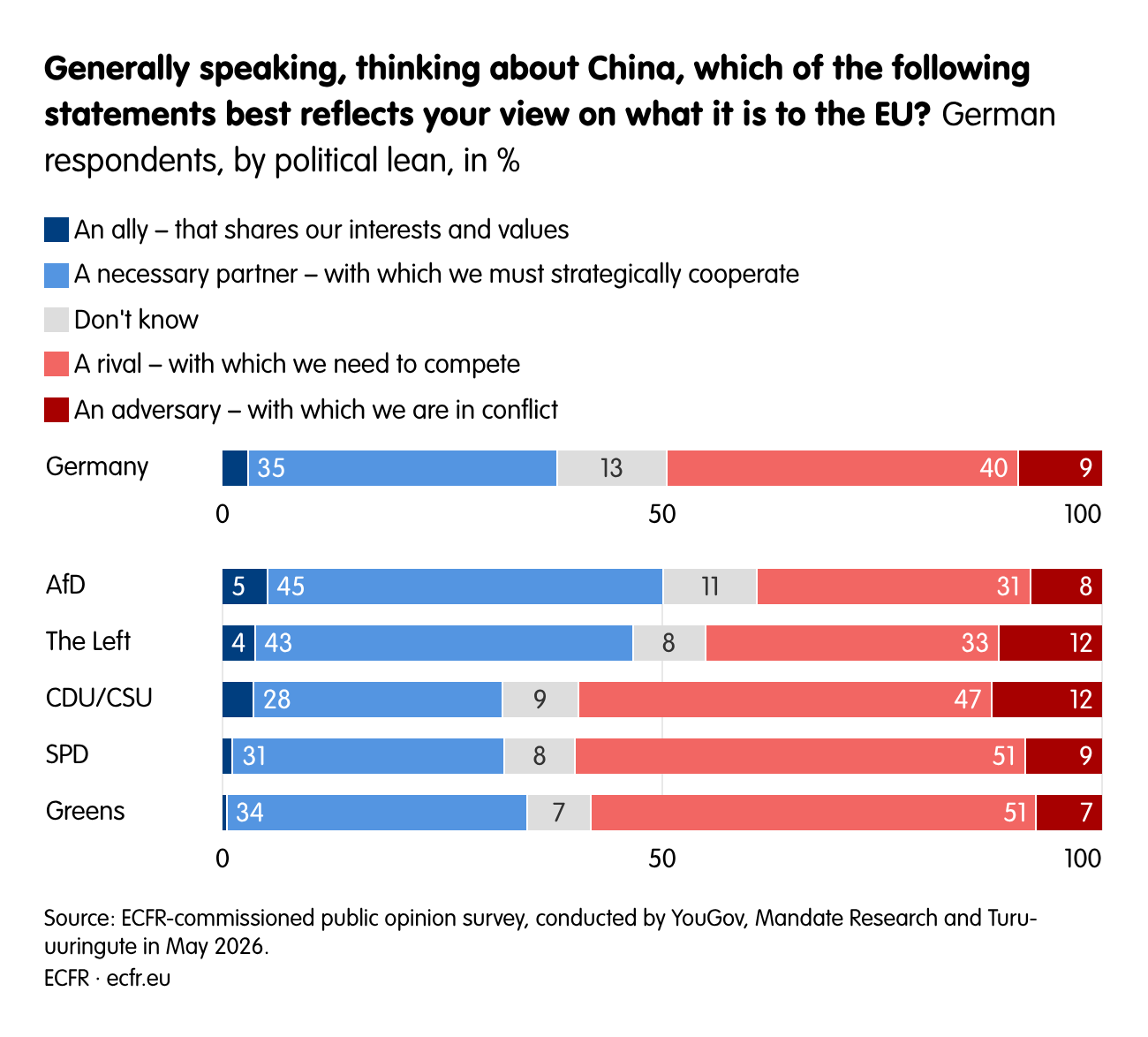
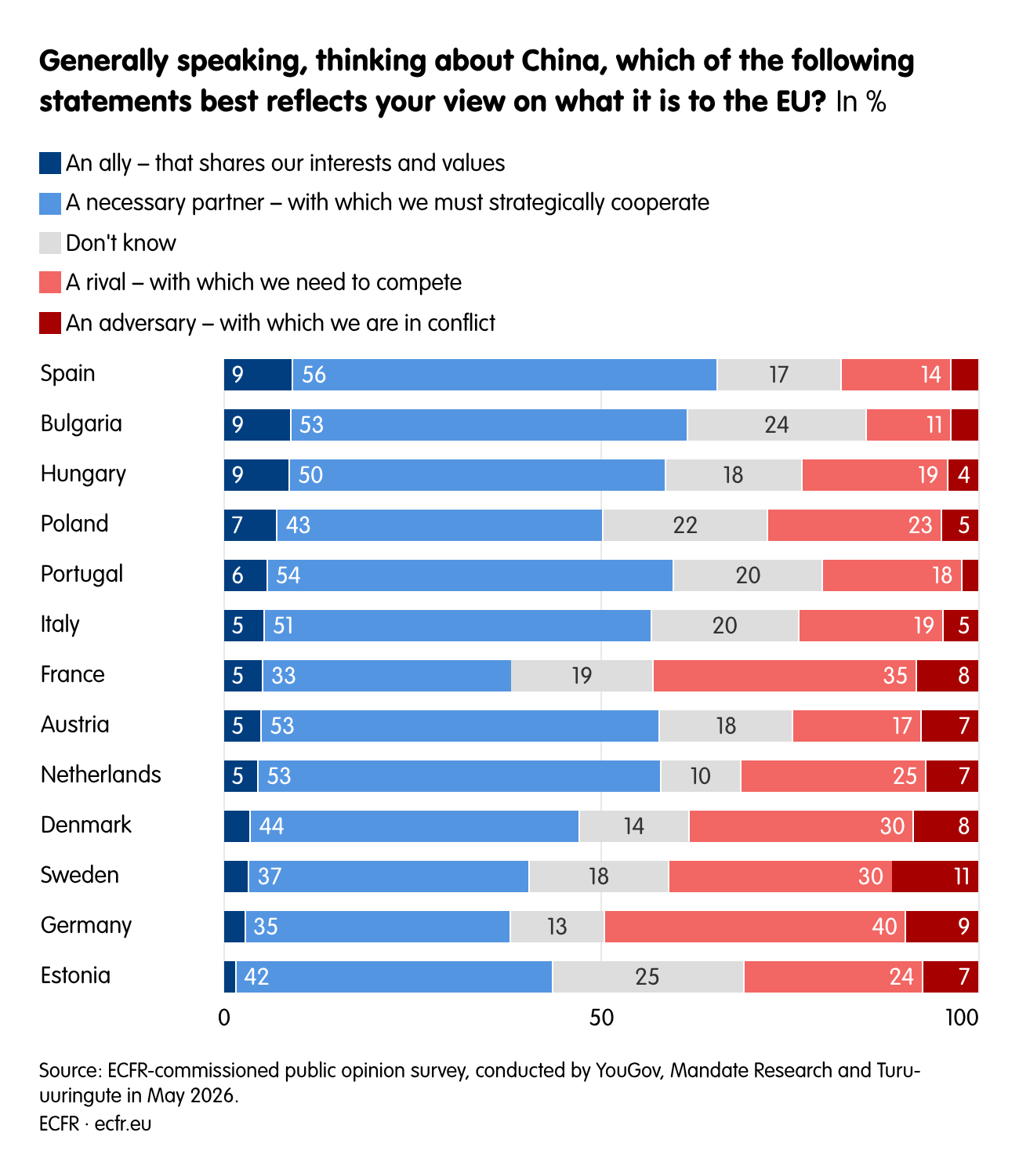
Yet, one thing Berlin should not worry about is voters’ disapproval should it pursue a more hawkish China policy. ECFR polling data find that Germans are the most China-sceptical out of 15 European countries surveyed. No fewer than 60% of Christian Democrat and Social Democrat supporters regard the country as an adversary or rival. In contrast, elsewhere in Europe, majorities still see China as either a “necessary partner” or even an ally. In Italy and Spain, 56% and 65% of people hold this view respectively. (Closest to the sceptical Germans are the French public; President Emmanuel Macron’s increasingly hawkish political posture vis-à-vis Beijing may have found an audience willing to listen.)
The China shock has hit Germany particularly hard: its manufacturing sector lost around 420,000 jobs between 2019 and 2025 and it continues to shed 10,000 jobs each month. The car industry is paying the highest costs, being squeezed out of a market increasingly dominated by Chinese manufacturers at home and abroad.
The mood in the European Council is shifting, and with Germany’s acquiescence. When EU leaders met in June 2026, they backed a stronger trade defence toolbox of existing measures against China. This included instruments such as the Industrial Accelerator Act’s “Buy European” provisions and limits on high-risk Chinese technology. Despite its past hesitations, Germany no longer acts as a spoiler on firmer EU action, and it has cautiously supported this new direction. Nevertheless, the combination of growing public scepticism towards China, mounting pressure on German industry and appetite for a more assertive policy on the European level creates a political mandate that German decision-makers could yet seize.
The German public’s views on the energy transition should also prove encouraging for their leaders. Voters want to see investment in renewables: 57% back what would amount to the growing electrification of the economy. Across the countries polled by ECFR, 61% of respondents say they support prioritising renewables and the clean tech sector.
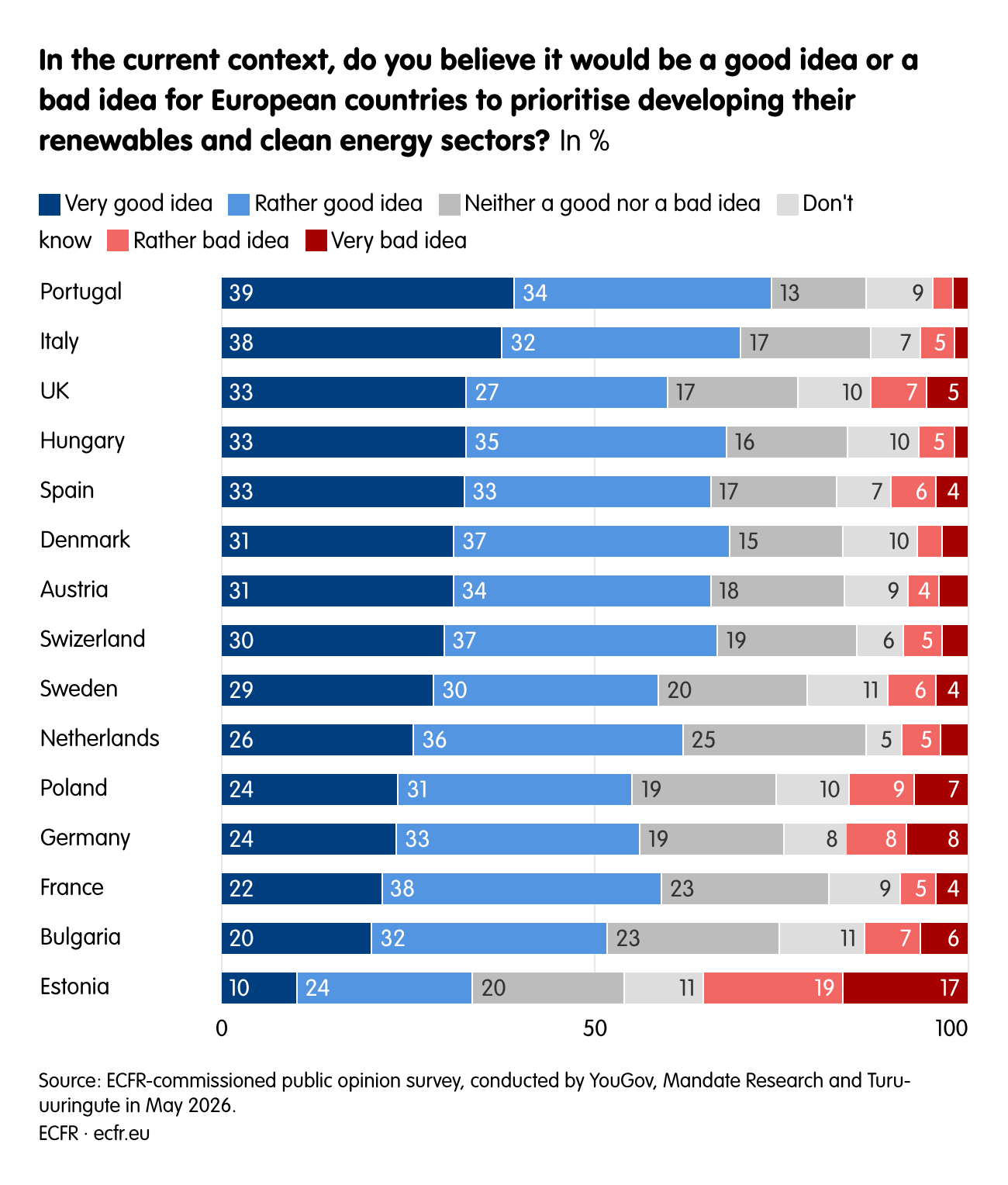
This public support should help persuade leaders, including in Germany, that they can take action to limit emerging dependencies on China. They can accelerate the energy transition while de-risking the clean tech sector through providing support for domestic European industries, from wind to batteries.
For Berlin, and capitals across Europe, it is safer to move ahead rather than delay. Chinese economic policy is already doing irreparable damage to European industry—but European policymakers still need to protect an increasingly electrified economy from weaponisation by China. If they fail to do so, governments will almost certainly pay the price at the ballot box. Those that pursue electrification and economic de-risking as a single package are most likely to reap the political rewards.
]]>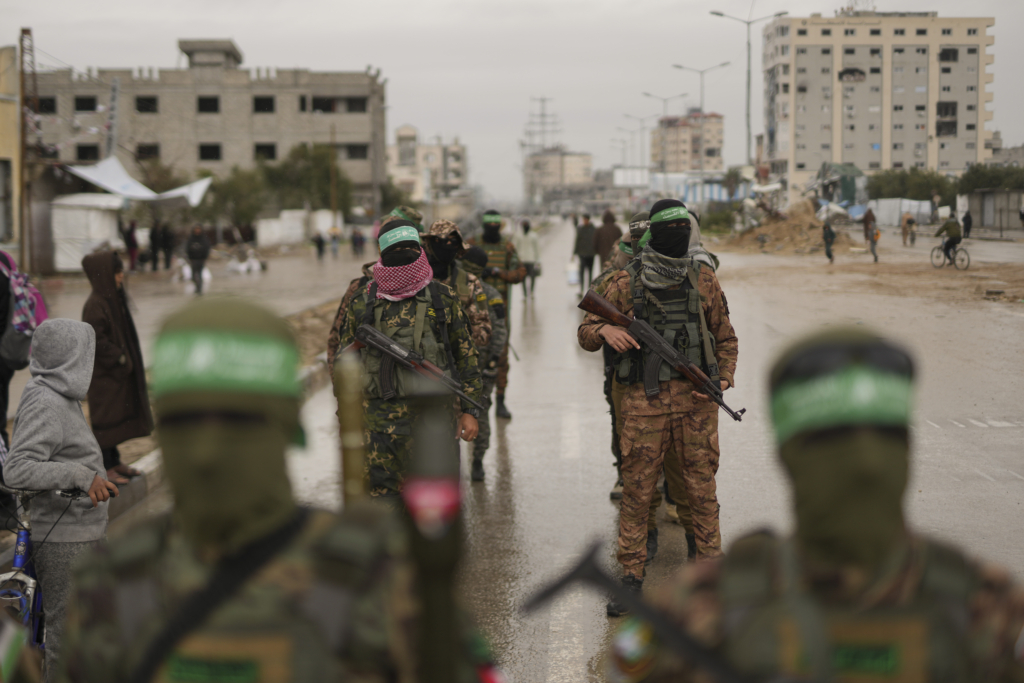
At the end of July, Hamas agreed to a Board of Peace (BoP) roadmap to implement Phase 2 of the three-stage ceasefire agreement. At its core is Hamas’s willingness to decommission its weapons. This would have been unthinkable only a few years ago and offers a realistic pathway for ending the Islamist group’s governance and security control over the devastated Strip.
This process will only begin once Israel has fully complied with its Phase 1 obligations, which it has yet to do. More fundamentally, it will require Israel to accept a process to end its military presence in Gaza and ultimately engage in negotiations towards Palestinian self-determination. Netanyahu and his hardline government have rejected the roadmap out of hand and are now the main threat to the ceasefire deal.
Having been largely sidelined, Europe now has a role to play in ensuring the deal succeeds.
The unfinished phase 1
Announced in September 2025, Trump’s 20-point plan aims to end the war in Gaza in three phases. The first phase conditioned the full cessation of hostilities and emergency relief on the release of Israeli hostages held by Palestinian groups. The second phase aims to remove Hamas from power and begin reconstruction—the roadmap Hamas agreed to in July outlines how this stage will work. The final phase would end with Israel’s full withdrawal from Gaza, the return of the Palestinian Authority (PA) and the launch of a “credible pathway to Palestinian self-determination and statehood”.
So far, the plan has significantly reduced violence, secured the return of all Israeli hostages held by Palestinian factions and prompted a partial redeployment of Israeli military forces. However, in violation of the agreement, Israel has continued to strike civilians and militants in Gaza, and impede the entry of humanitarian aid. The Israeli military has also advanced beyond the Yellow Line, to which it was supposed to withdraw in the first phase.
At the same time, Israel has continued to demolish Palestinian homes and infrastructure in the 70% of Gaza that remains under its control. Israel may now be seeking to create a new de facto border with Gaza and effectively annex a large chunk of the territory, potentially preparing for the return of Israeli settlements there in the future.
The roadmap
Once Phase 1 is complete, Palestinian factions will begin handing over their heavy weapons to the Palestinian National Committee for the Administration of Gaza (NCAG), a transitional body created as part of the 20-point plan to replace Hamas governance and security control in the Strip. This will include the full alphabet soup of Palestinian armed groups—many of which are more hardline than Hamas—as well as Israeli-backed militias.
Heavy weapons will effectively be placed under lock and key, monitored by the International Stabilisation Force (ISF), which will deploy as a buffer between Israeli forces and NCAG-controlled areas. BoP officials have said Palestinian weapons could ultimately be dismantled and melted down. This would replicate how Northern Ireland’s decommissioning process dealt with weapons held by paramilitary groups. Tunnels and weapons production facilities would also be put out of action.
Small arms like AK-47s will instead be regulated by NCAG through a system of permits. NCAG will also establish a new police force made up of newly trained recruits and members of the Hamas-run civil police vetted and approved by the BoP.
Critically, the roadmap links the decommissioning process “to an Israeli withdrawal, in phases, from the areas under its control in Gaza”. According to previous understandings, Israel would withdraw to a new “Red Line” by the end of Phase 2, and from there to a “Black Line” along Gaza’s perimeter, where it would retain a narrow buffer zone until “Gaza is properly secure from any resurgent terror threat.”
While the contours of Phase 2 are now clear, the final operational details still need to be hammered out between the sides during follow-up talks. Questions also remain over the lack of funding for the NCAG and the status of the ISF, which to date has only around 200 pledged troops from Morocco, though smaller numbers may also come from countries including Kosovo and Uganda. Meanwhile, the new Palestinian police force has yet to begin training in Egypt.
Europe is right to avoid directly funding the BoP. But it has considerable expertise in disarmament and security-sector reform, including through the EU’s EUPOL COPPS mission, which was established to assist the PA police in the West Bank. Europeans should offer critical personnel and technical expertise to support both the decommissioning process and the training of the new Palestinian police force.
The spoiler
The biggest obstacle remains Israel’s opposition to any transitional political process that would eventually force it out of the Strip and into talks on Palestinian self-determination
The biggest obstacle remains Israel’s opposition to any transitional political process that would eventually force it out of the Strip and into talks on Palestinian self-determination. The Israeli government has instead vowed to remain in Gaza and continue its military attacks. It has also opposed NCAG taking over until Hamas fully disarms, and demanded the right to veto troop contributions to the ISF from “hostile” countries such as Turkey and Qatar.
BoP officials now appear to be altering parts of the laboriously negotiated deal (and its own press release) to accommodate Israel’s hardline stance. They now state that Israeli withdrawal beyond the Yellow Line would begin only once the decommissioning process is complete. This appears to contradict the original text and Nikolay Mladenov, the BoP’s high representative, who initially said the two would move forward “in lockstep”. The accompanying Explanatory Note also reinforces this interpretation, outlining “a step-by-step process linking withdrawal phases to verified decommissioning steps.”
Such manoeuvring risks undermining Hamas support for the agreement. Moreover, by conditioning all further Israeli withdrawals on Gaza’s full demilitarisation, the BoP is in effect giving Israel a veto over the process itself, allowing it to deepen its control over the eastern half of Gaza. Given the near impossibility of removing every single Palestinian weapon, as many are held by families, clans, criminal networks and jihadi groups, Israel could argue indefinitely that the conditions for its withdrawal have not been met.
But even BoP efforts to placate Israel have failed to satisfy prime minister Benjamin Netanyahu. He continues to demand that the deal be re-negotiated, insisting that no Israeli redeployment will take place, even to the original Yellow Line, until Hamas has fully disarmed.
The path forward
Having secured Hamas’s unprecedented agreement to decommission its weapons, the BoP now needs to show the political will to implement its own deal. US officials have already warned Israel that US president Donald Trump would be “very, very disappointed” if Netanyahu derailed it. Although the prime minister’s far-right coalition limits his room for manoeuvre, Netanyahu has invested heavily in portraying his close relationship with Trump as a political asset—which means he cannot easily afford a public rupture with him.
Mladenov has won wide international praise for brokering the deal. Rather than modifying the terms he himself negotiated and risk the diplomatic gains already achieved, he should use his current political capital and Trump’s momentary re-engagement to insist that Israel implements rather than rewrites the agreement. If necessary, he should be prepared to call out Israeli obstruction, just as he previously cast Hamas as the main obstacle. Europe can further strengthen his hand by also highlighting Israel’s non-compliance with its obligations, as the Arab and Turkish mediators have done. The EU should also resume discussions on suspending the Association Agreement with Israel unless it complies.
Sustained diplomatic engagement before Israel’s October elections should aim to shift the terms of the domestic debate. The Israeli opposition has also been critical of the deal, accusing Netanyahu of weakness by allowing Hamas to survive, and is unlikely to chart a radical new course on Gaza if it wins. Nevertheless, opposition figures have also acknowledged that Israel’s battlefield gains need to be converted into lasting diplomatic achievements. Europe should use the political framework established by the Gaza roadmap to reinforce this logic and demonstrate how military gains can be converted into a sustainable political settlement.
Ultimately, success will depend on whether both sides conclude that diplomacy offers greater rewards than renewed war. Hamas is unlikely to complete decommissioning unless it believes that concessions today will lead to genuine political gains tomorrow towards Palestinian liberation. Equally, Israel will only embrace a durable ceasefire if it sees political transformation within Hamas that locks it into credible peace negotiations as a means of strengthening its long-term security. This makes Phase 3 every bit as important as Phase 2.
Without a credible pathway towards Palestinian self-determination, decommissioning risks becoming an end in itself rather than the foundation of a lasting Israeli-Palestinian peace. Equally, a future Israeli government will need to view full implementation of the Gaza agreement not as a concession to Hamas, but as the indispensable stepping stone towards normalisation with Saudi Arabia and deeper integration with the Arab and Islamic world. Europe should therefore work with its Arab partners to ensure that the Gaza deal is tied to a regional package. That would allow a future Israeli government to present withdrawal from Gaza and acceptance of a political process leading to a two-state solution not as unilateral compromises, but as part of a US-brokered grand bargain that underpins Israeli integration and security in the region.
]]>- Marine Le Pen’s candidacy for president means Europeans should brace for the possibility of a France wholly different to the one they know.
- A Rassemblement National government would be hostile to the EU and a disruptive partner on numerous issues facing Europe; including on Russia, enlargement, climate and migration.
- The party is divided over whether and how to work with other right-wing parties in France; and how to position the country within Europe and the Western alliance.
- Le Pen is likely to work in a “duo” with party leader, Jordan Bardella, but there are notable differences between their outlooks. Europeans should pay attention to these.
- European political leaders would struggle to influence a Le Pen-led government, but nor should they expect a unified European far-right to emerge. They would be wise to begin their preparations now.
Note: This policy brief is a second edition of an earlier paper published on June 9th 2026. It updates the prior analysis in light of Marine Le Pen’s confirmation that she will run for the French presidency.

The restoration of a matriarch
In the early hours of November 2nd 1976, a bomb exploded outside the Paris home of the far-right leader Jean-Marie Le Pen and his family. The perpetrators were never found. His youngest daughter, Marine, 8 years old at the time of the attack, later seethed that the family was not shown “the slightest sign of solidarity or compassion” by the French authorities. Today, as Marine Le Pen launches into her fourth—and most competitive—bid for France’s presidency, that quote reveals something of the woman who might soon occupy the Elysée Palace. If she wins, European policymakers will need to understand this self-defined outsider and how her family’s and party’s long years in the political wilderness shape her domestic and international agenda.
That insurgent self-perception may seem odd now. After all, the National Rally (Rassemblement National, RN) is far ahead in polling for the first round of the election, is accepted by an increasing share of French polite society, and is close to some of the country’s most powerful economic elites. But it still explains why the rest of Europe should brace for the possibility of a French president who sees herself as a rebel against the country’s and the EU’s established norms and institutions. As this paper will argue, a Le Pen presidency of France would be a significantly more formidable challenge to European orthodoxies than Giorgia Meloni is in Italy or Viktor Orban was in Hungary.
*
Only one thing is certain about the result of France’s presidential election next year: President Emmanuel Macron’s decade in power will come to an end. Who replaces him is an open question, with any number of conceivable outcomes. The exact field of candidates is not yet clear, not even in Macron’s centrist camp, where two former prime ministers—Édouard Philippe and Gabriel Attal—are vying for primacy. French presidential election campaigns are often volatile; both those in 2017 and 2022 saw major shifts over the half-year before polling day. But current polling suggests that the RN party candidate is on track to win the first round, on April 18th 2027, and to enjoy good prospects in the second, due on May 2nd.
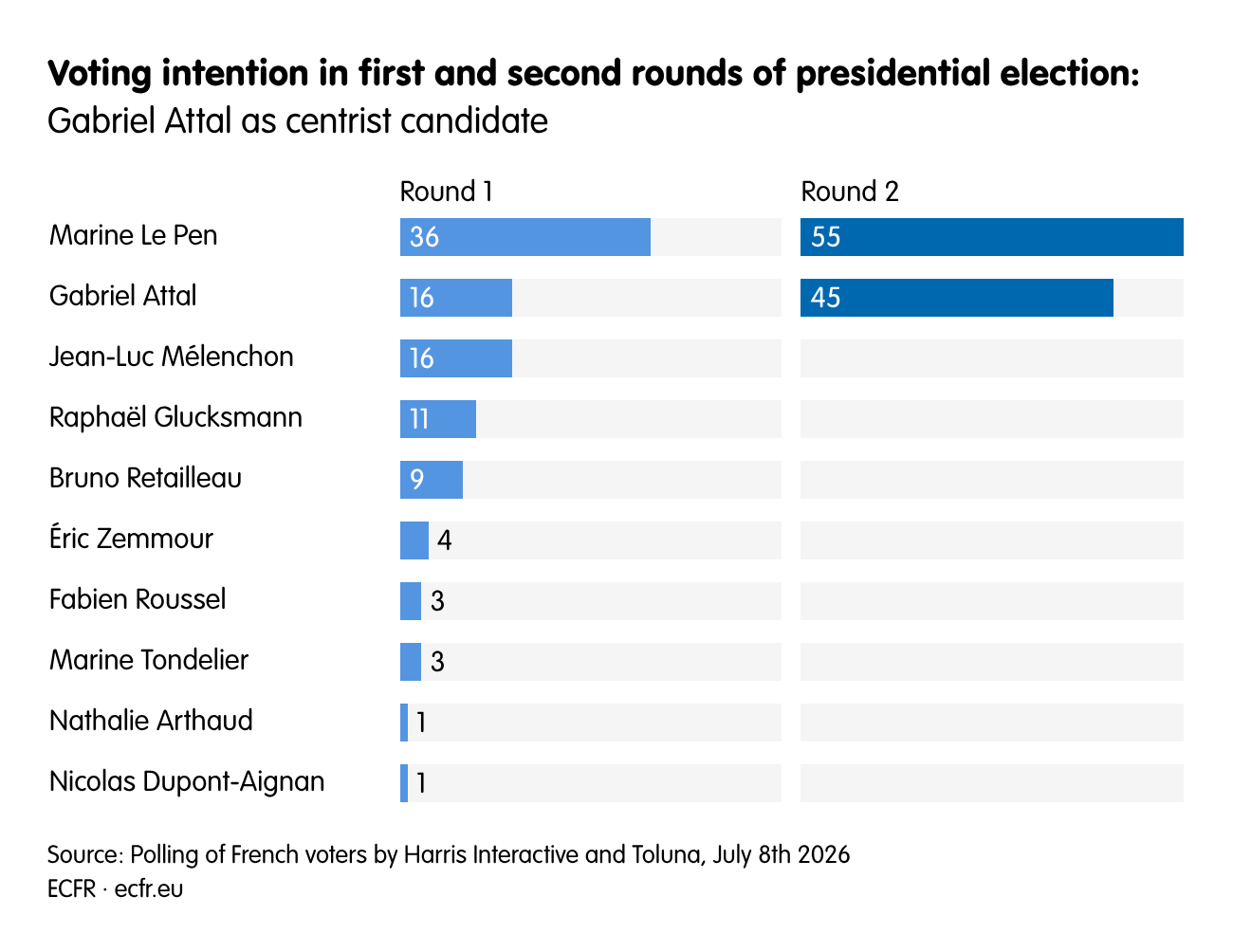
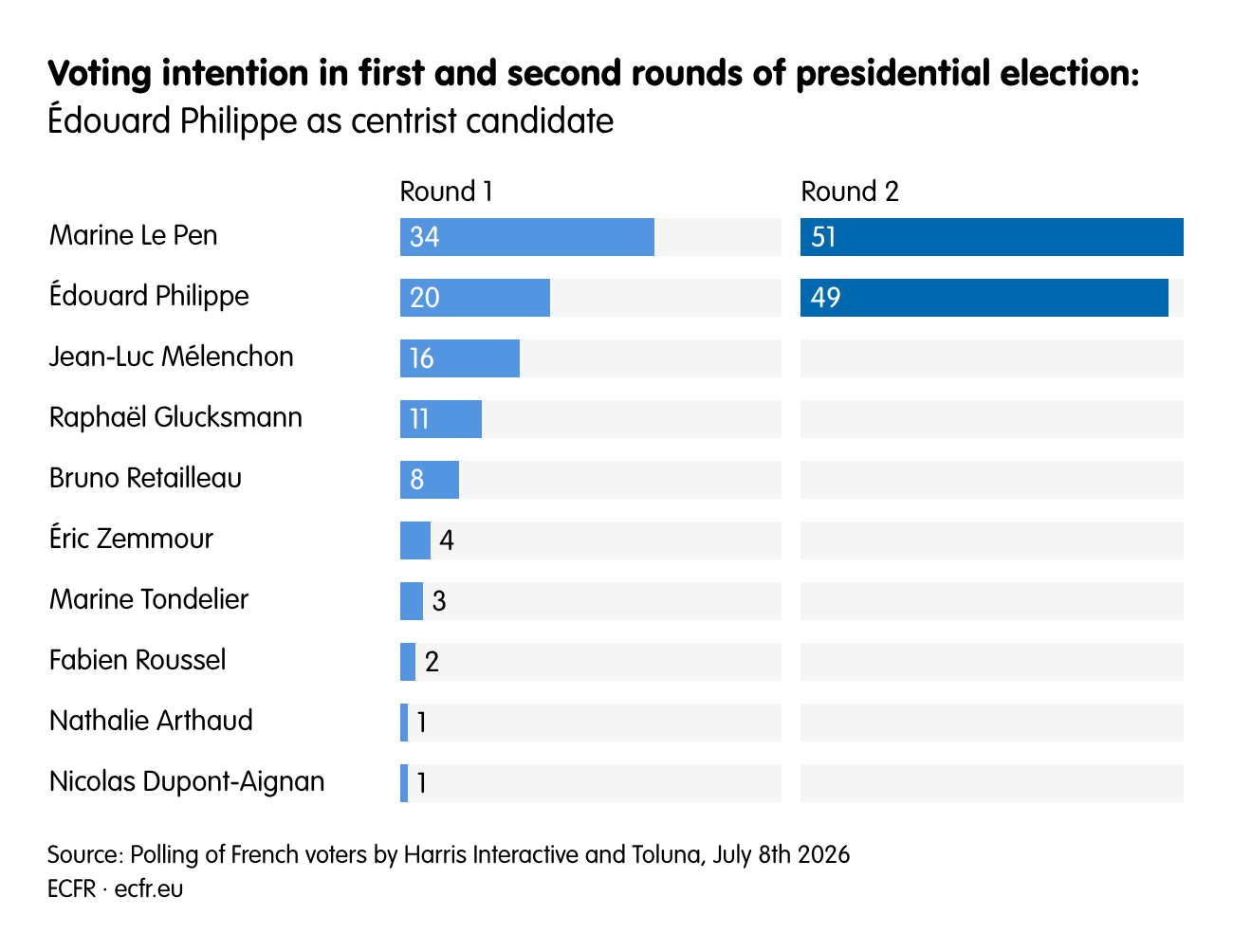
The RN went through months of speculation over who would represent it at the presidential election. In March 2025, Marine Le Pen was convicted of embezzling European parliamentary funds and received a five-year ban on standing for election. Over recent months, Jordan Bardella, the RN’s untested young leader and Le Pen’s protégé, was talked about as the party’s best hope.
On July 7th 2026, however, the Court of Appeal reduced Le Pen’s ineligibility penalty, which enabled her to run. It also required her to serve a year of house arrest with an electronic ankle tag. That evening, Le Pen announced that she would seek the presidency and would appeal to the Court of Cassation. The penalty is suspended until France’s highest court rules on the case, which could take place as late as April 2027.
Her candidacy has significant implications for the rest of Europe. Le Pen is an experienced campaigner and an established (though also divisive) figure in France. Her bid for the presidency is perhaps more likely to survive the heat of the campaign than a Bardella run would have. The fact that she is the candidate probably increases the chances of the French far-right coming to power for the first time since Marshal Pétain, the puppet leader of Vichy France.
Le Pen is marked by the RN’s long years in the wilderness. She believes in radical solutions. As president, she would likely be a confrontational and abrasive force in Europe.
To reiterate, the outcome of the election remains wide open. But the scale of the potential rupture of a Le Pen win means policymakers elsewhere in Europe must both understand the RN and prepare for that eventuality. To that end, the authors of this paper have extensively researched the party’s Europe and foreign policies. The following study is based on in-depth interviews with an array of senior RN figures and external experts as well as analysis of the party’s speeches, legislative proposals, voting records and electoral programmes. The result is a series of five theses about what a Le Pen win next year would mean for Europe.
Understanding an RN presidency
Point 1: Marine Le Pen’s candidacy reaffirms her primacy inside the RN, although her duo with Bardella will endure

Marine Le Pen’s decision to run for president despite her upheld conviction—and in contradiction of her own prior statements—is a reminder of her centrality to the RN. She is still the party’s dominant leader. The decision also dispelled the illusion that Bardella constitutes a real alternative to her leadership. It showed that today’s RN is still Marine Le Pen’s inheritance and achievement.
The party was founded as the National Front (FN) in 1972 by Jean-Marie Le Pen, along with French former members of the Waffen-SS and other nostalgists for colonial French Algeria. It drew together different threads of the far-right. For decades most French citizens considered it beyond the pale. When Jean-Marie Le Pen narrowly made it into the second round of the 2002 presidential election, it shocked both France and Europe. He was roundly defeated by 82% to 18% by then-president Jacques Chirac.
Taking the reins of the party from her father in 2011, however, Marine Le Pen pursued a strategy of “dédiabolisation” (“detoxification”). This saw her expel Jean-Marie from the party in 2015 over his racist and anti-Semitic comments. After her resounding defeat to Macron in 2017 she intensified the process, renaming the party and dropping its commitment to “Frexit” (leaving the EU).
In 2019, she appointed a fresh-faced young activist from a deprived Paris suburb to lead the RN’s campaign for the European Parliament election. Jordan Bardella delivered the party’s first ever first-placed result in a national election and was rewarded with the RN presidency in 2021. He would play a central role in the party’s 2022 presidential campaign—a much closer contest—and in its triumphant win in the 2024 European vote. Le Pen further empowered Bardella when she announced he would be her choice for prime minister. When it looked like she might be banned from running, Bardella became her natural replacement as a presidential hopeful.
Nevertheless, despite Bardella’s rapid rise and growing public profile, the RN remains firmly in Le Pen’s hands. For nearly half a century, the promotion of family members, such as Marine Le Pen’s niece Marion Maréchal, and significant turnover among the lower levels of the party has kept power within the Le Pen clan. Many of the party’s cadres remain more loyal to her than to Bardella, and were determined that she should run rather than him.
Now that the party is back behind its leader, Le Pen will continue to highlight the duo she forms with Bardella—as she did on prime-time television when she launched her campaign. She once again promised to make him prime minister if she becomes president. Running a “ticket” for the French presidency is unprecedented and anathema to the function. But it has a distinct advantage: broadening her voter coalition while keeping the party together.
Le Pen’s own political base has two main parts. First, an anti-elite and disaffected working- and middle-class electorate in the northern post-industrial Pas-de-Calais region that she has represented since 1998 (as a councillor, MEP and in the National Assembly), And, second, a chain of strongholds along the Mediterranean coast, which adhere to long-term RN positions hostile to immigration and taxes.
By contrast, Bardella appears more economically liberal and temperamentally closer to other parts of the French right, including the conservative flank of the Republicans (LR, the rump centre-right force) and culturally reactionary forces like Éric Zemmour’s far-right Reconquest. He is also more engaged with the wider European right, especially Meloni in Italy. Within the RN itself this aligns him more with a more bourgeois and younger new electorate.
Over the last year, Bardella had even started to sand down some of the party’s most abrasive ideas. Where Le Pen cleaves to some of the party’s old Putin-friendly instincts on Russia, he has spoken in defence of Ukraine’s sovereignty. He also broke from Le Pen on pensions reform, suggesting dropping the fixed retirement age and moving to a more contributory system. Where Le Pen went to Budapest to help out an embattled Orban, he struck a friendly tone towards Germany and even met with the country’s ambassador in Paris. All this created expectations in Brussels and other EU capitals that a President Bardella might be closer to the bloc’s economic orthodoxies and more open, at least, to compromises.
Le Pen’s candidacy firmly relegates him to a subordinate position within the party. Gone, too, is the spectre of a somewhat more conciliatory RN presence in the Elysée Palace if the party wins power next year. “Bardellism cannot exist, as it is ultimately Marinism”, Jean-Philippe Tanguy, a senior RN figure, has said. The reassertion of Le Pen’s primacy within the RN thus makes the party both more likely to take power and more likely to disrupt the rest of the EU and its foreign policies if it does.
Point 2: An RN presidency would be a rupture in French and European politics
France is a highly centralised state, and its president wields executive power more akin to an American president than to counterparts in its European neighbours. The country also remains a pivotal power in Europe as one of its two nuclear-armed countries and half of the Franco-German motor that long drove the European project.
News of an RN win would therefore send shockwaves around the continent, stunning the mainstream. It would also lift the spirits of much of Europe’s radical right after a difficult 2026 in which its pre-eminent governing leader, Orban, lost power and its links with Trump turned out to be liabilities. After all, the RN has been unapologetic in its support for fellow “patriots” across Europe. Le Pen campaigned for Orban, and Bardella has engaged closely with Meloni and her government in Italy and Nigel Farage’s Reform in the UK.
Farther afield, the RN has been increasingly welcomed by fellow nationalists like Israel’s Likud government, which hosted Bardella and other far-right leaders in 2025. The Trump administration has professed its own commitment to supporting “patriotic parties” and would react favourably to an RN win. This is despite Bardella’s and Le Pen’s efforts to cool their party’s earlier enthusiasm for the US president.
The RN would revel in the sense of rupture. In private, party leaders compare their potential accession to power to left-winger François Mitterrand’s historic victory in 1981—which they see as the only true political change France has undergone in the last 50 years.
*
Thus empowered, the RN would want to enact its programme. Although foreign and defence policy may not be its top policy priority, “fixing” France’s relationship with the EU is bound to be one.
In its 2019 and 2024 European election campaign manifesto, the RN suggested transforming the European Commission into a mere secretariat of the EU, leaving legislative initiative only to the European Council. The party decries attempts to expand qualified majority voting, refuses any new transfers of competencies on foreign and defence policy to the commission—and seeks European allies in that endeavour.
The RN is vehemently against EU common taxation and borrowing. Both Le Pen and Bardella have proposed slashing the French contribution to the EU budget (by “between €2bn and 3bn”, as Bardella suggested, equivalent to 9-14% of the French payment in 2024). RN MPs have already put forward several amendments to the budgetary laws to that effect. In July, Bardella has even advocated reducing the contribution by half. In place of European joint spending, the party wants the creation of a sovereign wealth fund to back “sovereign industries” in defence, technology and energy.
The party’s antipathy towards NATO means it plans to prioritise national-level defence instead. The RN has committed to maintaining current defence spending, but argues this should support France’s own military-industrial infrastructure first and foremost. Even if it has paused an earlier plan to leave NATO’s integrated command, at least for “as long as the war [in Ukraine] goes on”, Le Pen revived the idea as recently as May 2026.
The strictly national principle applies to energy too. The RN has promised to lower French energy costs, notably by breaking from EU-wide electricity pricing (which often depends on gas prices less relevant to France’s nuclear-heavy energy system) and thus allegedly reducing the French retail price. And, despite claiming to be concerned about the consequences of climate change, the RN is relentless in its opposition to the European Green Deal and its insistence that French nuclear energy should exempt the country from EU climate strictures.
Overall, if Le Pen were to become president, the RN’s highly disruptive European agenda would inevitably put France on a path to confrontation with European partners and institutions. As the fight against the EU is both a symbolic and a policy priority for the RN, other European leaders may have to find a way to negotiate on some of the demands—that for a budget rebate, for example—in order to prevent French vetoes.
Point 3: The RN’s inexperience and lack of interest in foreign policy would make France an erratic partner, especially in a crisis
Europe’s best hope, in the event of a Le Pen presidency, may reside in the fact that foreign policy would not be the top priority for the RN in power.
First, the RN’s foreign policies often remain vague or only partially formed. Despite its long-standing presence in the French political landscape, the party has no national governing experience and only in 2022 won a significant share of seats in the National Assembly. With little network among the French diplomatic establishment, RN leaders have rarely engaged closely with foreign policy debates. The party prefers to hide behind references to General de Gaulle’s pro-independence foreign policy to justify criticisms of the EU or NATO without being too specific.
According to RN insiders, the party’s foreign policy decisions emanate from private discussions between Le Pen and Bardella, with the occasional counsel of the advisory group Les Horaces. If she attains power in 2027, Le Pen may seek to attract more experienced figures from the traditional right (from LR or UDR) or from the military to lead on top foreign policy positions.
Second, the RN is clearly prepared to change its tone on international topics when political expediency dictates. RN figures privately insist that foreign policy cannot win it elections, but can lose it ones. They blame Le Pen’s defeat in April 2022 on her failure convincingly to pivot away from Russia after its full-scale invasion of Ukraine two months earlier.
The party abandoned Frexit after the UK’s Brexit turned out to be a disaster. It curbed its old openness to strongmen such as Putin (repaying a contentious loan to a Russian bank in 2023) and Syria’s Bashar al-Assad. In recent years, it attempted to erase its anti-Semitic past by adopting a strongly pro-Israel line. Since February 2022, the party has walked a tightrope: paying lip service to Ukraine’s right to self-defence while criticising sanctions against Russia as costly to French consumers and opposing some military aid to Kyiv as escalatory. Having greeted Trump’s re-election in 2024, the party has become a nimble critic as his erratic foreign policies have made alignment with him a political liability.
It is safe to assume, then, that, even with Le Pen as candidate, the party will tend towards orthodox language on most foreign policy ahead of the election. It has a vested interest in a campaign that focuses on topics such as immigration, crime and purchasing power (where the party is most confident), rather than one that debates France’s role in Europe or global geopolitics (where it is more uncertain and, in some cases, divided).
And even if the party wins power, the domestic agenda will likely come first. This can be summarised as: countering cultural and industrial decline by pursuing “national preference”. In policy terms it would include harsher law-and-order measures (especially on migration and crime), trade protectionism and efforts to reverse green policies in the hope of revitalising industry, and prioritising French nationals over foreigners in accessing welfare or public services. European partners should reckon on an RN presidency being most intransigent on EU matters related to those domestic priorities—and possibly being more open to negotiation in other areas.
In sum, however, they should expect a Le Pen foreign policy that is unclear, evolving or even contradictory. Under her leadership, France would take few initiatives and rather behave as a blocker. For example, it is hard to imagine an RN president responding decisively to a security crisis on Europe’s eastern flank. If under pressure from EU member states to be tougher on Russia, she would likely seek concessions and negotiations rather than further action.
If it does anything proactively, such a presidency would concentrate on disentangling France from EU policies that contradict its domestic goals. At best, the RN’s lack of interest and inexperience may be an opportunity for other European governments to shape some of the outcomes, as long as they keep their expectations low.
Point 4: How broad and how European? The strategic debates running through the RN

Today’s RN is infused by two strategic debates that would shape Le Pen’s tenure as president.
Movement or coalition?
The first has to do with the RN’s political identity: the party is struggling to determine whether it seeks to forge an union des droites (union of the right) or whether its outsider populist status remains its core identity.
In the long years the FN and the RN spent on the political margins, the Le Pens’ “neither left, nor right” approach appealed to disillusioned voters who rejected all forms of politics. It acknowledged the cordon sanitaire between the mainstream right and their parties. Even back in the FN days, Jean-Marie Le Pen crushed several internal attempts to unite the right. Marine Le Pen remains firmly opposed to any such efforts today.
But the RN’s proximity to power is challenging its outsider identity. Proponents of a union of the right are multiplying. One is Eric Ciotti, the mayor of Nice and former president of LR, who decided to join forces with the RN ahead of the 2024 snap legislative election. This created a major clash with his party and ended with the foundation of a new outfit (the Union of the Right for the Republic, UDR). The union of the right has also been promoted by Maréchal. She quit the RN in 2021 for Zemmour’s Reconquest, though has since drawn back towards her aunt’s party.
If she is elected, it is unclear how Le Pen will position herself towards other right-of-centre French parties. Her instinct seems to be that working with them would dilute the RN and prevent it from conducting truly disruptive policies. Given her aversion to compromise and her long years of ostracism by the mainstream political class, Le Pen would struggle to extend a hand to others to form a majority in the National Assembly.
She may, however, continue using Bardella as a useful bridge to other parties of the right, at both national and European levels. In an interview with Le Figaro after Le Pen’s official launch of her presidential bid, he insisted that, as prime minister, he would seek to gather the right-wing electorate back to his party in order to build a “solid majority”.
It is reasonable to expect that, if Le Pen allows Bardella to forge these links at home, she will let him do so abroad too. If so, Bardella would continue building alliances with the European right spanning conservatives and various families of the radical right, likely with immigration as a focal point. The RN has already demonstrated its ability to build coalitions with other far-right parties and the European People’s Party to advance tougher migration legislation in the European Parliament. It would likely continue to do so if elected. Bardella has indicated that he would share this agenda with leaders such as Meloni and German chancellor Friedrich Merz and seek to work with them.
Rival futures
The second faultline within the RN today is between rival conceptions of national sovereignty, a point that came across especially strongly in the authors’ interviews with senior party figures. Le Pen and the “old guard” around her have long held the view that France must resist Anglo-American hegemony and EU technocracy alike. They treat Washington and Brussels as equal threats to French autonomy.
Yet a new generation around Bardella—having come of age against the backdrop of the 2015 terror attacks in Paris and the Russian full-scale invasion of Ukraine—has adopted an identity-based sense of Europeanness. It acknowledges the need for European cooperation against common threats, as long as this cooperation is “chosen”. It is inclined to invoke a shared Western and European cultural affinity.
For example, on Russia and Ukraine, Le Pen and the old guard have continued to blame NATO’s enlargement for “provoking” Russia. This fits their antipathy to Washington and Brussels. Their old ideological affinities with Moscow as a counterweight to American hegemony allow them to imagine a future in which Russia might even be a partner in a multipolar order once the war ends. But Bardella has admitted the “naivety” of Europeans in the face of the Russian challenge. Despite a less-than-keenly pro-Ukrainian voting record in the European Parliament, he has also spoken in favour of Ukrainian national sovereignty and against Russian imperialism.
These debates will continue within the RN—especially because Le Pen has been unwilling to sweep aside Bardella’s “union of the right” and rhetorically “pro-Ukraine” positions. For as long as she wants the electoral breadth he brings, the tension will persist.
Point 5: The likeliest outcome of an RN presidency would be a more isolated France in a weaker EU
The disruptive nature of RN policies towards Europe means France’s relationship with European partners would deteriorate over time.
At first, the RN would likely seek to reassure the financial markets and its international partners. Victory for the party may be accompanied by protests and strikes, and the new government would face economic limitations like France’s high levels of debt. In this context, Le Pen may want to project stability. Nevertheless, the RN has promised to engage on a number of priorities that will put it at odds with other European governments—including those led by the right—as well as EU institutions.
Opting out of the EU-wide electricity pricing could push up prices for other member states; quitting the migration pact would put greater pressure on others; curbing the French contribution to the EU budget would force others to pay more and possibly trigger an infringement procedure. More generally, Paris governing in a spirit of French exceptionalism would roil Europe’s collective efforts on common challenges.
Enlargement could prove an especially inflammatory topic. Plenty of European governments have concerns about bringing Western Balkans countries, Moldova and especially Ukraine into the EU. But if the RN wins the French presidency, it will be the most outspokenly opposed government among major European states. It has warned that enlargement would ruin French agriculture and suppress French wages; intensify the EU budgetary demands on France; and further centralise power within the EU at the cost of individual states. The accession of Ukraine, with its vast agricultural industry, particularly alarms the RN.
The long-term result of these trends would likely be some degree of French isolation. The party’s policies and instincts would set Le Pen up for conflict with the European Commission—but also with other national governments, including right-wing counterparts. Although others in the EU might conceivably come around to RN doubts about enlargement, the insistence on French national priority will alienate even ideologically sympathetic forces elsewhere.
Tensions could emerge with other far-right leaders, such as Meloni, over issues like migration. Despite broad ideological alignment on reducing migration, the RN prioritises national sovereignty over the management of borders and migration flows. By contrast, Brothers of Italy has advocated greater EU coordination and burden-sharing. As a result, a cohesive far-right alliance at the EU level should not be taken for granted. If these conflicts escalate, an “empty chair” moment, where France simply withdraws from EU meetings as it did under de Gaulle in 1965, is not unthinkable.
At a time when nationalist parties are rising in other major EU states, including Germany, an RN presidency could encourage unilateralism there too. The result could be doubly paradoxical: a lonelier right-wing France in a more right-wing Europe, and a more nationalist France more exposed to the interference of external powers like China, Russia and the US.
How the rest of Europe can move into “brace position”
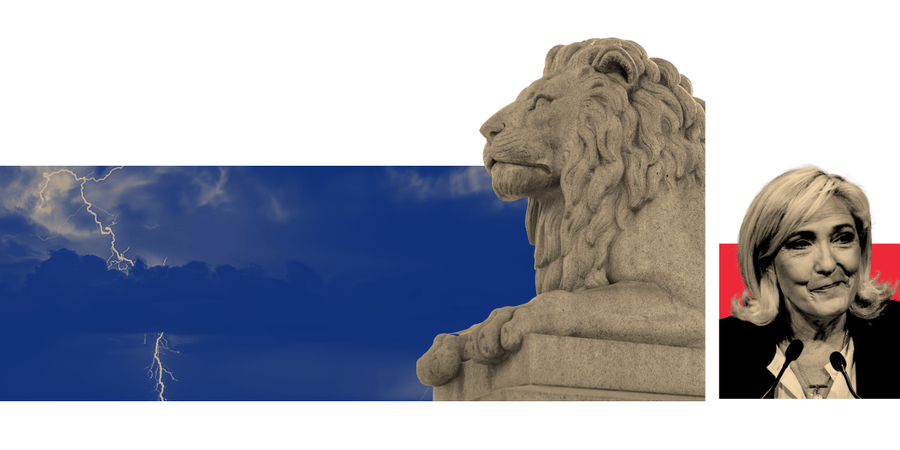
As the rest of Europe faces up to the possibility of President Le Pen, the risk is that leaders and other policymakers bunch around one of two poles: complacency (the over-confident belief that she could simply be “handled” like any other challenging leader); and panic (the fatalistic assumption that an RN-led France would automatically mean the beginning of the end of the European project). Of the two courses, the first—the assumption of business as usual—currently looks like the greater risk. But neither is advisable.
This paper has shown that an RN win is a real possibility and would herald great disruption for the EU and its place in the world. It has argued that a Le Pen presidency would see itself ultimately as a radical insurgency against the French and European establishment. But it has also explored some of the complexities and shed some light on how the rest of Europe should think about them. In particular, leaders elsewhere on the continent should:
Abandon all precedents when thinking about an RN-led France
As president, Le Pen would be as fundamentally rooted in French traditions and peculiarities as equivalent leaders are in those of their countries. Trump’s America is simply too different to be closely relevant to France, despite the executive power both presidents wield. Orban’s Hungary does not fit either, with its distinctive tale of state capture and subordination to kleptocratic interests. Meloni’s Italy, meanwhile, is a complex story of creeping authoritarianism at home but emollience internationally. A Le Pen presidency would bear passing resemblances to each, but be sui generis.
Seek to understand the party and its instincts
Le Pen is a familiar figure, but her party has never held national power before and has evolved over time. Knowing how it ticks will be essential. This should lead decision-makers to engage with the party now, including by pursuing carefully calibrated efforts to meet with its senior figures to assess their true intentions. The decision of the German government to make contact with Bardella, for example, was the right one—though Europeans should be wary about reading Le Pen’s positions and instincts via Bardella and his circle.
Brace for a wider, but not necessarily more unified, European right
An RN win would be significant for Europe’s far-right. But ECFR’s research points firmly away from the idea of a coherent and durable European “union of the far-right” of any sort. The radical right has an emphatic sense of momentum, but that is not the same thing as a common project. Indeed, dismantling European integration is likely to generate conflicts over budgets and policies on issues like borders, energy, industry and defence—even between governments of similarly nationalist ideological hues.
Manage expectations when seeking to work with an RN-led France
Even in today’s more plural Europe, France is too big and too important to be circumvented entirely in a world of predators. Perhaps there would even be some limited common ground (most likely to be around defence, geoeconomics and building strategic autonomy). There could even be the possibility to mould a party that is still uncertain about its exact foreign policy agenda. But, especially under Le Pen rather than Bardella, this would still be a significantly less predictable, less collegiate and less European France than the one partners have known under Macron.
Prepare to deploy all the arts of European and international politics
An RN-led presidency would be complicated and disruptive. It would call for real diplomatic skill and political leadership in the EU and the rest of Europe, especially in powerful states like Germany, Italy, Poland, Spain and, outside the bloc, Britain. In some cases, the task at hand might be to moderate France and bind it into groups of other states on matters of common and agreed interest. In others, it would be to build coalitions of the willing where France was reluctant to join. This would be a good time to deepen relationships between Brussels, Berlin, Rome, Warsaw, Madrid and London, as well as other capitals.
The other futures
Europeans prepare for the possibility of Le Pen as president of France, they should keep in mind that an array of outcomes is still possible. There is also a significant chance of a moderate candidate making it to the second round and rallying the republican front once again against the RN. And in today’s volatile and fragmented French politics, there is even the possibility of a far-right against far-left runoff. But polls are polls, and probabilities are probabilities. This paper is a response to one major possibility among several—and an urgent call to France’s European partners to be ready.
About the authors
Célia Belin is a senior policy fellow at the European Council on Foreign Relations and head of its Paris office.
Jeremy Cliffe is editorial director and senior fellow at the European Council on Foreign Relations. He co-heads the New Politics Project within the European Power programme.
Camille Lons is a policy fellow and deputy head of the Paris office at the European Council on Foreign Relations.
Constance Victor is the Paris office coordinator at the European Council on Foreign Relations.
Acknowledgments
We would like to start by thanking ECFR colleagues, including Piotr Buras, Teresa Coratella, Agathe Demarais, Janka Oertel, Nicu Popescu, Jana Puglierin, Marta Prochwicz Jazowska, Herman Quarles, Jeremy Shapiro, Vessela Tcherneva and Pawel Zerka who gave thoughtful comments on various drafts. We would also like to thank Zineb Bouziane for her thorough research support in the earlier stages of this project.
We are grateful to experts such as Catherine Fieschi, Jacob Ross and Victor Mallet for engaging with us and offering constructive feedback. We also would like to acknowledge the politicians, journalists and thinkers we interviewed over the course of this research; while we respect their anonymity, we thank each of them for their time and insights.
The task of editing the two editions of this paper fell to Kim Butson and Adam Harrison and we are grateful for their time and dedication in bringing it to completion. Thanks also go to Chris Eichberger for offering beautiful visuals to complement our work.
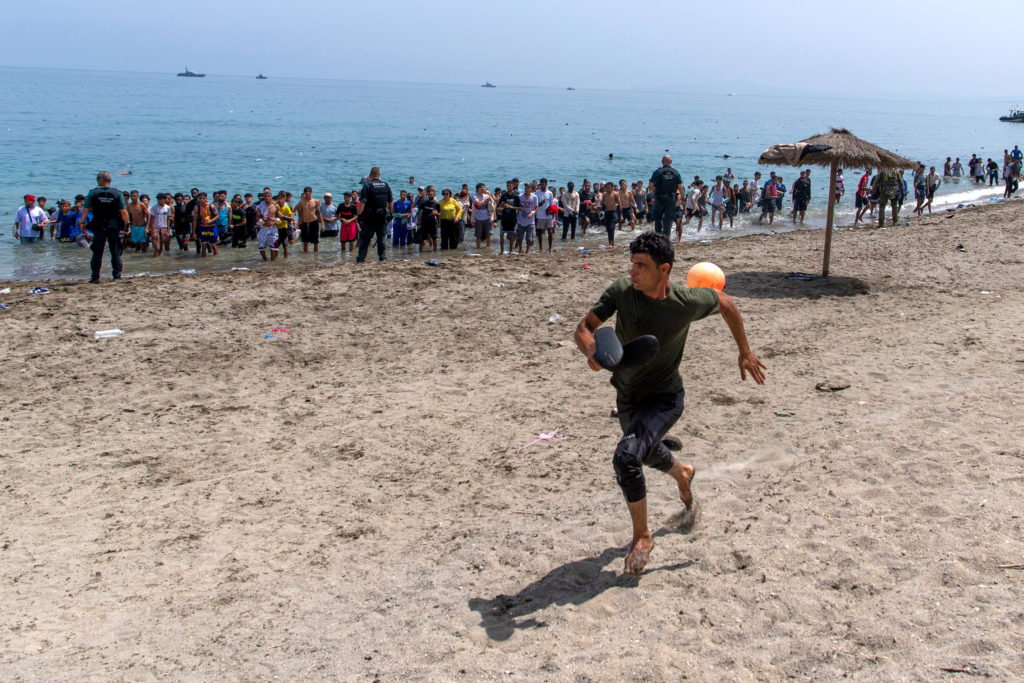
Problem
Around 60,000 migrants crossed from Morocco into the Spanish exclave of Ceuta in 24 hours between July 30th and 31st, overwhelming the territory and exposing divisions within the EU.
The immediate cause is unclear. Morocco’s authorities have yet to issue an official explanation. Spanish officials have pointed to a recent Supreme Court ruling ending the automatic return of migrants intercepted while attempting to swim to Ceuta and Melilla. But the sheer scale of the crossings suggests Morocco might have deliberately relaxed border controls. The timing is also suspicious. The crisis came just ten days after Spanish prime minister Pedro Sánchez visited Algeria— Morocco’s arch-rival—and announced a “new phase” in Spain-Algeria relations.
The reaction within Europe has been striking. Rather than display solidarity with a member state facing pressure at the EU’s external border, Italian prime minister Giorgia Meloni not only blamed Sánchez’s migration policies but also called for Spain to be suspended from the Schengen area. Madrid responded by summoning the Italian ambassador and rebuking Rome’s “partisan demagoguery”.
Responses from other leaders have been similarly unsympathetic. Finnish interior minister Mari Rantanen supported Italy’s proposal to suspend Spain’s Schengen status. Manfred Weber, president of the centre-right European People’s Party, urged the European Commission to hold Sánchez accountable for failing to protect the EU’s external border. Meanwhile, France has reinforced controls along its frontier with Spain. Remarkably, little criticism was directed at Morocco itself.
Solution
In the immediate term, the EU should demonstrate solidarity with Spain. European leaders need to treat migration pressure against a member state as a collective problem and a challenge to the integrity of the EU’s external border. Publicly blaming the targeted member state lowers the political cost of weaponising migration.
Brussels should make clear that any use of migration as blackmail will carry European rather than merely Spanish consequences. Around two thirds of Moroccan exports go to the EU, which is also its largest source of foreign investment. Brussels should also be prepared to suspend negotiations on a comprehensive partnership upgrade with Rabat.
Europe also needs to revise its migration policy, which largely shapes its relations with North Africa. In the absence of a common European approach, relations default to bilateral bargains, leaving North African leaders holding the lever. And until Europe changes the incentives, Rabat will keep pulling it.
Context
Spain has managed the migration relationship with Morocco bilaterally for decades, leaving Madrid increasingly hostage to Rabat. The latter has repeatedly used migration as political leverage, most notably in 2021, when it allowed some 6,000 migrants into Ceuta in a single day amid a diplomatic rift over Western Sahara.
The following year, Spain abandoned its longstanding neutrality on Western Sahara by endorsing Morrocco’s autonomy proposal, a policy shift many attribute to the 2021 crisis. Government sources unofficially said at that time that the new bilateral understanding included Moroccan commitments to avoid a repeat of the episode.
Rabat also appears particularly emboldened at present. It enjoys strong backing both from the US and Israel, and both have become increasingly hostile towards Sánchez government. The White House responded to the latest crossings by celebrating it as evidence of the “destructive philosophy” of “extreme left and globalist policies, including those that facilitate massive migration”.
]]>

Problem
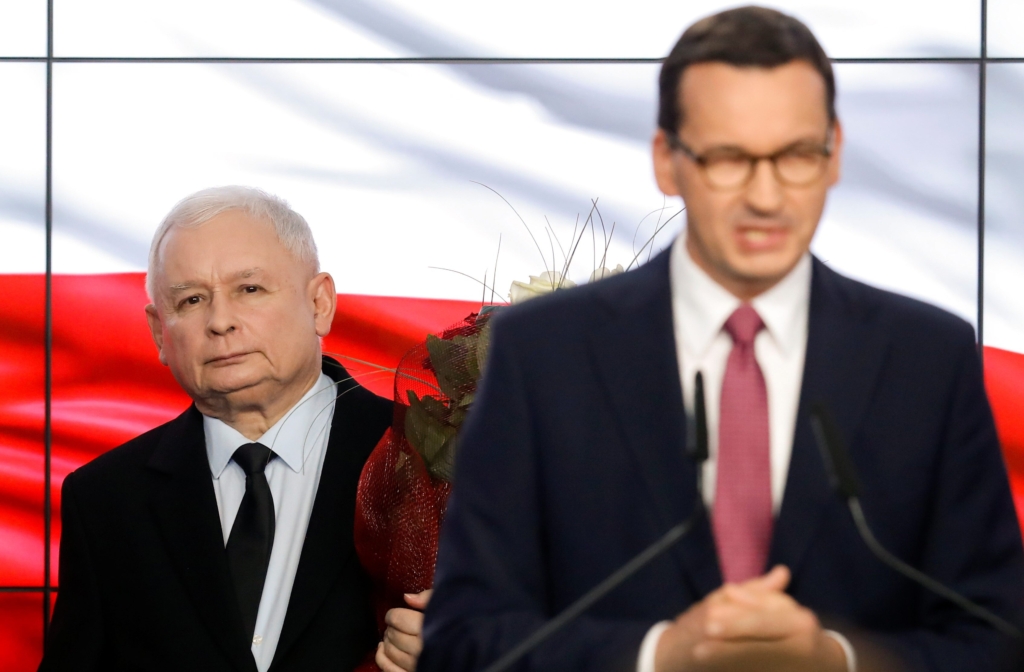
Poland’s party system is unravelling. The Law and Justice (PiS) party, led by Jaroslaw Kaczyński, has split. More than 40 of its members have formed a separate parliamentary caucus that includes Mateusz Morawiecki, prime minister for most of the party’s rule from 2015 to 2023. This ends an era of over 20 years that has been shaped by two powerful men and their parties: Kaczynski’s right-wing nationalist, Eurosceptic PiS and Donald Tusk’s liberal-conservative, pro-European Civic Coalition (KO).
At first glance, the collapse of his old enemy is a gift to Tusk. KO leads with 29%; PiS has slipped below 19% since the split. Four groupings now compete on the right, and Poland’s voting system punishes fragmentation, so four medium-sized parties win fewer seats than one large party on the same vote.
However, Morawiecki broke away in protest at PiS’s radicalisation, hoping to win over the very centre-right voters who helped return Tusk to power in 2023 after eight years of PiS rule. Most are now disillusioned (Tusk’s government has dismal approval ratings), politically homeless and angry. If they split their vote among the four right-wing parties or stay at home, Tusk may meet the same fate as Kaczynski in 2023: he could win the election in 2027 but be unable to assemble a majority coalition.
The other problem is one of method. For two decades Tusk has, often successfully, run against Kaczynski rather than on a programme of his own. Polarisation served both men well: each could rally his own voters by invoking the threat of the other, and smaller parties were squeezed out. Kaczynski’s decline forces Tusk to find another way to win.
Solution
Rather than betting on his enemy’s demise, Tusk should proactively set the agenda and win centrists beyond his base, as in 2023. Economic and social questions will matter, but foreign policy is set to loom unusually large in next year’s campaign. A record 25% of Poles favour leaving the EU (“Polexit”), hostility to Ukraine is rising and the right-wing parties are competing to outdo one another in anti-EU, anti-German and xenophobic rhetoric.
Tusk, a risk-averse tactician, has long avoided confrontation on those fundamental issues, calculating that exposing himself to attack from the right would be self-defeating. The far-right, however, has filled that vacuum, for example through its campaign against SAFE, the EU’s defence-loan scheme, and in the hardening mood towards Ukraine.
A more volatile party system may paradoxically make anti-Tusk majorities easier to build. That is an argument for the leader of Poland’s pro-European camp to take up the fight rather than duck it. Tusk needs to explain to Polish voters, more forcefully than before, why the EU is the best response to pressure from Donald Trump and Russia; why anchoring Ukraine in Europe is a Polish raison d’état; and how Poland’s interests differ from those the nationalists describe.
Context
Poles vote for a new parliament in October 2027. Tusk’s five-party coalition faces an uphill struggle to stay in office. The coalition partners have weak support or may not be able to re-enter the government at all.
Recent polls give the four right-wing parties a majority between them; whether their rivalries would allow a coalition is another matter. PiS has moved further right in recent months to stop core voters defecting to more radical rivals, in a shift which provoked Morawiecki’s rebellion. His departure will probably set off further political realignments before the 2027 election.
]]>LuHan highlights how young people in China are increasingly questioning the meaning of development and modernity beyond material progress. Kee Beng reflects on Malaysia’s complex relationship with China, arguing that their growing engagement is reconnecting South-East Asia to older historical patterns of regional interaction. Chelsea explains how, in Vietnam, attitudes towards China have shifted dramatically since the covid-19 pandemic, with young people becoming more curious about Chinese technology and society.
Together, Mark, LuHan, Kee Beng and Chelsea explore whether a post-Western, rather than anti-Western, generation is taking shape across the region. How did the covid-19 pandemic reshape perceptions of China in South-East Asia? Which aspects of Chinese modernity resonate most with younger generations? Is China becoming a new reference point for development and aspiration? And what do these shifts mean for Europe’s role in an increasingly multipolar world?
This podcast episode was recorded on July 10th 2026.
Bookshelf
A Maritime Vietnam: From Earliest Times to the Nineteenth Century, by Tana Li
State Building in Cold War Asia: Comrades and Competitors on the Sino-Vietnamese Border, by Qingfei Yin
Border Country, by Raymond Williams
The Scythian Empire: Central Eurasia and the Birth of the Classical Age from Persia to China, by Christopher I. Beckwith
Adrift in the South, by Xiao Hai
The NATO Summit in Ankara ended with a short but consequential declaration. Alongside commitments to develop a wide range of capabilities—such as drones, a warfighting cloud and AI models—the allies pledged to make them interoperable.
This is not a trivial statement. Weapons systems are becoming increasingly software-defined, and NATO standards need to keep pace. Interoperability would address a major problem of European armed forces: fragmented command-and-control systems that cannot easily share data. Yet the declaration also raises difficult questions. Interoperability requires common standards, and whoever defines these standards will control how allies operate and upgrade their militaries. Choosing the wrong architecture could replace one weakness with another.
Ukraine’s software edge
Russia’s war of aggression against Ukraine has demonstrated the importance of AI-assisted command-and-control systems. These are “systems of systems”, unified architectures that help aggregate and analyse vast amounts of battlefield data, thereby assisting in situational awareness, intelligence, mission planning and after-action review. Much commentary attributes Ukrainian battlefield progress in 2026 to certain drone models, underestimating the significance of Delta, Ukraine’s command-and-control system.
Compared to similar systems used by European armies, Delta offers significant advantages: it is the only one that provides a single digital architecture across the armed forces, integrating sensors, weapons and units regardless of the service branch or the system’s manufacturer. It can therefore rapidly coordinate different elements to achieve the desired effect on the battlefield, whether directing artillery and drone strikes, conducting air-defence operations or treating and evacuating casualties.
In contrast, EU militaries are much more fragmented. Different countries, and in many cases different service branches within the same country, operate different command-and-control systems, with limited interoperability. A French radar may be unable to exchange raw sensor data with an Israeli command-and-control system simply because they were built by different manufacturers and use different proprietary software.
NATO’s Link 16, a secure battlefield data-sharing standard, exchanges only relatively limited information, such as friendly positions or aggregated target tracks—meaning sensor observations that have already been processed into identified targets, such as aircraft or vehicles. Exchanging raw data would have overwhelmed the computing power available in the 1990s, when Link 16 was developed. Therefore, each system, whether a Patriot battery or a frigate, must first convert radar echoes (“plots”) into confirmed targets (“tracks”) before it can share them through that network. However, sharing only processed tracks comes at the cost of discarding potentially valuable data. Echoes that cannot be confidently identified are discarded as clutter, even though combining them with data from other sensors could reveal targets that an individual system cannot detect on its own.
Modern command-and-control systems overcome this limitation. Platforms like Delta can digest huge quantities of raw data, from drone footage to radar returns and electronic intelligence intercepts. Powerful data centres then aggregate these disparate inputs to extract patterns that individual systems and their operators could never detect alone. The result is a level of intelligence and situational awareness that in the past required a wide range of high-end surveillance equipment, such as satellite constellations and fleets of expensive intelligence aircraft or ships. Smaller militaries like Ukraine’s can now achieve results once reserved for great powers.
European governments have taken notice of the trend. As NATO seeks to shift a larger share of its military burden from the US onto European members, the challenge for Europe is to achieve self-sufficiency quickly. Recreating America’s globally oriented force structures would be very expensive and probably unnecessary. The Ukrainian model of dense networks of cheap sensors linked by sophisticated software is certainly more attractive.
Without integrated digital architecture and interoperability, a pan-European combat cloud and AI-assisted command-and-control system cannot work
However, to truly emulate Ukraine, Europeans need to do more than simply buying drones. They will need to dismantle the institutional barriers that separate different countries, service branches and defence-industrial ecosystems. Without integrated digital architecture and interoperability, a pan-European combat cloud and AI-assisted command-and-control system cannot work.
One code, one gatekeeper
The commitments made in Ankara reflect this ambition. The difficult question is what comes next. Which standards will underpin interoperability? Who will provide and maintain the software? What will be the terms and conditions of its use, adaptation and application? Washington naturally favours adopting American standards and software across the alliance. Yet other allies fear that dependence on US software will have commercial and operational costs, as well as limit their sovereignty.
Take for example the Government Reference Architecture (GRA), the new US software for operating and integrating drones. On paper, GRA is a hardware-agnostic, open-source software that allows different drones from different manufacturers to operate across a common foundation. It also allows operators to integrate new algorithms and software onto existing drones, enhancing their service life and making it easier to integrate new weapons and sensors, or to re-programme the drone for new tasks and missions.
But what does “open source” really mean in a military environment? In practice, the US Air Force is still the custodian of the software, managing integration, updates and distribution. European manufacturers involved in these discussions say the source code of substantial parts of GRA is not disclosed to them.[1] If European governments and armed forces were to adopt it straight from the box, they would not be able to verify exactly what the programme enables on their platforms—nor would they be able to freely adapt it to their specific operational and tactical needs.
Furthermore, elements of the architecture fall under America’s International Traffic in Arms Regulations (ITAR), which could constrain exports of European systems built around GRA, as well as complicate cooperation with non-NATO partners. And what happens if Europeans want to use it in operations which the US does not approve? Ukraine has already experienced how American restrictions on deep-strike systems affected deliveries of European weapons using US software and data: when Britain and France supplied Storm Shadow/SCALP cruise missiles, Kyiv was initially barred from using them against targets inside internationally recognised Russian territory because the mission-planning software and the data were subject to ITAR, requiring Washington’s approval.
America’s technological lead is undeniable. Outside Ukraine, no other ally has developed digital military integration on the same scale. But AI-powered command-and-control systems will be the backbone of modern warfare, the defining factor in a military’s ability to fight effectively. If Europeans—and Canadians—sign up to the American standards, can they be certain that Washington will not abuse this power? The fact that the Trump administration has slapped tariffs on Europe despite existing commitments, threatened to invade and annex Greenland, and temporarily suspended intelligence and military assistance to Ukraine in March 2025 should give them pause.
A truly open cloud
There is no doubt that NATO needs integrated and AI-supported command-and-control systems, a common combat cloud, and a standardised architecture to integrate crewed and uncrewed platforms. But they need to be truly open. That means that their source code needs to be transparent to all participating governments, while certification, management and distribution should be entrusted to an independent multinational authority rather than a single state. The Linux ecosystem offers one possible model. Many companies use and adapt the same underlying open-source software, yet no single firm controls it. Even so, a central authority is needed to maintain and certify the software’s core—in this case, that role is played by the Linux Foundation.
If America resists such a solution, the EU and its closest allies (Canada, Norway, the UK and Ukraine) will need to build their own architecture. The cost of building a parallel architecture would be high, but the cost of surrendering control over the software that underpins military power could be higher still.
[1] Interviews with system developers at two European drone manufacturers in May and July 2026.
]]>
When the G20 met on African soil for the first time in November 2025, it signalled that the continent is becoming more important to the world as an economic partner. China and the United Arab Emirates (UAE) have already spent the past decade gaining ground as trade partners to African countries, narrowing the EU’s long-held lead.
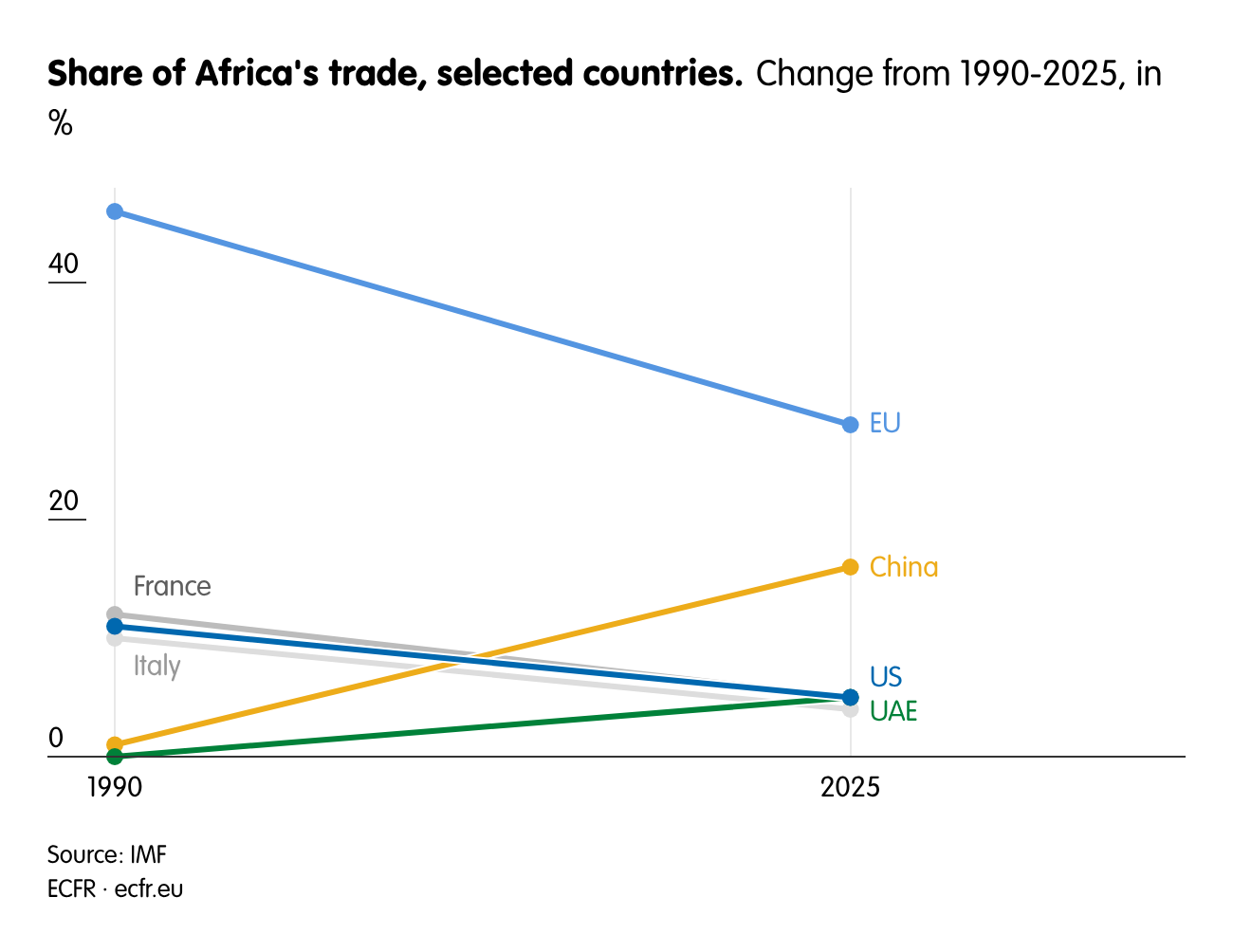
France and Italy have recast their economic strategies accordingly, hunting for markets and suppliers of their own in Africa as global alliances shift and supply chains fracture. In 2026 alone, Italy convened its second Africa Summit in Addis Ababa and France held its Africa Forward Summit in Nairobi, the first France-Africa summit co-organised with an African country outside France or Francophone Africa. The rest of Europe is also adapting its approach. Since 2020, at least nine European countries have revised or substantially repositioned their Africa policies, recognising that Africa can be more than a supplier of natural resources.[1]
Africa’s own governments are pressing for this shift, positioning themselves as equal partners rather than aid recipients. European language is adjusting to match, with Brussels, Paris and Rome talking more about investment and partnership than about aid. European leaders must now make those national strategies pull in the same direction, keeping pace with rivals and delivering for both sides of the Mediterranean.
Under pressure
The EU is Africa’s largest trading partner, but individually its largest member states are just middle-sized players in today’s Africa.
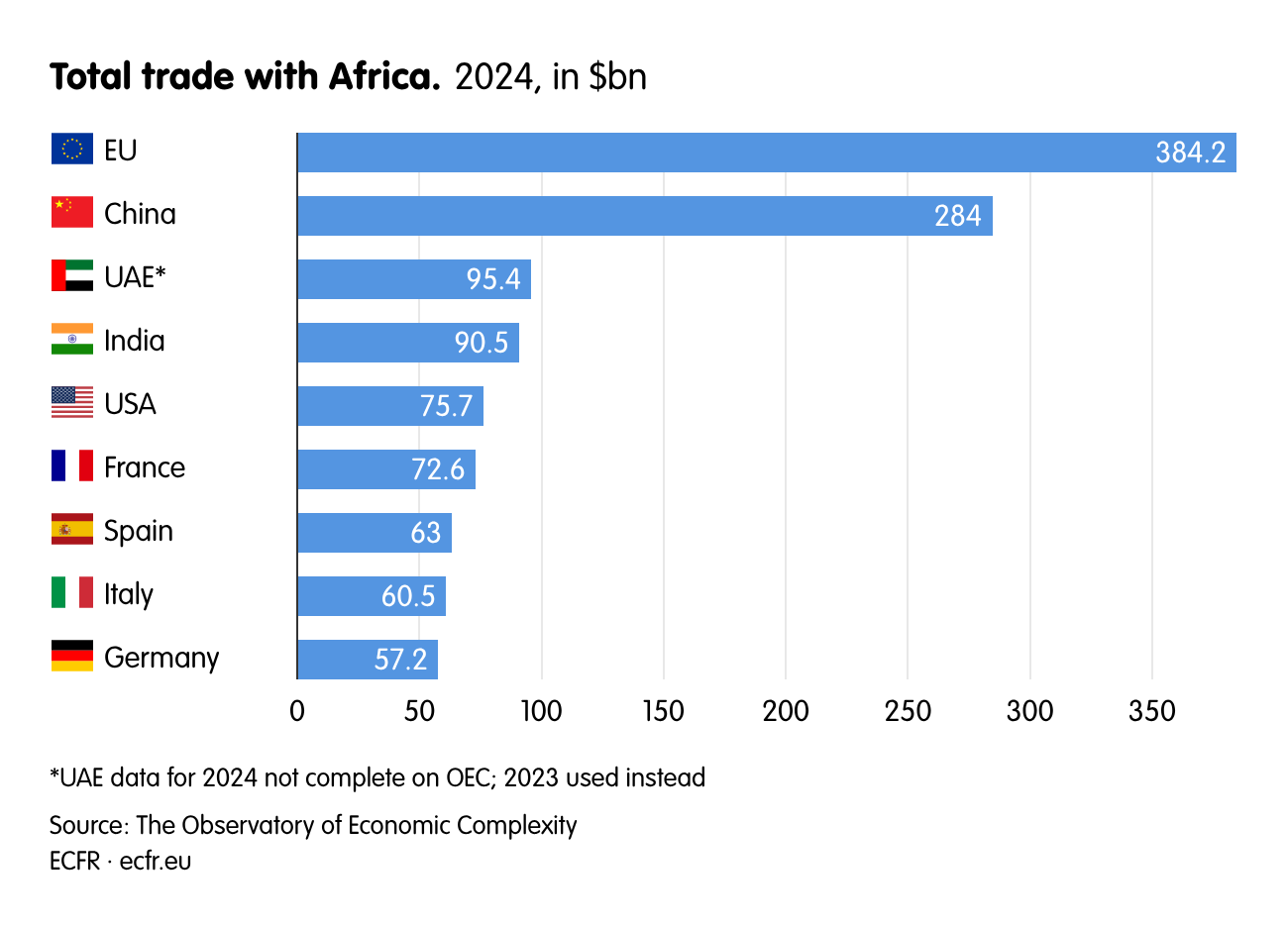
Investment tells a similar story. European firms hold the largest stock of foreign investment in Africa, over €250bn, but only 10% of all new investment to African companies in 2024 came from Europe.[2] China and Gulf Arab states have spent the past decade increasing state-backed private investment to build market share across the continent. On present trends, the EU will fall further behind.
The right sort of investment
The kind of investment matters as much as its scale in making Africa a stronger industrial partner for Europe: greenfield manufacturing projects, regional infrastructure and industrial ecosystems do more than capital alone to build that capacity. However, European commercial ties with Africa are more extractive than transformative. In 2025, 70% of EU imports from Africa were primary products and just 28% were manufactured goods. Both French and Italian imports from Africa follow the same trend, which also shows up in where the money goes. In 2024, Italy and France were among the top investors in Africa’s extractives. Most capital-exporting economies share this extractive bias, since it reflects where Africa’s industrial development currently stands. Manufacturing gets only a modest share of investment, even though it matters most for the continent’s shift away from raw material exports.
The reason lies in how investors price risk. Capital is expensive in Africa: investors see the continent as disproportionately risky, which pushes money towards safe, asset-backed extractive projects rather than the long-term capital needed for more uncertain sectors, such as manufacturing. Even Africa’s own $4trn in domestic capital sits idle: weak banks and cautious institutions channel it into short-term holdings and government debt instead of long-term manufacturing investment.
Winds of change
France, Europe’s traditional leader on African matters because of its colonial and post-colonial history, and Italy, now seeking to emerge as its rival in European policy towards Africa, are already trying to address these issues. Both have overhauled their Africa policies and both used their G7 presidencies (in 2024 and 2026 respectively) to position Africa and development cooperation within a broader agenda of economic security built on private capital rather than aid. Yet this shift has not been matched by greater strategic coordination across Europe.
France, Italy and the EU broadly agree on what matters—energy, critical minerals, infrastructure, skills and industrialisation—but not on how to pursue it. A growing number of other member states, such as Germany and Spain, now see the continent as a partner for secure supply chains and political influence. The EU’s Global Gateway, its flagship strategy to mobilise up to €300bn in global infrastructure investment by 2027, was meant to give these efforts a common framework. Yet these strategies largely continue to operate in parallel, reflecting national priorities, commercial interests and historical ties. That leaves Europe without the scale, coherence or investor confidence needed to support industrial ecosystems and compete with partners able to combine finance, diplomacy and commercial clout.
Italy’s flagship Africa strategy, the 2024 Mattei Plan, and France’s 2026 Africa Forward investment strategy illustrate this dynamic: though the two emerged from different starting points, they increasingly pursue the same objectives, target overlapping countries and lean on comparable financial instruments. This reflects both Europe’s converging strategic interests and the reality that Africa’s infrastructure deficit concentrates investment in a narrow set of sectors. But it also shows that these strategies are additive rather than complementary.
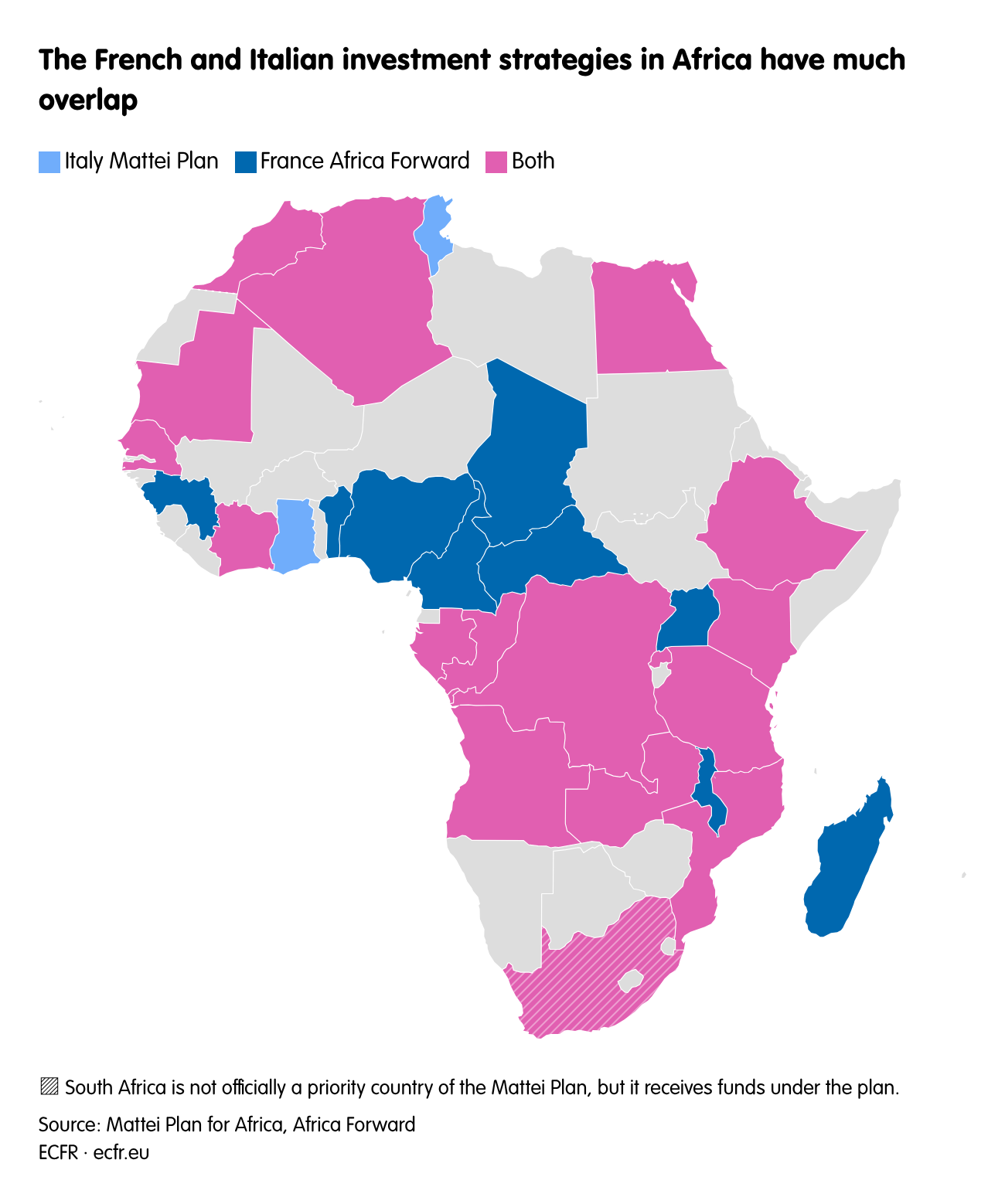
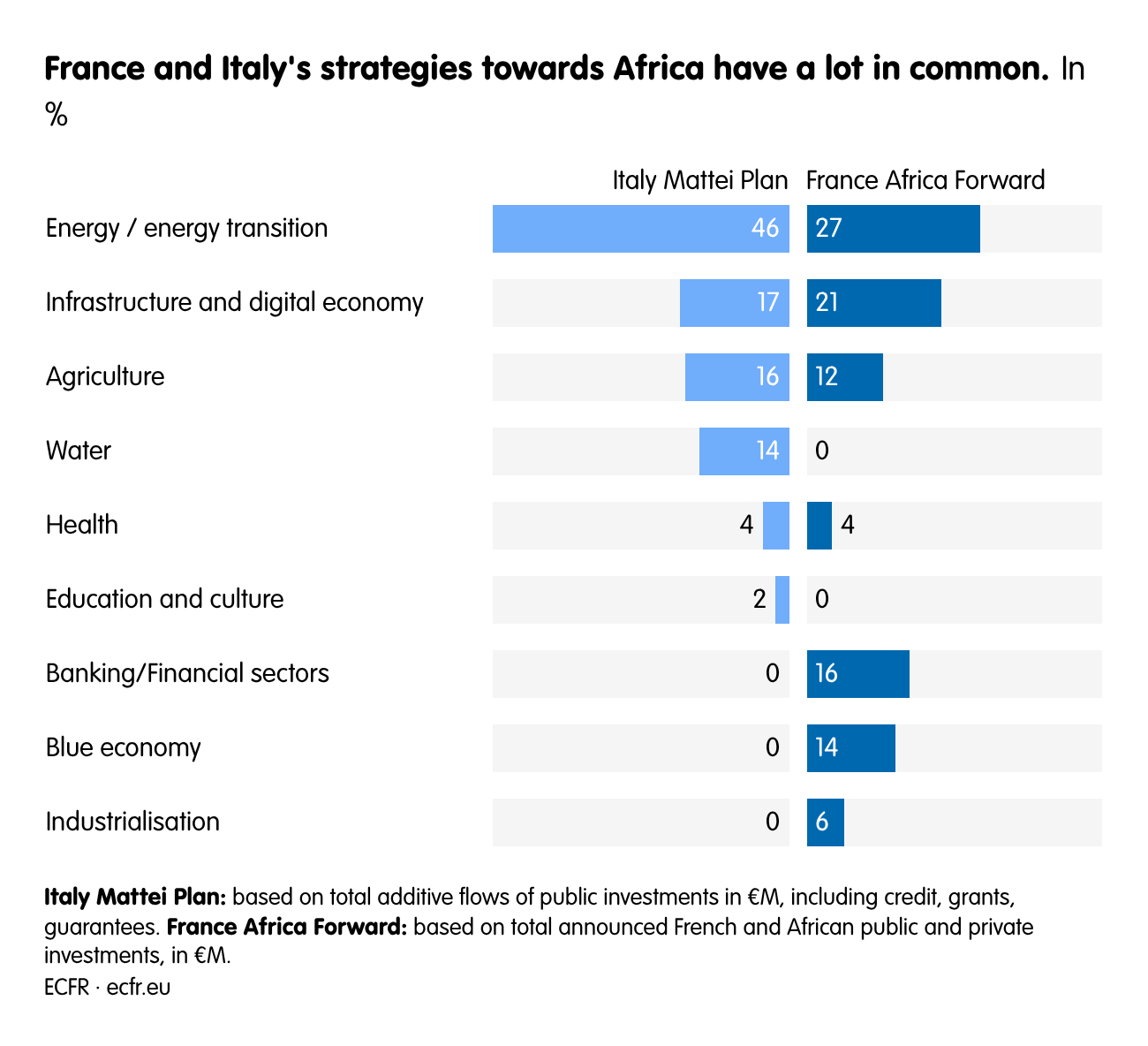
Doing more with less
A core part of France’s and Italy’s new strategies is how to finance their ambitions in Africa. China, the UAE and even America use their private sectors as tools of state strategy. Italy and France are responding by using public money to pull in private investment and international lenders.
The Mattei Plan itself is a modest €5.5bn public fund spread over four years (2024–2027), but it uses guarantees, development finance and partnerships to unlock far more money than that. Italy’s export credit agency, SACE, has already put up €4bn in guarantees since the Mattei Plan was launched, pulling in an estimated €18.5bn of private funds. Partners such as the African Development Bank (AfDB), the World Bank and the UAE add even more to the pot.
France’s plan, set out in the Africa Forward Summit, is part of a wider €23bn package, split between a €14bn pledge from Paris and €9bn from African partners. Of that, just €1.94bn is public funds; the rest is private. The strategy targets African strategic autonomy, especially in food and digital technology, and leans more on small businesses, private investors, and risk-mitigation tools such as the African Trade and Investment Development Insurance, a pan-African credit insurer. As with Italy, the aim is to make limited public money go further.
Rome and Paris find it easier to build coalitions with international lenders and non-European partners than with each other
Both countries have internationalised their financing—leaning on institutions such as the AfDB, the World Bank, Gulf sovereign investors and export-credit cover. Yet joint European ventures remain rare: aside from a handful of joint initiatives—such as the collaboration between the Italian, French and German state development banks on a water infrastructure project in Morocco under the Mattei Plan, or Denmark’s support for the Italy-AfDB Mattei Plan financing facility—both strategies have attracted relatively little structured participation from other European governments. Rome and Paris find it easier to build coalitions with international lenders and non-European partners than with each other. This limits opportunities to pool resources and build larger industrial investment platforms.
What Europe should do
France and Italy are changing course. The EU should now turn their separate initiatives into systems that reshape investment and drive African industrialisation. Three recommendations show how.
Share the risks
Since European countries individually cannot outspend China or the Gulf states, they must change the terms on which their capital competes. Member states and European institutions should increasingly pool guarantees, coordinate development finance institutions and build common project pipelines. Joint risk-sharing mechanisms involving institutions such as Italy’s development bank (Cassa Depositi e Prestiti), France’s development agency (Agence Française de Développement), the European Investment Bank and African financial institutions would reassure private investors more than multiple national commitments operating independently. The objective should be to change the risk calculus for investors.
Think in corridors
European countries deal with Africa country by country, or sector by sector. Industrialisation, however, crosses borders and sectors. Value chains need regional energy systems, transport corridors, customs integration, digital connectivity and labour mobility. Europe’s comparative advantage lies precisely in its experience building integrated markets. Even its most ambitious African venture, the Lobito Corridor—a planned rail line linking Congolese and Zambian mines to Angola’s Atlantic coast, backed by America, the EU and Italy—has yet to knit infrastructure, investment and regional integration into a single plan. Rather than approaching Zambia, Angola or Namibia as separate investment destinations, Europeans should use their collective weight to back it, and corridors like it, as platforms that align infrastructure, regulation, energy and manufacturing across several countries.
Help shape the rules
Some barriers sit above any single project: high sovereign risk premiums, the cost of capital and weaknesses in the global financial system continue to discourage productive investment in Africa. Europe should use platforms such as the G7 and the upcoming UK and South Korean G20 presidencies to ensure greater African participation in these discussions. It should also work to reform the global investment environment itself: support the African Credit Rating Agency, use multilateral guarantees more, and make financing cheaper for African economies. Shaping these rules is how Europe can help Africa become an industrial partner.
***
Europe is adapting, and France and Italy are showing the way. The challenge now is to weave these separate national efforts into one system capable of making Africa a genuine economic partner with a stronger geopolitical voice.
[1] Czech Republic, Denmark, France, Italy, Germany, Netherlands, Spain, Sweden, United Kingdom.
[2] EU outward investment to Africa: €9bn in 2024, per Eurostat (approximately $9.7bn converted at the yearly average exchange rate of 1 EUR = 1.0822 USD). Total FDI inflows into Africa: $97bn in 2024, per UNCTAD’s World Investment Report 2025. $9.7bn ÷ $97bn ≈ 10%.
]]>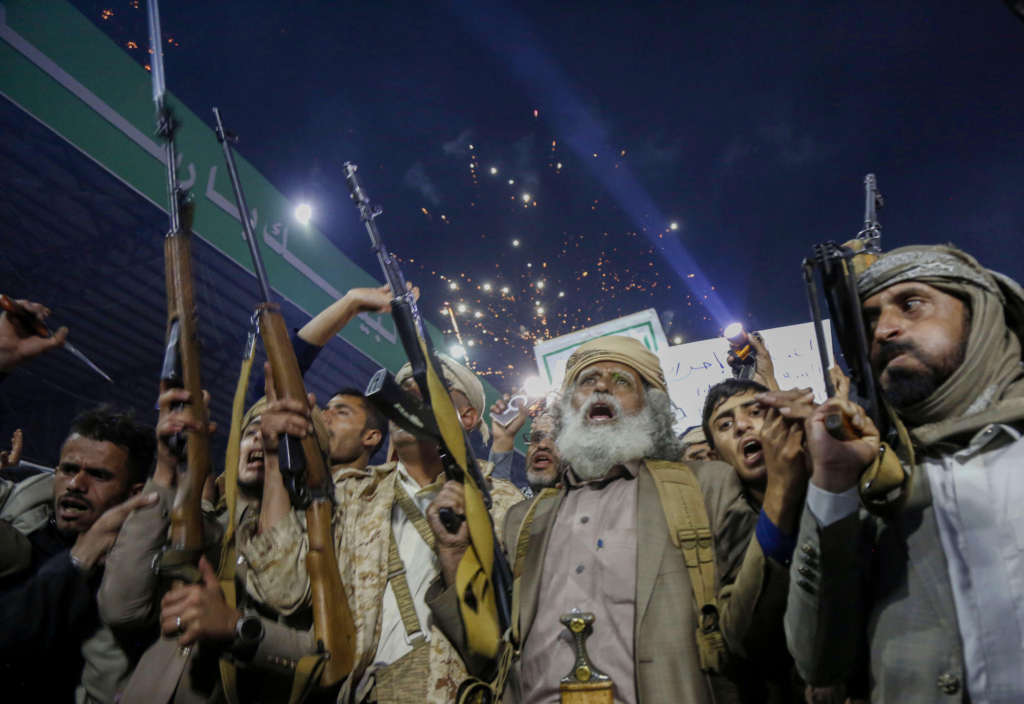
The next phase of the war between the US and Iran may be decided not in the Gulf but in Yemen. The Houthis’ decision to blockade Saudi Arabia in the Red Sea—including by attacking two Saudi ships as well as Aramco’s oil infrastructure—could become a turning point in the wider conflict. Such escalation could force Riyadh to reconsider the diplomacy-first strategy that has defined both its response to the Iran war and its handling of Yemen after a costly military intervention failed to uproot the Houthis.
Staying out of the war
Since the Iran war began in February, Riyadh has maintained channels with Tehran and urged Washington to pursue de-escalation, diplomacy and an end to the war. This strategy stems from Saudi Arabia’s exposure to prolonged turmoil and its determination to avoid being dragged into a war.
There is also a more immediate Saudi calculation. By keeping lines open with Tehran, Riyadh sought, with partial success, to persuade Iran to spare the kingdom the kind of retaliation it directed at the UAE, whose support for the US-led war has been overt. Restraint has also strengthened Saudi diplomacy with the Houthis and helped preserve an uneasy truce.
This diplomatic approach has also allowed Riyadh to keep exporting oil even as Hormuz remained closed. Crude continued to flow through the East-West Pipeline from the Eastern Province to Yanbu on the Red Sea, preserving access to Asian markets, which account for up to 70% of Saudi crude exports. While the route still handles only a fraction of export volumes during peacetime, it provided Saudi Arabia with an economic lifeline while easing pressure on global markets.
That arrangement is now under strain. After Saudi-backed forces in Yemen struck the runway at Sana’a airport to prevent Iranian aircraft from landing (arguing they were enforcing a no-fly embargo on military supplies), the Houthis launched ballistic missiles and drones at southern Saudi Arabia, ending a four-year truce.
The attacks appear to reflect a shift in Iran’s strategy towards the kingdom. As the US expanded its attacks on Iranian infrastructure, Tehran has reportedly asked the Houthis to prepare to close Bab al-Mandab and threatened the East-West Pipeline directly, declaring a “port against port” doctrine under which Gulf infrastructure hosting American operations would become targets. By threatening both Hormuz and the Red Sea, Tehran appears to seek to raise the global cost of the American campaign—while again overestimating Riyadh’s ability to press Washington for de-escalation.
Riyadh’s choice
Saudi Arabia must now decide how to respond. If the Houthis fail to cause meaningful disruption at Yanbu and the East-West Pipeline, it may seek a new exclusion agreement with the group and Iran. Under such an arrangement, Saudi tankers, ports and infrastructure would be removed from their target list in exchange for restrictions on refuelling American aircraft and on intelligence support for American operations, as well as tighter controls on the Saudi-backed Yemeni forces. Tehran would also expect Riyadh to keep pressing the White House for de-escalation. The Houthis would likely demand concessions of their own too, such as resumed flights to Sana’a, access to the port city of Hodeidah, salary payments and a more formal recognition of their authority in northern Yemen.
If, however, the Houthis continue to block Saudi exports while attacking Yanbu, the East-West Pipeline or other critical infrastructure such as Aramco facilities, Riyadh may conclude that diplomacy has become a mechanism for managing its own strangulation. At that point, accommodation could be more dangerous than escalation. Saudi Arabia could then move closer to the American campaign against Iran while also reviving its own war against the Houthis. That would draw the Arab world’s most influential state directly into the conflict, making it far harder to contain.
After their public split around Yemen, the two Gulf powers now have a shared incentive to confront a common enemy
Riyadh would first try to deal with the Houthis. Saudi Arabia has already struck Houthi sites at the port of Hodeida and on Kamaran island. The next steps would likely involve coordination with the UAE. Abu Dhabi has long argued that Riyadh’s accommodation with the group was doomed to fail. After their public split around Yemen, the two Gulf powers now have a shared incentive to confront a common enemy. The UAE-backed forces in the south have already mobilised alongside the Saudi-backed internationally recognised Yemeni government, attacking Houthi missile and drone launch sites as well as weapons depots in Marib and Al-Jawf.
Avoiding a wider war
Such an escalation would be an enormous gamble for all sides. Iran would end up facing a broader coalition. Saudi Arabia would be joining an American military campaign that is yet to deliver a decisive blow against Iran, while reopening a conflict in Yemen that it previously failed to settle. Iran has already demonstrated that it can keep Hormuz closed despite US strikes, showing it retains highly dispersed missile and drone systems able to sustain a prolonged war at a very low cost. The Houthis can do much the same in the Red Sea. Meanwhile, a renewed ground war in Yemen could reignite the country’s longstanding civil war.
Europe has every interest in preventing that outcome. A prolonged closure of Bab al-Mandab would disrupt the Suez route, increase energy and shipping costs and heap further pressure on the European economy. If Saudi Arabia abandons restraint against Iran and the Houthis, the chances of a diplomatic settlement that addresses both Hormuz and the region’s wider security architecture would diminish significantly. The EU is now considering expanding the mandate of Operation Aspides to include minesweeping, amid concerns that Iran or the Houthis could use naval mines to keep Bab al-Mandab closed even after de-escalation. But naval and economic plans should support, not replace, diplomatic efforts. Europeans should use their channels with mediators, including Pakistan, Qatar and especially Oman to dissuade Iran from opening new fronts in Bab al-Mandab and against Saudi Arabia, while also pressing Trump to hold back from widening American attacks to core Iranian infrastructure.
]]>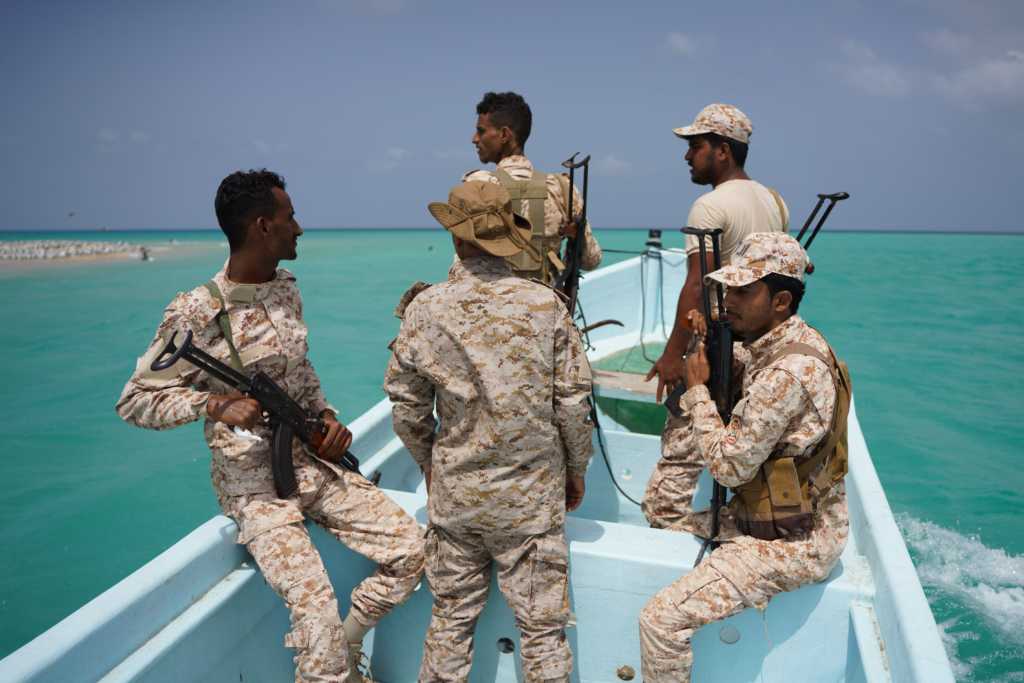
Houthi attacks on Saudi oil tankers and facilities have reignited tensions around Bab el-Mandeb. But the Iran-backed group is no longer the only threat to security in the Red Sea. Across the water, conflicts in the Horn of Africa are merging, fuelled by competing middle powers and increasingly threatening one of the world’s most important maritime corridors.
The timing could hardly be worse. The war between the US and Iran exposed the vulnerability of the Strait of Hormuz, renewing interest in alternative export routes. In April and May, Saudi Arabia exported between three and four million barrels of oil per day through the Red Sea, nearly double the volume shipped via the Bab el-Mandeb strait in 2024. Energy projects designed to bypass Hormuz, such as the expansion of the East-West pipeline across Saudi Arabia or Iraq’s proposed connection with Jordan’s Red Sea port of Aqaba, could increase the corridor’s importance even further.
The Houthis have shown how easily Bab el-Mandeb can be disrupted, but the danger no longer comes from Yemen alone. Sudan’s civil war is increasingly converging with the Ethiopia-Eritrea crisis. In northern Somalia, local disputes are becoming entangled with the Saudi-Emirati and Israeli-Turkish rivalries, potentially creating a new flashpoint in the Gulf of Aden. At the same time, piracy is resurging, increasingly aided by al-Shabab. Between April and May, Somali pirates hijacked three ships in the Gulf of Aden, including two oil tankers—more hijackings than in the previous five years combined.
The spread of low-cost drones means that both state and non-state actors can target this narrow maritime corridor cheaply. Although no group has yet fully replicated the Houthis’ tactics, the Islamic State in Somalia has carried out its first recorded drone strike in January, in Puntland, while reports suggest that al-Shabab has used drones for reconnaissance and propaganda.
Any major disruption to commercial and energy flows through Bab el-Mandeb would reverberate far beyond the region, with European energy importers and export-oriented economies particularly exposed. As the Red Sea becomes more important, the Horn of Africa matters more too.
When the Horn’s conflicts merge
The war between the Sudanese Armed Forces (SAF) and the Rapid Support Forces (RSF) in Sudan is not an isolated conflict. As it drives mass displacement and destabilises neighbours, it is also merging with the Ethiopia-Eritrea rivalry, raising the risk of a broader confrontation along the Red Sea.
Addis Ababa continues to seek sea access through Eritrea’s Red Sea port of Assab. Asmara, for its part, has strengthened ties with Tigrayan leaders and other anti-government groups inside Ethiopia. And their rivalry is increasingly spilling into Sudan. Reports indicate growing coordination between Tigrayan forces, the SAF and Eritrea in the east, while the RSF has allegedly received Ethiopian assistance in Sudan’s Blue Nile state. This new RSF front borders the areas of South Sudan where the government is trying to suppress a mounting insurgency among the Nuer, the country’s second largest ethnic group, potentially turning the vast tri-border area into a major conflict zone.
Any escalation between Ethiopia and Eritrea would likely draw in Sudanese factions and external powers, notably Egypt, which aligns closely with the SAF and Eritrea, and regards the Grand Ethiopian Renaissance Dam (located just across the border with Sudan) as a major security threat.
These tensions are amplified by competing Middle Eastern alignments: Egypt, Turkey and Saudi Arabia support the SAF and Eritrea, while the UAE, and to a lesser extent Israel, have ties with Ethiopia and the RSF, though officially denied. Such backing risks encouraging local actors to overestimate their capabilities and could trigger a wider regional confrontation threatening Red Sea security and navigation.
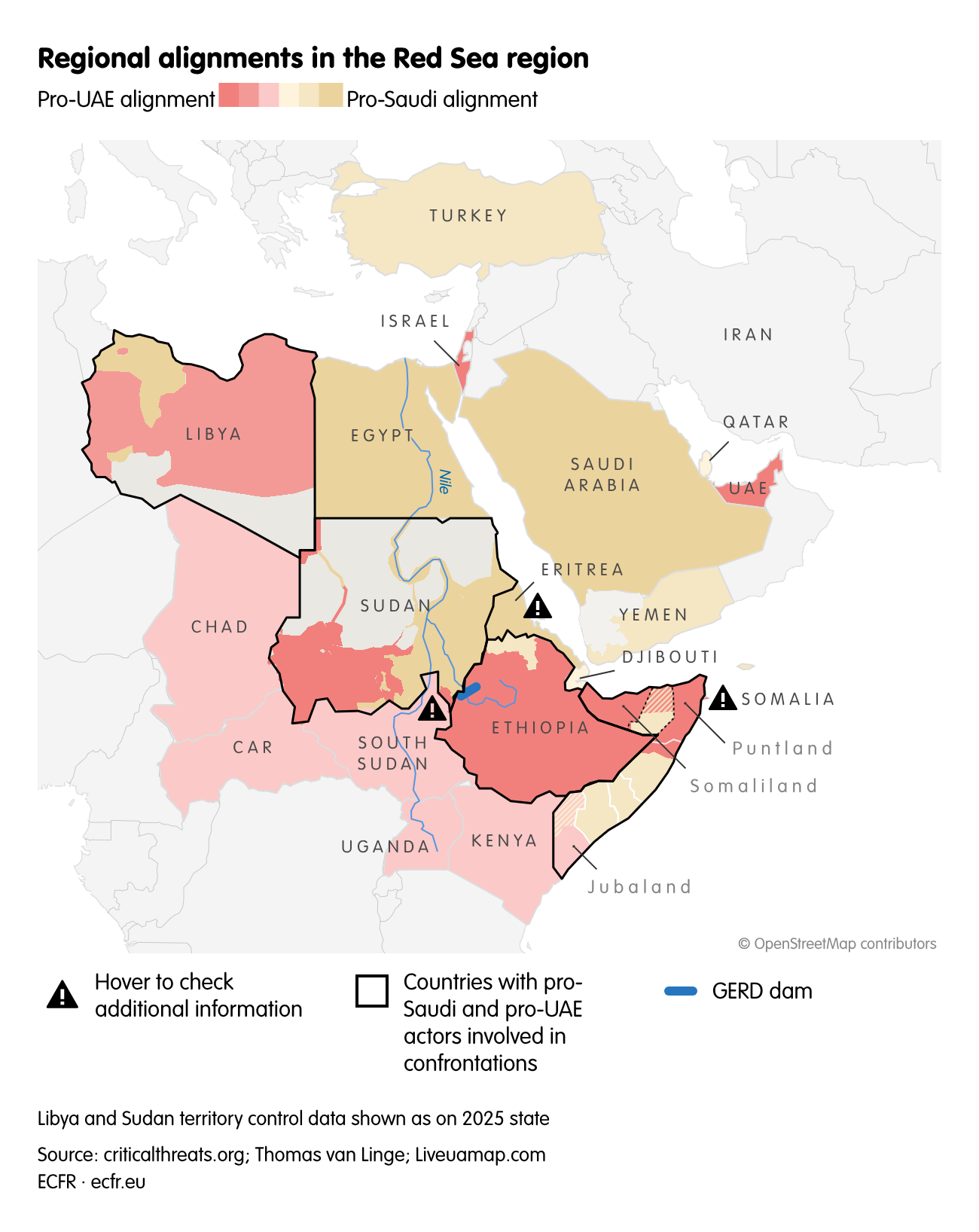
Somalia’s turbulent waters
Somalia could become the second major front in the Red Sea crisis. As in the Ethiopia-Eritrea-Sudan triangle, domestic feuds are becoming entangled with broader Middle Eastern rivalries.
In December 2025, Israel recognised the breakaway, UAE-backed republic of Somaliland. The two sides signed security agreements covering training and intelligence cooperation, and Israel could soon deploy asu limited military presence in the Emirati base in Berbera, which is reportedly under expansion. A visit to Israel in late June by Somaliland’s president Abdirahman Irro showed how quickly the relationship is deepening.
Mogadishu responded to the recognition by severing diplomatic and security ties with the UAE. It has since moved closer to Saudi Arabia and Qatar through defence agreements, while strengthening its longstanding partnership with Turkey. In January, Turkey deployed F-16 fighter jets to the Somali capital.
Amid its dispute with Mogadishu, Abu Dhabi has continued to support for Puntland and Jubaland,[1] two federal states that broke relations with the Somali government in 2024 in pursuit of greater autonomy. That support has become more consequential as Somalia enters another struggle over federal leadership.
In March 2026, President Hassan Sheikh Mohamud extended the mandates of both the presidency and parliament by one year beyond their May 15 expiration date. Opposition figures, including the leaders of Puntland and Jubaland, rejected the changes and demanded elections. After mediation failed, government forces and opposition-aligned groups clashed in Mogadishu on June 3rd and 4th, echoing the violence surrounding the 2020–2021 electoral process.
Although the federal government’s substantial deployment in the capital makes the forcible removal of the president unlikely, violence may intensify elsewhere.[2] The most concerning area lies in northern Somalia, where a local territorial dispute is increasingly drawing in external actors.
Since declaring independence in 1991, Somaliland has controlled most of this area, but its authority has long been contested in the eastern regions of Sool, Sanaag and Cayn by local clans and by neighbouring Puntland. These tensions erupted into conflict in 2023, when the pro-government Dhulbahante sub-clan defeated Somaliland forces. In the aftermath, Mogadishu then backed the creation of a new state, the North East State, covering territory claimed by both Somaliland and Puntland.
The main prize is Sanaag, located along the strategically important Gulf of Aden coast. Its sub-clans are divided in their loyalties among Somaliland, Puntland and Mogadishu, and a worsening drought is fuelling clashes over resources.[3] Such fractures offer tempting openings for outsiders.
Turkey reportedly plans to establish a presence in Lasqoray, Sanaag’s main coastal town, where both Turkish vessels and aircraft linked to the UAE have been spotted.[4] Meanwhile, Mogadishu is courting Puntland sub-clans and business elites dissatisfied with the state’s president, and has suggested that the army stands ready to deploy in Somaliland.[5]
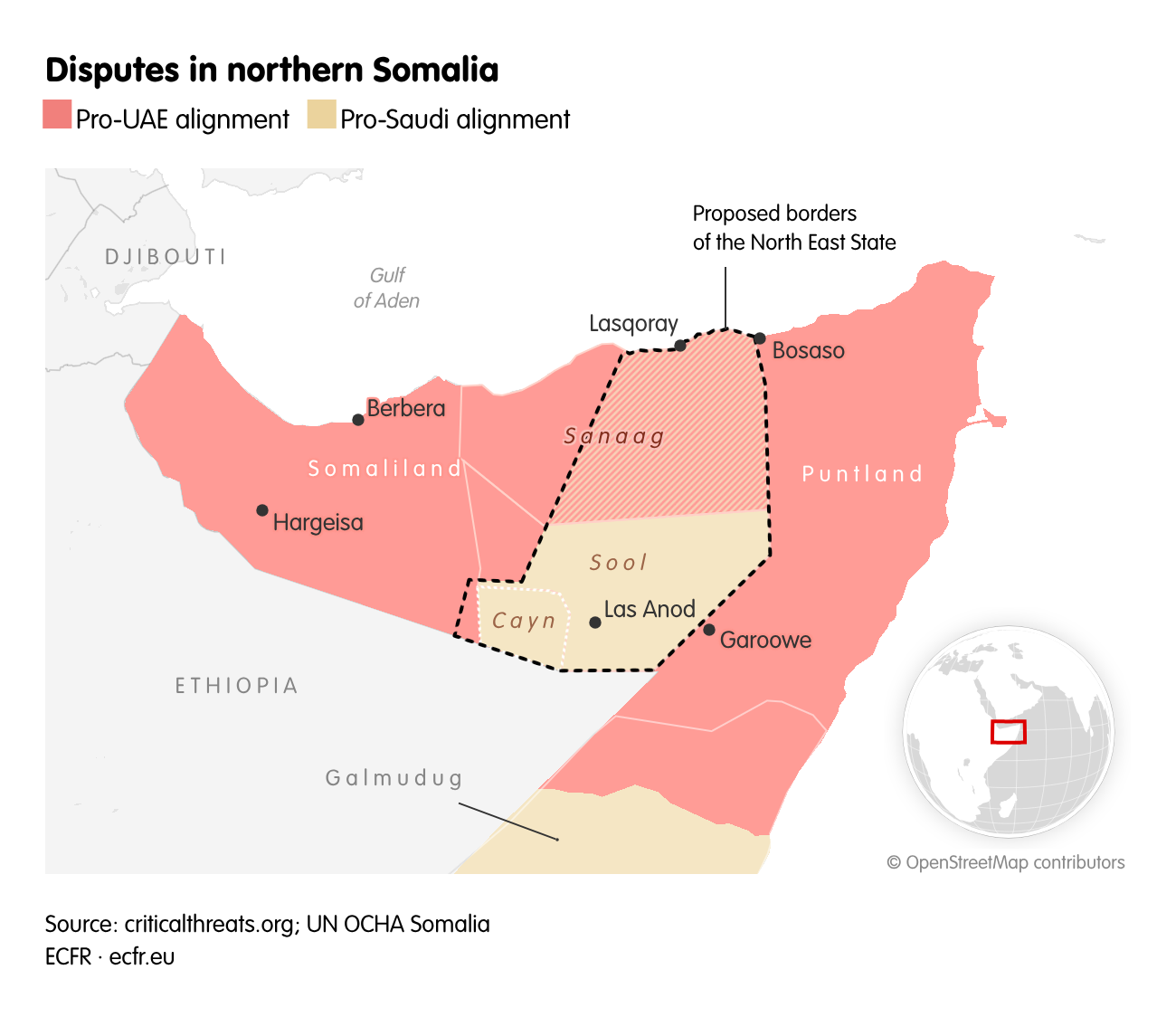
Northern Somalia is therefore becoming a battleground where local and national rifts collide with rivalries between Saudi Arabia and the UAE, and between Israel and Turkey.
Northern Somalia is therefore becoming a battleground where local and national rifts collide with rivalries between Saudi Arabia and the UAE, and between Israel and Turkey. Any serious escalation would pose a direct threat to the Gulf of Aden. It would also create opportunities for other groups: piracy networks, the Islamic State in Somalia and al-Shabab also operate in the area, with the two jihadist groups receiving smuggled weapons from the Houthis across the sea last year.
Message for Europe
Instability in the Horn of Africa creates new threats to Red Sea navigation, with direct consequences for European security and economic stability. Strained European economies cannot afford another disruption after Hormuz.
Europe must therefore abandon the widespread perception that it is primarily a provider of aid. Prevention must combine soft and hard power.
The EU already deploys two naval missions in the Horn of Africa’s seas: Aspides and Atalanta. But both were designed for a different threat environment. Atalanta was created to combat Somali piracy, while Aspides was established to protect shipping from Houthi attacks with a deliberately defensive mandate.
As maritime threats intensify, the EU should increase deployments and expand the mandates of both missions to include offensive operations, particularly against al-Shabab and the Islamic State in Somalia. This would strengthen anti-piracy efforts, increase pressure on destabilising actors and signal a more credible European security posture in the Red Sea. To ease fears of retaliation, Europeans should reassure regional states such as Saudi Arabia and Djibouti that the expanded mandate will not include offensive operations against the Houthis. Europeans should also seek a greater naval presence from Asian players with major stakes in Red Sea security, such as South Korea and Japan.
At the same time, the EU and its member states should engage more directly with northern Somali actors, including Somaliland and Puntland. A stronger European presence through security and development instruments would increase influence in this highly contested area, feeding into its de-escalation efforts. An expanded mandate for EU naval missions, for instance, could support Puntland’s and Somalia’s federal government operations against the Islamic State in Somalia and al-Shabab.
Greater engagement would also give Europe more leverage to encourage dialogue between the federal government, Somaliland and Puntland over disputed territories, and help push Somali political actors toward a resolution of the electoral standoff. In this regard, the EU must act transactionally to ensure that its 2026 funding packages, including €75m for the African Union peace mission and €63m for humanitarian aid, contribute to these stabilisation goals.
The EU should also coordinate closely with America and Britain, which in the past have led credible mediation efforts around the electoral standoff and security initiatives in the north, such as anti-IS operations. Similar coordination could support de-escalation efforts between Ethiopia and Eritrea, where Washington has recently engaged both sides.
Finally, engagement with Middle Eastern actors is unavoidable. The Horn of Africa’s instability is increasingly shaped by the competition between the two emerging blocs around Saudi Arabia, Egypt and Turkey on one side and the UAE and Israel on the other. The recent war with Iran has increased the value these states place on reliable international partners and regional stability. Europe should use this moment to press for restraint. The EU, Germany, France, Italy and Spain, in coordination with the UK and, where possible, the US, should make clear to Middle Eastern powers that any support to Ethiopia and Eritrea in the context of an all-out escalation would cross a red line and trigger immediate consequences on relations with them across the board. A similar approach should be adopted for northern Somalia.
Europeans can do far more to prevent the Horn of Africa’s conflicts from converging into a wider crisis. They cannot afford to wait until they become another maritime emergency.
[1] Author’s interview with Somalia security expert on May 21.
[2] Author’s interview with European diplomat on May 10.
[3] Author’s interview with Somalia security expert on May 21.
[4] Author’s interview with European diplomat on May 10.
[5] Author’s interview with Puntland-based civil society representative on May 12.
]]>In this episode, Jessica Hendrick welcomes Igor Bandović, director of the Belgrade Centre for Security Policy and head of the Belgrade Security Conference; and Luka Filipović, research associate at the Institute for Contemporary History in Belgrade working on the RE-ENGAGE project. Igor argues that Serbia is now in “authoritarian suspension”: the government still holds the machinery of power but is increasingly losing its ability to convince citizens that institutions work in the public interest. Luka points to an equally striking finding from the research—trust between citizens is strengthening even as trust in formal institutions falls.
Drawing on the student-led protests, the debate over snap elections and Serbia’s complicated relationships with Brussels, Moscow, Beijing and Washington, Jessica, Luka and Igor discuss whether a leaderless movement can turn civic mobilisation into political change, why the EU’s approach to Serbia has struggled to build democratic credibility, and how Belgrade’s strategy of “geopolitical shopping” is reshaping the country’s place between East and West.
Can Serbia’s protest movement convert public anger into lasting democratic change? Has Europe prioritised stability over democracy for too long? And how long can Belgrade continue balancing between competing powers before that strategy begins to break down?
Further reading:
RE-ENGAGE research on Serbia
RE-ENGAGE policy recommendations on Western Balkans
This podcast was recorded on July 21st, 2026.
]]>Cobus explains why many young Africans increasingly associate China with modernity, technological progress and economic opportunity, while Loubna posits that, in the Middle East, China is often viewed less as an aspirational model. Instead, China has become more of a counterweight to US influence—it is a relatively neutral actor and potential balancing force in the Middle East’s changing geopolitical landscape.
Together, Mark, Cobus and Loubna explore whether a new post-Western, rather than anti-Western, generation is emerging. They discuss the political consequences of China’s growing presence, the legacy of colonialism and the challenges of building intellectual and economic connections beyond traditional Western frameworks.
How is China changing ideas of development across Africa? Why does it occupy such a different place in the Middle Eastern political imagination? Can South-South partnerships create new pathways for growth and influence? And what do these changes mean for Europe’s relationships throughout the world?
This podcast episode was recorded on July 10th 2026.
Bookshelf
How China Escaped the Poverty Trap by Yuen Yuen Ang
Fire in Every Direction by Tarek Baconi
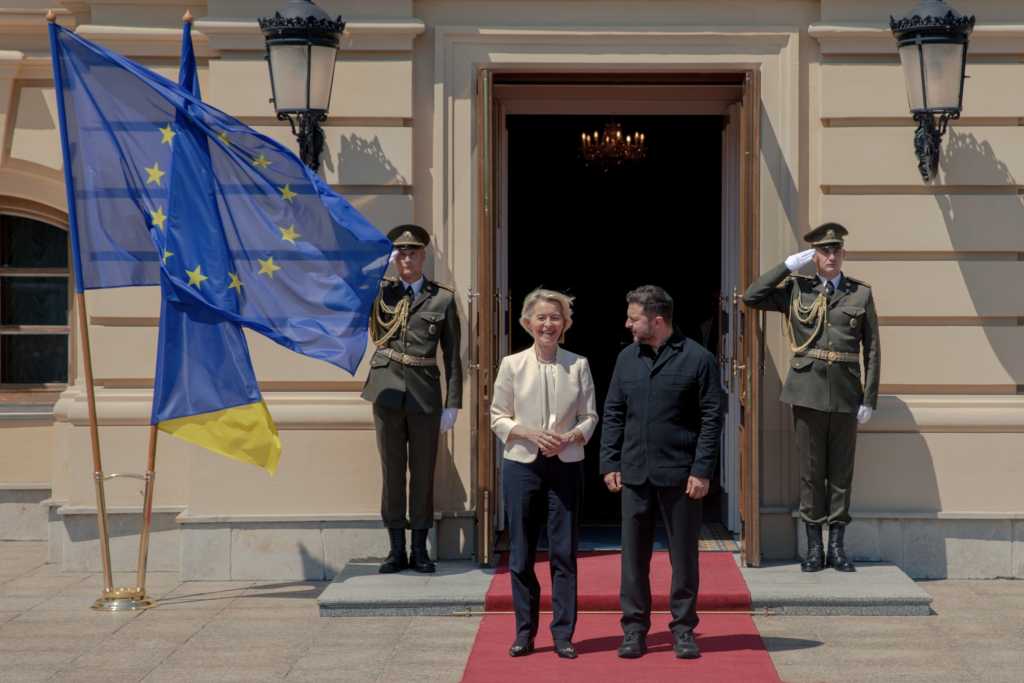
Summary
- The prospect of a peace settlement in Ukraine has prompted a flurry of activity among the EU and member states on how to carry out enlargement.
- For now, the debate is contained among elites. But this will need to change.
- Key “clusters” of member states can begin to address this. They should work together to create a new approach to enlargement and tailor messages to voters.
- To drive an accession framework suitable to the geopolitical and domestic challenges of today, a “Team Enlargement” coalition of ten key EU states should come together.
- This coalition, led by Germany, should work through a four-step timetable to deliver this strategy over the next 18 months.
- The coalition should also promote a narrative that is flexible enough to reflect national and local contexts while sharing the benefits of enlargement for European security and prosperity.
Time to move
The EU lacks a strategy to get Ukraine quickly and safely through the door.
The question has surged to the fore because EU membership is highly likely to be essential to any peace settlement that Kyiv—and the Ukrainian people—would accept. America has also made clear it sees Ukrainian membership as an indispensable element of such a settlement. Ukraine itself is pushing to join as early as 2027.
But the EU and its member states are not ready. They have struggled for decades to absorb new members, and more recently failed to agree on how to bring in Ukraine, Moldova and others. In 2026, proposals have swirled around Brussels and member state capitals; and Berlin has shared a notable proposal that aims to answer the question of how to make accession happen.
It is time for the EU to move forward decisively. The geopolitical case for enlarging the EU to include Ukraine, Moldova and the Western Balkans has never been more compelling. Failing to integrate candidate countries bordering the bloc represents a growing vulnerability in economic, political and strategic terms. European leaders largely understand the geopolitical imperative for enlargement. Where they hesitate is over how to make it work in practice. They are faced with public scepticism, questions about the EU’s own preparedness, the rise of far-right parties as well as American transactionalism that undermines EU conditionality frameworks. Many are thus asking the same question: Can the EU successfully enlarge without overstretching itself?
This policy brief identifies the key challenges shaping the current enlargement debate within the EU. It acknowledges the array of competing enlargement models and explores the lack of alignment between the EU, its member states and candidate countries. The paper draws on the findings of more than 25 interviews conducted by the authors with officials and experts working on enlargement in Europe. Views and ideas shared in closed-door seminars and dinners in Berlin, Paris and Vienna also informed the paper, as did the expertise found in ECFR’s network of national offices across Europe.
Listening to policymakers, alongside studying public opinion data, enabled the authors to propose three distinct clusters of member states on enlargement. The “principled conditionalists”— Denmark, Germany and Sweden—support enlargement in principle but also provide its credibility backbone by insisting on rule of law safeguards and institutional reform. The “conditional sceptics”— Austria, France, Italy and the Netherlands—carry political weight but remain risk-averse, with their backing more subject to national concerns. The “security maximalists”—Lithuania and Poland—are driven less by unconditional enthusiasm than by an urgency rooted in their exposure to Russia. Hungary sits as an outlier that is nevertheless supportive of enlargement in the Western Balkans.
The clusters’ logics are not mutually exclusive, and a credible enlargement strategy will need to weave together narratives that appeal across many countries. On this basis, the paper offers solutions that are limited in number but potentially transformational if achieved. EU member states should agree a core, but sizable, Team Enlargement coalition to thrash out the issues. They must make a definitive proposal for a new enlargement framework, agree a timetable for 2026 and 2027, and work hand in hand with candidate countries to make the political case and allay fears about enlargement.
Member states have not yet converged around a single strategy. The moment to move is now; or enlargement may never happen.
Getting on the front foot
The EU debate over enlargement has entered a new, more dynamic phase. This is principally because discussions around an eventual peace settlement for Ukraine invariably presuppose EU membership for the country. This geopolitically driven situation led the European Commission to present member states with three options for enlargement at a dinner in Brussels in March this year. The options were:
- The status quo: continue the existing, merit-based accession process, with all its strengths and weaknesses.
- Enhanced gradual integration: a version of “gradual integration”—an established idea under which candidate countries would access specific EU policies and benefits progressively, but before they have completed full accession. The enhanced model would introduce new benefits and be linked to negotiation clusters.
- Phased integration: also known as “reverse enlargement”, under this model new members would be initially integrated into a small number of selected EU policies, with full rights and obligations extended to them over time. It would make Ukraine a political member before it fulfils all the criteria.
But the commission found little support for reverse enlargement in particular among member states; in the words of an EU official, “this presented the real unity of member states”.[1] Member state representatives pushed back hard against what they saw as the commission developing new proposals without engaging them first, and indeed on a model they felt to be undeliverable. Nonetheless, member states still seem willing to explore the contours of an enhanced gradual integration model.
Merz’s letter
Following the backlash, the commission asked countries for their own ideas.[2] Small groupings of member states set about drawing up proposals.
One idea, initiated by Austria, came from the informal group of EU member states known as the Friends of Western Balkans. France and Germany each shared plans for Ukraine’s accession aiming mainly to develop the concept of gradual integration. France also floated “an integrated state status”, which it envisaged would be granted through a European Council decision to open all accession negotiations and provide access to EU funds available to third countries.
But the most influential proposal came in May when German chancellor Friedrich Merz sent a letter to European institutional leaders proposing associate membership for Ukraine. This would give Ukraine a presence in the European Council, European Commission and European Parliament, without voting rights but retaining the eventual aim of full membership. The proposal was unlike anything suggested for an accession country before. (Merz has also argued on several occasions that the EU cannot afford to frustrate the aspirations of Western Balkans countries.)
Among those most closely involved in planning for enlargement, the move was welcomed as a first step in the right direction.[3] Officials regard it as the most compelling proposal on the table, perhaps the only one with a realistic chance of building consensus.[4] It has yet to be developed into a full concept. But it has already ignited debate across Europe and could open the way to a feasible enlargement strategy.
Ahead of an EU summit with Western Balkans states held in Montenegro in June, France and Germany issued a joint proposal whose thrust was to simplify the joining process for Western Balkans countries and Moldova. At the European Council meeting in June, Germany pushed for a debate among member states on this idea and his Ukraine proposal. One major change in the first half of 2026 was the result of the Hungarian general election, after which Budapest lifted its veto over starting accession talks for Ukraine. The council duly agreed to open the first cluster on fundamentals for both Ukraine and Moldova.
Merz and Macron further institutionalised their joint proposal in their ministerial council meeting on July 17th, and emphasised enlargement’s contribution to building “a secure, prosperous and democratic Europe”. The two leaders further called on the EU to push for progress internal reforms and trailed an in-depth discussion at the October council meeting.
The politics of enlargement in an age of fragmentation
As they begin to peer over the precipice, domestic decision-makers know they need to create politically sustainable coalitions to see enlargement through.[5] To build a bridge to enlargement, they will have to tailor both policy design and political messaging to the concerns that dominate in member states. Security, rule of law safeguards, migration management, economic stability, identity and sovereignty concerns—all shape how enlargement is perceived and politically contested across the EU. But the next phase of EU enlargement will not be decided by technical accession criteria alone.
The enlargement debate has so far remained confined to policy circles. However, the lack of conversation with domestic audiences may leave fertile ground for populist and far-right narratives. Such narratives often frame enlargement and associated issues not as a strategic investment but as a source of risk: a driver of migration, a fiscal burden and a potential importer of instability. In particular, the prospect of Ukraine joining the EU is a potential flashpoint, with various forces—from Russian disinformation to European political players—portraying the country as a war risk, a reconstruction and economic liability and a governance challenge. This frames enlargement as something that will harm Europe and Europeans rather than something that will strengthen the EU and keep people safe.
Trump’s return to power, alongside the deepening political and ideological links between MAGA-aligned actors and European far-right parties, has given related movements in Europe a renewed sense of confidence and legitimacy. In candidate states, America’s transactionalism is eroding the very conditions candidate countries must meet to join the EU—even as Washington still expects Ukraine to become a member. In the Western Balkans, Washington has been actively undermining the EU’s rule of law conditionality by engaging with illiberal leaders, including lifting sanctions previously placed on them. Its focus on making money for American business has led to episodes such as the EU ambassador to Bosnia and Herzegovina warning that US antics were jeopardising the country’s EU accession process.
In this political environment, the fear of handing additional ammunition to populists, the spectre of divisive national referendums on future accessions, and the lingering trauma of dealing with Hungary deter decision-makers in EU capitals from openly engaging with the enlargement debate.[6]
Building a team
Enlargement can only succeed if the process, the chosen model and the accompanying politics all address the concerns outlined above. Member states remain divided over which model to adopt for acceding countries. But what commonalities could EU capitals converge around? What could give them a solid basis with which to go to their electorates?
To find out what plausible coalition could look like, the authors of this paper focused on the following ten EU members: France, Germany and the Netherlands (members that talk above all about the importance of merit-based accession and the rule of law); Austria and Italy (the driving forces in the existing Friends of Western Balkans group); Denmark, Poland, Lithuania and Sweden (which border Ukraine and the eastern neighbourhood and support the accession of Ukraine and other candidate states); and Hungary (an outlier, because it supports the integration of Western Balkans countries but long blocked Ukraine’s accession).
The authors then examined four key issues that could bring the ten member states together and enable consensus on enlargement. As noted, they drew on interviews with officials in Brussels and EU capitals, discussions with experts at different convenings and their own desk research.
Maintaining merit-based conditionality and adherence to the rule of law
The first of the four unifying issues is merit-based conditionality and the rule of law: they are the foundation of the enlargement process, and the one point on which none of the ten disagrees. European Council president António Costa and European Commission president Ursula von der Leyen reconfirmed the centrality of these issues at the most recent EU-Western Balkans summit. These principles are also firmly embedded in the 2020 revamped enlargement methodology. The “Fundamentals” cluster covers core EU values and principles, the rule of law, fundamental rights and the democratic functioning of institutions. This cluster is first to open in accession negotiations, but it is also the last to close. This is to ensure rule of law conditionality is applied throughout other clusters and chapters.
Denying access to membership funds before full accession
The second issue is driven by fears that new members’ financial demands will reduce the amount of cohesion funding existing member states receive. The common agricultural policy (CAP) is often the main focus of policymakers because of worries about Ukraine’s massive agricultural potential. Although the commission has suggested pre-accession allocated funds for Ukraine and other accession countries, its new proposal for the new multi-annual financial framework omits any suggestion of allocated funds for new members. Since the recommencement of Russian aggression in 2022, the commission has increased the amount of pre-accession funds for the Western Balkans, Moldova and Ukraine. The growth plan for the Western Balkans aims to integrate countries into the single market and deepen EU-related reform.
Applying safeguards and reversibility
In June, Belgium, France, Germany, Luxembourg and the Netherlands suggested the accession treaties of new member states should include a new blueprint to support “sustained progress after enlargement”. The goal was to strengthen the rule of law but also to boost public support for the ratification of future accession treaties. The commission and member states are looking for ways to insulate the new enlargement framework from Orban-style regression in the rule of law and democratic practices after new members join. Aligning around this issue will reassure both policymakers and voters that the EU can enlarge without then being undermined from within.
Controlling migration
Migration is the top concern connected to enlargement according to the latest EU barometer on “Attitudes towards EU Enlargement”, at 40% (followed by corruption and organised crime at 39%, and the cost to European taxpayers at 37%). In Austria 47% of people express concern about uncontrolled migration arising from future enlargement, and the figures are similar in Denmark, France, Germany, Hungary, Italy, Lithuania, the Netherlands, Poland and Sweden. Although mobility concerns are driven more by Schengen arrangements and transition periods than by accession itself, this remains an under-communicated element of the accession debate. Parts of the accession process (Chapter 24, Justice and Home Affairs) are aimed at preventing migrants from transiting through candidate countries. Still, enlargement-sceptic countries refer to the issue of uncontrolled migration to slow-walk accession.
The only genuine common ground across all ten member states examined (including Hungary) is merit-based conditionality—it is the glue that holds this group together. No member state publicly opposes this; disagreement centres on what “merit” means in practice and how fast the bar can be cleared. What could keep the group divided is the tension between Ukraine becoming a member first, with Western Balkans states coming later (although a new enlargement approach open to all candidates could address this tension).
Three clusters on enlargement
The ten countries analysed can be clustered into three distinct groupings. Each has different primary drivers, domestic constraints and potential roles in building a coalition to drive enlargement.
ECFR polling shows that a big chunk of European voters are yet to make up their mind about enlargement in the current context. Space remains for opinions to change, either for or against enlargement. The following three clusters can help shape this trajectory. (The clusters are covered in more detail in the annex, including public opinion polling.)
Principled conditionalists, comprising Denmark, Germany and Sweden
These countries’ support for enlargement is genuine but calibrated by strong insistence on a merit-based approach, the rule of law and strict institutional quality. These member states provide credibility on governance standards without which an enlargement framework could appear to trade the rule of law and conditionality for geopolitical imperatives.
Conditional sceptics, comprising Austria, France, Italy and the Netherlands
These countries’ support for accession is real but determined through specific national concerns (decision-making safeguards for France, fiscal prudence for the Netherlands, migration for Italy and Austria). It is unlikely the members of this group will proactively champion enlargement in the near term. But they could come along as supporters of an initial framework for future members, especially if they can secure specific gains.
Security maximalists, comprising Lithuania and Poland
These countries’ support for enlargement is not entirely unconditional, but it is urgency-driven and anchored in these countries’ existential threat perception of Russia. Lithuania and Poland articulate the geopolitical urgency and the eastern European solidarity essential to any future enlargement framework.
The outlier, comprising Hungary
Prime minister Peter Magyar’s government will not obstruct Ukraine’s accession and financial support like his predecessor, Viktor Orban, did. Moreover, with Budapest no longer providing a convenient shield, some member states may increasingly have to reveal their own rather sceptical positions on enlargement.
Clusters and coalitions
| Cluster | Main fear | Main enlargement logic | Far-right pressure point | What can be sold politically | Preferred narrative | Coalition role |
| Principled conditionalists (Denmark, Germany, Sweden) | Institutional dysfunction, democratic backsliding | Enlargement with safeguards and credibility | “EU cannot manage itself”, nationalism, sovereignty politics | Rule of law, conditionality, reversibility, controlled enlargement | “Credible and responsible enlargement” | Provide legitimacy and governance credibility |
| Conditional sceptics (Austria France, Italy, the Netherlands) | Migration, economic disruption, fiscal burden | Enlargement only if politically manageable | Enlargement as chaos, unfair burden, instability, enlargement not desired by public | Economic safeguards, transition periods, migration management, practical gains evident to voters | “Managed enlargement with pragmatism and gains for the EU and its member states at its core” | Support enlargement if reassured |
| Security maximalists (Lithuania, Poland) | Russian aggression, geopolitical vacuum | Enlargement as security architecture | Anti-Brussels sovereignty politics, putting Ukraine above the needs of domestic audiences | Defence, resilience, strategic sovereignty, Ukraine as a security asset | “Security through enlargement” | Maintain urgency and momentum |
| Outlier (Hungary) | Domestic backlash | Transactional and domestically constrained | Anti-Ukraine narratives, anti-Brussels rhetoric | National-interest framing, gradual normalisation | “Protecting sovereignty within Europe” | Passive enabler in the best-case scenario |
The clusters were constructed by the authors on the basis of an assessment of interviews, public opinion data, the public positioning of the countries on EU enlargement and analysis of the narratives surrounding EU enlargement. They reflect recurring themes identified across EU enlargement debates, including salient domestic public concerns and sensitivities, as well as framings advanced by political parties. As such, they help identify narratives and measures (such as safeguards and transition periods) with the greatest potential to resonate with both governments and their electorates, foster support for enlargement and explain each cluster’s role within the coalition.
The review and the summarising table display the different logics of the clusters and the roles each would play in a broader coalition. Those logics and roles are not mutually exclusive. If balanced correctly, these can be used to devise a credible, watertight (to the extent this is possible) enlargement strategy that respects the urgency of the matter while bringing EU citizens on board. For example, a French government can confidently say it is insisting on rigorous merit-based standards while retaining its influence in EU decision-making. A Dutch government can say it is applying strict rule of law principles as well as fiscal prudence. An Austrian or an Italian government can say it has secured migration management as a precondition.
The coalition’s centre of gravity is situated between the urgency felt in Lithuania and Poland and the emphasis placed on conditionality in countries like France and the Netherlands. The credibility insisted on by Denmark, Germany and Sweden can enable them to build bridges among the different clusters. Austria and Italy could be brought along provided some of their wishes, such as controlled migration and economic security, are met. The politics of Hungary could always prove difficult but the opportunity now exists to move ahead.
How to make enlargement happen
Set up a “Team Enlargement” coalition
The ten member states examined here should form a “Team Enlargement” coalition. Its goals would be to agree the parameters of the next phase of accession and actively shape domestic discourse on enlargement.
Germany would be a key player because of its support for merit-based accession, exploration of new approaches, and express political commitment to accession countries. Merz’s May letter set Germany apart as the member state willing to lead on this major question facing the EU. The principles set out in the letter encapsulated almost completely the issues that divide—but could unite—Team Enlargement: its stipulation that associate membership is intended as an interim step towards full membership; its insistence that candidate states must fulfil the criteria to become a fully-fledged member; its denial of access to funds reserved for EU states until full membership is achieved; its enshrining of reversibility should the country show signs of regress.
A Team Enlargement coalition also aligns with evolving German policy more generally. In May 2026, the German federal foreign minister Johann Wadephul laid out six points on Germany’s role in Europe’s politics. The first point described forming coalitions of member states around topics where consensus cannot be found among all 27 EU member states.
Take four steps to lock in a durable enlargement strategy by 2027
Team Enlargement should take the following four steps to drive a new enlargement strategy.
Step one—Agree to develop the “Merz letter” into a full concept
Timeframe: From now until the October 2026 European Council meeting)
A German lead supported by the security maximalists and principled conditionalists should move forward and turn Merz’s letter into a fully developed enlargement concept. This would set out a framework of principles structured explicitly around the four key issues: merit-based conditionality, no access to certain funds before full membership, safeguards and reversibility, and migration. Next, Germany should circulate the concept to the remaining coalition members—conditional sceptics will have the ability to ensure it adequately addresses domestic concerns and is shaped with national sensitivities in mind, thereby strengthening its political viability. The concept would then be refined through iteration and broadened out to other supportive member states. Throughout, Germany should continually work with France as a co-shaper of the process. Meanwhile, discussions with Hungary would focus less on shaping the concept itself and more on mitigating potential veto risks and limiting future obstruction.
Step two—Share a new narrative on enlargement
Timeframe: From now until late 2026
Wherever they are starting from, each member state should recognise the inevitability—and potential urgency—of providing for Ukraine, and being seen to play their part in bringing about peace.
Member state governments would therefore be well advised to invest in domestic narrative work. This would include parliamentary debates, media and influencer outreach, civil society action, social media campaigns and expert analysis. But effective narrative preparation cannot be the responsibility of governments alone. The political sensitivity of enlargement means a whole-of-society approach is essential to ensure the conversation is credible and inclusive. Experts, academics and think-tanks can contribute evidence-based analysis that helps counter misinformation. Businesses and economic stakeholders would bring practical perspectives, highlighting opportunities for the economy. Civil society organisations can involve local communities, youth groups and underrepresented voices. Governments can share lessons learned and best practice among themselves, and especially so within the clusters.
On specific messaging, the principled conditionalists can lead and anchor the process in rule of law, safeguards and credibility. The conditional sceptics can demonstrate that enlargement can be managed in ways that protect economic stability and address public concerns. The security maximalists can set out the security rationale to their domestic audiences but also to the other coalition members. As such, rather than promoting a single rigid vision, a broad European narrative should allow member states to emphasise the aspects most relevant to their domestic realities.
Step three—Secure endorsement by the European Council
Timeframe: October and December 2026
The coalition would propose the new enlargement framework as a formal position in the General Affairs Council ahead of the October European Council meeting, with coalition members working to gain the support of other member states. Coalition clusters should draw on their respective strengths in this effort: principled conditionalists should underline the framework’s credibility; conditional sceptics should help reassure more cautious governments that concerns related to migration, fiscal impacts and economic disruption have been adequately addressed; security maximalists should make the strategic and geopolitical case for enlargement. Acting in concert, the coalition would aim to demonstrate the framework combines security and geopolitical imperatives with responsible governance and risk management.
At the October 2026 European Council meeting, EU member states should endorse the new enlargement proposal. The Irish presidency would be charged with using the December 2026 European Council to agree political conclusions that endorse the framework.
Step four—Put the new framework into practice
Timeframe: Throughout 2027
The EU would apply the framework to candidates Albania, Moldova, Montenegro and Ukraine to demonstrate its use as a functional governance instrument. In particular, Montenegro’s accession treaty will provide the first opportunity to put the new framework into practice. This would build confidence among sceptical EU member states that enlargement can be both strategically necessary and responsibly governed. The accession treaty could then act as a final membership contract for Montenegro as it joins.
Work more closely with candidate states
Candidate states have an important role to play in helping reduce anti-enlargement sentiment across the ten member states analysed in this paper. Beyond aligning with formal accession requirements, candidate countries will need to adapt to a far more politicised and fragile enlargement environment inside the EU itself.
This means the governments of candidate states must prepare to take seriously the fears surrounding enlargement in existing members. They must of course demonstrate a clear and sustained commitment to implementing EU reforms in full and swiftly, particularly regarding the rule of law, anti-corruption measures, democratic governance and institutional resilience. They should also demonstrate openness to discussing safeguards, transitional arrangements, migration management mechanisms and other tools. This can help reassure sceptical member states and voters that enlargement would remain controlled and manageable.
Crucially, candidate states need to pay close attention to the domestic political realities within member states. Political leaders in member states operate within politically constrained environments and contend with strong domestic pressure on issues such as migration, economic security and agriculture. In turn, EU member states should signal how domestic sensitivities may obstruct the path to accession. With this two-way communication in place, candidate countries should work with member states to identify ways to make enlargement more politically sustainable across different national contexts.
This could include candidate state representatives speaking directly with audiences in member states. Citizens’ dialogues, town hall discussions and public debates on issues that matter to local communities should become the hallmark of a sustained public communications and outreach campaign. Business roadshows, investment forums, study visits, cultural initiatives and exchange programmes for community leaders—all these activities can make candidate countries more familiar and relatable to EU citizens. These should take place across all parts of a country, not just in capital cities.
Conclusion
The approach suggested by this paper can help build a broad European narrative around enlargement: one that combines enhanced security with enlargement that is credible, responsible and managed. The purpose of such a narrative would be not to erase national differences or political sensitivities—having a single grand and rigid vision on enlargement could be counterproductive. But it will allow different member states to emphasise the aspects of enlargement most relevant to their domestic political realities while remaining part of a coherent collective strategy.
European leaders must be ready to promote and defend stories and visions for a better future. They should also do this sooner rather than later, given the calendar of elections in the coming years. The opportunity for a newly minted enlargement framework will shrink as the months pass—France’s 2027 electoral cycle will freeze discussions and decision-making around enlargement, as will elections in other member states during the second half of 2026 and 2027. The uncertainty around when a ceasefire might take place in Ukraine only increases the pressure on the EU and member states to prepare.
While none of the candidate countries (with the possible exception of Montenegro) is ready to join the EU today, now is precisely the moment for the EU and its member states to act. This means seeing through reforms via a credible and strictly conditional accession process. The other main challenge will be for the EU to prepare itself internally—its institutions, politics, and, crucially, its publics—for the moment when candidates are ready to join. This, too, will require a specific, and urgent strand of work which must take place in parallel to the work lead by Team Enlargement.
Annex
Today, enlargement politics are rooted in different political logics competing over what kind of enlargement Europe can politically sustain. As such, enlargement can only succeed if it addresses multiple forms of insecurity simultaneously among the clusters of countries identified in the paper. The clusters provide a way to understand the dynamics at play, the commonalities between countries and domestic drivers within them.
Principled conditionalists (Denmark, Germany and Sweden)
This cluster favours EU enlargement in principle and brings a backbone of credibility and legitimacy to the process. For the states in this cluster, safeguards within the enlargement process are crucial, as they dread new dysfunction within the EU, do not want a repetition of dealing with Hungary in the Orban years, stress the importance of the rule of law and have fiscal concerns.[7] This group worries about the EU falling apart if enlargement is not carried out correctly. As such, the principled conditionalists may not fear enlargement itself, but they do fear enlargement without control.
This generally positive stance is strongly reflected in public opinion—75% of people in Denmark, 49% in Germany and 79% in Sweden back EU enlargement. In all these countries, respondents identify “complicated decision-making at EU level” as their biggest concern about enlargement. Worries around corruption, organised crime, terrorism and costs to European taxpayers follow. Unsurprisingly, respondents stress upholding the rule of law, the fight against corruption and protecting fundamental rights as the elements crucial to the success of future enlargement.
Such topics are often found among the narratives of the far-right—that new members would bring corruption with them into the EU, make European cities less safe through uncontrolled migration and worsen the already-bureaucratic monster of EU decision-making. In this context, the principled conditionalists cluster could help take on the challenge contained in these attacks by supporting the credibility of enlargement policy. The commitment to enlargement shown by the members of this cluster means they can play an important role as the broker between geopolitical urgency and ensuring the credibility and feasibility of the enlargement process.
Conditional sceptics (Austria, France, Italy and the Netherlands)
The states within this cluster carry significant political weight but are (domestically) politically risk-averse towards enlargement. The governments of these countries worry that enlargement would not be politically survivable with their electorates. As such, their politics often revolve around issues such as domestic stability, migration, economic security, social cohesion and fiscal concerns. Top concerns among conditional sceptics for both governments and publics centre on economic security, the costs of enlargement and the financial burden created by admitting new members. In countries such as France and Italy, these are the practical worries that likely include fears of reduction of cohesion funds, destabilisation in the labour market and the impact of Ukraine’s membership on the CAP given its massive agricultural sector. All that being said, voters in these countries could be further persuaded in either direction: 45% of people in Austria, 43% in France, 53% in Italy and 69% in the Netherlands are in favour of further EU enlargement.
Voters in the countries in this cluster also have other worries: respondents in France and Italy note uncontrolled migration as their main concern. In Austria, the costs to European taxpayers, corruption, organised crime and terrorism, downward pressure on employment or wages, and uncontrolled migration are the main concerns.
The conditional sceptics are unlikely ever to become enlargement enthusiasts. But they could find ways to secure reassurance for themselves and their voters and refrain from blocking the process. They do not respond well to moralising and share many of the ideas and worries of the principled conditionalists—they have a pragmatic approach that emphasises practical gains, control, predictability and risk management. Addressing these should thus be core to any enlargement strategy.
Security maximalists (Lithuania and Poland)
In Lithuania and Poland, enlargement is looked on very favourably: 74% of people in Lithuania and 70% of people in Poland indicate their support. When asked about the biggest benefit of future enlargement, a “more secure EU and better defence against foreign influence” is the top choice among respondents in both countries. Alongside this, the countries of this cluster and their publics stress the necessity for a merit-based approach and emphasise the rule of law. Nevertheless, the sense of urgency is palpable, which may allow the security maximalists to be creative in the solutions for enlargement they would accept. This could include being open to interim solutions for candidate states.
In Lithuania especially, Ukraine’s accession is considered a key element in Europea’s security architecture. Poland’s position is also supportive, with the added nuance that this support is driven by Ukraine’s integration into the West (and especially into NATO) being a strategic necessity for Poland. Concerns around domestic agricultural competition, labour markets and historical memory issues can induce a somewhat more cautious outlook regarding Ukraine’s EU accession. This leads many in Poland to favour a gradual approach, complete with safeguards, transition periods and carve-outs.
The tension is evident both within the public but also between the oft-diverging views of the Polish government, presidency and other political power centres. Just recently, a leader of the nationalist far-right Confederation party argued Poland should block Ukrainian accession over historical disputes, including a military unit name controversy and Volhynia massacre exhumations. Such anti-Ukraine sentiment is also reflected in ECFR polling, which shows that the voters of the two far-right parties in Poland see Ukraine as primarily a “rival” or an “adversary”. (Similar sentiments are shared by supporters of the Freedom Party of Austria, Fidesz in Hungary and Alternative for Germany.)
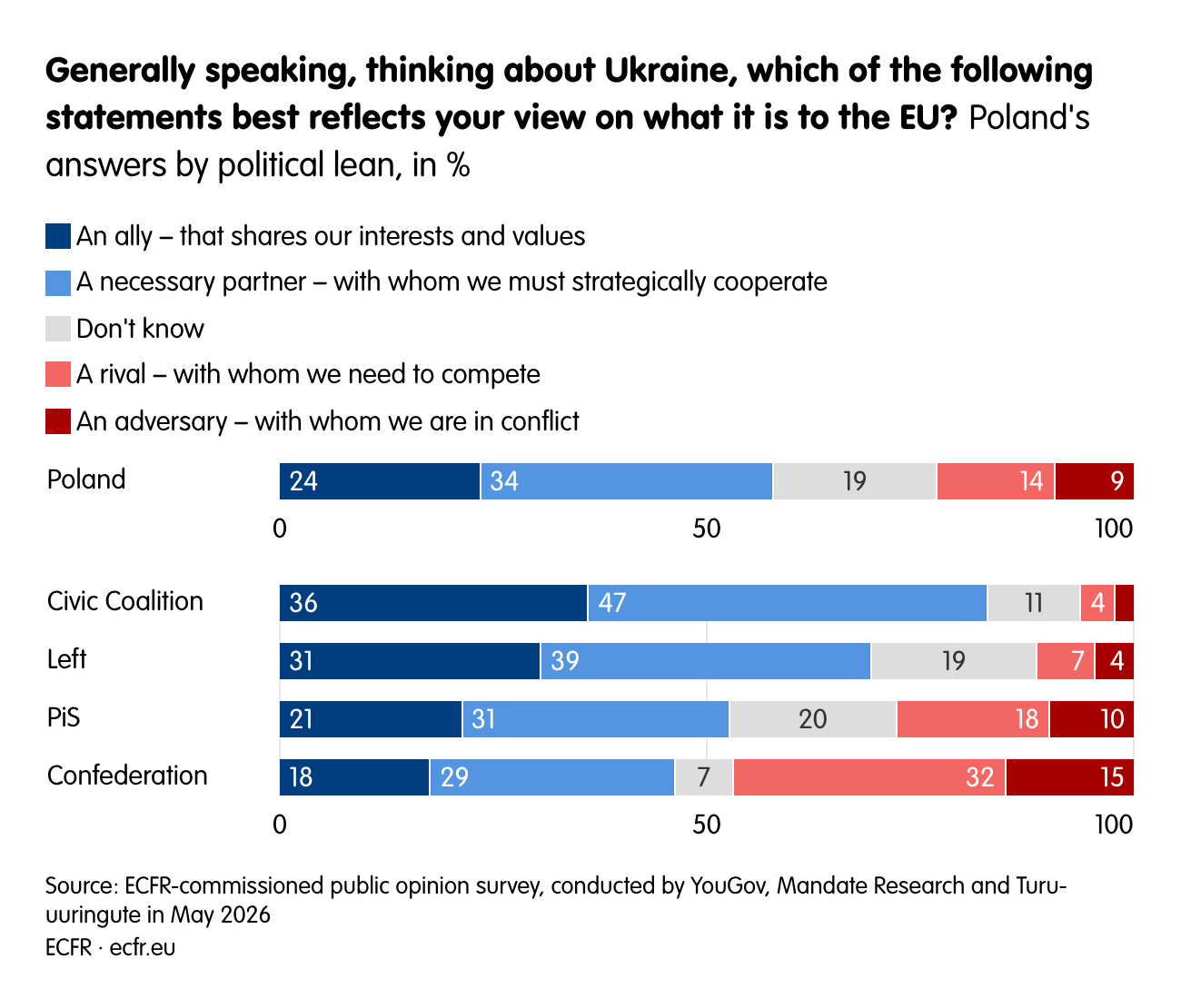
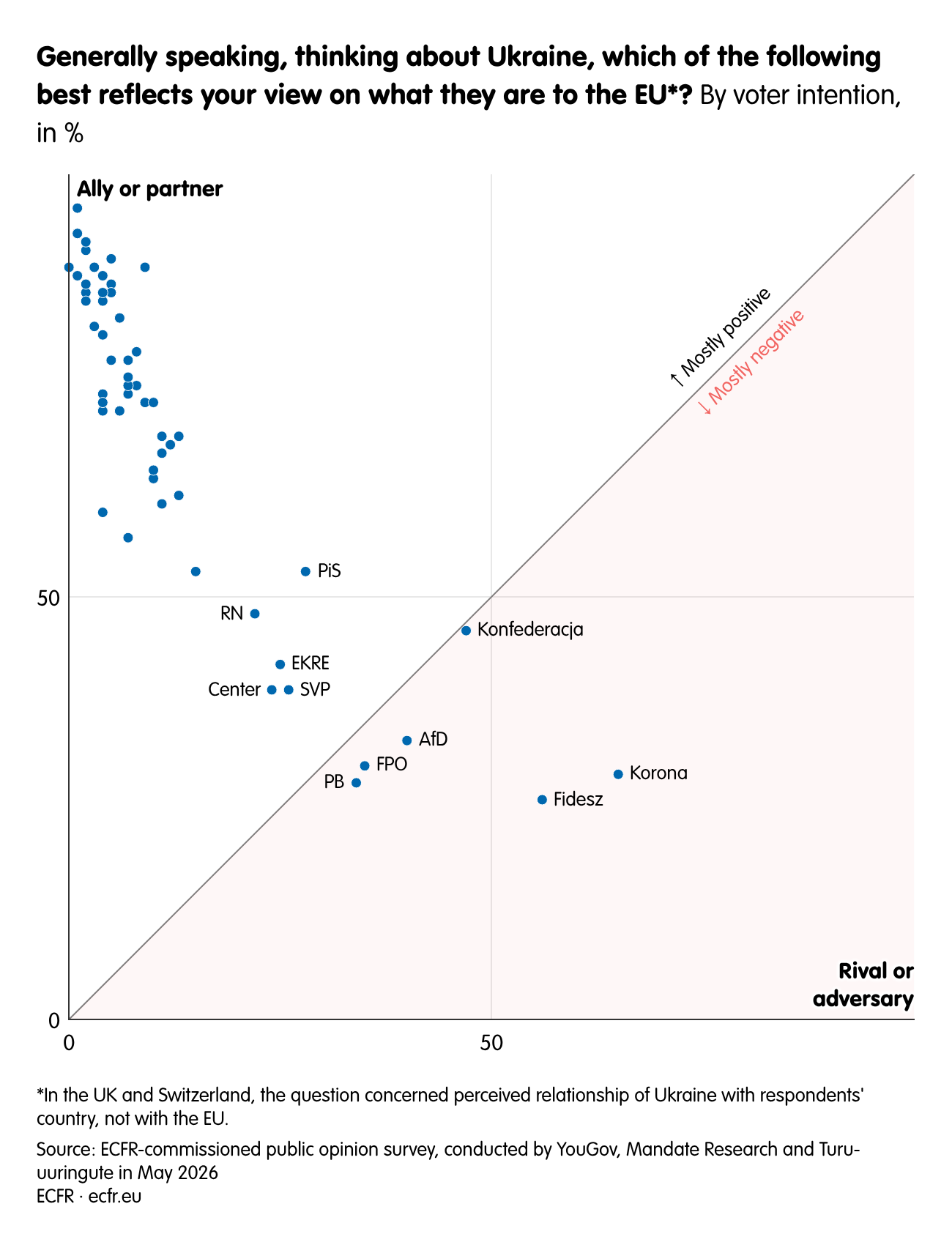
The security maximalists may lead on the geopolitical and security narrative of enlargement and present it as a crucial element of European security. Without the close involvement of this cluster, the whole process could slip into proceduralism or slowly disappear altogether. At the same time, this cluster can strongly relate to, and cooperate with, the principled conditionalists and conditional sceptics on the need to uphold the rule of law and obtain clear commitments to reforms from candidates.
Outlier (Hungary)
This year’s change of government in Hungary may well enable a reset between Budapest and Brussels on questions of enlargement. ECFR data reveal that the new prime minister’s mandate is not straightforward. While the new government aims to restore trust and ties with its European allies and partners, Magyar will be dealing with a society that expects domestic matters to come first. It is split on Ukraine following a decade of anti-Kyiv propaganda, with Fidesz voters being particularly opposed Ukraine’s accession bid moving forward.
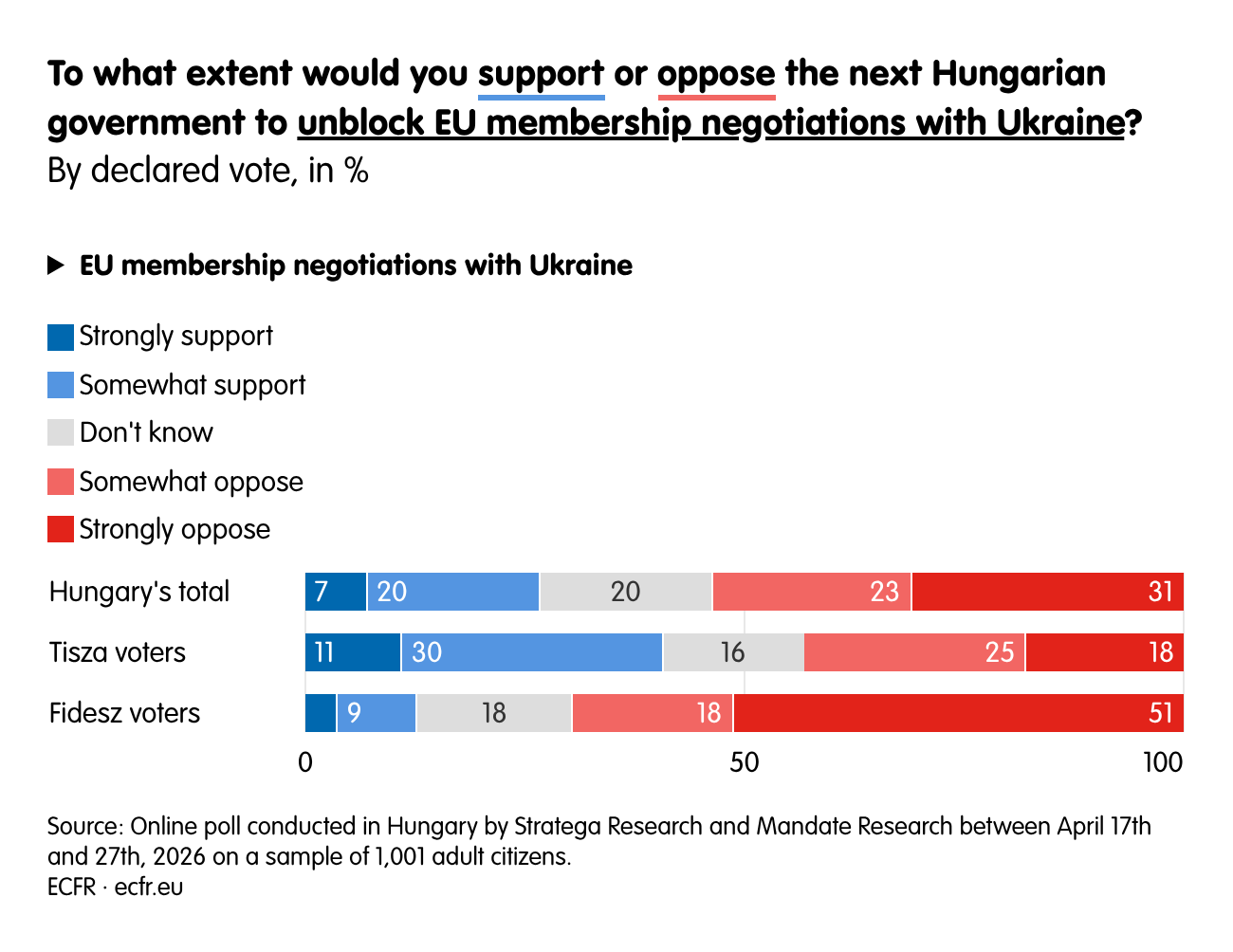
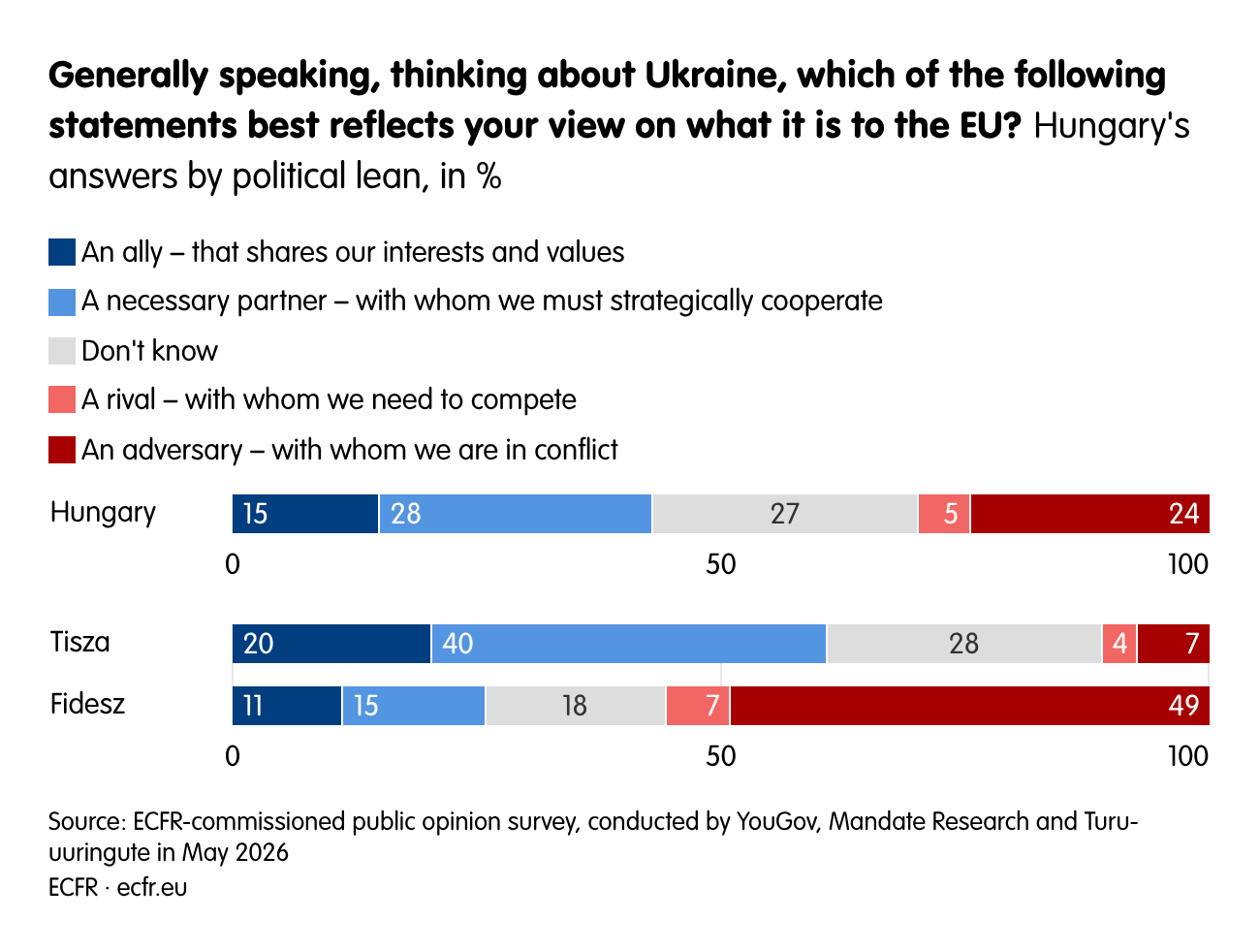
A total of 64% of Hungarians say they favour further EU enlargement, for mainly pragmatic reasons: being part of a larger, more innovative market, and gaining more opportunities for work and skilled labour. Causes for worry include corruption, organised crime and terrorism, along with increased vulnerability to security challenges.
Hungary is unlikely to seek creative solutions around EU enlargement, especially when it comes to Ukraine. Its government will have to navigate turbulent waters and needs time to change public perceptions. Nevertheless, there is good reason to believe Budapest will drop its previous role as blocker-in-chief on Ukrainian membership. Domestically, enlargement could gain more sustainable traction if the economic and pragmatic benefits of welcoming new members are tangibly showcased to citizens, in a similar vein to the challenge facing members of the conditional sceptics cluster.
About the authors
Engjellushe Morina is a senior policy fellow with the European Council on Foreign Relations’ European Security programme, based in Berlin. Her work mainly addresses the geopolitics of EU enlargement, Kosovo-Serbia relations and Euro-Atlantic integration.
Gabrielė Valodskaitė is the European Security programme coordinator at the European Council on Foreign Relations, based in Berlin.
Acknowledgments
We are deeply grateful to all the interviewees who generously shared their time, expertise and candid insights with us. Their perspectives were invaluable to this research.
We would also like to thank ECFR’s European Security programme team for their thoughtful feedback and support throughout the development of this paper. Their insights helped sharpen our analysis at every stage, and their patience in listening to our reflections, debates and occasional frustrations about the intricacies of enlargement was greatly appreciated.
Special thanks go to Adam Harrison for his sharp editing and for helping transform a collection of ideas into a coherent argument. We are also grateful to Nastassia Zenovich, whose talent for turning data into clear and compelling visualisations greatly enhanced this paper.
This paper was made possible with support from the ERSTE Foundation but does not necessarily represent the views of the ERSTE Foundation.

[1] ECFR closed-door high-level dinner, Berlin, May 2026.
[2] Author interviews with high-level EU officials, Brussels, March 2026.
[3] ECFR closed-door high-level dinner, Berlin, May 2026.
[4] ECFR closed-door high-level dinner, Berlin, May 2026.
[5] Author interview with officials, Paris, March 2026.
[6] Author interviews in Brussels, Paris and Berlin, March and April 2026.
[7] Author interviews in Brussels, March 2026, and Berlin, April-May 2026.
]]>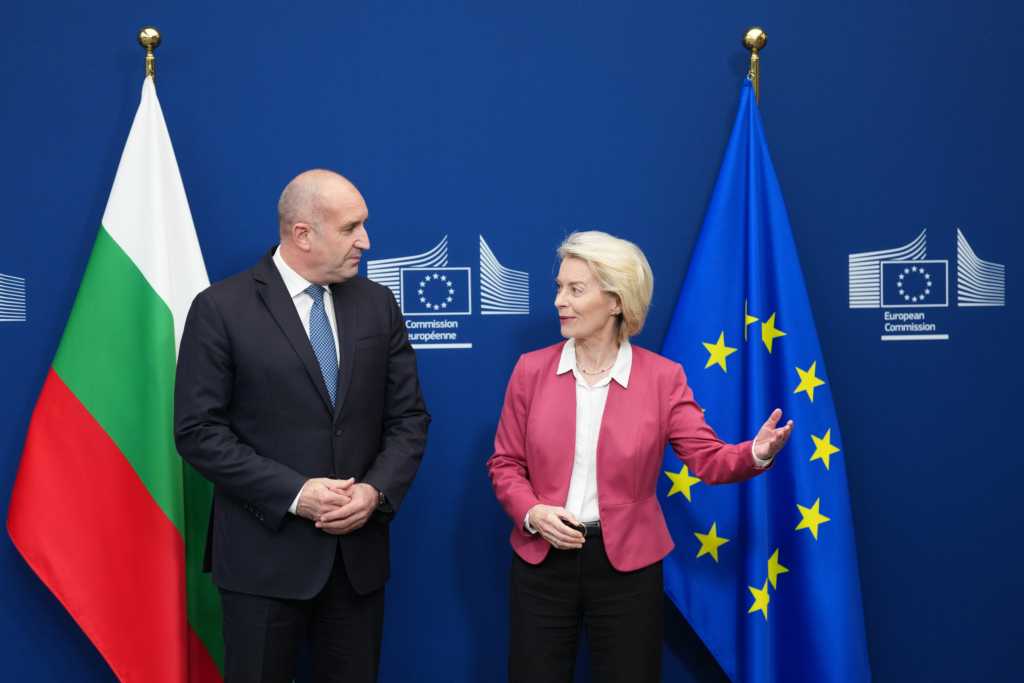
Problem
Bulgaria has agreed to host up to eight American refuelling tankers at its Bezmer military base to support US operations in the Middle East. The announcement came just days after prime minister Rumen Radev withdrew his country from the European coalition of the willing (CoW) for Ukraine, arguing that military support would only prolong the war and that Bulgaria lacks the resources to contribute.
Radev has put the final decision on Bezmer to a vote in Bulgaria’s parliament, allowing him to spread the political responsibility and limit direct ownership of the move. Now the prime minister can maintain his rather clumsy position: by rejecting military support for Ukraine (despite previous parliament votes) and justifying logistical support for American military operations elsewhere, he hopes to preserve US security guarantees without dedicating Bulgaria to Europe’s developing security architecture.
These decisions expose a growing inconsistency in Bulgaria’s strategic posture. Sofia is distancing itself from European efforts to strengthen Ukraine and is planning for its own defence, while simultaneously supporting Washington’s military operation in the Middle East. Rather than aligning with the broadly pro-European consensus and anti-American sentiments in Bulgarian society, Radev is attempting to balance competing security frameworks without sufficiently considering European security interests.
This ambiguity also presents a broader challenge for Europe. As the Trump administration continues to conduct foreign policy through bargaining, some European governments appear tempted to pursue bilateral arrangements with Washington rather than invest in European unity. Such behaviour risks weakening collective defence, precisely when strategic coordination is needed.
Solution
European security cannot rely on member states choosing cooperation only when politically convenient. The EU needs to engage more actively with the Bulgarian government and push back on Radev’s form of hedging while political conditions remain favourable, to help strengthen defence cooperation among the EU’s 27 member states.
The EU should also reinforce the political and practical incentives for participation in common defence initiatives, for example through its Multiannual Financial Framework (MFF) and other European defence instruments. At the same time, it needs to reduce opportunities for external powers—particularly China, Russia and the US —to exploit divisions, institutional weaknesses and the strategic ambiguity encouraged by MAGA. Bulgaria’s recent work to delist two Russian oligarchs and a Russian patriarch from the EU’s 21st sanctions package is an example of Russia’s growing leverage over the government in Sofia.
Overall, the EU should treat Bulgaria as an urgent political case rather than a lost cause. This is especially true given that, in 2027, Europe will see several major elections which have the potential to return governments that are more concerned with nationalism than European unity. This, in turn, would constrain the political space in which governments committed to a strong European foreign and security policy can act.
Context
Since taking office in May 2026, Radev has gradually shifted Bulgaria’s foreign policy away from alignment with its European partners. Bulgaria did not join the international agreement to establish the Special Tribunal for the Crime of Aggression against Ukraine, nor did Radev attend May’s B9 summit in Bucharest. Bulgaria’s decision to leave the CoW has attracted strong criticism from pro-European parties and raises broader questions about Bulgaria’s long-term strategic orientation.
The latest move in Bezmer follows the previous deployment of as many as 15 US tanker aircraft at Sofia Airport between February and June, which sparked political controversy. The government ended the deployment, which was linked to arrangements for (unsuccessful) discussions on Bulgaria’s inclusion in the US Visa Waiver Program, on June 30th.
Delays in military modernisation and uncertainty surrounding planned defence-industrial cooperation, including a Rheinmetall partnership, are compounding Sofia’s lack of clarity about whether it intends to become a consistent contributor to Europe’s security architecture. As it stands, Radev appears to be pursuing more transactional, case-by-case relationships with both Europe and the US.
]]>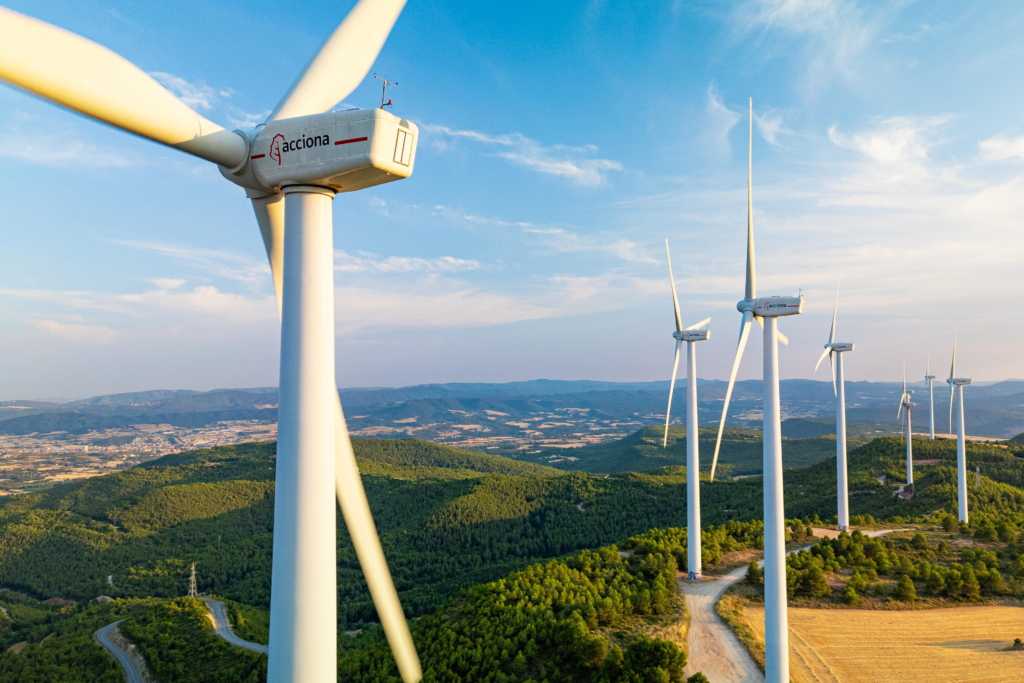
Problem
Industrial decarbonisation is not easy. While EU leadership in the field has brought some benefits—it was the first to offer innovative, low-carbon products to the global market, for example—there are also transition costs, especially in sectors such as steel and chemicals.
Now Russia’s full-scale war in Ukraine and the US-Israel-Iran conflict are pushing up energy prices; there is fierce competition from China and others for products such as chemicals, fertilisers and steel. At the same time, companies also face growing emission trading costs. Other parts of the world are not moving fast enough to reduce cost differences for European front-runner companies; the 2025 IEA Breakthrough Agenda report shows that global low-carbon industrial transitions are happening too slowly to achieve the targets of the Paris Agreement.
At the EU level, climate diplomacy is not sufficiently prioritising partnerships for industrial decarbonisation and instead focuses on general mitigation and financing issues. While the launch of the EU Task Force for International Carbon Pricing and Markets Diplomacy in 2024 was an important step, it did not address how Europeans can help develop the infrastructure, access to finance, intellectual property rights and personnel skills necessary for industrial decarbonisation.
The EU thus requires a stronger and more coherent diplomatic approach to industrial transformation. Most of all, it needs to focus on improving its outreach and expanding its offers on finance, market demand and innovation cooperation.
Solution
An informal meeting of environment and climate ministers (ENVI) is taking place on July 23rd-July 24th. It has two relevant items on the agenda: decarbonisation and competitiveness, and climate diplomacy. But these items are interconnected, and ministers should take an integrated approach when addressing them.
The EU should learn from the more active industrial policies of China, Japan and South Korea, which have the institutional capacity to make strategic choices about which technology to support, and have designed a good mix of policy instruments to promote them. Europeans should also look at how European coal regions, for example in Poland, have transitioned to create new green jobs. Such areas provide a blueprint for other countries trying to build public acceptance for closing mines and winding down fossil-dependent manufacturing.
The EU needs to devote more resources to international cooperation with partner countries on industrial transformation, for example by lowering the climate impact of steel and cement production. Such partnerships should be long term and include innovation cooperation for emerging clean technologies. Ministers should include industrial transformation diplomacy in the strategic roadmap document that underpins their discussions, and push for adequate funding in the next “Global Europe” instrument for development policy.
The EU must address the lack of coherence between EU and member state initiatives and promote a “Team Europe” approach. To meet the China challenge, even big member states such as Germany cannot build strong enough partnerships alone. But this requires a more cooperative culture; staffing for climate diplomacy in Brussels and at EU delegations should be increased to facilitate this.
Finally, ministers should engage more positively in the industrial decarbonisation agenda under the Paris Agreement. This could follow Brazil’s 2025 initiative to launch a process for accelerating low-carbon transformations of industry, and Turkey’s ambition to continue this work at COP31 in November 2026.
Context
The EU has set ambitious climate targets for 2030 and 2040, with the bloc aiming to become climate neutral by 2050. However, policy instruments are being hotly debated. For example, on July 17th the European Commission proposed weakening EU emission trading to accommodate industry while simultaneously strengthening its support mechanism for green transitions.
In parallel, EU environment ministers and their climate negotiators have started a process to improve climate diplomacy after what many saw as disappointing, weak language on reducing overall emissions at the 2025 COP30 in Belém. The process has so far focused on improving preparations for formal climate negotiations, such as the upcoming COP31 in Turkey—and less on broader partnerships around, for example, industrial decarbonisation.
]]>
Summer is here, and with it ECFR’s entertainment list. As the year passes its midpoint, with headlines dominated by uncertainty, crises and conflict, it’s time to take a break. And with the Annual Council Meeting 2026 held in Vienna, a city which provided one of the biggest intellectual movements of the 20th century, this year’s entertainment list could hardly be anything but enlightening.
This year, our contributors’ choices take us to the US—but far beyond the newspaper headlines—to learn about the country’s people, their fights and their struggles. With Russia’s war in Ukraine showing no sign of abating, another recommendation for a book about the difficulty to survive provides insights about real life on the ground. We’ll take a quick stop in Alexandria to learn more about books, libraries and the written world, and jump forward in time to England’s Tudor court and what it meant to be powerful. Then our journey takes us to Nigeria’s civil war, where we explore themes of identity, displacement, trauma, love and the enduring legacy of colonialism.
Enjoy all of this and much more with the recommendations below. ECFR wishes its readers pleasant journeys and a restful summer.
“Half of a Yellow Sun”, by Chimamanda Ngozi Adichie
Recommended by

“Half of a Yellow Sun” recounts the Nigerian Civil War (1967–1970), also known as the Biafran War, through the eyes of Ugwu, a village boy who comes to work for Odenigbo, a university professor. Alongside Odenigbo lives his partner, Olanna, who abandons her privileged life in Lagos to be with him; Olanna’s twin sister, Kainene, who takes over her parents’ business; and Kainene’s British lover, Richard. Through their intertwined lives, Adichie explores identity, displacement, trauma, love and the enduring legacy of colonialism with remarkable empathy, allowing the reader to immerse themselves in Nigerian and Biafran perspectives of the time. She creates deeply compelling characters who exist against the vivid backdrop of the social and political realities of 1960s Nigeria. By foregrounding voices that have long been marginalised in European narratives, Adichie demonstrates exceptional prose and storytelling.
“Beloved”, by Toni Morrison
Recommended by

“Beloved” is inspired by the true story of Margaret Garner, an African-American slave who in 1856 escapes to the free state of Ohio. The book tells the story of escaped slave Sethe, her daughter Denver and a mysterious woman named Beloved. It covers multiple topics, including slavery, identity crisis, discrimination, the condition of female slaves, trauma and madness; “Beloved” mixes history, fiction and the supernatural. Morrison won the Pulitzer Prize for Fiction in 1988 for her novel, and the Nobel Prize in 1993 for her work.
Ozark, available on Netflix
Recommended by
“Ozark”,an American crime thriller tv series with Jason Bateman, Julia Garner and Laura Linney (yes, the Laura Linney from Love Actually!) follows the story of the Byrde family, who move from Chicago to the Lake of the Ozarks region in Missouri. Family fights, strong women, weak men, strange people, plot twists, and beautiful and peaceful landscapes will keep you on the edge of your seat from beginning to end of this four season and 44-episode show.
“My Life on the Road”, by Gloria Steinem
Recommended by

“My Life on the Road”, by Gloria Steinem, is a splendid biography of the author’s life as a writer, reporter and activist. This book is a compilation of the stories she learned on the road while growing up—and afterwards, throughout the rest of her life.
Here she describes her campaign trail: from Bobby Kennedy to Hillary Clinton, her early experience with social activism in India, of organising ground-up movements in the US and listening to people whose voices, ideas and values would inspire change and revolution. This book has some of everything: it is shocking, it is funny and it is inspiring.
“My Life on the Road” is a great book for anyone who wants to understand the people behind the headlines. As Steinem points out, focus on country capitals often overshadow the lives of ordinary people and paint a distorted picture of a country. But through her travels, she shows how the true character of a place is found on its streets and roads.
“The Odyssey”, attributed to Homer (translated by Emily Wilson)
Recommended by

With Christopher Nolan’s big-screen version of “Odyssey” hitting cinemas in mid-July, there is no better moment to revisit Emily Wilson’s translation, which deserves a place on any reading list. The story—a man’s 20-year journey home from war—is well known, but Wilson’s rendering lays bare the flaws in both its hero and his household. Odysseus, for all his cunning, loses all his men during his voyage back to Ithaca and, once home, dispatches every one of Penelope’s suitors in a scene of slaughter that is excessive and genuinely uncomfortable to read. His son Telemachus, meanwhile, spends much of the poem sulking, more petulant adolescent than budding king.
Wilson does not sand down these rough edges, nor does she soften the poem’s darker vocabulary: where earlier translators reached for “servants”, she writes “slaves”, restoring an uncomfortable truth that previous polite translations had smoothed away. The effect is a text that feels more modern and raw; with heroes who are flawed, and their misfortunes partly the result of their own natures. Those wanting more should turn to the film “The Return” (2024), Ralph Fiennes’s stripped-back 2024 take on Odysseus’s homecoming.
“Endling”, by Maria Reva
Recommended by

“Endling”, by Maria Reva, is a witty, powerful novel about three women whose lives intersect through Ukraine’s booming marriage industry. What begins as a search for a missing mother and a fight to protect a rare species soon becomes an unforgettable road trip across a country on the brink of Russia’s full-scale invasion. Blending dark humour with emotional depth, Reva explores gender, survival and resilience in a story that lingers long after the final page.
“Bundyville”, a podcast by NPR
Recommended by

Like most folk, I have an outsized love for my hometown community and, as a result, an exaggerated view of its historical importance. Thus, I believe that an armed standoff between a libertarian Mormon ranching family and the federal government outside of Las Vegas in 2014 was a precursor to the Trumpian years that followed—and thereby I recommend my favourite podcast.
Structured like a true-crime series, “Bundyville” follows the Bundy family of Bunkerville, Nevada, through interviews with people at the centre of their fight with the federal government over cattle-grazing rights. Compared to January 6th 2021 and the right-wing unrest that followed, the conflict looks almost quaint; but it reveals just how deep American distrust of the government runs, and how far people will go in the name of “freedom”.
“Salvage the Bones”, by Jesmyn Ward
Recommended by

If you’re looking for a light summer read, this is not it. “Salvage the Bones” begins like a coming-of-age novel as 14-year-old Esch discovers love, desire and her changing body, all during a long Mississippi summer. But she is also growing up in a world shaped by poverty, neglect and misogyny, where the consequences of her choices fall far more heavily on her than on the boys around her. Hurricane Katrina approaches, but it is only one of the many forces threatening her family. Over 12 days, the novel paints a devastating portrait of those living on the margins, abandoned by the systems meant to protect them. This novel describes the quiet resilience of people forced to survive with almost nothing. It is a powerful reminder that disasters are never equal, and that for some, the storm began long before Katrina made landfall.
“Papyrus: The Invention of Books in the Ancient World”, by Irene Vallejo
Recommended by

“Papyrus”, by Irene Vallejo, is a captivating journey through the history of books, libraries and the written word in the ancient world. From Egyptian papyrus scrolls and the legendary Library of Alexandria, to the rise of the codex, Vallejo traces how books shaped civilisations and preserved human knowledge. Blending history, mythology, literature and personal reflection, she introduces a vibrant cast of emperors, librarians, scholars, poets and rebels whose lives were intertwined with the power of words. Along the way, she explores enduring themes such as education, censorship, identity and cultural memory. Both scholarly and accessible, Papyrus is a celebration of humanity’s enduring love of stories and a tribute to the books that have carried ideas across centuries.
“The Automobile Club of Egypt”, by Alaa Al Aswany
Recommended by

Alaa Al Aswany’s “The Automobile Club of Egypt” is entertaining and easy to read: but it is above all a thought-provoking account of Cairo in the 1950s that blends history, politics, love and family drama. Through the lens of a corrupt British-run club, Al Aswany exposes the hypocrisy and class struggles of colonial Egypt. The novel’s multi-layered narrative follows a variety of characters—from the club’s elitist members to its marginalised Egyptian employees—each grappling with power, identity and resistance. The book explores themes of power, justice, loyalty and social change, while Al Aswany’s storytelling blends satire, social critique, sharp dialogue and vivid descriptions to make it the perfect summer read.
“Wolf Hall”, by Hilary Mantel
Recommended by

There’s a reason everybody likes the Tudors. The dynasty, which began with Henry VII becoming king in 1485 and ended with the death of Queen Elizabeth I in 1603, was so embedded in rivalry, passion and intrigue that it has long provided rich material for all manner of cultural outlets. But perhaps no one captured the emotion behind the machinations of the Tudor court quite like the late Hilary Mantel. “Wolf Hall” is the first in her trilogy of novels which imagine the consolidation of power and eventual fall from grace of Thomas Cromwell, the son of a blacksmith who rose from obscure beginnings to become one of Henry VIII’s most trusted advisers. While “Wolf Hall” is a hefty book, with the paperback clocking in at 672 pages, it is nothing less than a page-turner; the plot, with its twists and turns, is aided by Mantel’s gift for writing as if she were alongside Cromwell at court. For anyone who wants to remember why the Tudors remain so fascinating—or who is discovering their story for the first time—”Wolf Hall” is one of the best places to begin.
“Empire of Pain: The Secret History of the Sackler Dynasty”, by Patrick Radden Keefe
Recommended by

“Empire of Pain” is about three generations of the Sackler family. As the owners of the pharmaceutical company behind OxyContin, they are renowned for their philanthropy—but notorious for the role they have played in the US opioid crisis. This book is a gripping story about greed, impunity, justice and the importance of investigative journalism.
I also recommend, as an accompaniment, the book “Demon Copperhead” by Barbara Kingsolver. Where Keefe does not let the reader forget that his book is non-fiction, Kingsolver makes them feel the impact and human cost of the opioid crisis.
“The Power of the Powerless”, an essay by Václav Havel
Recommended by

Mark Carney’s speech at Davos brought renewed attention and relevance to Havel’s 1978 essay, in which he analyses how the communist regime in Czechoslovakia functioned and sustained itself for decades. In his essay, Havel describes dissidence as a form of opposition that brings together thinkers from conservative circles, liberals and radical leftists, with Havel serving as a central and unifying figure. The core of the movement—and its power—lies in its non-negotiable demand to live in truth and in the parallel society of dissidents who shared this worldview. This is exactly what Havel brings to today’s world of unorder: reject conformity and the ruthlessness dictated by others, stand for truth, and engage with those who share this bare-minimum vision and values.
]]>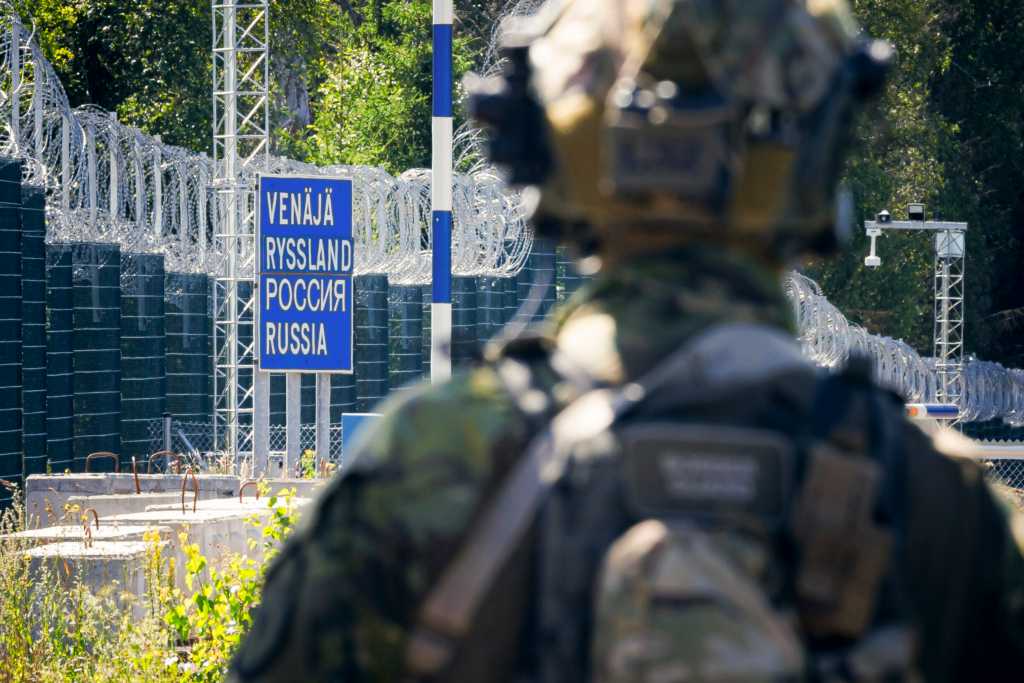
Summary
- The war in Ukraine will eventually end, but probably in a ceasefire that leaves Russia, Europe and America locked in open-ended, low-grade, chaotic confrontation.
- Europe has the greatest stake. It is closest to the conflict and would carry much of the cost should it escalate. America will still have an interest in maintaining stability, but other, more pressing priorities will likely come first.
- American and European policymakers should keep that confrontation stable enough to prevent it from tipping into another war. They should aim for a state of “managed disorder”, where rivalry continues but becomes less likely to escalate.
- They can achieve managed disorder through a staged framework that combines credible deterrence, compartmentalised cooperation and conditional, reversible incentives.
- To succeed, the framework will need to accommodate divisions between America and Europe, and within Europe itself. It will also need to give Ukraine, Russia, China and other players in the region clear incentives to comply with the framework, and clear costs for defecting from it.
After the ceasefire
It is 2028. The war in Ukraine ended in an uneasy ceasefire eighteen months ago. Russian forces remain in occupied territories, and Ukrainian forces hold defensive positions, armed with American weapons and European money. The ceasefire talks failed to establish either a buffer zone or an observer mission because the parties could not agree on the terms. Europeans have given vaguely formulated “security guarantees” with an ill-defined American backstop, but NATO has no clear presence near the contact line.
One morning, Ukrainian intelligence detects Russian armoured movements towards the ceasefire line. The government in Kyiv claims Russia is preparing for invasion; officials in Moscow insist it is routine repositioning. Within 48 hours, shooting starts and each side blames the other. Russian forces cross the ceasefire line at three points. Calls go out to European capitals and Washington, but no one agrees on what the intelligence shows. The security guarantors reach for the ceasefire documents and find they say different things depending on who is reading them.
Nobody knows what to do—whether NATO should respond militarily, whether European states should act alone, or whether America, focused since 2027 on a series of interventions in Latin America, should engage at all. Nobody has agreed what the rules are, what triggers intervention, what constitutes a proportionate response or who decides.
The outcome of this scenario is chaos and escalation driven by uncertainty and domestic political pressure. These are the conditions that precede catastrophic wars. The goal of this paper is to help prevent that scenario or, more precisely, to ensure clear answers exist before the shooting starts. The post-war environment in Europe will be unstable in the near term and perhaps for a generation or more because the war will almost certainly end without a genuine peace settlement that resolves key questions of sovereignty, security, power or identity. The wounds are too deep and the sides too evenly matched to agree on a comprehensive peace.
This is not an unusual situation after inconclusive wars. To adapt the historian Michael Howard’s insight, the end of fighting does not itself create peace. Between war and peace lies a large and dangerous space of armistices, frozen conflicts and unstable political settlements. The task for American and European policymakers will be to build enough structure around that dangerous space to prevent it from producing the next war.
America and Europe can do this by transitioning from chaotic confrontation with Russia to “managed disorder”: a state in which rivalry remains, but becomes less vulnerable to accident, panic and domestic political pressure.
To achieve this state of managed disorder, this paper proposes a staged framework built on verification, certification and conditional incentives. The framework would temporarily freeze facts on the ground, but not legitimise them, and give the main actors reason to adhere to agreements. This would help American and European policymakers maintain stability in Europe, defend Ukraine and deter further revisionism while reducing the risk of escalation. It would also give Russia a sense of safety and a seat at the table to discuss European security. Hostility would persist but it would be channelled into rules, limitations and predictable behaviour.
Managed disorder does not imply legitimising territorial conquest or rewarding aggression. It also falls well short of a durable settlement. Importantly, it does not require “trust”, a commodity that is generally lacking in international affairs and particularly in relations with Russia.
However, building such a system will be politically hard. Russia may prefer chaos to managed disorder. Ukraine may reject any arrangement that appears to freeze partition. European states will disagree over deterrence, sanctions, reconstruction, enlargement and engagement with Moscow, and the US may remain indispensable but unreliable. But these are not objections to managed disorder; they are the reasons it is needed. Its purpose is precisely to manage these political pressures through rules, incentives and procedures before a crisis makes improvisation the only option.
This paper traces the hard road to the modest achievement of managed disorder. It first outlines the sources of disorder after the war in Ukraine and why the key players might find managed disorder preferable to the alternatives. It then describes a staged plan to get from a ceasefire in Ukraine to a hopeful but realistic stability. The plan accepts that the future is contingent and will certainly surprise us. It therefore seeks to adapt to circumstances even as it keeps in mind where we want to go and what we want to avoid.
The sources of post-war disorder
The war in Ukraine is likely to leave relations between Russia, Europe and the United States in significant disorder. A ceasefire, armistice or exhausted pause in the fighting would stop large-scale violence but not settle the question of sovereignty over contested territories. Russian forces will probably remain on Ukrainian territory while Ukraine continues to assert its territorial integrity. Europe will still face a revisionist Russia on its borders and the United States will still have to decide how much of European security it intends to underwrite.
This state of affairs will be the first source of disorder. The ceasefire will probably not resolve any of the geopolitical ambiguity. It will also likely fail to clarify what counts as a violation or establish who monitors the ceasefire, who enforces it and who decides when one side has broken it. This is the central danger of the post-war moment. Although major combat may be absent, every movement of forces, artillery exchange, drone incident, act of sabotage and political crisis in Kyiv or Moscow could result in renewed escalation.
The second source of disorder lie within the West itself. America and Europe will not enter this period as a single strategic actor, even though they will retain important common interests—both will want to prevent a wider war, avoid nuclear escalation and stop Russia from conquering Ukraine outright. For the US, Russia will remain a nuclear power and a disruptive actor, but no longer the organising threat of American strategy. Washington will increasingly focus on China, the Western Hemisphere and the fiscal costs of global leadership. Europe will have no such luxury. Russia will stay a nearby military threat, and Ukraine’s reconstruction will become a European problem. Any failure of deterrence will unfold on Europe’s doorstep.
This divergence means that the Atlantic alliance will become less automatic, even if it does not collapse. The US may remain essential for nuclear deterrence, intelligence, sanctions enforcement and crisis diplomacy with Moscow, but it may also grow less willing to sustain Ukraine’s conventional defence, less patient with European divisions and more tempted by bilateral understandings with Russia that promise quick gains or theatrical success. Europe will fear both American abandonment and American freelancing. It will need Washington to work towards managed disorder, but will no longer be able to count on it to take the lead.
Europe will also generate disorder of its own. The war has produced a rhetorical consensus—Ukraine must survive and Europe must do more for its own defence—that hides deep disagreements. Poland, Sweden and other eastern and northern states will judge any post-war arrangement through the lens of deterrence, vulnerability and Russian deception. Spain, Italy and others will place more weight on stability, fiscal pressures and eventual economic normalisation with Russia. Some governments, such as those in the Baltics, will want to accelerate Ukraine’s integration into the EU and the European defence economy. Yet others, like Poland, will worry that Ukraine’s accession—and its agricultural exports, corruption, security needs—could transform the bloc in ways it cannot control.
These divisions will shape security policy and domestic debates. Russia will try to exploit them. Any post-war arrangement must therefore manage Europe as much as it manages Russia. It must prevent European disunity from becoming an instrument of Russian strategy.
Ukraine itself will form a further source of disorder. It will depend on American and European weapons and money for years after the fighting stops—creating leverage but also resentment. If Ukraine concludes that a post-war order locks in partition while offering only vague promises of future integration, it may resist the whole idea. If Europe concludes that Ukraine is using its support to pursue military aims that Europe cannot sustain, European commitment may fracture. This arrangement, therefore, cannot simply constrain Ukraine. It must give Ukraine a visible future: a defensible state, deepening European integration, reconstruction and a credible non-military path to eventual territorial restoration.
Russia will create the most obvious source of disorder, but not necessarily through renewed invasion. Moscow may accept a ceasefire because it believes time is on its side. It may calculate that Ukraine will become politically divided, that European publics will tire, that American attention will wander and that sanctions will erode. It may use the pause in fighting to rebuild forces, probe American and European resolve, influence European politics and normalise its gains—all while formally conceding nothing. A ceasefire may therefore mark not the end of Russian revisionism, but its movement into a different register.
American and European policymakers should not assume Russia fears disorder the way they do. Disorder may serve Russian purposes. Ambiguity can help Moscow test thresholds. For instance, hybrid operations impose costs on the West while preserving deniability. Political interference can weaken European unity without triggering a military response. For America and Europe, deterring a second invasion of Ukraine may well be the easier task; the harder one will be to curb Russia’s appetite for exploiting turbulence around Europe’s borders.
The post-war order will also face regional spillover. Ukraine will remain the epicentre of the confrontation with Russia, but Moldova, the Black Sea and the Arctic could face intensified coercion too. Africa and the Middle East may offer Russia opportunities to punish Europe indirectly through migration, mercenary activity, energy disruption or political leverage. A system that manages only the line of contact in Ukraine will not contain all of the disorder stemming from the conflict.
China will add another layer of complexity. Its economic weight can cushion Russia from Western pressure, but Beijing’s interest in stability also constrains Moscow’s options.
The final source of disorder will come from the absence of accepted leaders. During the cold war, the US claimed and largely exercised the role of Western leader. That world will not return. Europe cannot yet replace America: the EU cannot speak with the speed or unity of a state. NATO can deter, but it cannot resolve every political dispute a bad ceasefire creates. Individual European leaders may speak to officials in Moscow, Washington or Kyiv, but none can credibly represent the whole continent. In that vacuum, others will try to manage the disorder: private envoys, Gulf intermediaries, business figures, transactional American negotiators or ad hoc coalitions formed in crisis. Without rules, the system will fill with middlemen.
These sources of disorder will keep producing flashpoints that risk a return to war. Maintaining stability in post-conflict Europe will take conscious, active management. A comprehensive settlement to the Russia question remains out of reach for now, so the aim should be to prevent a bad and incomplete peace from decaying into a more dangerous confrontation.
The incentives that will shape a settlement
Managed disorder will hold together only as long as its incentives do. America and Europe, Ukraine, Russia, Turkey and China each bring different interests, so the system of managed disorder must align incompatible motives around a limited common interest: avoiding a return to uncontrolled war.
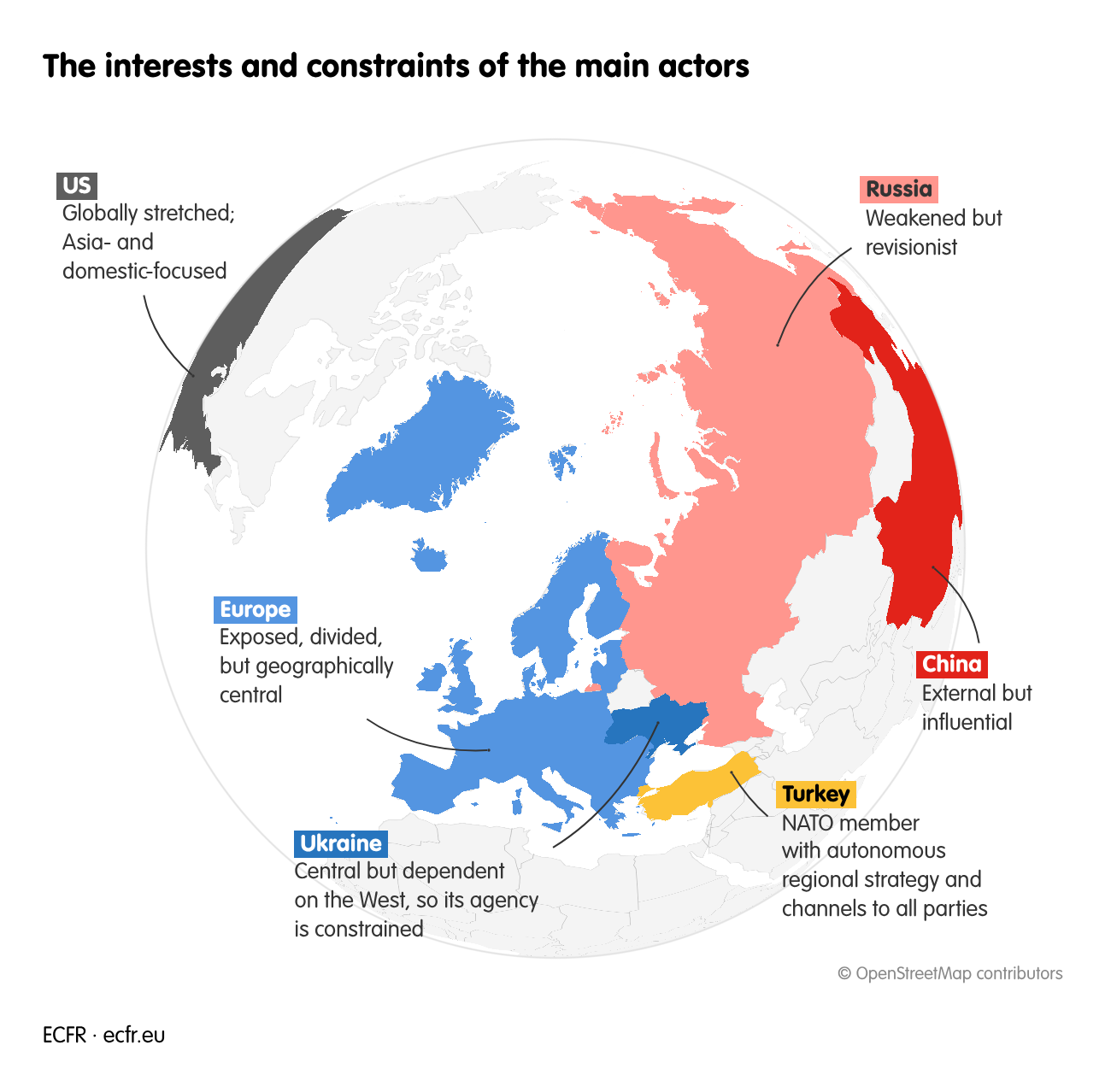
Ukraine is the hinge
Stabilising and strengthening Ukraine is the foundation of the entire system. For that, Ukraine must want to comply with it rather than be forced to because it needs American and European money and weapons to rebuild itself and deter Russia. The benefits need to be tangible and politically defensible at home. Therefore, in addition to sustained military aid, joint defence production and reconstruction funding, a stable system must offer Ukraine a path into the EU and a credible route to recovering lost territory without renewed fighting. Ukraine will not abide by the rules of managed disorder if it experiences it only as a restraint on its actions rather than as a route to a stronger Ukrainian state.
The main part of that route goes through EU membership. Europe should tie the pace of Ukraine’s accession—market access, regulatory alignment, reconstruction funding—to its conduct within this system. Cooperation opens the door; obstruction closes it. No Ukrainian government can afford to turn its back on a European future.
That pull is real, but it has limits. EU membership is economic and political; the bloc’s mutual-assistance clause, Article 42.7, carries none of NATO’s integrated command structure or binding defence commitments. However, Ukrainian officials under domestic pressure may present accession as delivering that protection anyway, leaving the public expecting a NATO-style military response that Article 42.7 was never built to provide. Any actual security guarantee will need its own separate instrument with defined triggers, scope and decision-making process.
In any case, Ukraine will benefit more from sustained American and European military aid, joint defence production and a homegrown arms industry than from any ambiguous or unenforceable security guarantee. The country will need artillery, air defence, drones and the factories to build them for decades to come. But offensive or long-range systems—capable of striking deep into Russian territory—should come from Western allies only if Russia attacks again, keeping the line between defending Ukraine and arming it for renewed war visible to Moscow and to sceptical Western publics.
Ukraine’s own expanding arms industry will blur that line. Washington and European capitals can condition their weapons transfers, but they cannot control what Ukraine builds. To manage disorder, therefore, they should tie reconstruction, defence-industrial cooperation and military assistance to rules about defensive posture and escalation.
The territorial question needs careful handling. A settlement must preserve Ukraine’s claim to the occupied lands—legally, politically and morally. Refusing to recognise Russia’s conquests should remain a core principle. But America and Europe must be honest too: Ukraine cannot retake its territory by force. Restoration will come through Ukrainian resilience, European integration, legal non-recognition, diplomacy and long-term shifts in the balance of power—not a bet on a better war later. Ukraine can keep hoping for its territory back without believing that another war is the way to get it.
Coalition dynamics will shape compliance with managed disorder too. Poland, Lithuania, Latvia and Estonia—Ukraine’s strongest backers—will have to be part of any difficult trade-offs. If these countries can support a compromise, Ukrainian leaders can argue that managed disorder strengthens Ukraine rather than abandons it, and western European governments can show that restraint does not mean appeasement. If they oppose it, critics in Kyiv and across Europe will portray the arrangement as a deal made over Ukraine’s head and at the expense of Europe’s most vulnerable states. In that case, neither Ukrainian nor European leaders could easily sell compliance at home.
In the end, Western policymakers must design Ukraine’s decision space, not just hope it will make the right decisions. They must show that cooperation delivers EU integration, reconstruction, military assistance, long-term deterrence and a path to restoring territory by weakening Russia over time—West Germany pulled off exactly that with the East, decades later. Obstruction delivers economic stagnation, dwindling aid, isolation and an indefinite war footing with nothing to show for it. The goal is to make cooperation the rational, defensible choice for any government in Kyiv.
Russia’s calculations
This paper does not assume that Moscow wants peace or even managed disorder. The only assumption is that a ceasefire would reveal some Russian interest in pausing large-scale war. The task is to exploit that pause to make restraint more attractive to Moscow than going back to war.
The logic is structured choice. Russia should know exactly what it gets for playing by the rules and what it loses for breaking them. If Russia complies, the rewards should be tangible—for instance, sanctions relief is immediate but reversible. If Russia violates the rules, the costs should be just as immediate—for example, suspended sanctions snap back automatically.
Military realities can reinforce this logic. The war has cost Russia dearly in soldiers, equipment, ammunition and political attention. Yet Russian weakness should not lull the US and Europe into assuming that Moscow’s appetite for aggression has diminished. Russia’s calculation will change only if Ukraine, armed by Europe, can defend itself. A second full-scale invasion would offer no easy win. Russia would confront a better-prepared Ukraine, a more fortified eastern flank and a Western sanctions system built to escalate rather than merely restore previous penalties.
Economic incentives can also matter, though they will not by themselves drive Russian policy. The Kremlin has shown it will sacrifice prosperity for war and ideology. But Russians value access to markets, targeted relief and the ability to travel, which shape interests inside the system, especially once the immediate demands of wartime mobilisation recede. Sanctions can thus create constituencies for restraint. Relief should remain selective, staged and reversible. It should reward observable behaviour, not political promises. And it should be designed so that renewed escalation hurts the specific people and networks that benefit from playing along.
None of this guarantees Russian cooperation. Moscow may still conclude that exploitable disorder serves it better than regulated confrontation, particularly if it can strike a bilateral understanding with Washington over Europe’s head. Western policymakers should therefore expect Russian violations and aim to narrow Russia’s room to exploit ambiguity.
Moscow does not need to like managed disorder to live with it. It only needs to face a world in which restraint brings some gains and cheating brings higher costs. Of course, the Russian government has not always responded to such incentives. No amount of pressure guarantees good behaviour. All any arrangement can do is make every alternative worse.
Turkey as a partner
Turkey belongs in this system because the Black Sea cannot be managed without it. Ankara controls access to the Black Sea through the Bosphorus and Dardanelles Straits, has direct interests in maritime security and commerce, and has maintained working channels with both Russia and Ukraine throughout the war. Any post-war arrangement that touches naval access, grain routes, energy transport, Russian warship movements, or the security of Ukraine’s southern coast will require Turkish participation. Ankara can either reinforce the framework or complicate it. Managed disorder should therefore treat Turkey as a necessary regional partner.
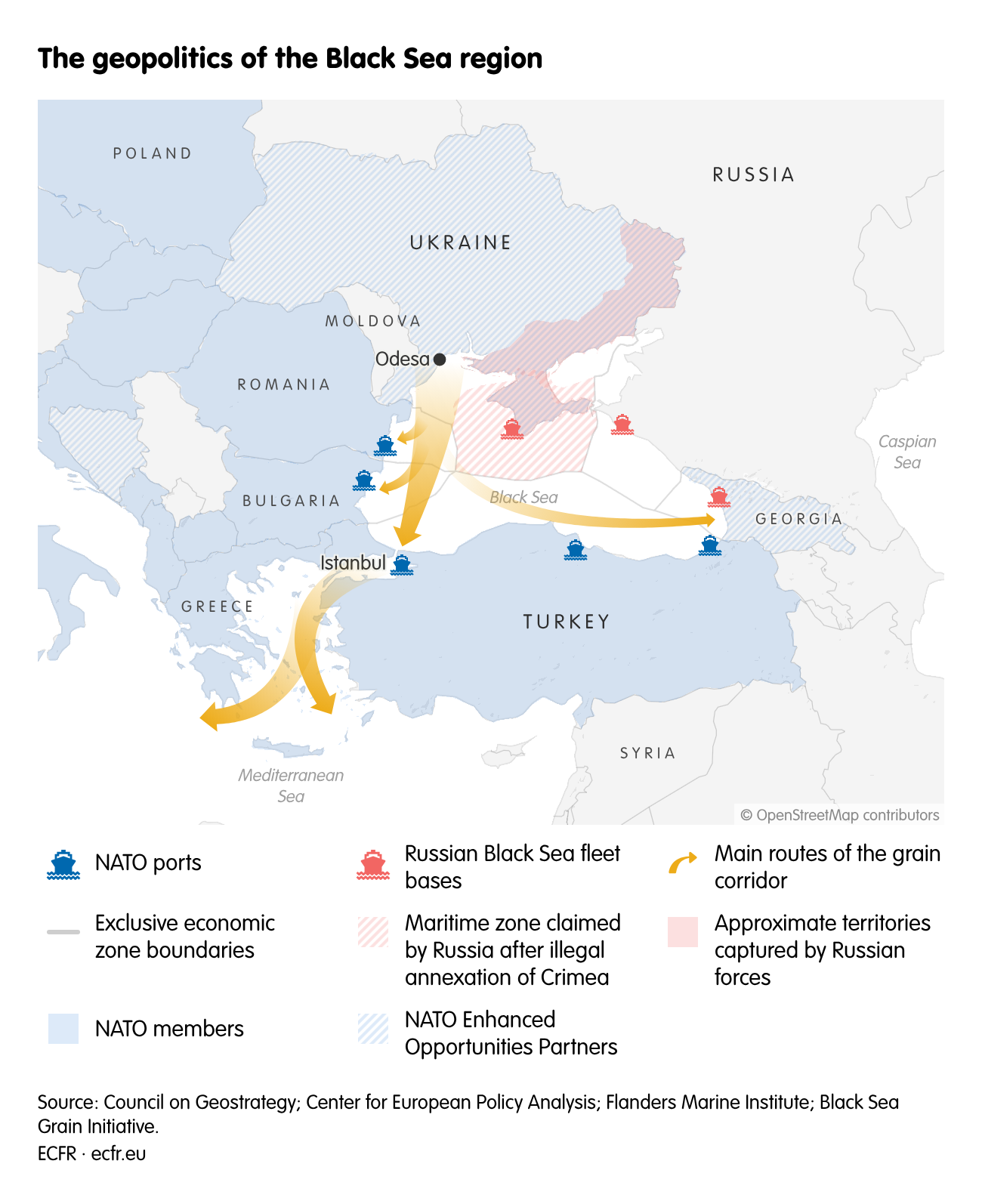
China in the background
The other major power shaping Russia’s future options is China. The two are not formal allies, but their partnership is more than a marriage of convenience. Russia needs China for markets, technology, diplomatic cover and long-term economic resilience. Moscow’s options depend as much on what Beijing will tolerate as on what Washington and European capitals will permit.
China need not endorse managed disorder for its interests to tacitly reinforce it. Beijing benefits from a stable Russia that checks American and European power, but not from a Russia that collapses or continually destabilises Europe. Endless war raises energy prices, invites secondary sanctions and risks escalation that could disrupt China’s own growth and global positioning. A structured post-war settlement that freezes borders, channels competition and conditions economic reintegration offers China predictability without forcing political alignment. If American and European sanctions tie relief to Russian conduct and penalises circumvention, Beijing may find it cheaper to let the system work than to help Russia rearm—provided the system leaves Russia viable as a geopolitical ally for China and a source of natural resources.
Economic interests pull in the same direction. Beijing values access to European markets and reconstruction opportunities in Ukraine. Western leaders should therefore make clear that stability unlocks better China-Europe economic ties, while a collapse of managed disorder would push Europe toward militarisation, protectionism and tighter technological coordination with the United States. China can benefit from this arrangement without choosing between Europe and Russia, so long as it prefers predictability and stability to escalation and sanctions spirals.
Managed disorder also needs a China clause. If Russia uses China to rearm and restock its munitions, the consequences cannot fall on Moscow alone. Europe should tighten its China policy, deepen coordination with America and target Chinese firms enabling violations with economic pressure. China must understand that helping Russia evade these rules costs Beijing more than it benefits it, while tolerating stability keeps the door to European markets open.
In this sense, China is neither an adversary nor an essential partner, but a structural constraint that can reinforce, undermine or passively enable whatever security order emerges in Europe. A system that links market access to stability, invites selective Chinese participation and penalises circumvention turns Beijing, intentionally or not, into a stakeholder in restraint.
The path to managed disorder
How the war in Ukraine ends will go a long way towards deciding the path to managed disorder. A fully disarmed or “neutralised” Ukraine is unacceptable to Kyiv and unsustainable for Europe. A permanently offensive Ukraine capable of striking deep into Russian territory would risk escalation and be unacceptable to Moscow. The same would be true if Ukraine were to host Western troops.
Between these poles lies the most workable model: a defensible, resilient Ukraine that is armed to deter, but not configured for offensive operations. This “steel porcupine” posture follows the same logic as cold war West Germany: strong enough to make conquest costly but not positioned as a launchpad for offensive war. It separates Ukraine’s legal and political claim to territorial restoration from the military means that could reignite the war, without conceding Russia’s territorial gains.
Europe is likely to bear long-term responsibility for Ukraine’s rebuilding, military assistance and eventual integration into European institutions. Even a supportive United States may commit fewer resources over time. A framework for managed disorder must ensure that Europe can sustain Ukrainian security on its own if America steps back, while leaving room for deeper US involvement should political conditions allow.
To reach that state, American and European policymakers will need to work amid mistrust, division and partial compliance. They must create a system in which Ukrainian restraint earns visible progress, and Russian violations bring consequences and compliance rewards. Importantly, they should also ensure European disagreement does not become paralysis and American involvement strengthens the system without owning it.
Designing around a divided West
Washington and European capitals share core interests yet diverge in priorities, attention and risk tolerance. The challenge will be to design a system that can operate with those differences built in.
America
A future American administration, whether populist or merely pragmatic, is likely to approach Russia as a file to manage rather than a sustained strategic priority beyond its nuclear dimension. To the extent it figures in US strategic calculations, Russia is more likely to be seen as part of America’s larger competition with China. Commitments to European security that once seemed permanent will depend on electoral cycles and budgetary politics.
That is why managed disorder should rely on European initiative and pre-agreed processes rather than sustained American focus: durability must be built into the mechanism itself, not assumed from Washington’s resolve.
Europe
European nations will see the landscape through a nearer lens. Russia is not a distant power but a neighbour capable of altering borders by force. European governments agree that Ukraine must survive yet disagree on what survival means: integrated or merely defended, heavily armed or cautiously defensible, anchored fully to Europe or held at strategic arm’s length. Populist and anti-migrant parties are often averse to sustained defence expenditure and will sometimes be open to friendly relations with Russia.
Given the European disagreements and the American focus on China, a genuine transatlantic consensus on a post-war order is unlikely to emerge. What is achievable and necessary is interoperability: a structure in which Europe and the US can act together when aligned and continue functioning when they are not. A framework to achieve managed disorder will therefore need to do two things. First, its stages, tracks and certification mechanisms should be designed to keep working whether or not Washington and European capitals are pulling in the same direction. Second, it should be designed for a permanently divided Europe. Its purpose should be to prevent disagreement from becoming paralysis.
That means creating a European core group: a few countries that can negotiate sanctions positions, military support thresholds, monitoring standards and responses to Russian violations before each crisis arrives. It should include the countries with the greatest military weight, financial capacity and geographic exposure—France, Germany, Poland and the UK, as well as the Nordic and Baltic states. The core group should drive the security logic; EU institutions should anchor the economic, sanctions, enlargement and legitimacy logic.
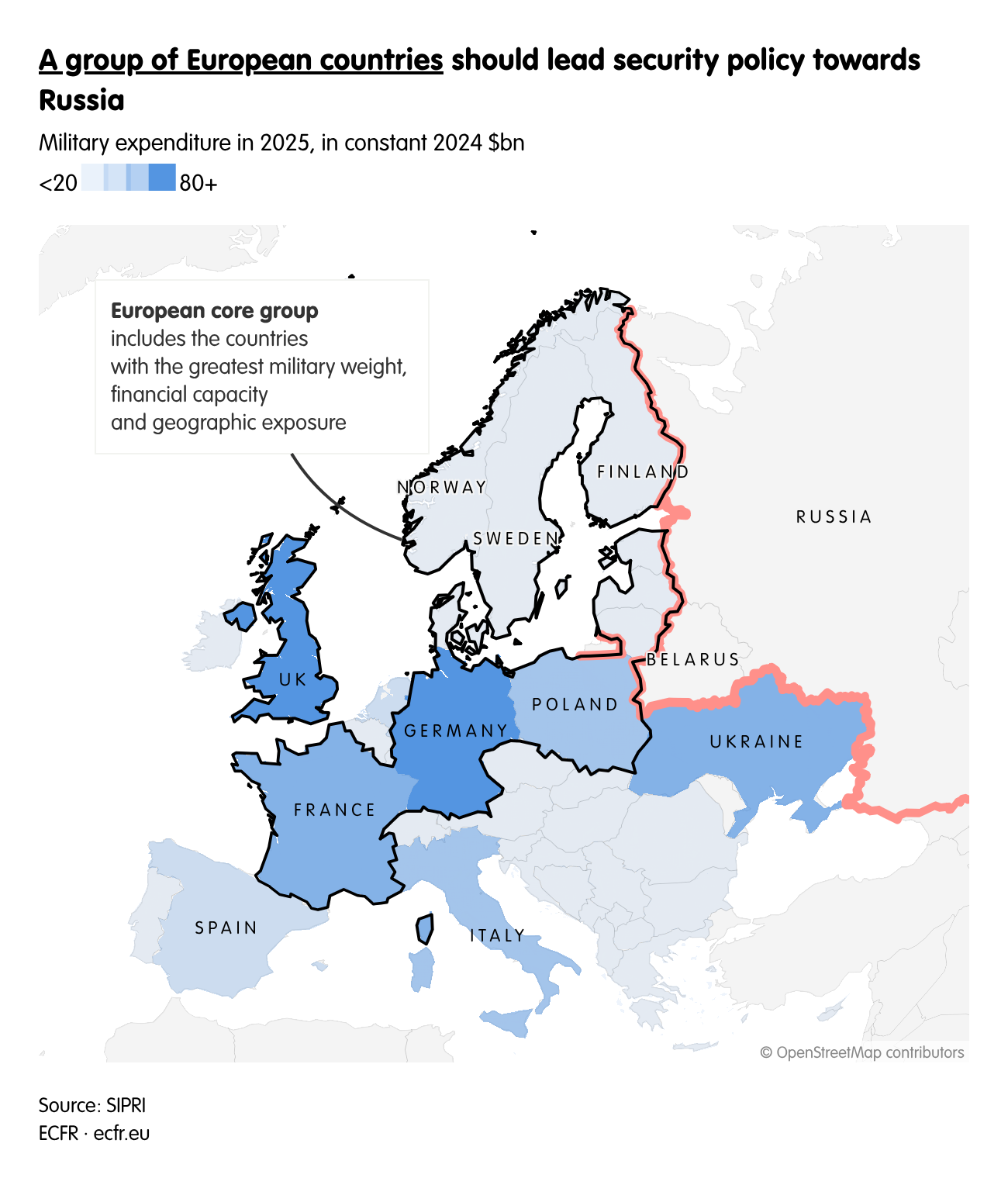
How to stop Russia from setting the security debate
Russia will seek to widen any post-war process beyond the line of contact in Ukraine. It will want to discuss NATO enlargement, American and Western European basing, missile deployments, military exercises, the Black Sea and the military balance along its western frontier. Europe and the US should expect these demands, but they should neither dismiss them reflexively nor accept them on Russia’s terms. Some issues do raise genuine risks of miscalculation between Russia and NATO. Large military exercises near borders, missile deployments, ambiguous troop movements, air and naval incidents, cyber operations against critical infrastructure and uncontrolled activity in the Black Sea can create crises regardless of the justice of the underlying political claims.
To stop Russia from setting the terms of the debate, European leaders should pursue two distinct negotiations. The first would revolve around the ceasefire and subsequent security arrangement in Ukraine, and must preserve Ukraine as a principal actor. The second concerns the wider Russia-Europe security environment and must prevent either Moscow or Washington from treating Europe as an object of negotiation. Russia will try to conflate the two tracks so that it can use NATO-Russia talks to extract constraints on Ukraine or claim that whatever Kyiv gives up, the West gave up too. European policymakers should resist this and keep the two discussions separate, though separation also has risks: if either track collapses, the other will suffer because both tracks are needed to ensure regional security. The first maintains immediate stability along the line of contact between Russia and Ukraine; the second tackles the wider geopolitics.
Russia will prefer to discuss regional security with America rather than with Europe. It will try to cast Europe as the object of negotiation, not a participant in it. If the American leadership is distracted by other priorities or tempted by bilateral deals with Moscow, it might even support that Russian position. The answer for Europe is to define the terms of engagement with Russia in advance, with frontline states fully involved and with clear limits on what can and cannot be negotiated.
To do that, Europeans need the core group to define common positions before the United States and Russia enter any serious dialogue. European leaders cannot prevent every American side channel with Moscow, but they can limit the damage by insisting in advance on the principles that should govern any regional security conversation. These might include no recognition of territorial conquest, no Russian veto over its neighbours’ alliance decisions, no limits on Ukraine’s sovereign choices and no economic relief without behavioural restraint.
This regional security agenda will make many European leaders uncomfortable. Frontline states will fear that any discussion of basing, exercises, missiles or notification requirements gives Moscow a path back to influence over their security. They have reason to worry. Russia has used previous security conversations to claim rights over its neighbours. It has, for example, consistently used the indivisible security clause of the 1999 Charter for European Security to assert that it has the right to deny its neighbours membership in Western security organisations such as NATO. Despite this record, to exclude regional security from the framework would leave Moscow free to raise it bilaterally with Washington or exploit it during crises.
Regional security therefore is one of the central tests of managed disorder. If the US and Europe refuse to discuss it at all, Russia will use the refusal to justify probing, escalating and direct talks with America over Europe’s head. If they discuss it on Moscow’s terms, it will legitimise coercion and weaken the states most exposed to its power. The only viable course lies between those failures: to create a framework that channels Russian security demands into reciprocal, verifiable and limited mechanisms.
A framework for managed disorder
Every actor has reason to tolerate managed disorder over the alternatives, but tolerance does not sustain itself; it has to be built into rules. Managed disorder therefore rests on at least three mutually reinforcing principles:
Separate where necessary: Europe should first reduce its exposure to Russia with stronger defences and less dependence on Russian energy. Ukraine should tie itself economically more closely to Europe and be able to hold its ground militarily. Effective deterrence is a precondition for any dialogue.
Compartmentalise where you can: Certain issues—nuclear risk, Arctic exploitation, climate change and counter-proliferation—are in everyone’s interest to manage together. Even Russia wants to avoid, say, nuclear war or environmental collapse. The parties should fence such issues off from more neuralgic ones, such as Ukrainian sovereignty, to prevent crises from cascading into areas of mutual benefit. Cooperation here is a limited and mutually beneficial transaction, not the embryo of a broader relationship.
Make engagement conditional: Russia should earn sanctions relief, diplomatic reintegration and economic access by meeting specific, verifiable benchmarks. These rewards should be reversible and calibrated, so that, for Russia, compliance pays and violations are costly. This system does not require faith—just working mechanisms.
Within these pillars, Europe can emphasise defensive resilience and sanctions, while America manages nuclear and global issues. Both are compatible with the same architecture, if properly sequenced.
The stages of managed disorder
Managed disorder will not arrive by some grand bargain. It must grow semi-organically from whatever unsatisfactory deal ends the Ukraine conflict. Progress will be uneven and contingent: each stage will require stability in the previous one and give Russia incentives to value restraint over escalation. Optimistically, it will take years to move from ceasefire management to durable rules, and probably a decade or more before habits, institutions and political constituencies for restraint begin to take root. The framework will thus also need to “fail well” in the sense that Ukraine and Europe need to be able to bounce back if there is a setback.
The sequencing below shows how war-termination mechanisms can become stabilisation tools, then arms-control practice, then institutions. This is deliberate. America and Europe should commit openly to this trajectory, making clear that progress depends on Russia sticking to core principles. Even so, however technical the criteria for moving from one stage to the next may look, all the parties will accept progress only if their domestic politics allow it.
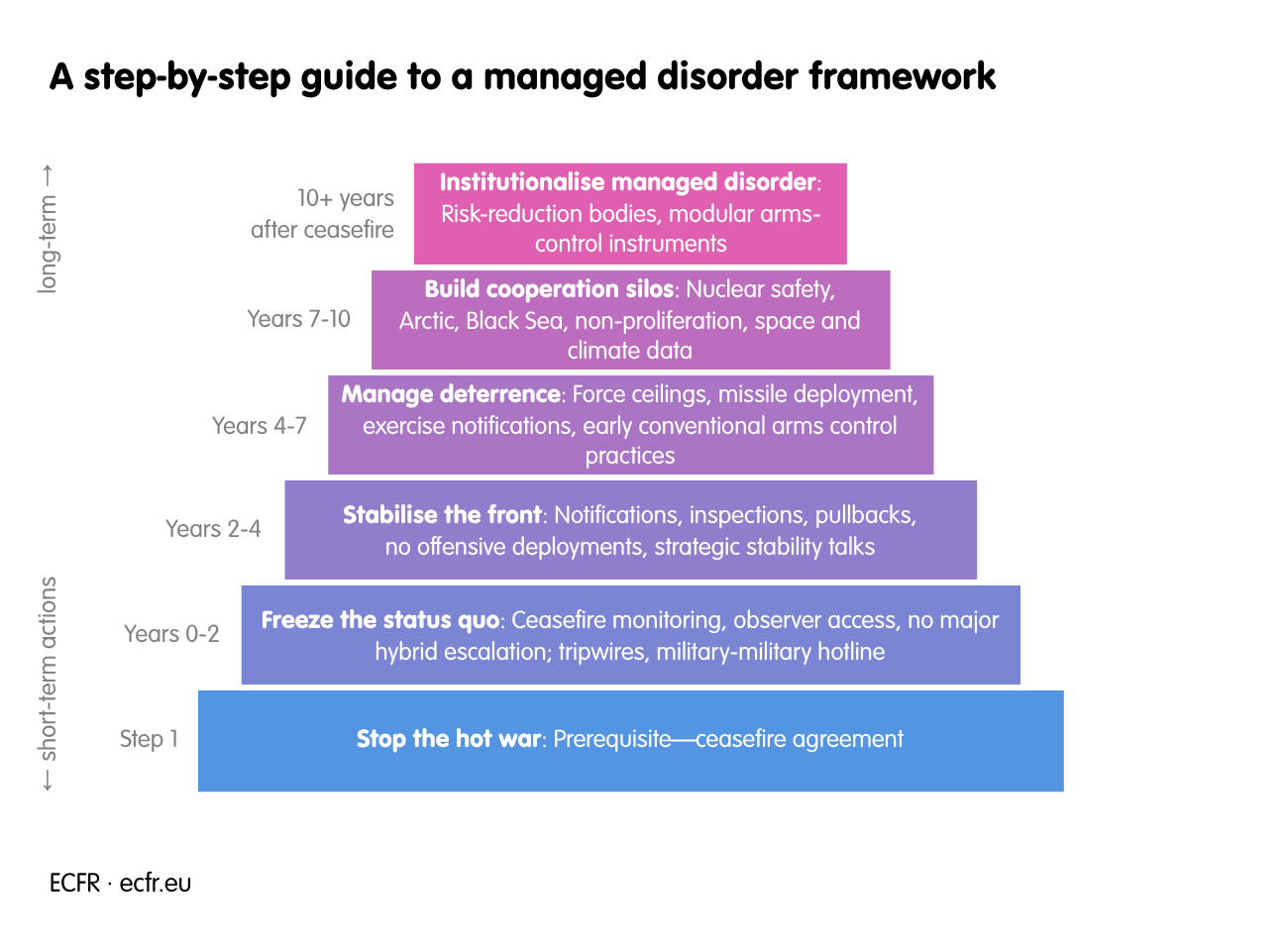
Stage 0: Secure a ceasefire (prerequisite)
A ceasefire, negotiated principally between Ukraine and Russia, is the prerequisite for everything that follows. It would be good if that ceasefire laid the groundwork for a more stable peace, but experience suggests that it will only nod in that direction and leave much unsaid. In the end, the purpose of a ceasefire is to stop the shooting rather than to ensure permanent peace. In Ukraine, that would be an accomplishment in itself and would at least open the door to the more sustainable process outlined below.
Stage 1: Freeze the status quo (~years 0-2 after ceasefire)
The first phase is about preventing a return to large-scale violence, preserving Ukraine’s survival and creating minimum conditions for a wider managed confrontation. It should embed the principle that behaviour has consequences. Monitoring and verification should come first—they enable later agreements by normalising inspections, data exchanges and the idea of measurable compliance. Those, in turn, provide the basis for rewarding Russian restraint.
This phase should establish baseline rules and mechanisms.
Military movements
- No renewed large-scale offensive action.
- No forcible changes to a clearly delineated line of control.
- No systematic attacks on European critical infrastructure.
- No escalatory hybrid campaign against EU or NATO states.
- Restrictions on long-range missiles and strike platforms near the line of contact.
The goal is to contain friction along the line of control and normalise external verification so that incidents do not spiral.
Communication and monitoring
- Humanitarian corridors and prisoner-of-war exchanges as first channels of dialogue.
- A Russian-Ukrainian military hotline with protocols for reporting ceasefire violations, troop movements, drone incidents and humanitarian emergencies.
- A joint or tripartite monitoring mechanism, potentially with UN endorsement even if not UN-staffed.
Monitoring in this phase should not be confused with Western intelligence assessments. A ceasefire mechanism needs visible procedures that both Russia and Ukraine can invoke when incidents occur. The American and European governments will also rely on classified intelligence, satellite imagery and Ukrainian reporting to assess whether Russia is preparing to attack again, but Russia need not accept those assessments for America and Europe to act on them. The two systems serve different purposes: the ceasefire mechanism manages incidents and referees disputes; intelligence assessments guide deterrence and enforcement.
Administrative
- A process for property claims, compensation and occupied-territory inventories.
Property claims will likely be one of the war’s most politically corrosive legacies. The framework must acknowledge them early, even if it cannot resolve them. Ukrainians have lost homes, businesses and land in occupied territories. Russian state assets and other linked private assets are frozen or seized across Europe. European nationals, companies and institutions have outstanding claims from pre-war investments. Left unaddressed, these grievances will curdle into domestic pressure against any government trying to sustain the framework. Experience from other post-conflict settlements suggests that unresolved property claims only get harder to settle and easier for spoilers to exploit the longer they sit.
This stage should therefore set up a dedicated arbitration channel for property claims, compensation and an inventory of assets in occupied territories. It should give affected populations a visible, legitimate process they can trust to address their claims eventually, even if immediate restitution is impossible. Otherwise, these issues become structural weaknesses that Russia, populist parties or affected lobbies can later exploit to fracture European cohesion.
No formal milestone marks the end of Stage 1—readiness to advance is a practical judgement. Triggers for progression to the next stage could include six to twelve months without major violations, inspectors consistently granted access or functioning communication demonstrated during minor incidents.
Stage 2: Stabilise the front (~years 2-4)
Once violence subsides, the next task is to keep it that way. This requires partial demilitarisation and transparency along the Ukraine-Russia and NATO-Russia contact lines. The logic resembles the earliest cold war confidence-building measures: small, technical arrangements that reduce risk without requiring political alignment.
Two tracks
Stage 2 creates, as noted, the two parallel negotiation tracks with Russia: one on the Ukraine-Russia contact line, Track A, and the other on NATO-Russia, Track B. Progress or failure in one track should have no bearing on the other, and the scope of Track B explicitly excludes Ukraine’s sovereign choices. Ukraine should be consulted before any Track B arrangement that materially affects its security. It should have no veto over NATO decisions, but it should not be treated as an object of them either.
The purpose of the negotiations would be to make the signs towards confrontation easier to read. Russia should be able to tell which US and European actions reflect routine deterrence from those signalling preparation for escalation, just as America and Europe need a clear read on which Russian moves stay within declared force posture and which mark renewed aggression. Ukraine, in turn, should know what kinds of Russian movements will trigger US and European responses—and frontline European states should trust that de-escalation measures will not come at their expense. The framework seeks to reduce the danger that military ambiguity becomes political panic.
Transparency measures and limits on destabilising deployments would increase predictability without weakening deterrence. The test is practical: a measure belongs in the framework if it reduces miscalculation while preserving the ability to defend Ukraine and NATO territory.
Examples of measures for each track include:
Track A—Contact line management (Ukraine-Russia, Western-facilitated)
- Reduced-force and weapon-limited zones on both sides of the line of contact.
- Restrictions on long-range strike systems or designated platforms near the line.
- Direct communication channels between local Ukrainian and Russian commanders, with agreed protocols for use during incidents.
- On-the-ground monitoring and inspection access, potentially with neutral observers.
- Verified pullbacks of heavy artillery or long-range systems from designated exclusion belts.
Track B—NATO-Russia military transparency (NATO-led, Ukraine consulted)
- Advance notification of exercises above a defined unit size along NATO’s eastern flank.
- Hotlines between NATO and Russian military commands with agreed rules of use.
- Observer arrangements for major exercises under agreed formats.
- Early data exchange on force levels and positions where this increases predictability without weakening deterrence.
- Technology-enabled transparency—such as satellite imagery, opensource intelligence aggregation, pattern detection—to support rather than replace agreed notification and inspection procedures.
- A restart of American-Russian strategic stability talks.
Crisis channels
Stage 2 should also expand crisis communications into separate channels, each with a limited purpose. A Ukraine-Russia channel should manage incidents along the line of contact. Exercises, air and naval encounters, forward deployments and missile notifications would run through a separate NATO-Russia military channel. A political channel—bringing together the European core group, the US, Ukraine and Russia—should handle cases that risk triggering sanctions snapback or military escalation. And the Black Sea requires a fourth channel, covering naval movements, commercial shipping, mine clearance, port access and other maritime incidents, with Turkey centrally involved.
The Black Sea requires special attention. Ukraine’s security depends on its land frontier as much as it does on Odesa—the country’s principal port and the conduit for the bulk of its grain exports, without which Ukraine would be cut off from global maritime trade. Turkey’s control of the Black Sea and its diplomatic channels to both Moscow and Kyiv make it indispensable here.
These channels should be linked by notification rules but should not be merged into a single negotiation. Their value lies precisely in compartmentalisation: failure in one channel should not bring down the rest.
Overall, these measures create predictability rather than normality. The metrics are practical: fewer surprises, lower risk of misinterpretation, calmer borders. Communication at the tactical level buys stability at the strategic one. The aim of the monitoring is to make suspicious behaviour visible enough, early enough that American and European governments can respond before ambiguity becomes paralysis.
Informal progression to Stage 3 could follow after 9–18 months of ceasefire compliance, a functioning inspection regime or verified pullbacks of heavy artillery or long-range systems from designated exclusion belts.
Stage 3: Manage deterrence (~years 4-7)
If stabilisation holds, America and Europe should shift their focus from military capability to deterrence. The relationship with Russia may remain adversarial, but it must be clear why and, within limits, predictable.
This stage should distinguish rearmament from deployment. At first, it should leave Europe, Ukraine and Russia to rebuild their armed forces. Capping rearmament outright would be unpopular, difficult to verify and potentially damaging to deterrence. The early aim is narrower: to curb the most destabilising forms of rearmament by regulating where forces are placed, how movements are notified, which exercises require observers, which long-range systems create escalation risks and what kinds of external assistance to Russia would trigger penalties. In short, managed disorder should allow rearmament but make it less surprising, less offensive in posture and less likely to spark a crisis.
Hybrid activity is a harder problem because Moscow has made it part of its regional strategy. Disinformation and cyberattacks cannot be managed through traditional arms control. The US and Europe cannot negotiate a clean cyber or hybrid non-aggression pact with Russia, but they can set conditions for participation in a wider framework. Russia cannot stop the drone war in Ukraine while continuing an infrastructure war across Europe and still expect sanctions relief and cooperation. A reduction in major hybrid attacks should become part of the price of entry into the framework.
This will require clear thresholds. Not every disinformation campaign warrants a crisis response, and not every cyber incident will carry a signature that all governments accept. But hybrid attacks on critical infrastructure, electoral processes, or political figures should carry consequences when evidence reaches agreed standards. The US and Europe should create a certification process that assesses such activity and links it to sanctions, diplomatic access and the pace of wider engagement. Attribution will remain contested, but the absence of perfect attribution cannot excuse permanent grey-zone coercion.
Both sets of rules—on rearmament and on hybrid activity—belong to the same emerging arms-control agenda, which could include:
- Geographically bounded force ceilings near Ukraine and NATO’s eastern flank.
- Reciprocal notification of major troop movements and exercises.
- Observer access to certain drills under agreed formats.
- A dialogue on missile deployments and dual-use systems, initially without formal treaties.
- Additional transparency measures for storage or deployment locations of sensitive weapons.
- Agreed thresholds for major hybrid activity, including sabotage of critical infrastructure, coercive migration operations, cyber operations against essential services and attacks on defence production, linked to certification and penalties rather than formal arms-control limits.
The US would lead this part because of nuclear considerations, while Europe anchors the conventional posture. Russia may well test boundaries, so deterrence must remain credible. But even imperfect predictability is safer than total opacity.
Triggers for informal progression to the next stage could include routine functioning of transparency mechanisms, no large undisclosed deployments near the line or political space inside EU and US capitals for conditional economic measures.
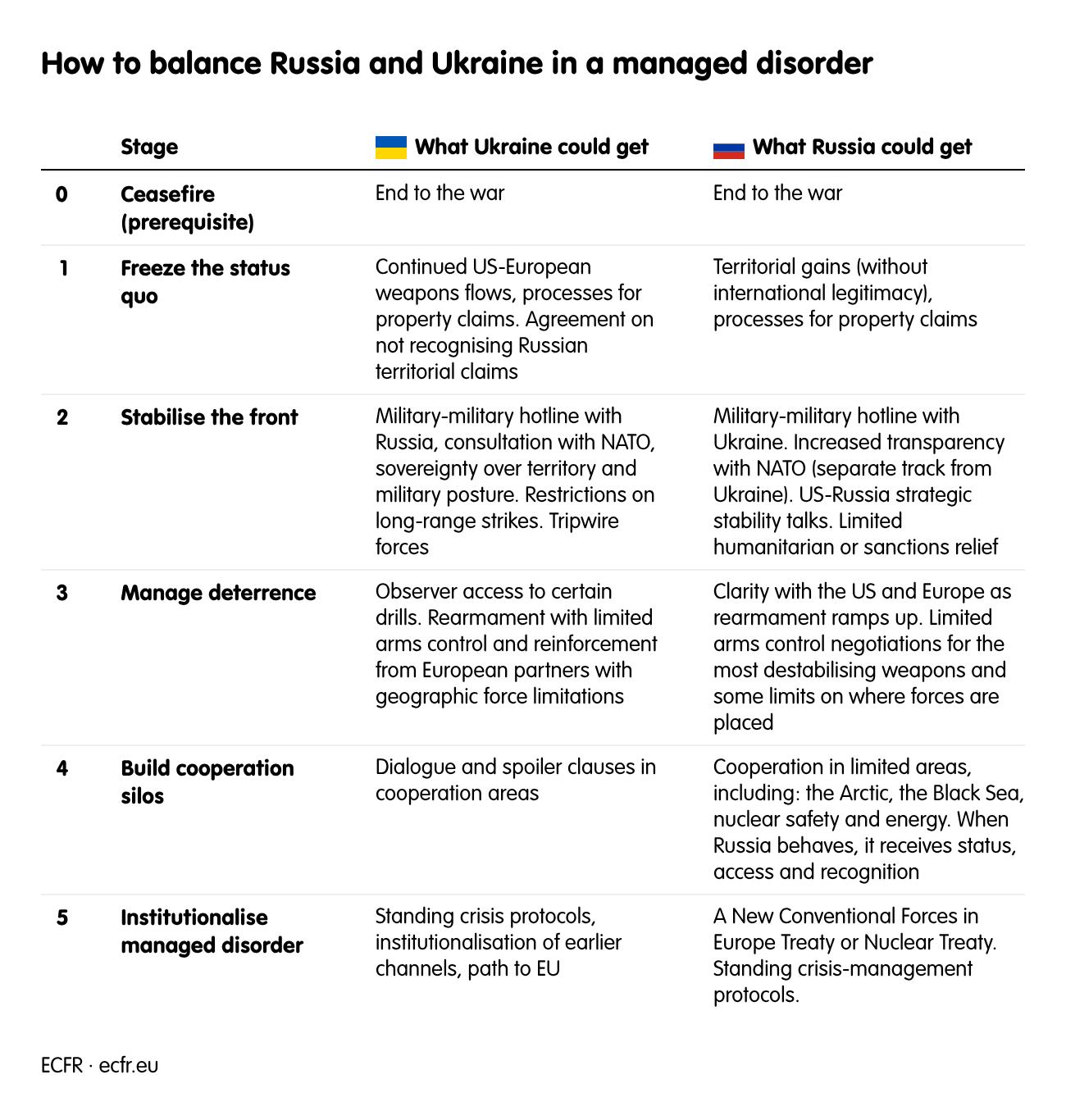
Stage 4: Build cooperation silos (begins early; matures over 7-10 years)
Cooperation in limited areas can help keep the wider framework from collapsing. Even after a ceasefire in Ukraine, Russia will still be able to destabilise Europe indirectly through hybrid operations within European borders and its wider neighbourhood. A managed framework will therefore need to go beyond Ukraine without assuming that cooperation in one domain signals goodwill or leads to broader reconciliation.
The purpose of functional cooperation is twofold. First, it can give Russia limited, visible benefits from predictable behaviour. Moscow values status, access and the recognition that it is an indispensable interlocutor. Carefully chosen cooperation channels can provide these at relatively low cost, provided they remain conditional and reversible. Second, such channels can reduce Russia’s incentive to use theatres outside Europe as pressure points. If Russia gains a stake in, say, Arctic safety, it may have more to lose from turning it into a battlefield.
The US and Europe should choose these areas carefully. Cooperation should start soon after a ceasefire wherever interests overlap. It can include humanitarian and economic essentials—fertiliser and food exports, prisoner-of-war exchanges—alongside maritime and safety measures such as Black Sea commercial shipping and nuclear safety. The early purpose is to improve people’s safety and daily lives rather than to preserve the peace. If the framework holds, functional cooperation can institutionalise and spread into two further clusters: maritime and Arctic cooperation, such as search-and-rescue and maritime deconfliction; and technical safety cooperation, such as space debris monitoring, counter-proliferation and climate and environmental data exchange.
The Arctic presents a distinct challenge. Before the war, it was one of the few spaces where Russia, America and Europe cooperated despite wider tensions, but that cooperation has since collapsed. Finland and Sweden’s accession to NATO, Russia’s militarisation of the High North, competition over energy and shipping routes, and Chinese interest in Arctic access have turned the region into a sharper theatre of rivalry. A functional Arctic track could help prevent accidents, manage search-and-rescue obligations, preserve basic environmental data exchange, and reduce the risk that military incidents in the High North spill into wider confrontation.
Functional cooperation could also help manage the Black Sea, building on the channel already established in Stage 2. The aim should be to cut the risk that a naval incident spirals into a wider escalation.
These channels should also serve as tests of Russian behaviour. Russia cannot expect cooperation in the Arctic while sabotaging European energy infrastructure, or maritime deconfliction while strangling Ukraine’s economy in the Black Sea. Functional cooperation should therefore rest on a spoiler clause: major destabilisation in one domain should cut benefits in others, though minor incidents, such as temporary denial of port access, should not automatically break compartmentalised cooperation. The point is to preserve communication during confrontation, but without allowing these channels to become sanctuaries for Russian bad behaviour. A standing certification mechanism should assess whether Russian actions remain compatible with continued participation; major violations, such as sabotage of critical infrastructure or using mercenary forces to destabilise European interests abroad, should trigger wider consequences.
Functional silos can also discipline European divisions by allowing limited contact with Russia where it serves security, while preventing that contact from becoming a general political thaw. This distinction lets hardline states accept narrow, security-driven engagement without conceding that Russia has been forgiven, while allowing more accommodating states to engage practically without waiting for a broader reconciliation that may never come. Silos also give European publics a clear rationale: certain risks require communication even among enemies.
The task for the bilateral re-engagement is to prevent unconditional normalisation by channelling it: bilateral contacts should be registered, reported to the core group where security-relevant and subject to spoiler clauses. Left unmanaged, bilateral contacts could become the pathway through which sanctions erode and Europe fragments.
China may play a limited role in this stage in areas where its interests—Arctic access, nuclear stability, maritime trade—align with predictability. Beijing will understand that stability preserves the economic access it values; Russian defection narrows it.
After a sustained period of compliance, the framework should offer Russia visible but reversible dividends for restraint: expanded diplomatic channels, ministerial-level meetings, greater facilitation of agricultural and fertiliser exports, enhanced participation in Black Sea or nuclear-safety mechanisms, and broader bilateral contacts. The aim is to show that restraint changes the terms of engagement.
The trigger for the next stage might be two to four years of stable front lines, deterrence and transparency mechanisms working as intended, and proof that narrow cooperation holds without spilling over or being exploited.
Stage 5: Institutionalise managed disorder (> 10 years)
If earlier stages mature and survive disruptions, an institutional architecture can begin to consolidate. Many elements may start earlier but will take shape over the long term. Institutionalisation marks a recognition that competition must be permanently managed. This day may never arrive, but it matters as an aspiration. Comparable cold war institutions took 25 years or more to emerge. For example, the Conference on Security and Co-operation in Europe (CSCE) was launched in the early 1970s but it only became a standing institution, the Organisation for Security and Co-operation in Europe (OSCE), in 1995.
Potential forms for institutions include:
- A US-Europe-Russia Risk Reduction Commission meeting at ministerial and military-to-military levels.
- A modular arms-control instrument replacing parts of the Conventional Armed Forces in Europe and Intermediate-Range Nuclear Forces frameworks, eventually bringing in other countries—notably China.
- A dual-track diplomatic structure: Washington–Moscow for nuclear or global issues; Europe–Moscow for regional security and Ukraine arrangements.
- A standing crisis-management protocol with predefined escalation control steps.
- An institutional layer consolidating the crisis channels of earlier stages, created through standing bodies, regularised military contacts and agreed evidentiary standards.
This stage is ambitious, uncertain and far off. It would require political durability inside Russia, Ukraine, the US and Europe. But it should remain visible as the horizon. The framework must offer a picture of a stable destination even if the road there is long.
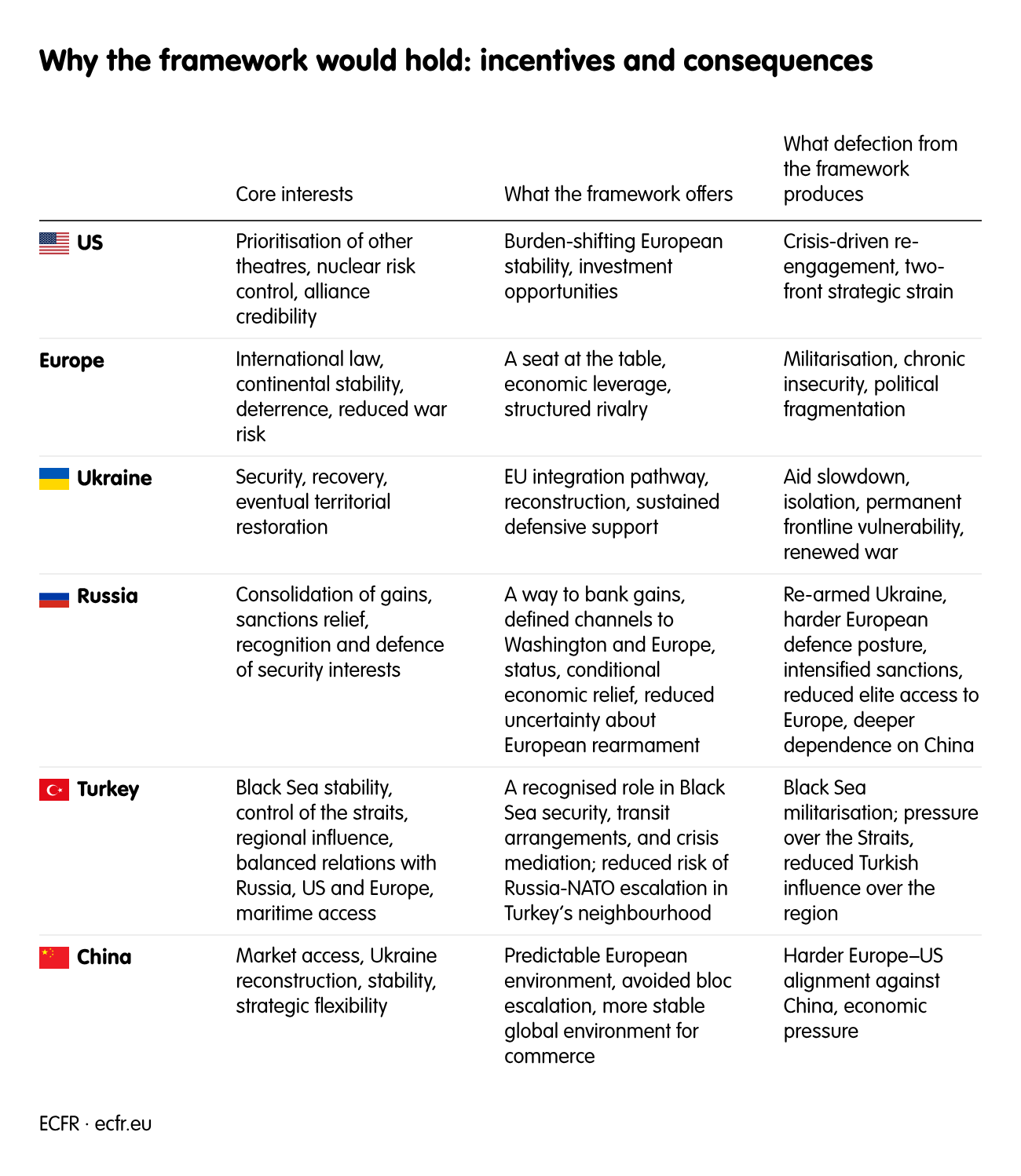
The path to stability runs through this framework; it structures a rivalry that will continue whether we prepare for it or not. The logic is incremental: ceasefire enables monitoring, monitoring enables transparency, transparency enables limits, limits enable rules, rules enable institutions. Each step must be earned through behaviour, not granted on faith. None of this works, however, if Europe cannot act as one.
How to overcome division paralysis in Europe
European cohesion will require a system that stops any single state from vetoing responses that the group has already agreed. The model should borrow from the Iran nuclear deal of 2015: participating states determine upfront what counts as a violation and what counts as a compliance milestone. Those criteria, once set, cannot be revised downward. The states most exposed to Russian pressure would write their red lines into the rules before the politics of the moment can erode them. A standing committee of the participating states then decides by qualified majority whether Russia has met a given criterion. If it has, the agreed reward or penalty follows automatically—unless a majority votes to block it.
This process flips the usual logic. The current system requires consensus to impose a snapback or advance a tranche of sanctions relief; the new one will require consensus to waive either. A hypothetical pro-Russian Hungarian or Slovak government seeking to delay consequences will need to openly vote to do so and bear public responsibility for that choice, rather than block it quietly through procedural abstention. Similarly, a frontline state such as Poland or a Baltic country will need to find a majority to block rewards once Russia demonstrably meets an agreed milestone. Frontline states appear to lose power here, but their red lines have already been written into the rules.
Spelling out in advance which consequences are appropriate for a breach would also help keep Europe united: cautious states will not tolerate escalation over every minor incident, and hawkish ones will not tolerate impunity for major violations. Proportionality will keep both cautious and hawkish states invested in the framework, rather than defecting to national responses. A three-tier system would make this balance work: minor procedural breaches might suspend talks or freeze a tranche of sanctions relief; material violations—such as denial of inspection access—may trigger limited snapback; major ones, such as attacks on defence production, should trigger full enforcement. This governance mechanism is only part of what will enable Europe to act cohesively within the framework; practical principles must also operate across every stage, beginning with crisis communication.
Operating rules
Several rules should apply throughout the framework. Managed disorder cannot rest on hopeful assumptions about Russian restraint or rationality. The framework must treat future violations as probable and place the burden on Russia to prove it is complying, not on America or Europe to show that it is not. In practice, that means adopting a presumption-of-violation approach: if, say, Russia denies inspectors access to a missile site, the refusal counts as a breach and triggers penalties. Sanctions relief, military deployments and cooperation channels continue only when Russia’s behaviour is visible and verifiable. If Moscow wants the benefits of a more predictable relationship, it must make compliance easy to see.
Crisis communication should begin from the outset. In a post-war environment, contact matters more than cooperation. Channels should allow the parties to clarify incidents and prevent local violence from escalating. These channels should be compartmentalised—for example, a line-of-contact mechanism should not depend on progress in NATO-Russia talks—so no single crisis can consume the whole framework.
Technology can help in this process, but monitoring cannot depend on it alone. Surveillance, satellite imagery, financial tracking, customs data, open-source intelligence and AI-assisted pattern detection can all improve visibility. But they cannot substitute for political judgment, agreed evidentiary standards and negotiated consequences.
In all stages, sanctions relief should be tied to periodic certification rather than ad hoc diplomacy. The certification mechanism described above—which includes the EU, the US, Ukraine and relevant European core group states—should govern the pace of sanctions relief, the triggering of snapback provisions, and the determination of whether conditions for stage progression have been met. It cannot eliminate political discretion, as that is impossible, but it can narrow it by defining operational and measurable criteria as precisely as possible. If Russia blocks inspections, moves forces without notification, conducts major hybrid attacks or violates agreed military limits, the default should be suspension or reversal of relief unless participating governments decide otherwise.
Why the alternatives are worse
Managed disorder will make no one happy. It will not deliver justice for Ukraine, reconciliation with Russia, strategic autonomy for Europe, or a restored US-European consensus on Russia. It will leave many questions unresolved and many grievances intact. But the relevant comparison is not with an ideal peace that cannot exist. The relevant comparison is with the conceivable alternatives. All of them are worse than managed disorder.
The alternatives below are ideal types. Few policymakers advocate for any of them in pure form. But examining each in isolation reveals why none can resolve the underlying problem and why mixing them without a governing framework tends to magnify their worst features.
The first alternative is regime change in Moscow. Many Europeans and Americans have concluded that no stable order with Russia can exist while Vladimir Putin or a Putinist system remains in power—a view with real force, given how central revisionism, militarism and hostility to the West have become to the current government’s legitimacy. But as a strategy, regime change offers no credible path from the world we inhabit to the world we want. Neither the US nor Europe can engineer a liberal transition in Moscow or build a European security order on the assumption that Russia will soon become a different country. Nor can they rely on sanctions, battlefield losses or elite discontent to produce a more palatable successor. A Russia after Putin could become less aggressive, but it could also become more nationalist, more chaotic or more determined to prove that the war was not lost.
The second alternative is permanent isolation. This approach would contain Russia through sanctions, diplomatic exclusion and military pressure. It has obvious appeal. Russia should pay a lasting price for aggression. But isolation alone will not manage the next phase. Sanctions will erode without a political strategy. European governments will divide over costs and enforcement. China, Turkey, the Gulf states and others will create channels around US and European pressure. Russia will adapt and wait for fatigue in the US and Europe. Permanent isolation may punish Russia, but it will not by itself create rules for regional security or Ukraine’s defence.
The third alternative is normalisation. This approach would treat a ceasefire as the end of the problem and move quickly toward restored diplomatic channels, trade and a wider European conversation with Moscow. Some governments and firms will want this as soon as large-scale fighting stops. They will argue that Europe needs stability to recover and a way to stop Russia from becoming still more dependent on China. Some engagement with Moscow will eventually prove necessary. But normalisation without conditions would reward aggression without securing restraint. It would tell Russia that conquest brings only a temporary crisis followed by eventual reintegration. It would weaken Ukraine, divide Europe and invite Moscow to test whether another round of coercion might yield another round of concessions. Engagement has value only when it forms part of a structure of leverage. Without that structure, it becomes appeasement by exhaustion.
The fourth alternative is unmanaged confrontation. This outcome is the most likely default because it requires no decision. Europe and America would continue to arm Ukraine unevenly, maintain sanctions haphazardly, talk to Russia episodically and respond to crises as they arise. NATO would reinforce some areas, neglect others and debate deployments after Russia tests them, leaving Ukraine dependent yet insecure. Russia, meanwhile, would keep probing European defences with hybrid tactics, even as Washington cuts its own deals with Moscow. European governments might denounce such freelancing while failing to offer a coherent alternative. In this world, rivalry persists and even grows, and no one sets the rules.
Unmanaged confrontation gives Russia more ambiguity to exploit, gives the United States more room to improvise over Europe’s head, and hands European governments more opportunities to defect from common positions. It also leaves Ukraine with less clarity about what the US and Europe will support and what they will not. Every crisis becomes a test of will, credibility and domestic politics. The result would not be principled firmness. It would be recurrent improvisation under pressure.
These alternatives also share a deeper flaw. Each assumes that one element of the problem can solve the whole: Russian transformation, Russian isolation, Russian reintegration or Western toughness. None can. The post-war confrontation will require deterrence and dialogue, punishment and incentives, European unity and coalitions of the willing, Ukrainian agency, American involvement and European hedging. Any strategy that chooses only one side of these tensions will collapse when reality supplies the other.
An operating system for a bad peace
If this trajectory does not take hold, the alternative is easy to imagine because it resembles the past decade: a ceasefire that freezes rather than manages the conflict, Russia regrouping and probing again when the balance shifts, Europe tiring under sanctions and domestic cost, the US distracted and inconsistent, and Ukraine trapped in recurrent wars. In such a world, escalation would be governed by crises rather than rules, and could arrive suddenly, triggered by accident, misunderstanding or opportunity.
America and Europe cannot choose a world without Russia, nor can they wish away their own disunity. But both Europeans and Americans can choose whether to confront Russia through chaos or through structure. Managed disorder is a strategy for containing escalation, preserving Ukrainian sovereignty, limiting Russian coercion and ensuring that rivalry remains predictable rather than world-ending.
The path forward begins in Ukraine. If policymakers treat war termination as the end of the problem, they will fail to respond to broader Russian concerns and leave Europe vulnerable to the next Russian offensive. If they instead treat war termination as the opening phase of a long process, they can shape the incentives and capacities that will govern the next decade.
A structured adversarial framework, rooted in credible deterrence and bounded by conditional cooperation, is the best available foundation. Managed disorder is not permanent peace, reconciliation or a just settlement. It is an operating system for a bad peace.
About the authors
Jeremy Shapiro is the research director of the European Council on Foreign Relations. His areas of focus include US foreign policy and transatlantic relations.
Samuel Charap is Distinguished Chair in Russia and Eurasia Policy and a senior political scientist at RAND. His research interests include the foreign policies of Russia and the former Soviet states; European and Eurasian regional security; and US-Russia deterrence, strategic stability and arms control.
Bob Deen is the General Director of the Netherlands Institute for International Relations “Clingendael” and specialises in matters of European security, with a focus on Eastern Europe, the Caucasus and Central Asia. Before joining Clingendael in 2020, he worked as Head of Section and Senior Adviser to the OSCE High Commissioner on National Minorities.
Hiski Haukkala is the director of the Finnish Institute of International Affairs. He is also an adjunct professor of international relations at Tampere University and a senior research associate at RAND Europe. He is the author of numerous books and articles on EU foreign policy, Russia and International Relations.
Ivan Krastev is chair of the Centre for Liberal Strategies, Sofia, and a permanent fellow at the Institute for Human Sciences, Vienna. He is the author of “Is It Tomorrow Yet? Paradoxes of the Pandemic”, among many other publications.
Hanna Notte is the director of the Eurasia programme at the James Martin Center for Nonproliferation Studies. Based in Berlin, she has written extensively about Russian foreign policy and is the author of We Shall Outlast Them: Putin’s Global Campaign to Defeat the West (W. W. Norton & Co).
Jim O’Brien is a distinguished visiting fellow at the European Council on Foreign Relations. He previously served as Assistant Secretary of State for European and Eurasian Affairs in the Biden administration.
Acknowledgments
This paper is the collaborative product of a working group that met several times over the course of more than a year, comprising the authors above and Michael Kimmage of the Kennan Institute. Jeremy Shapiro took the pen on this paper, but the working group shaped, debated and contributed to it in essential ways. All of the members of the working group except Michael Kimmage fully endorse the paper.
The authors would also like to thank Kat Fytatzi for her patient and incisive editing. Kat’s editing was painful, but in exactly the right way. Nastassia Zenovich applied her usual genius for the graphical representation of extremely verbal ideas to a paper that badly needed it. She has our eternal gratitude. We’d also like to thank the Andrew Carnegie Foundation for the funding and patience that made this project possible.
]]>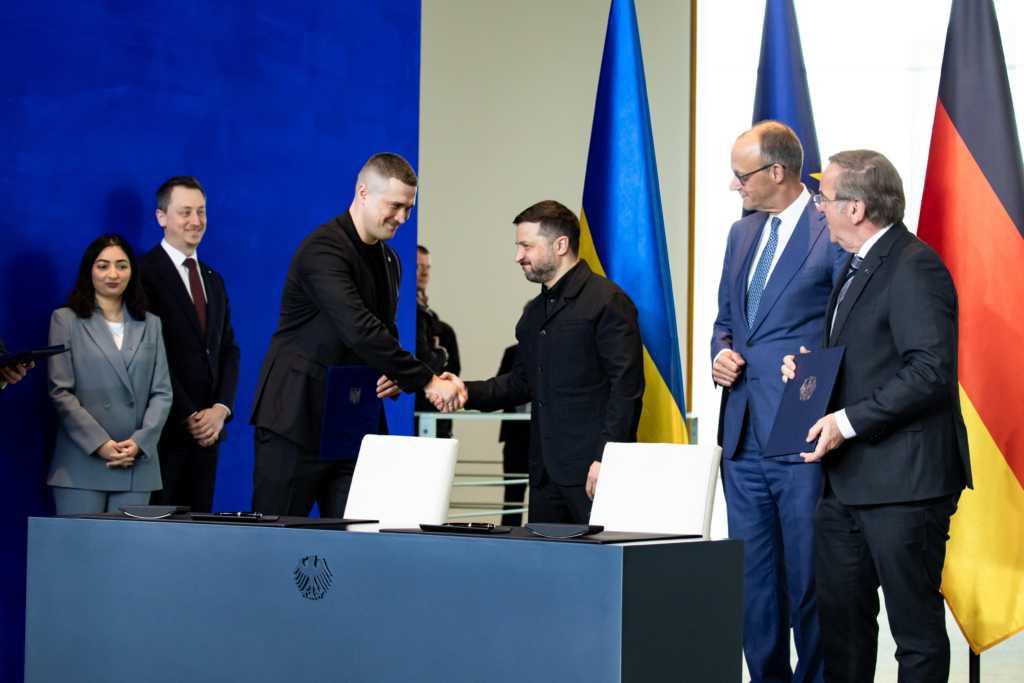
The problem
For the second July running, a controversial decision from President Volodymyr Zelensky has sparked protests across Ukraine. Last year it was his attempt to weaken two anti-corruption bodies. This time it is the dismissal of his popular young defence minister, Mykhailo Fedorov, after just six months on the job. Zelensky cited a breakdown of relations between the ministry of defence and the military leadership as a key reason for his decision.
Fedorov was blunter. In a scathing statement, he criticised the commander-in-chief of the armed forces Oleksandr Syrsky for choosing loyalty over performance, sticking to outdated ways of war fighting, and sabotaging necessary reforms. “Instead of working out how to asymmetrically defeat Russia”, Fedorov said, “[Syrsky] has worked out how to split the country.” Such internal strife is the last thing Ukraine needs. But Fedorov’s allegations also call into question whether Western military assistance for Kyiv is being used in the best possible way.
The solution
Zelensky has proposed Yevhen Khmara to replace Fedorov, subject to approval by parliament. Khmara is a respected military commander and the acting head of Ukraine’s security service, so has credentials as a military leader. But Ukraine’s parliament must also decide whether he can be a trustworthy manager in the job.
This is, of course, Ukraine’s sovereign decision to make. But it is a consequential one for the rest of Europe, too: at the end of the second quarter, defence accounted for roughly 80% of Ukraine’s annual budget, with almost a third of this coming from external partners (who also supply a lot of the country’s civilian needs). The EU and European countries are by far Kyiv’s biggest financial and miliary backers. And how these funds are spent matters for Ukraine’s success; as does whether its military strategy, supplies, recruitment and procurement are aligned. The resources also need to be used efficiently. Fedorov’s allegations thus deserve proper scrutiny.
Ukraine’s European partners should not back any one choice of new defence minister. But they should make clear that, whether it is Khmara or somebody else, Fedorov’s replacement must be a credible, competent and trusted partner. This means he or she should be proven as a commander, but also be able to continue Ukraine’s defence reforms and address problems related to mobilisation, relations with the military, and corruption in the sector. Fedorov’s replacement should also be committed to continuing to build up the country’s defence technology base.
Context
Before he became defence minister in January 2026, Fedorov headed Ukraine’s digital governance revolution. He transferred his tech-savviness to the ministry of defence and is widely credited with Ukraine’s recent advances in defence technology which helped turn the tide against Russia. Several military commanders have defended Fedorov’s work as defence minister and supported his claims against Syrskyi; others in the military have spoken in favour of the commander.
In his statement, Fedorov remained loyal to Zelensky but rumours about the outgoing official’s political ambitions have been circulating for weeks. Whether there is any truth in them or not, protesters see this as a motivation behind the president’s reshuffle. And the views of the public matter. Ukraine’s defence is a whole-of-society affair, partly sustained by volunteers and the private sector. So, Zelensky will need to dispel these rumours—a country at war can hardly afford to make decisions based on political preference at the expense of competence or defence logic.
The onus is now on Zelensky to convince everyone that Khmara is the man for the job. While parliament approved a new government led by Sergy Koretsky on July 15th, this did not include the names of the president’s (constitutionally required) proposals for defence and foreign ministers. Barring an extraordinary session, MPs will only reconvene in mid-August. This means they have time to reflect and engage in a dialogue. This should result in a defence minister who commands not just the president’s trust but also that of the military, society—and international partners.
]]>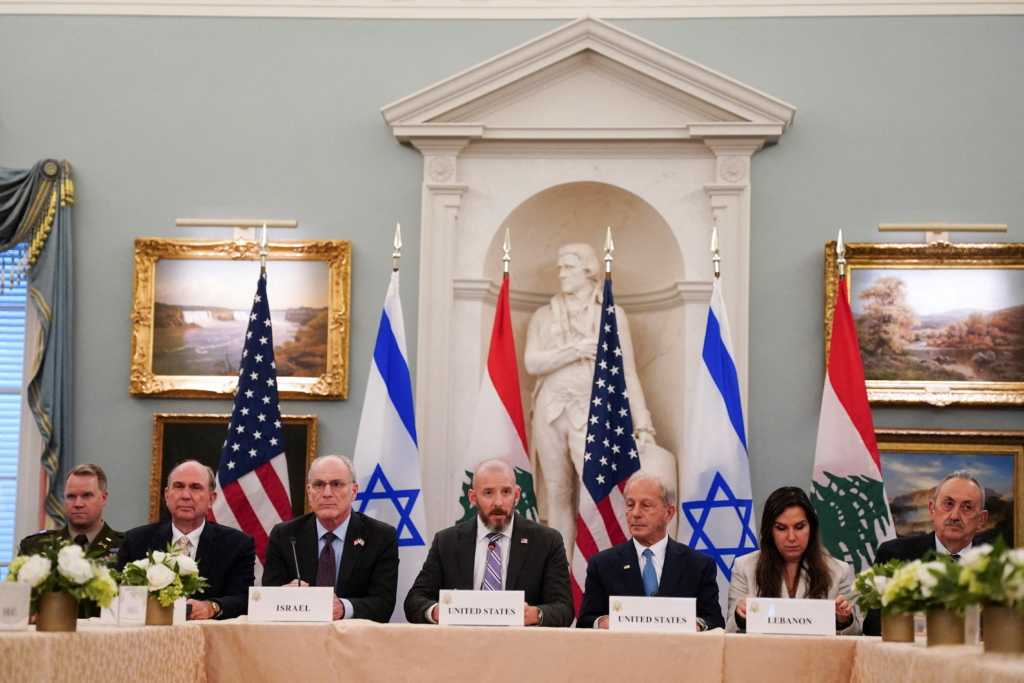
In the latest episode of ECFR’s WOMENP podcast, Ellie Geranmayeh is joined by three leading Lebanese voices— Alia Moubayed, senior economist; Randa Slim, Middle East Programme director at the Stimson Center; and Maha Yahya, director of the Carnegie Middle East Center in Beirut—to unpack the consequences of the trilateral framework deal signed by Israel, the US and Lebanon.
Lebanon is among the countries most impacted by the US and Israel’s war against Iran. Following the death of Iran’s Supreme Leader, Hezbollah resumed direct attacks against Israel in March, plunging the country back into conflict. Around 4,000 people in Lebanon have since been killed and over a million displaced, with Israeli ground forces now occupying parts of south Lebanon.
In June, Israel, the US and Lebanon signed a historic—and controversial—trilateral framework deal, with the parties meeting again in July to discuss the implementation phase, including the withdrawal of Israeli forces from occupied parts of Lebanon. But with a ceasefire between the US and Iran unravelling, the durability of the Lebanon deal is unclear. Together, Ellie, Alia, Maha and Randa discuss whether the deal can bring lasting peace to Lebanon and how international players can support efforts to stabilise the country.
Listen to all past episodes of ECFR’s WOMENP series.
This podcast was recorded on July 16th, 2026.
Bookshelf:
The Best Kind of American: A True Story of Murder, War, and America’s Undoing in the Middle East by Kim Ghattas
Beirut Blues by Hanan Al-Shaykh
A House of Many Mansions: The History of Lebanon Reconsidered by Kamal Salibi
]]>
European leaders left Ankara relieved that US president Donald Trump has reaffirmed US support for NATO and avoided announcing major troop withdrawals, but fundamental questions about Washington’s long-term commitment remain unresolved. Mark, Camille and Marta explore how Europe can strengthen its own defence capabilities while maintaining NATO as the cornerstone of collective security.
Can Europe build the military capabilities it still lacks? How should responsibilities be divided between NATO, the EU and smaller coalitions of willing states? What would a more credible European nuclear deterrent look like? And can Europe strengthen its own defence without weakening the transatlantic alliance?
This podcast episode was recorded on July 9th 2026.
Bookshelf ·
The Sleepwalkers by Christopher Clark ·
The Great Delusion by John J. Mearsheimer
]]>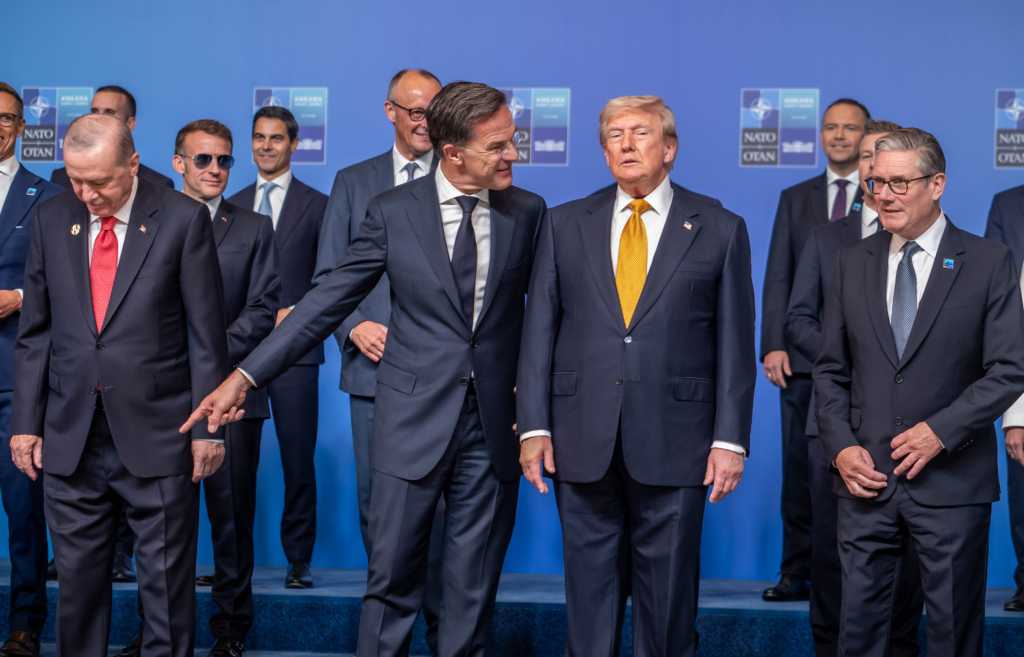
European leaders breathed a sigh of relief as US president Donald Trump departed last week’s NATO summit in Ankara, Turkey. Despite a few unseemly moments in which Trump reiterated his desire to seize Greenland and nonsensically ordered a halt to all trade with Spain, the meeting went off without any major catastrophes.
Most importantly, Trump did not announce any major troop withdrawals from Europe or any moves to leave the alliance. He even had warm words for Ukrainian president Volodymyr Zelensky, and pledged to grant Ukraine a license to manufacture Patriot air-defence missiles domestically. By the end, even Trump proclaimed that there was “love” in the air.
But optics aside, the summit was an absurd exercise. NATO leaders revelled in their pledges to increase defence-related spending to 5%, even though everyone knows that this arbitrary number means nothing in the absence of deeper discussions about capabilities. The figure was pulled out of thin air last year to appease Trump. In the months leading up to the summit, the same leaders had worried that Trump would withdraw the US from the alliance or dramatically reduce its presence in Europe, which would then find itself at the mercy of Vladimir Putin’s Russia.
That is why NATO leaders expended so much energy preparing a summit that would not allow for any unscripted moments. Fears that the mercurial US president would use the occasion to undermine the alliance were palpable. When the moment came, European leaders reportedly fell over themselves to praise Trump, with NATO’s secretary general, Mark Rutte, leading the sycophantic charge.
Some commentators believe that saving NATO and keeping the Western alliance alive was worth this self-abasement. But by kowtowing to Trump and indulgently harking back to the good old days of the transatlantic relationship, Europe’s leaders are risking more than just their dignity.
Consider the period following the fall of the Berlin Wall. After the initial euphoria, many parts of the former German Democratic Republic (East Germany) were emptied out as their populations left, even as property prices were driven up by an influx of wealthier West Germans. The result was a wave of nostalgia for a lost world, expressed in films like Good Bye, Lenin!
The term coined to describe this emotion was Ostalgie (“Eastalgia”), and it has shaped German politics and culture for almost 40 years now. Although many East German writers have criticised such sentimentality for trivialising East Germany’s decades-long repression, some see it as the key to understanding what ails Germany’s eastern regions today. There one finds a widespread refusal to acknowledge that the world has changed, a habit of free riding, and a tendency—occasionally—to look ridiculous, such as when East Germans parrot Russian talking points on Ukraine.
Ironically, Europe’s problem today is not just that Ostalgie has held back eastern Germany; it is that a new malady, Westalgia, has taken hold. It was on full display in Ankara.
Westalgia has several key features. The first is a refusal to acknowledge that the world has moved on. By acting as if US security guarantees are still as ironclad as they were under the Ronald Reagan and George H.W. Bush administrations, and by continuing to purchase US weapons, they hope to turn back the clock. But a better strategy would recognise that America has changed in fundamental ways. Even if a Democrat moves into the White House in January 2029, US retrenchment will continue.
Europe’s hyper-reliance on American power clearly had an infantilising effect
Those who want to turn back the clock naturally see the past through rose-tinted glasses, even though elements of the post-cold war settlement were not to Europe’s advantage. Specifically, Europe’s hyper-reliance on American power clearly had an infantilising effect. Even when caught between a predatory Russia, a fickle US and a coercive China, Europeans are still wont to downplay and underestimate their own power and influence.
The second feature of Westalgia is a tendency to free ride. Just as eastern Germans grew accustomed to the transfer payments and subsidies (the infamous Solidaritätszuschlag, or “solidarity tax”) that flowed eastward after unification, so have Europeans become accustomed to America bankrolling their security. As a result, Europeans have under-invested, not just in defence but also in their industrial base, technological sovereignty and energy independence.
Instead of complaining that US citizens no longer want to be responsible for defending Europe, and instead of spending billions of dollars to satisfy Trump’s vanity, Europeans would be better off having a serious conversation about how they could fight a high-intensity conflict on their own, if necessary. Instead of spending an arbitrary share of their GDP on defence, they should critically evaluate their capability gaps and adjust their spending to match their needs. Coffers are tight everywhere, but it will be easier to justify expenditures on weapons if they appear less geared toward flattering Trump.
Third, in their subservience to the US president, Europeans often do not hide it well, which prevents them from being taken seriously—be it by Trump, Putin, or Chinese leader Xi Jinping. If there is one man who presumably respects Rutte less than Rutte himself, it is Trump. Europe will garner the world’s respect only when it stands up for itself.
Whereas Ostalgie was a bottom-up phenomenon, Westalgia is being driven by elites. Of course, European politicians need to allay their skittish electorates’ fears. But if they want to succeed in the 21st century, they must stop selling nostalgia and start looking to the future.
This article was first published by Project Syndicate on July 15th 2026
]]>