The Trail Guide Problem: Judge, Jury, and Design Patent Claim Construction

by Dennis Crouch

The Federal Circuit denied rehearing today in Range of Motion Products, LLC v. Armaid Co., No. 23-2427 (Fed. Cir. Aug. 11, 2026), leaving in place the panel decision I wrote about in February. 166 F.4th 981 (Fed. Cir. 2026). The denial is accompanied by two opinions. Judge Cunningham, who wrote the panel majority, concurred in the denial and was joined by Judge Hughes, the other member of that majority. Chief Judge Moore, who dissented from the panel decision, dissented again, joined by Judge Reyna. Judges Stoll and Stark dissented without opinion. Judge Newman did not participate, and the poll failed.

What the two opinions circle around is the question of whether Markman v. Westview Instruments, Inc., 517 U.S. 370 (1996), belongs in design patent cases at all. Markman gave claim construction duty to judges based on the idea that construing written instruments is something judges do better than jurors do. But nothing in law school or legal practice teaches judges to interpret design drawings. And, as the Chief explained, “[t]he entirety of a design patent is a series of pictures.” In other words, the foundational premise doesn’t fit. This is compounded by the ornamental-versus-functional sorting that is being pushed inside design patent claim construction. But that is really not interpretation but rather factfinding on evidence that doesn’t appear in the patent document. Judge Cunningham’s answer is that somebody has to fix the scope of the claim before a jury compares anything, and that in doing so the court “guides the jury like a trail guide, placing flags and signposts to delineate the boundaries of the claimed design.”

(more…)

Provisional Prior Art

by Dennis Crouch

Dental Monitoring SAS v. Align Technology, Inc., No. 2025-1752 (Fed. Cir. Aug. 10, 2026)

Patent law cases often turn on timing. In our first-to-file system, the question often boils down to whether the patent at issue was effectively filed before the competing patent application.  This case is about the prior-art date of a patent or published application.  We know that under 102(a)(2), they are back-dated to the date they were “effectively filed,” and the case answers when we look-back all the way to the provisional filing date.  Today’s decision is important because it overturns USPTO policy implementing the AIA and ultimately, this gives patent owners a new way to knock out references that reach back to a priority filing date.  Although this decision centers on priority to US provisional patent applications, it should also apply to foreign filings.  That makes it a big deal since patents claim priority to one or the other of these.

Section 102(d) spells out the effective prior art date of a patent or published application in some detail but is worded in a clunky fashion:

such patent or application shall be considered to have been effectively filed, with respect to any subject matter described in the patent or application . . . (2) if the patent or application for patent is entitled to claim a right of priority under section 119, 365(a), 365(b), 386(a), or 386(b), or to claim the benefit of an earlier filing date under section 120, 121, 365(c), or 386(c), based upon 1 or more prior filed applications for patent, as of the filing date of the earliest such application that describes the subject matter.

The analysis thus requires both a document and subject matter analysis: was priority properly claimed and does it disclose the right subject matter.  For any given disclosure in the reference, the prior art date is the filing date of the earliest application in the chain that (1) the reference is entitled to claim priority to or benefit from, and (2) itself describes that disclosure.

In the pre-AIA case of Dynamic Drinkware, LLC v. National Graphics, Inc., 800 F.3d 1375 (Fed. Cir. 2015), the Federal Circuit held that a reference does not get its provisional’s filing date simply by claiming it. The provisional must supply § 112 support for the claims of the reference itself, and the party relying on the reference bears the burden of showing it. Because the rule is a necessary condition, a reference with no supported claim gets no earlier date at all, even where the provisional plainly describes the subject matter being used for the rejection.  But, the USPTO has been following a different and looser rule for post-AIA patents.  The agency reasoned that the new statute specifically states what is required, and that it requires less: the reference need only be “entitled to claim” priority, and the earlier application need only “describe the subject matter” being relied upon. Whether any claim of the reference is actually entitled to the earlier date drops out of the analysis.

Now, in Dental Monitoring, the Federal Circuit has rejected the USPTO’s post-AIA approach and held instead that the same Dynamic Drinkware rule carries over to post-AIA prior art dating under 102(d)(2).  The outcome overrules the Board’s precedential decision in Penumbra, Inc. v. RapidPulse, Inc., IPR2021-01466 (PTAB Mar. 10, 2023).

(more…)
Ex parte Baurin and the Anti-Harassment Rationale for Double Patenting

by Dennis Crouch

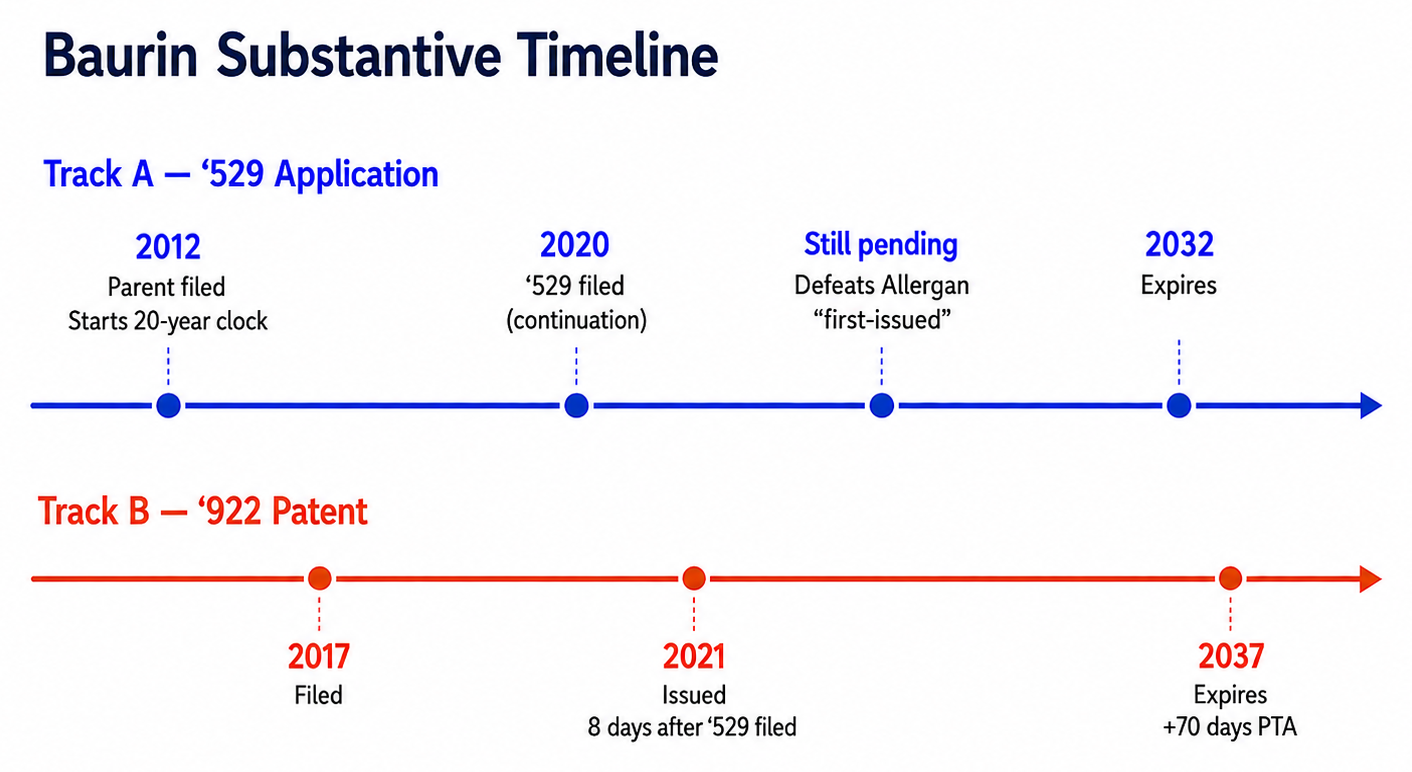
Director John Squires has issued another precedential decision, this time focusing on obviousness-type double patenting (ODP). In Ex parte Baurin, Appeal No. 2024-002920 (ARP Aug. 6, 2026), an Appeals Review Panel led by Director Squires (joined by Chief Administrative Patent Judge Deshpande and Acting Deputy Chief Judge Ankenbrand) reversed the Board and reinstated six ODP rejections of Sanofi antibody claims. The panel held that the risk of divided ownership and duplicative infringement suits, the “anti-harassment” rationale, independently supports an ODP rejection even though the rejected claims would expire five years before the reference patent.

The remarkable part is that the panel does not appear to believe in the rule it applies. They found the decision required by Federal Circuit precedent, but then explained in some detail why the standalone anti-harassment rationale should be abandoned or sharply limited, telling the Federal Circuit that the Office “would welcome” clarification.  The basic question: when – if ever – is a double patenting rejection proper in a pending application that will expire before the already-issued reference patent?

Timeline comparing the '529 application (2012 patent term filing date, 2032 expiration) with the '922 reference patent (2017 filing, 2021 issuance, 2037 expiration)

The CAFC has its opportunity to clarify. The same question is pending in In re Ablynx N.V., No. 26-1333 (Fed. Cir.), the appeal from Ex parte Baumeister, 2025 WL 3515282 (PTAB Nov. 20, 2025). The USPTO has not yet filed its brief in that appeal; after two extensions it is due August 14, 2026, with no further extensions anticipated. In these direct appeals the Office is represented by its own Solicitor’s office rather than by the Department of Justice, so Director Squires controls the filing. I expect that Baurin reads as a preview of the USPTO’s upcoming arguments.

(more…)

Examiner Allowance Rates Under Director Squires

by Dennis Crouch

USPTO examiner allowance rate by director tenure, anchored to date of last substantive examiner action, 2005 to 2026

Director John Squires has been in office for about ten months, and the patent application allowance rate appears to be continuing its downward trend that began under Director Vidal.

A big caveat here is that our data ends in January 2026. The chart is keyed to office action rejections that lead to abandonment. But when an examiner mails a rejection, the applicant gets six months (three plus three under 37 C.F.R. § 1.136(a)). Nothing is abandoned until that six-month period runs. So the curve above ends in January 2026, and the Squires portion of it is just four months.

The chart above updates the measure I introduced in March – which anchors each disposed application to the date of the examiner’s last substantive action: the Notice of Allowance on one side and, on the other, the last rejection for cases later abandoned. See Dennis Crouch, The Third Way: Examiner Action Dates and the Allowance Rate Curve, Patently-O (Mar. 2, 2026).  I like to use this anchoring because it captures the moment the agency decides rather than the moment the paperwork catches up or the applicant takes action: this helps us zero in on patent office activity.

One additional note – I have refined the allowance calculation since March, which moved levels by about one percentage point in some areas, but the general shape of the curve is unchanged.

(more…)

Rise of AI Patents and their Corresponding Eligibility Rejections

by Dennis Crouch

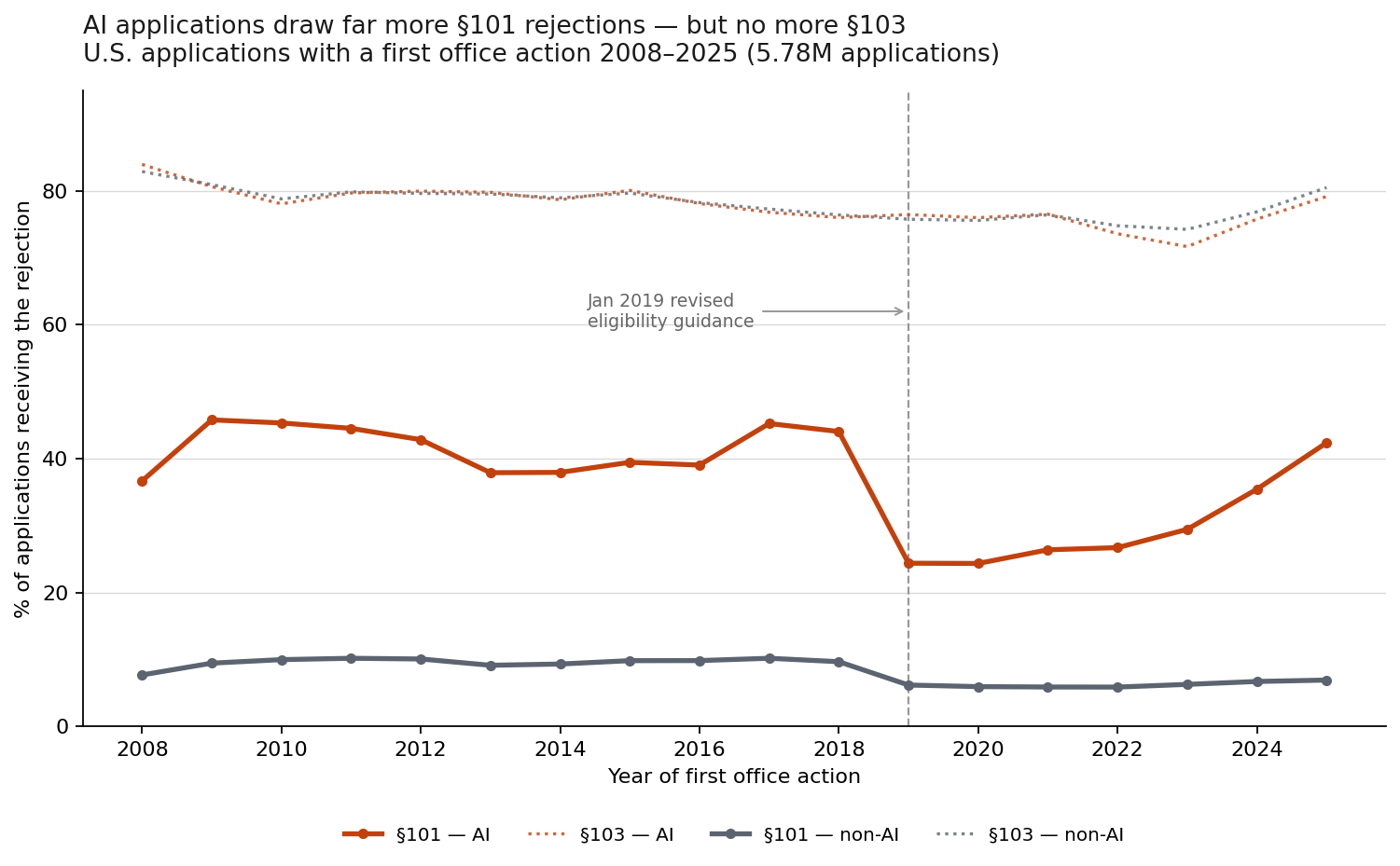
A few years ago the USPTO created an AI-patent classifier that identifies AI related patent applications.  I used that classifier to update activity through 2026. No surprise, AI application receive substantially more 101 eligibility rejections than their non-AI counterparts. An example – among applications whose first office action came in 2025, 42% of those containing AI have so far drawn a § 101 rejection, against 6.9% of those without.  The chart below shows no difference between the two categories for obviousness rejections, both of which hover close to 80%.

Share of U.S. applications receiving a section 101 and a section 103 rejection, AI against non-AI, by year of first office action, 2008 to 2025

As you can see from the chart, the pre-COVID Revised Patent Subject Matter Eligibility Guidance cut the AI §101 rate about in half.  By 2025 that reduction has essentially disappeared. Whereas the eligibility rejection rate in non-AI applications  has not risen. From this data, I cannot tell the extent that the change is tied to changes by applicants in what is being filed or instead changes at the USPTO. (more…)

SCOTUS: Patent Owner Joins the Section 314(d) Cert Queue

by Dennis Crouch

FedEx has asked the Supreme Court to decide whether any court can make the Patent Office follow 35 U.S.C. § 312(a)(2), the requirement that an IPR petitioner identify “all real parties in interest.” The petition in Federal Express Corp. v. Qualcomm Inc., No. 26-170, seeks review of the Federal Circuit’s precedential decision in Federal Express Corp. v. Qualcomm Inc., 174 F.4th 910 (Fed. Cir. 2026), where Judge Hughes wrote for a panel including Judges Cunningham and Stark. The Board in that case refused to decide whether Qualcomm’s IPR petitions had named all real parties in interest, then went ahead and cancelled claims. The Federal Circuit held the refusal unreviewable because a challenge grounded in § 312(a)(2) “boils down to a challenge over whether there should have been institution at all.”

Director Squires has reversed the underlying policy, but still argued that it was unreviewable on appeal.

This is the fifth petition now pending on the reach of § 314(d), and the first from the patent owner’s side of the table. Google LLC v. VirtaMove, Corp., No. 25-1230, Intel Corp. v. Squires, No. 26-73, Tesla, Inc. v. Granite Vehicle Ventures LLC, No. 26-136, and the still-undocketed Kahoot! petition all come from challengers complaining that the Office will not institute. See Dennis Crouch, Four Petitions, One Question: Tesla Joins the Supreme Court’s IPR Reviewability Docket, Patently-O (July 30, 2026). FedEx complains about the opposite: the Office instituted and adjudicated without satisfying a statutory precondition. Earlier this summer the Court denied certiorari in Dolby Laboratories Licensing Corp. v. Unified Patents, LLC, No. 25-1011, which raised the same question about the same agency practice.

(more…)

Rise of OpenAI in the Patent System

by Dennis Crouch

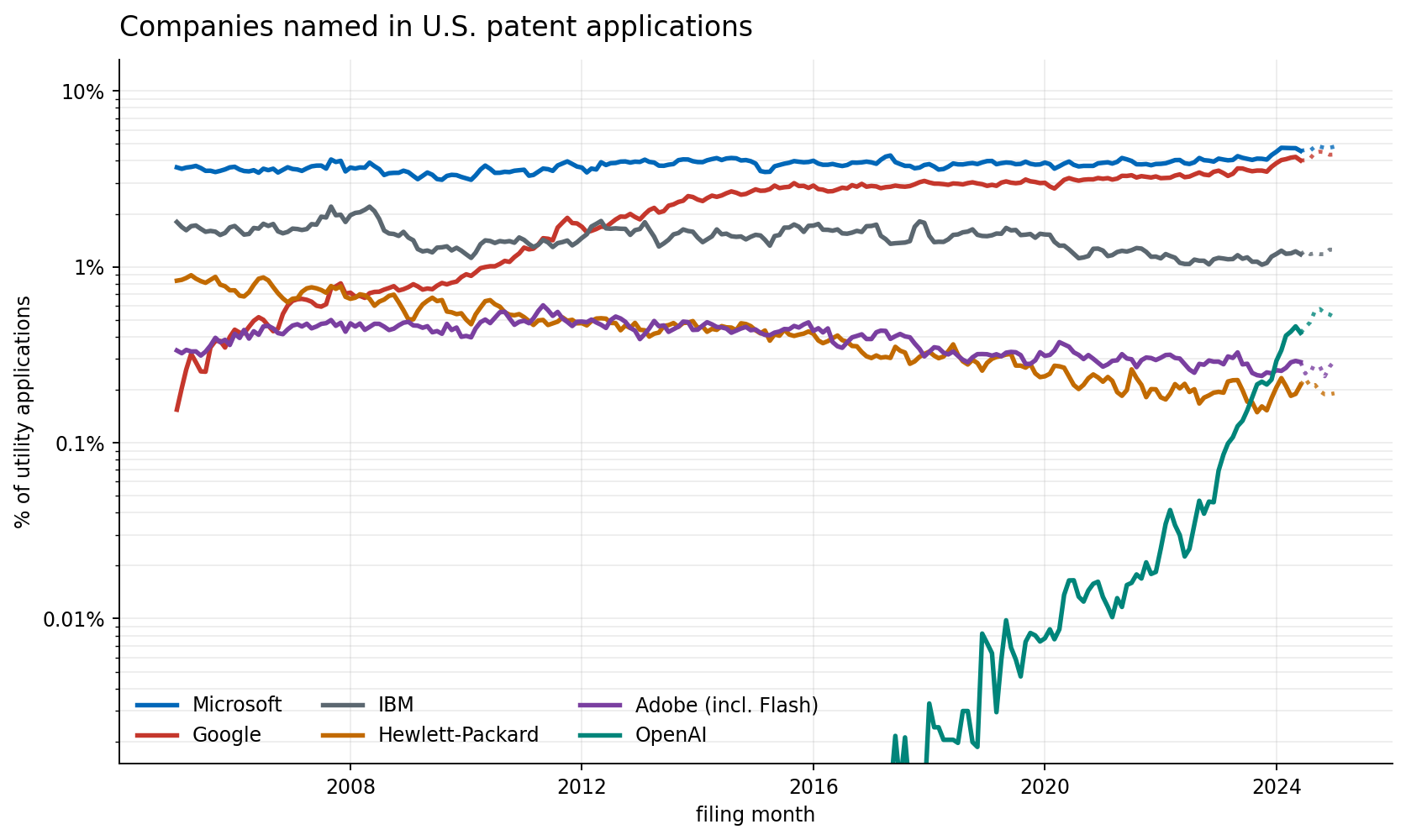
The chart below is on a log scale to help fit the pieces together, but it is interesting to see how OpenAI has risen so rapidly in patent applications. Because of the publication delay, the solid lines run through the end of 2024. The dotted segments that follow cover filing months where publication is still incomplete.

Percentage of published U.S. utility patent applications naming Microsoft, Google, IBM, Hewlett-Packard, Adobe, and OpenAI, by filing month, 2005 through 2025

Reference to Microsoft has remained at roughly 4% of all utility applications for twenty straight years, a nearly flat line running through the mobile transition, the decline of Windows as a share of computing, and the shift to cloud services. Google starts at 0.15% in 2005, passes IBM around 2011, and closes most of the remaining gap on Microsoft by the end of the series. IBM peaks near 2.2% in 2008 and drifts down to about 1.2%. Adobe peaks around 2011 and falls off from there. Hewlett-Packard runs the opposite path, starting near 0.9% in 2005, dropping below Adobe around 2009, and ending at about 0.2%. OpenAI went from nothing to passing both Adobe and Hewlett-Packard in about six years of measurable activity.

(more…)

Judge Newman’s Name may soon be on the Bench, Even if she is Barred from Entry

by Dennis Crouch

Representative Darrell Issa (R-CA) introduced H.R. 10026 on August 3, 2026, a bill that would designate Courtroom 201 of the Howard T. Markey National Courts Building at 717 Madison Place NW as the “Pauline Newman Courtroom.” Room 201 is the Federal Circuit’s main courtroom, where the court hears its argued cases and sits en banc. The bill, titled the Honoring Circuit Judge Pauline Newman Act of 2026, lists a set of findings and the only operative part designated the courtroom name.

Judge Newman has not sat in Room 201 since March 2023. Most recently, the Supreme Court denied certiorari in Newman v. Moore, No. 25-1101 (U.S. June 15, 2026), ending her three-year effort to get some Article III court to reach the merits of her constitutional challenge. Congress wrote the statute that allowed for her suspension, this bill though is only about a nameplate.

(more…)

Partial Retreat: Ten Months of § 101 Data After the Surge

by Dennis Crouch

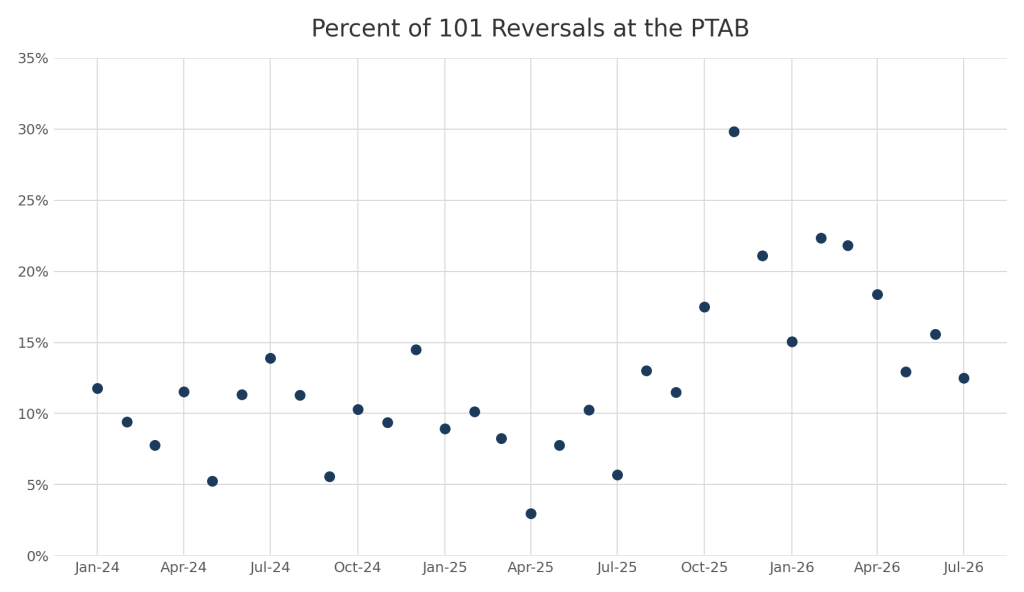
This is the third post tracking Section 101 reversals at the PTAB. The first, PTAB Doubles Section 101 Reversal Rate Under Director Squires (Jan. 2, 2026), reported that the Board’s reversal rate on eligibility rejections roughly doubled after John Squires was sworn in as USPTO Director in September 2025. The second, Recalibration: Seven Months of PTAB § 101 Data (Apr. 23, 2026), found the surge had cooled off its November peak and settled into what looked like a new equilibrium near 20%. Data through July 31, 2026 shows that equilibrium has not held.

Monthly percent of Section 101 reversals at the PTAB, January 2024 through July 2026

The numbers. From October 2025 through March 2026, the Board reversed the examiner’s § 101 rejection outright in 21% of ex parte appeals that reached an eligibility holding. From April through July 2026 the rate is 15%. The pre-Squires baseline, running January 2024 through September 2025, was 9.4%. What we’re seeing here is a partial retreat, not a reversion.

(more…)

Back to 1789: Collision Asks the Federal Circuit to Rewrite the eBay Factors

by Dennis Crouch

Collision Communications filed its opening brief yesterday in Collision Communications, Inc. v. Samsung Electronics Co., No. 2026-1893 (Fed. Cir.), appealing Judge Gilstrap’s refusal to enjoin Samsung’s ongoing infringement of U.S. Patent No. 7,593,492. Paul Clement signed as counsel of record, alongside trial counsel, including Austin Curry, who has shepherded the arguments.

The brief asks the court to vacate and remand with instructions to enter a permanent injunction, resting first on a narrow ground: a district court that has already found ongoing irreparable harm and rejected the defendant’s hardship showing as unsupported cannot then hold that the patentee flunked the balance of hardships. But the brief also asks for more. It urges the Federal Circuit to hold that traditional equitable principles, as they stood in 1789, treat ongoing patent infringement as ordinarily constituting irreparable harm that money cannot remedy.

This is my third post on this dispute. The first covered Collision’s originalist-equity motion and the DOJ-USPTO statement of interest; the second covered Judge Gilstrap’s denial. See Dennis Crouch, “Intitled to Tie Him Up”: Can 18th-Century Chancery Practice Restore Patent Injunctions?, Patently-O (Mar. 2, 2026); Dennis Crouch, Categorical Rules Cut Both Ways: Originalist Equity, NPE Status, and the Symmetry of eBay’s Four-Factor Test, Patently-O (May 20, 2026).

The short version of the decision below: after a $445 million willful infringement verdict, Judge Gilstrap found that Collision had established irreparable harm and the inadequacy of legal remedies under eBay Inc. v. MercExchange, L.L.C., 547 U.S. 388 (2006), rejected the idea that a non-practicing patentee can never satisfy those factors, but then denied the injunction because Collision had not carried its burden on the balance of hardships and the public interest.

Read the appellant brief here: Collision Communications, Inc. v. Samsung Electronics Co., Ltd. – Entry BL-12

(more…)

Boilerplate or Not: Reading “Secure” Broader Than IPSec in MPH v. Apple

by Dennis Crouch

The Federal Circuit today rejected a claim construction that had limited the word “secure” in MPH Technologies’ patents to one particular protocol, IPSec.  The court then vacated the stipulated judgment of noninfringement. MPH Technologies Oy v. Apple Inc., No. 2025-1069 (Fed. Cir. Aug. 3, 2026) (nonprecedential). Judge Stoll’s opinion separately reversed a holding that claim 1 of MPH’s U.S. Patent No. 7,937,581 is indefinite.

I see the case as asking something like “how much slack a patentee gets for imprecise drafting?”

The district court had noted IPSec appears in the ‘949 patent close to 200 times, and the specification says that “[a]n essential idea of the invention is to use the standard protocol (IPSec).”  But, against all of that the panel set a single sentence near the end of the summary of the invention: “The invention is not restricted to the details of the figures and accompanying text, or any existing protocols, such as the currently standardised IPSec.” The panel called the construction question “a very close issue” and held that the one sentence wins, noting that it was not simply boilerplate, but included the specific protocol by name.

On indefiniteness, the district court treated a mismatch in antecedent basis as fatal, but the appellate panel found the scope reasonably certain.

(more…)

Has Patent Term Adjustment Peaked?

by Dennis Crouch

Back in April I wrote that patent term adjustment was still climbing and that the slope showed no sign of leveling. It has now leveled. The six-week trailing average of PTA for newly issued utility patents peaked at 319 days in late May 2026, and has held between 305 and 320 days every week since. See Dennis Crouch, Still Climbing: PTA Hits 318 Days, Back to 2015 Levels, Patently-O (Apr. 21, 2026).

(more…)

Rejection Is Not Denial: What a Final Office Action Actually Costs

by Dennis CrouchPatent Prosecution Odds following USPTO Action, published utility applications filed 2015-2018

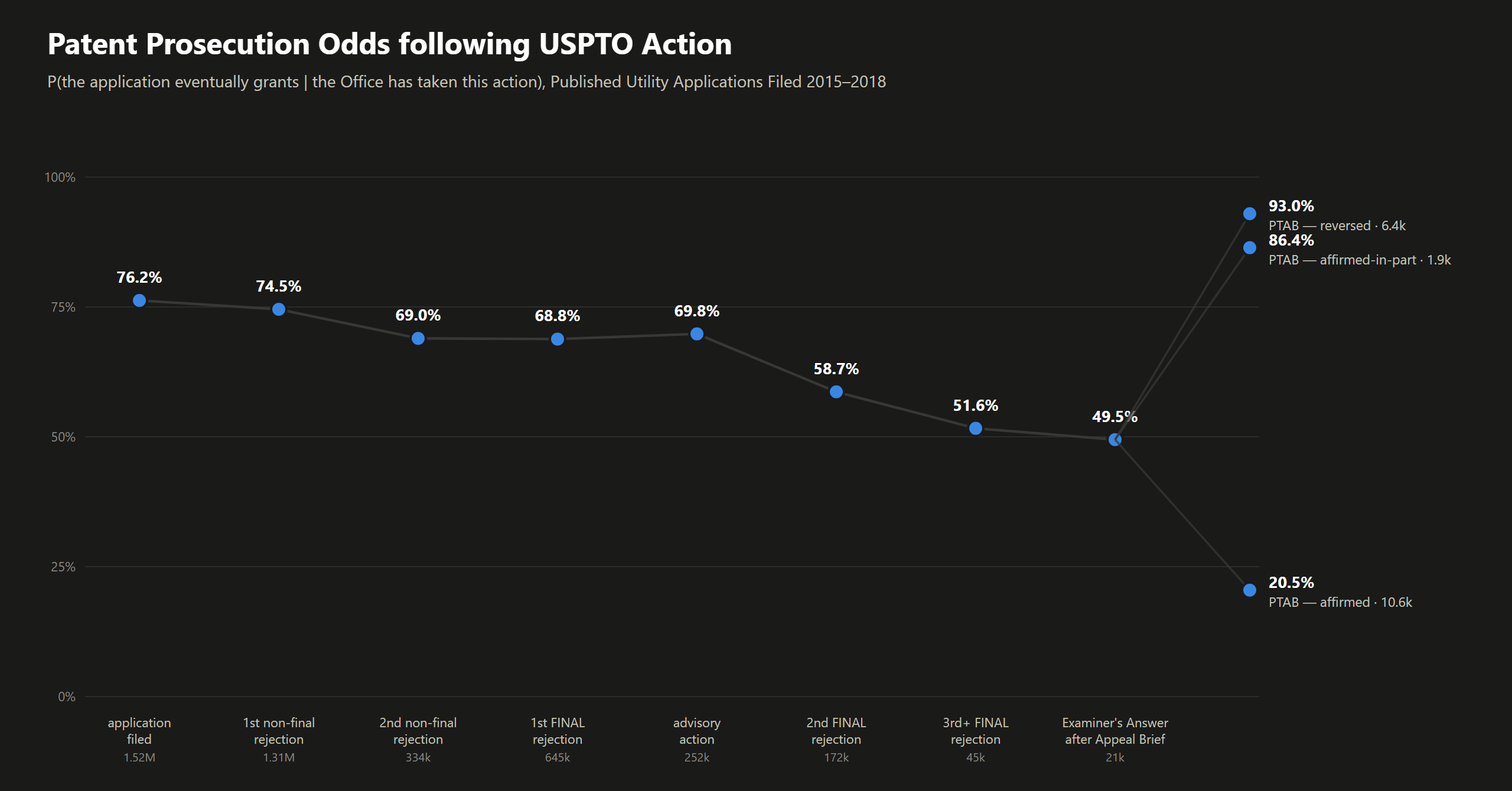
Across the 1.5 million published utility applications filed from 2015 through 2018, 76% eventually issued as patents. A first non-final rejection moves that to 75%. A first final rejection moves it to 69%. The chart above plots this for each action the Office takes: the probability that an application eventually grants, conditioned on the Office having taken that step.

Most applications never get that far. Of the 1.5 million, only about 42% receive a final office action. The ordinary path through the Patent Office is short and undramatic: a non-final rejection, a response, an allowance. Nearly everyone is rejected at least once, though, with first action allowance at about 10%. (more…)

Four Petitions, One Question: Tesla Joins the Supreme Court’s IPR Reviewability Docket

by Dennis Crouch

Four petitions are now pending at the Supreme Court asking whether any court may test the USPTO’s inter partes review (IPR) institution criteria against the statute, or whether agency discretion at the institution stage is truly unreviewable. The newest petition arrived this week: Tesla, Inc. v. Granite Vehicle Ventures LLC, No. 26-136, filed July 27 and docketed July 29, 2026. It joins Google LLC v. VirtaMove, Corp., No. 25-1230, Intel Corp. v. Squires, No. 26-73, and the Kahoot! petition filed July 24, which as of this morning still has no docket number. All four attack the same holding: that 35 U.S.C. § 314(d), which makes the determination whether to institute “final and nonappealable,” insulates the agency from needing to defend its decisionmaking in court.

I have written about the Google and Kahoot! petitions. Tesla and Intel are new here. The four are not duplicates. They occupy different cells of a grid. Two challenge the Fintiv time-to-trial rule (Tesla and Intel) and two challenge the six-year settled expectations rule (Google and Kahoot!). Three arrive by mandamus from a denial of institution (Tesla, Google, Kahoot!) and one arrives from a separate suit under the Administrative Procedure Act (APA) that challenges no denial at all (Intel). Tesla’s petition makes the grid explicit, telling the Court that the cases together present the question “in every relevant procedural posture,” and asking for a grant alongside Google and Intel.

Case Docket Posture Rule challenged Next date
Google v. VirtaMove 25-1230 Mandamus Settled expectations SG brief due Aug. 12
Intel v. Squires 26-73 APA suit Fintiv Response due Aug. 17
Tesla v. Granite Vehicle Ventures 26-136 Mandamus Fintiv Response due Aug. 28
Kahoot! v. Interstellar None yet (25A1279) Mandamus Settled expectations Awaiting docket number

(more…)

The Pre-Dawn USPTO Filing Window

by Dennis Crouch

I was recently looking at timing of USPTO filings. The vast majority come in during the standard US work week, but a substantial number are submitted during off-hours.  For example, during May and June 2025 about 1,300 new patent applications arrived at the USPTO between 3 and 5 a.m. Eastern.  As the chart shows below, about two thirds of these came from East Asia. China accounted for 26% of that pre-dawn volume, Taiwan 19%, Japan 15%, and Korea 6%, with a second cluster out of Germany and Israel.

Applicant origins of new patent applications filed 3 to 5 a.m. Eastern, May and June 2025

When it is 4 a.m. in Alexandria Virginia (USPTO HQ), it is 4 p.m. in Taipei and Shanghai, 5 p.m. in Tokyo and Seoul, and mid-morning in Frankfurt and Tel Aviv.  These are people working ordinary hours on their own clocks whose submissions happen to land in Virginia before sunrise.

But then that begs the question of who is actually submitting to the USPTO – since the Office requires a U.S. patent practitioner.  The natural assumption might be that a U.S. attorney or agent of record is burning the midnight oil – that is not what I found. (more…)

Before the Sensor: Filter Ordering and Self-Collision in Amsted Rail v. Squires

by Dennis Crouch

The Federal Circuit has affirmed the cancellation of claims in Amsted Rail’s railcar monitoring patent, along with the Board’s refusal to let Amsted swap in substitute claims. Amsted Rail Co. v. Squires, No. 2025-1063 (Fed. Cir. July 24, 2026) (nonprecedential). U.S. Patent No. 10,137,915 covers sensor nodes and radios bolted onto freight cars to watch for derailments, damaged wheels, and overheating bearings. Claim 1 recites:

… (b) one or more sensors … configured to measure accelerations of the railcar; and
(c) one or more filters configured to filter at least a portion of the accelerations …

Amsted argued the two elements as a sequence: measure first, filter second. But the panel held that the claim imposes no order, which opened the door to invalidating prior art. Both appeals were argued on June 1: this one and a companion covering two more Amsted patents, which the same panel disposed of on June 3 with a one word Rule 36 judgment.

Figures 4 and 5 of U.S. Patent No. 10,137,915

Ordering. A claim does not require its elements to operate in sequence unless the language, as a matter of logic or grammar, demands it, or unless the specification makes the sequence part of the invention.

Amsted’s hook was the definite article: claim 1’s filters filter “the accelerations,” which Amsted said refers back to the accelerations measured by the sensors. But the Board read “the accelerations” as including physical motion of the railcar rather than the signal alone, and the panel agreed. On that reading a silicone pad that keeps unwanted frequencies from ever reaching the accelerometer is filtering accelerations in the sense claim 1 uses.

(more…)

FRAND at the Pool Level

by Dennis Crouch

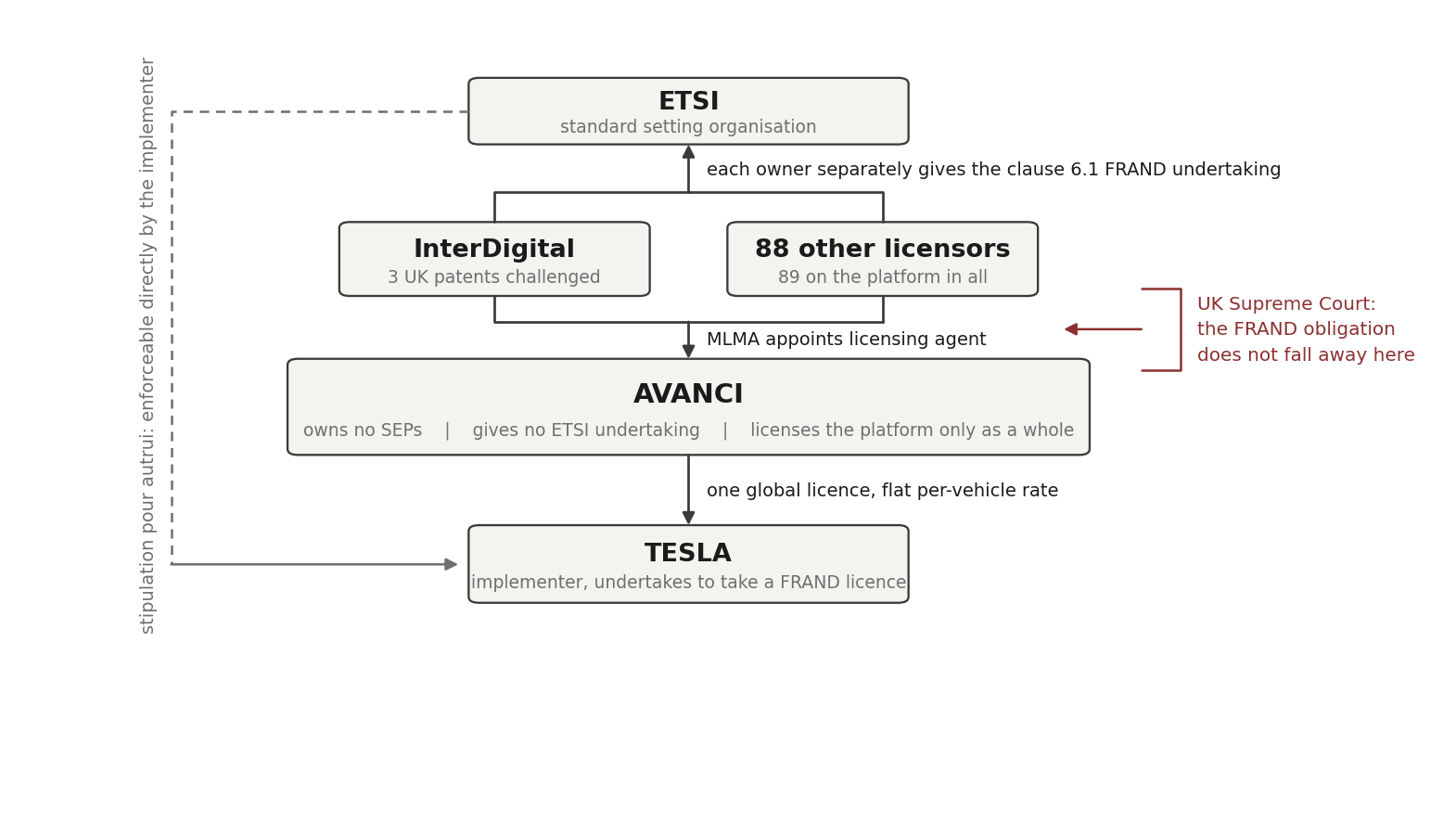
The UK Supreme Court this morning unanimously revived Tesla’s challenge to the royalty charged by the Avanci 5G licensing platform, and held along the way that the Delaware Court of Chancery is not an available forum for the dispute. Tesla, Inc. v. InterDigital Patent Holdings, Inc., [2026] UKSC 27 (27 July 2026). Lord Hamblen and Lord Kitchin wrote jointly, with Lord Sales, Lord Briggs, and Lord Burrows agreeing. The judgment reverses a divided Court of Appeal and adopts Lord Justice Arnold’s dissent on essentially every point. The forum ruling is the piece likely to interest American readers most. Tesla’s parent, both InterDigital entities, and Avanci are all US companies, the defendants offered to submit to Chancery in Del., but the Court still concluded that Delaware was unavailable, reasoning that a US court would probably not set a FRAND rate for UK patents.

The UK Supreme Court: Created by the Constitutional Reform Act 2005 and sitting since October 2009, it took over the judicial work of the House of Lords and is the final court of appeal for civil cases from England and Wales, Scotland, and Northern Ireland. It has twelve justices, styled Lord or Lady rather than Justice, and most appeals are heard by panels of five. Permission to appeal is normally decided on the papers by a panel of three, and the court below may also grant it. The Court of Appeal refused Tesla permission here; the Supreme Court granted it.

Avanci owns no standard essential patents. Rather, it runs a patent pool, which it calls a platform, acting as licensing agent for 89 companies that do (including InterDigital). Each of those companies has promised ETSI, the European body that writes the 5G specification, to license its essential patents on fair, reasonable and non-discriminatory terms. Avanci offers vehicle makers one global license covering the whole pool at a flat per-vehicle rate (the judgment’s illustration uses $32), and it has no contractual authority to license any subset.
To the Court of Appeal majority, each owner promised to license its own patents on FRAND terms and promised nothing at all about the price of the bundle. Tesla was therefore suing on a promise nobody had made. The Supreme Court disagreed, holding that Tesla has a real prospect of showing that a patent owner stays bound by its commitment when it licenses collectively, and a real prospect of showing that the only FRAND license of InterDigital’s UK patents in the pool is the pool license itself, at a rate the court sets.
Schematic showing FRAND commitments running from InterDigital and 88 other licensors up to ETSI, the licensors appointing Avanci as licensing agent, and the single pool license offered to Tesla

(more…)

Two Pages of Testimony: JMOL of Anticipation in Board of Regents v. Boston Scientific

by Dennis Crouch

Board of Regents of the University of Texas System v. Boston Scientific Corp., Nos. 2024-2062, -2063 (Fed. Cir. July 27, 2026), erases a $42 million Delaware jury verdict and holds that Boston Scientific was entitled to judgment as a matter of law on both invalidity and infringement.

Judge Taranto wrote for a unanimous panel, finding (1) UT’s U.S. Patent No. 6,596,296 is anticipated by a 1994 patent on gradual-release fibers; and (2) Boston Scientific’s drug-eluting stent does not contain the claimed “fiber” and so does not infringe. This is the second time the dispute has reached the Federal Circuit; the first was the 2019 venue appeal, where UT tried and failed to invoke state sovereignty to keep the case in Austin. Dennis Crouch, Sovereign Indignity: Texas must Litigate its Infringement Case in Delaware, Patently-O (Sept. 6, 2019).

To be honest, it is a bit wild for a defendant to win JMOL of anticipation. Courts grant JMOL to a party bearing the burden of proof only in extreme cases, particularly so here where invalidity requires clear and convincing evidence.  District Court Judge Williams denied the motion below on that very ground.

On the last of the four asserted claims, the entire body of evidence was the prior art reference and roughly two transcript pages from Boston Scientific’s expert, with nothing in response from UT.  In order to win invalidity on JMOL, that evidence should have been so strong that the jury was not at liberty to disbelieve it, leaving invalidity as the only conclusion a reasonable juror could reach.

This decision aligns with the many examples of the past few years of the Federal Circuit freeing itself to set aside jury verdicts. See Dennis Crouch, EcoFactor: Did the Federal Circuit Unconstitutionally Displace the Jury?, Patently-O (Sept. 29, 2025). The Seventh Amendment objection to the practice reached the Supreme Court this term in Finesse Wireless LLC v. AT&T Mobility LLC, No. 25-953, asking whether the Federal Circuit may second-guess a jury’s assessment of expert credibility on a cold record. The Court denied certiorari in June.

(more…)

A Cleaner Test Case: Why Kahoot! Adds Fire to the Supreme Court’s Settled Expectations Docket

by Dennis Crouch

The USPTO’s “settled expectations” policy now has a second challenger at the Supreme Court. On July 24, 2026, Kahoot! AS filed a petition for certiorari (docket number pending) asking the Court to review the Federal Circuit’s order in In re Kahoot! AS, No. 2026-119, 2026 WL 519635 (Fed. Cir. Feb. 25, 2026), a two-page per curiam mandamus denial from Judges Taranto, Mayer, and Stark. The petition presents the same two questions already pending in Google LLC v. VirtaMove, Corp., No. 25-1230:

  1. Whether the agency has statutory authority to deny inter partes review institution based on a patent’s age, given that Congress set a nine-month minimum age for IPR petitions but no maximum; and
  2. Whether 35 U.S.C. § 314(d) bars judicial review, even by way of mandamus, when a denial rests on grounds contrary to the statute.

Igor Timofeyev of Paul Hastings is counsel of record, joined by Naveen Modi and Rudy Kim. Ginger Anders of Munger Tolles filed the Google petition. Kahoot! asks the Court to grant and consolidate the two cases, or alternatively to hold its petition for Google. [Kahoot – Certiorari Petition with appendix.]

I wrote about the Google petition when it was filed and again when seven amicus briefs arrived in late May. The PTO waived its response, but the Court requested a response. The Solicitor General obtained an extension to August 12, 2026, while VirtaMove went ahead and filed its brief in opposition on July 13. A call for a response is no guarantee of anything, but it means at least someone at the Court wants the government to defend the policy before the petition is resolved. The two cases also offer a key factual difference with regard to settled expectations: Google’s challenged patents had been in force for more than fourteen years, while Kahoot!’s target was less than six years old on the day the IPR petition was filed.

(more…)

Anonymous No More: Real-Party Disclosure Comes to Ex Parte Reexamination

by Dennis Crouch

The USPTO has proposed to end anonymous ex parte reexamination as we have known it. A notice of proposed rulemaking scheduled for Federal Register publication on July 22, 2026 would add 37 CFR 1.510(b)(7), requiring every third party request for ex parte reexamination to include a statement identifying all real parties in interest to the request. Docket No. PTO-P-2025-0545, RIN 0651-AD94. Comments are due 30 days after publication, or about August 21. A requester may ask that the statement be kept confidential, and the Office would then exclude it from the patent and reexamination files. But confidential is not the same as secret. A key part of the rule is that the Office would know who is behind a request even when the public does not.

Inter partes review has always demanded that a petitioner name all real parties in interest: the statute lets the Office consider a petition “only if” it does so. 35 U.S.C. 312(a)(2). Ex parte reexamination never has. Section 302 lets “any person” request reexamination, and Section 301(e) lets that person ask to have its identity excluded from the patent file and kept confidential. Anonymity here is a congressional design feature that has sometimes made reexamination attractive, but that feature appears gone.

(more…)