Life has a funny habit of going full circle. At least mine does.
A couple of weeks ago I was talking with my kids about the new UK Defence Investment Plan, parts of which commit us to developing advanced drone technology by 2030. I couldn’t help but make the point that Ukraine were developing new drones almost monthly, and they were under constant attack. Needing four years sounded like a joke. We quickly started talking about the concept of innovation out of necessity.
Then, last night I stumbled across a fascinating paper published last summer by the Swedish Entrepreneurship Forum focussing on Ukraine’s world-leading drone industry, which made the very same point. They argue it wasn’t created through conventional entrepreneurship, government planning or commercial ambition. Instead, it emerged because ordinary engineers, software developers, volunteers and small businesses were confronted with an existential crisis that demanded immediate action.

The authors describe this as ‘reluctant innovation’, drawing directly on the concept in my book, The Rise of the Reluctant Innovator. In their case they define it as innovation driven not by profit, prestige or long-term strategy, but by necessity and an overwhelming desire to solve urgent, real-world problems. In other words, a full-scale invasion by Russia.
What’s particularly interesting is that, rather than focusing on a handful of heroic inventors, the paper explains how thousands of citizens became innovators almost by accident. Existing technical skills, volunteer networks and grassroots initiatives combined with rapid government reforms, supportive procurement policies and international partnerships to create a decentralised innovation ecosystem capable of producing hundreds of drone designs in just a few years.
But perhaps the most striking finding for me is that the Ukrainian experience reinforces the central argument behind my book that many of the world’s most transformative innovations emerge not because people set out to innovate, but because circumstances leave them with little choice. Faced with immediate human need, individuals stop asking how they might ‘invent something’ and instead ask how they can solve a very real problem. In other words, innovation becomes an outcome rather than the objective.
You can download a copy of the paper, ‘Ukraine’s Drone Industry’, here. The Rise of the Reluctant Innovator is now out of print, but you can buy second hand copies online or very cheaply on Amazon for Kindle. There’s also a free PDF available on the kiwanja website here.
Thanks again to Pontus Braunerhjelm and Maryna Brychko for a fascinating paper, and for their openness and transparency in the use of my earlier work.
]]>We’re entering an era where our greatest challenges are no longer purely technical. Think artificial intelligence, climate change, space exploration, biodiversity loss, human rights and global health, among countless others. Every one of them demands extraordinary innovation, but innovation alone is not enough.
We also need perspective.
The most successful organisations of the future won’t simply be building better things. They’ll be asking better questions. They’ll understand people as deeply as they understand engineering. They’ll recognise that curiosity, empathy and exploration are strategic advantages, not luxuries.
That’s where an Explorer in Residence comes in.
An Explorer in Residence is not another consultant, not another executive, and certainly not another expert with a ready-made framework. They’re an explorer. Someone whose role is to travel across disciplines, challenge assumptions, connect seemingly unrelated ideas, ask difficult questions and help organisations see opportunities that others miss.
For more than thirty years I’ve explored the intersection of technology, anthropology, conservation, humanitarian work and social innovation. I’ve learnt that the most valuable insights rarely emerge from staying within the boundaries of one profession. They emerge at the edges, where different worlds collide.
Every frontier organisation reaches moments where the next breakthrough isn’t another process or another meeting. It’s a different conversation. So if you’re building something ambitious and believe your organisation could benefit from an Explorer in Residence, I’d love to talk.
The future won’t simply belong to those who innovate fastest. It will belong to those who remain curious the longest.
]]>It’s been a challenging week. Not as challenging, of course, for those who continue to suffer in Gaza, the West Bank, South Lebanon and beyond, but challenging for me in a different kind of way.
My LinkedIn posts, whatever the topic, tend to come from a place of genuine curiosity, compassion or concern. Anyone who knows me will be aware of my heightened level of sensitivity, my ‘empathy overdrive’ as I often call it. It’s something I struggle with, not rejoice in. So when I post about unimaginable human suffering that most of the world seems to be ignoring, I don’t expect to have to justify calling it out. I assume that the feeling of sadness, anger and frustration would be universal. Suffering is suffering, and it shouldn’t be necessary to debate whether some suffering is acceptable while some is not.
At least that’s what I would hope.
But defend myself I have. Over the last few months I’ve found myself repeatedly challenged by those who believe the deaths of 75,000 civilians in Gaza is somehow okay, that they deserved it in some way, and that any country should have the right to do whatever it likes in order to defend itself. It’s the same with Lebanon. The argument goes that the displacement of millions, the deaths of thousands and the levelling of entire towns and villages in the south is fine because the objective is self defence, even if those being killed and displaced have nothing to do with the conflict. “Our lives, and our right to live in peace, is greater than anyone else’s”.
From what I can tell there are a handful of ‘common justifications’ for the war, and the repeated violations of the ceasefire and humanitarian law, in Gaza in particular:
- October 7th
- Hostages (less relevant now)
- ‘They’ want Israel annihilated
- Hamas must be completely defeated
- Preventing future attacks
- Buffer zones for security
- Hamas uses civilian infrastructure for military purposes
- Israel ‘has no choice’
- Everyone in the strip is a terrorist and therefore a legitimate target
Some of my posts start with the words ‘Buts aside’ because I refuse to believe that anyone could be proud of what’s being done in their name. How anyone can’t feel an ounce of remorse or concern for any of this is beyond me. Because the numbers speak for themselves.
- In Gaza there have been 72,819 reported civilian deaths and 172,894 wounded. Over 20,000 children have died, and 45,000 injured
- At least 235 journalists and media workers have been killed in Gaza, despite claims they are never targeted
- The World Health Organisation has documented 735 attacks on health care facilities in Gaza, including 35 attacks on hospitals. This is not just immoral. It’s illegal under international humanitarian law
- In Southern Lebanon, 16 hospitals have been damaged in recent weeks, and 147 ambulances have been attacked. Five hospitals have been forced to close. There are no tunnels under these hospitals
- UN satellite analysis has identified 123,464 structures destroyed in Gaza with another 198,273 damaged. 81% of all structures in the strip have been hit
- Roughly 60% of Gaza’s population – approximately 1.2 million people – have lost their homes
- Tens of thousands of properties have been systematically demolished in Southern Lebanon since the ‘ceasefire’ in a 600 square kilometre ‘buffer zone’
- Israel’s far-right National Security Minister Itamar Ben-Gvir released a video of him taunting foreign flotilla activists who were bound and tied on the ground after their arrest and detention
- UN Human Rights report that Israeli forces and settlers have killed 1,054 Palestinians in the West Bank, including East Jerusalem. Over 760 settler attacks have been documented since the outbreak of war, the majority supported and encouraged by Israel’s far right government
- The UN recently added Israel to its ‘blacklist’ for sexual violence in conflict zones, a significant international condemnation reflecting documented allegations of abuse by detained flotilla activists and broader concerns about the treatment of Palestinian detainees
- Over 3,000 people have been killed by Israeli attacks on Lebanon in the past three months
- Over a million people in Gaza remain in urgent need of basic shelter and humanitarian relief
- The list goes on
People can agree with it or not, or feel it is justified or not, but these things have all happened, or continue to happen. The only thing that appears to be in dispute is whether or not the victims deserved it, which is a hard pill to swallow.
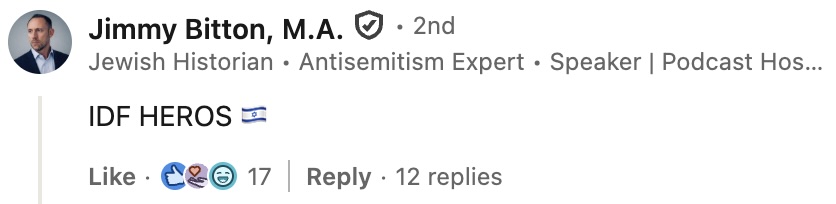
I truly get the anger and distress caused by October 7th, if we take just one justification for the war. What happened that day was horrific, barbaric and inexcusable. But so has been the response. Yet I don’t see a single comment from anyone sharing an ounce of regret or demonstrating any embarrassment or shame for the extreme actions of the Israeli government. None. Many just cheer on the IDF and say how amazing it all is, and what heroes they are. And then they wonder why the tide of public opinion is increasingly turning against them. But not to worry – just call all critics antisemitic and ‘jew haters’ and they’ll soon be scared into submission. That’s the tactic, anyway.
On many occasions I’ve tried to respond honestly to supporters of the war in my effort to genuinely understand the mindset of those I don’t agree with. But so far it’s proved virtually impossible. On top of the killing, the suffering and the distress of everyone living in Palestine, Iran and Lebanon, my biggest disappointment is the lack of humanity shown by the aggressors – on both sides. I’m still waiting to have a conversation about all of this, one that comes on all sides from a place of genuine concern and acceptance that this level of suffering is wrong.
One day, as Omar El Akkad puts it brilliantly in his book, everyone will have always been against this. But right now it feels like much of the world is washing its hands of the whole sorry saga, and meanwhile the killings – and the arguments justifying it all – go on.
]]>It’s been nearly four years since I wrote my last book. Given I’m not a professional writer who makes a living from the art, that’s fine. But last week a book idea came to me out of nowhere, and in the spirit of not resting on my laurels I got to work on it straight away.
 The universe delivered and I published it yesterday. The Little Book of Mindful Social Change is the first time I’ve written down my philosophy to social change – ideas and strategies and behaviours learnt over many years in many places.
If you care deeply, think carefully and wonder if helping might just add to the noise, this book is for you. It’s for people who believe deep down that change should be thoughtful, humane and grounded. Not rushed, performative or driven by ego.
Drawing on years of real-world experience with kiwanja.net and FrontlineSMS, the book looks at what actually makes a difference. And it’s not grand strategies or shiny tools but quiet adaptations, humility, deep listening and trust in local knowledge. The most meaningful impact often comes from letting go. Letting go of control, of certainty and of the need to be right.
Running through this short collection of observations is a gentle exploration of mindfulness, Buddhism and inner work, offering a steady counterbalance to the urgency and intensity that so often surround social change. The book speaks honestly about the risks of good intentions, the harm that can come from moving too fast, and the importance of acting with care, respect, love and humility.
In the spirit of collaboration, friendship and inclusivity, the book is available as a free PDF here. It is also available on Amazon Kindle here, and will soon be available in paperback and hardback.
]]>“Terrible things are happening outside. Poor helpless people are being dragged out of their homes or off the street. Families are torn apart. Men, women and children are separated. Children come home from school to find that their parents have disappeared”.
This quote is taken from Anne Frank’s diary in an entry dated January 13th, 1943. Yet any Palestinian could have said it any time over the last 60 years, or any American any time over the last 12 months.
At some point in their lives roughly one in every five Palestinian men in Gaza and the West Bank have been arrested – or abducted – and detained without charge. Just stop and think about that for a moment. Several thousand Palestinians are still held in Israeli detention centres or prisons. Indefinitely. Without charge.
Hundreds of those are children.
In the USA, ICE agents arrested a mind-blowing 328,000 people during 2025. Out of those, 327,000 were deported. Four people were killed during attempts to arrest them. Protestors aren’t safe, either. Just remember what happened last week.
And in the UK last summer, thousands of elderly protesters – including an 83-year-old Anglican priest, a 79-year-old Holocaust survivor’s daughter and an 89-year-old retired psychotherapist – were arrested for demanding an end to genocide in Gaza.
These are all acts of democratically elected governments.

If you thought this could never happen in the ‘civilised West’, think again. The rules-based order we’ve all come to depend on is being pulled apart right in front of our eyes. Laws are being applied selectively, power overriding accountability and norms once taken for granted are being openly ignored.
We might not know how to put an end to these horrors, but let’s not pretend they’re not happening.
One day they might come for you.
]]>Many moons ago, during two happy years as a Visiting Fellow at Stanford University, I had the pleasure of meeting more than my fair share of Valley multi-millionaires (and the odd billionaire). Back in those days there were plenty of them about and many – after years of playing nasty as they built their businesses – decided it might be a good idea to develop a bit of a conscience and do something good with all their wealth. I enjoyed sharing my work with them, explaining how emerging mobile technology was helping reshape the humanitarian and conservation sectors, and how FrontlineSMS was at the forefront of much of it. I could never have done what they’d achieved, but I did get some comfort knowing that their work hadn’t had the kind of positive impact mine had.
One thing constantly niggled me back then though, and twenty years later it still does. Meeting those wealthy individuals who only decided to turn their attention to making the world a better place after they’d got rich, made me wonder if I’d done things the right way round. While they were ruthlessly building their startups, I was either building schools or doing conservation work in East Africa or running primate sanctuaries in Nigeria. While I was busy laying the foundations for a career in social impact, opportunities to join the tech boom and make a few quid were passing me by.
Would it have been better for me to try and make some serious money like them, and only then focus on doing good?
 When I did eventually do something impactful with FrontlineSMS, when I stepped back people assumed I’d got rich from it. After all, it was incredibly successful and had scaled to just about every country on earth. But the reality was very different. FrontlineSMS was always a free tool, it had no business model behind it, and when I stepped away there was no big pay day.
I now look back with envy at those who are able to self-fund their ideas. As I reflect on a lengthy career trying to do the right thing – while at the same time looking at how messed up the world has become – the need feels greater than ever. At a time in my life when I should probably be stepping back and slowing down, I’m as engaged and motivated and driven than ever.
So, if you’re reading this and by some crazy twist of fate we happened to have met in the Valley in 2007 or 2008, and you’re still looking to invest some of your hard-earned cash in doing a little good in the world, I’d love to talk. In the new year I’ll be throwing everything I’ve got at my new project, apathy to action, and I could do with a little help.
]]>For the past few months I’ve been working on apathy to action, a project that aims to help people move from feeling overwhelmed by global crises to taking meaningful, emotionally grounded action. The idea is simple but powerful – combine behavioural science, mindfulness and modern technology to help people reconnect, re-engage and rediscover their agency in a world that can feel paralysing and overwhelming.
The basic concept has already been sketched out, and I’m now looking to take it to the next level.
 To do that I’m seeking a small amount of seed funding from a high-net-worth individual, an angel investor or a charitable foundation who sees both the urgent need and the enormous potential. The funding will give me six months to fully focus on building out the core concepts for the app and website, refreshing my coding skills, and preparing the platform for private beta release.
Why does this matter?
Because millions of people care deeply about the world but feel stuck – emotionally exhausted, disconnected and unsure where to begin. If we can help even a small number shift from apathy to meaningful action, the ripple effects could be profound.
Why support this?
Because it’s a rare opportunity to invest a relatively small amount in a project that could have significant global social impact, led by someone with a long track record in social innovation. I’ve spent two decades creating and promoting tools that genuinely empower people, and ‘apathy to action’ has the potential to be my most impactful work yet.
If you’re interested in being part of this journey, or know someone who might be, please share this post or reach out.
Because when we trade silence for courage, even the smallest action can spark a wave of change.
You can read more about the project on the apathy to action website here.
Thank you.
]]>Most of us have pondered the miracle of life at some time or another. It’s hard to get your head around, but Bill Bryson breaks things down in ‘A Short History of Nearly Everything‘ in the most incredible way. He writes:
To begin with, for you to be here now trillions of drifting atoms had to somehow assemble in an intricate and curiously obliging manner to create you. It’s an arrangement so specialised and particular that it has never been tried before and will only exist this once. For the next many years (we hope) these tiny particles will uncomplainingly engage in all the billions of deft, co-operative efforts necessary to keep you intact and let you experience the supremely agreeable but generally under appreciated state known as existence.
As if that weren’t enough, our home planet is equally as amazing. Earth isn’t even the tiniest speck of dust on the vastest of stages. In the grand scheme of things we’re irrelevant. The universe we can actually see (forget everything we can’t) stretches approximately 93 billion light-years across – a distance so incomprehensible that light, traveling at 186,000 miles per second, would take 93 billion years to cross it. And our galaxy is just one of an estimated two trillion galaxies scattered throughout space. We might feel like the centre of the universe, but we’re far from it.

‘Pale Blue Dot’ is a photograph of Earth taken on February 14th, 1990 by NASA’s Voyager 1 spacecraft from a distance of about 3.7 billion miles (6 billion kilometres) away. In the image, Earth appears as a tiny, almost imperceptible blue speck suspended in a band of scattered sunlight, highlighting the planet’s fragility and smallness in the immensity of space. It sure is lonely out there.
We haven’t even touched on the sun, an ‘average’ star among roughly 400 billion other stars in our galaxy. But get this. Earth orbits it at a distance of 93 million miles, a position so precisely calibrated that scientists call it the ‘Goldilocks Zone’. Too close and we’d be scorched like Venus (which has surface temperatures reaching 900 degrees Fahrenheit). Too far, and we’d freeze like Mars, where water exists only as ice. This delicate positioning represents one of countless astronomical miracles that make life on Earth possible.
Sometimes it all feels so unreal, it’s tempting to think it’s not real at all. Are we really here?
The conditions required for life as we know it are also staggeringly specific. Earth’s atmosphere contains exactly the right mixture of gases – 78% nitrogen and 21% oxygen – while its magnetic field deflects lethal cosmic radiation that would otherwise sterilise us and everything else alive. Our unusually large moon stabilises our rotation, preventing catastrophic climate swings that would make complex life impossible. Even our location within the Milky Way is fortuitous. We’re far enough from the chaotic galactic centre to avoid being bombarded by radiation, yet close enough to benefit from the heavy elements created by all those exploding stars. We literally wouldn’t be here without them.
Indeed, this is perhaps the most staggering thing of all. The carbon in our muscles, the iron in our blood and the calcium in our bones were all forged in the nuclear furnaces of ancient stars that lived, burned and died billions of years ago. When these massive stars exploded as supernovas, they scattered precious elements across space, eventually coalescing into new star systems, planets and, ultimately, us. This is precisely the miracle that Bill Bryson was getting at earlier.
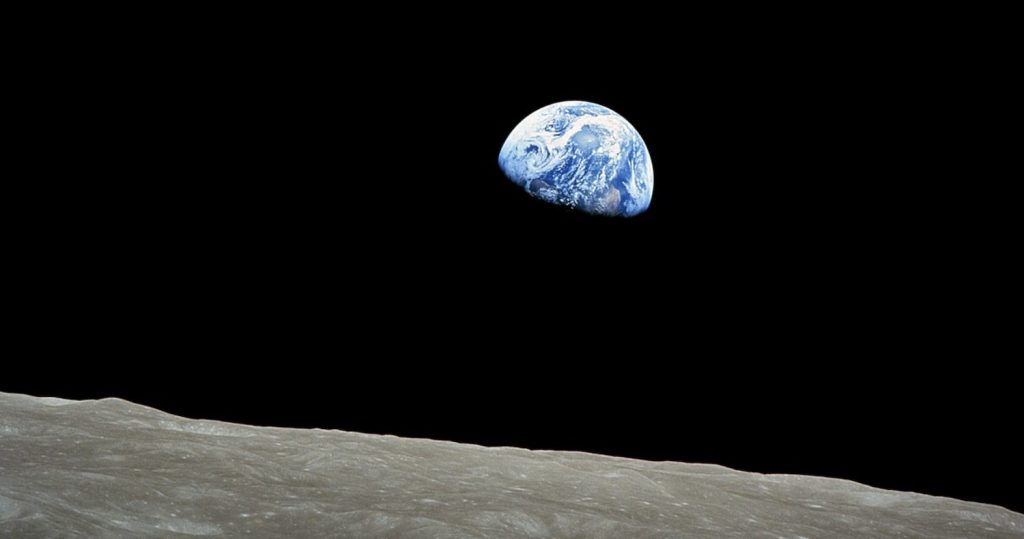
‘Earth Rise’, an image captured by Apollo 8 astronaut William Anders in 1968, shows our planet rising above the lunar horizon, a powerful reminder of Earth’s beauty and fragility.
As far as we know we’re alone out there, a singular miracle not repeated any time over tens of billions of years in the vastness of space. And this is what really gets me. We just don’t know how lucky we are. Everything is a miracle. Earth is the greatest cosmic gift of all.
So why is humanity so hell bent on throwing it all away?
We’ve transformed our pale blue dot into a battlefield of endless conflicts where nations wage war over neighbours divided by invisible lines on a map, all while the very miracles that sustain life collapse around us. Our species, gifted with unprecedented intelligence and technology, chooses to poison the air we breathe, acidify the oceans that regulate our climate and drive countless other species into extinction.
Perhaps, more tragically, we’ve allowed greed and short-term thinking to override the long-term survival of us and and our miracle planet. While we possess the knowledge and capability to live happily and sustainably as one species, instead we continue strip-mining our finite resources, pumping greenhouse gases into the atmosphere and treating Earth as if we have somewhere else to go. We’ve turned our miraculous home into a dumping ground for plastic waste, chemical pollutants and nuclear materials that will outlast entire civilisations.
This conscious self-destruction represents the ultimate cosmic irony. The most complex known creation in the universe – human consciousness – actively working to destroy the very conditions that allowed it to emerge.
I think about this a lot. And whether there’s really anything I can do to stop it.
]]>I don’t yet have an insightful opinion of AI that warrants a blog post of any kind, but I have found one aspect particularly fascinating. You see, the openness of my approach to work over the past 22 years turns out to be something of a goldmine in our brave new AI-driven world. Since 2003 I have regularly blogged my ideas and thoughts, and I’ve posted up dozens of copies of articles I’ve written, including PDFs of my books, and shared audio interviews and videos of many of my talks. While there’s certainly going to be a down-side to all of this (deep fakes anyone?) it also means that tools like Claude and ChatGPT know plenty about me, my work, and my work ethos.
That means I can ask it questions. And when I do, I sometimes get the most surprising answers.
Recently I asked ChatGPT how my work ethos over the years might touch on traditional Buddhist thinking. Not only did I get what I thought was an impressively deep answer, I discovered that it thought that ‘kiwanja Buddhism’ was actually a thing. Of course, it would have meant a lot more to me if a Buddhist monk had told me that, but I’ll take AI for now.
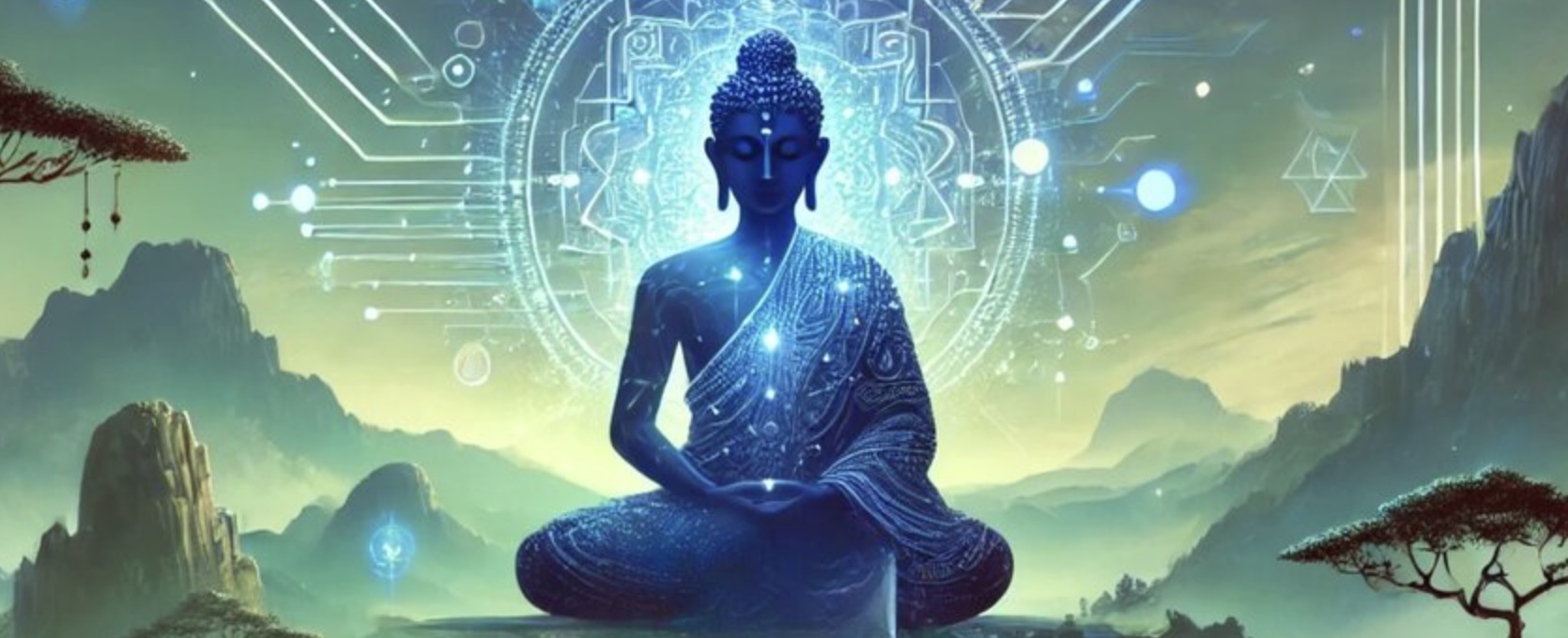
Here’s what ChatGPT said.
kiwanja Buddhism refers to a perspective where Buddhist principles like mindfulness, compassion, interdependence and wise speech are applied to the fields of social impact and entrepreneurship. It’s a practical, non-dogmatic approach championed by Ken Banks on the website kiwanja.net, emphasising deep listening, intentional action and fostering empathetic, sustainable change in the world.
Key Concepts
Mindful action
Taking time to understand problems deeply before acting, avoiding knee-jerk reactions.
Compassion
Leading with kindness, listening to all perspectives and seeking solutions that uplift everyone, rather than acting from anger.
Interdependence
Recognising that all issues, like environmental problems and inequality, are connected and cannot be solved in isolation.
Wise speech
Engaging in truthful, kind and unifying communication rather than spreading anger or division.
Deep listening
Truly hearing others’ suffering and perspectives without judgment to foster empathy and understanding.
Letting go of ego
Focusing on the true impact of work for social good, rather than personal recognition, status or credit.
How it is Applied
Social innovation
Using Buddhist principles to inspire a shift from apathy to action, leading to technology-based solutions that promote empathy and change.
Coaching and mentoring
Guiding change makers to slow down, reflect and act with greater intention and wisdom.
Development work
Encouraging a deeper, more empathetic approach to addressing global challenges like inequality and environmental destruction.
If anything, this is an incredibly accurate reflection of how I’ve tried to go about my work over the years. Anyone who has read this blog or heard any of my talks will recognise all of the points that ChatGPT raises.
Sometimes it’s more about how you go about what you do and not what you actually do. So if kindness and empathy are the only things I’m remembered for, I’ll be more than happy with that.
In my last post I wrote about how I’d decided to offer my skills completely free of charge to any legitimate Israeli or Palestinian organisation working on Gaza relief, Palestinian humanitarian causes or broader justice initiatives in the region. I’d had enough of standing by and witnessing all the suffering, and doing nothing about it. Maybe that’s how you’ve been feeling, too.
A big thank you to everyone who engaged in the LinkedIn version of that post – liked it, shared it or commented. Every interaction means a lot, and encourages others to speak up.
There was quite a lot of interest from others who also wanted to help, so I promised to share my approach in a separate post – which you’re reading here.

I decided to break my offer down in four separate but distinct areas. You might find this helpful as you think about how you might be able to help yourself.
⦿ Hard skill: Offer to do something I usually get paid for for free.
⦿ Soft skill: Become a mentor to those needing support.
⦿ Financial: Identify a small number of initiatives/organisations to donate to.
⦿ Social: Join an online community focused on the people and the issues.
I also decided to do all of this openly in the hope that it might encourage others to do the same. But it’s also totally okay to do it privately. Some people will have no choice.
Finally, I was thinking about listing the organisations (and individuals) that I’ve been recommended this week, but they may not want me to. Instead, if you found my approach useful and could do with a little help yourself, drop me an email – heretohelp@kiwanja.net – and I’d be happy to try and join some dots for you. I appreciate it’s sometimes confusing knowing who to support when there’s so much need.
Thank you.
]]>A while back I took the plunge on LinkedIn and started sharing posts about the war in Gaza, hitting ‘Like’ and ‘Share’ and thinking I might in some way be doing something useful. At the very least I was speaking up, something many people also on LinkedIn seem afraid to do. (Refusing to stay silent on issues that matter is something I’ve previously written about here).
But honestly? I’ve reached a point where posting feels hollow when people are dying and suffering on such a massive scale.
The statistics are hard to ignore, yet many people seem to manage it. Over 65,000 dead, children starving, entire communities displaced, whole villages raised to the ground, members of the press gunned down or blown up by the hundred.

I can’t shake the feeling that my comfortable screen-based outrage isn’t enough anymore – if it ever was.
I now realise I need to do more than just call out the death and destruction. So I’ve decided to start offering my skills completely free of charge to any legitimate Israeli or Palestinian organisation working on Gaza relief, Palestinian humanitarian causes or broader justice initiatives in the region.
I’m not looking for recognition, or for social media content. I’m not even sure what impact I might have. But I do know that if I have skills that could help get even a slither of aid where it’s needed, or help amplify minority voices, or support organisations doing real work on the ground, then I should.
Sitting on the sidelines isn’t an option anymore. So I’m now ready to help with:
⦿ Creative, engaging content for campaigns, websites, newsletters
⦿ Storytelling and creative writing
⦿ All-things social purpose, start ups and social impact
⦿ Proof-reading, copy editing or sense-checking reports or papers
⦿ Strategy conception and development
⦿ Coaching and mentoring
⦿ Technology support, and advice on innovation
⦿ General encouragement and support
There’s more on what I can offer on my coaching site here.
If you’re working with an organisation that could use help, or know of reputable groups that need the kind of expertise I could provide, please reach out – or like or share this post. I can be reached on heretohelp@kiwanja.net
Help me channel my frustration into something that actually matters.
Thank you.
]]>Imagine your neighbour’s house is on fire, but you’re too busy scrolling through social media to call for help, or you just assume someone else will handle it. Scale that up globally, and you’ve captured how public apathy operates during major crises.
Public indifference isn’t just inconvenient – it can be deadly. When people mentally check out from global problems governments lose political pressure to act, funding disappears and windows of opportunity close. The psychology behind this is well-documented. Our brains respond more to individual stories than mass statistics. One child in a well captivates us. 25,000 children dying daily from preventable causes is easily filed away and forgotten.

The consequences can be devastating. During the 1994 Rwandan genocide, 800,000 people died in 100 days while public pressure for intervention remained virtually nonexistent. Climate change offers another stark example. Despite scientific consensus since the 1990s, Yale research shows only 8% of Americans are worried enough to take action, giving politicians cover to delay meaningful responses for decades.
History does, however, show that apathy can be overcome. Live Aid concerts in 1985 transformed abstract Ethiopian famine statistics into urgent, actionable concern for millions. The 2014 ALS Ice Bucket Challenge used social media to raise $115 million and massive awareness for a rare disease. Environmental movements have learned to make climate change feel local and immediate rather than distant and abstract.
The most effective strategies combine emotional storytelling with clear actions, make distant problems feel personal and local, and give people confidence their contributions matter. Youth climate activists like Greta Thunberg have been particularly successful at creating urgency around problems that for many seemed distant.
Breaking through public apathy isn’t about making people feel guilty, though. It’s about understanding human psychology and designing engagement accordingly. As global challenges intensify, overcoming indifference isn’t optional – it’s existential. The biggest problems facing humanity can only be solved when enough people decide it’s worth solving.
If you feel confused, angry, disenfranchised or simply frustrated at the state of the world, check out my new project, apathy to action. You are not alone.
]]>