Put
a foot on a rock. Choose

one route through millions of pebbles. Follow
clearly seen, sometimes pain-filled paths, or abandon
people's spoor & artefact. Wander. Smell

peats' waters. Sniff

dry limestone's,
    rhyolite's, granite's, or grit's
                dusts as ground's scuffed. Inhale

subtle or pungent sap sprays as plants are squeezed. Flex...

("Walk" from Steps (Longbarrow Press)
One has to step, and one has to choose to start some/where, and one has to decide to follow the trail that may be already there, or not — “wander” with and through the features and elements of land/scape. “Walk” (and Steps) encompass the physical, kinesthetic elements of moving through felt geographical spaces. It incorporates the sensory impacts from what those spaces hold, both in the moments of stepping, the “to” of “here to there”, and in the sense of now to then, durational time. It allows a double imperative, both directional and an acknowledgement of potential or the lived experiences and leavings of others along those same paths, the actualities of what is under hand and under foot, the specifics of what is there: limestone, rhyolite, granite, and their mixed breakdown, grit.
“Walk” evokes the relationship between the physiology of the body-in-movement and the physical features of landscape, a sort of synchronicity from moment to moment that doesn’t constitute reflective thinking, so much, as, through the body, grasping/intuiting what is already there and taking in — a coordination (in text, aided by the stylistic use of enjambment):
                     ....Leap
from friction-patch to
     friction-patch amongst algae-coated boulders rounded

by mountain's blood. Step

and step in time to flow

vibrant meat-encased bone over
soil and stone. Without knowing

know

("Walk" from Steps (Longbarrow Press)
Here, there are parallels and inversions of visceral, actual entities: “algae-coated boulders” shaped by the flow of water (“mountain’s blood”) and the flow of movement by the body over earth (“vibrant meat-encased bone”). The rock, obscured by algae, is described in a way counter to the body, which is described through pure function: energy (“vibrant”) and mechanics (“meat-encased bone”). Movement does comprise a situational “Not knowing/know” dynamic; this last paired line similar to taking a step into, the physical gap, the kinetic motion, between footfalls. And, perhaps, the body “knows” before the mind’s knowing is actualized…and we are landed, balanced for a moment, on “know”, with a space above, and that space below, before maybe we decide, again, to “Put/a foot on rock…”
Along some parts of the trail, there are bits of tin and iron, tires, wheel tracks, and other forms of land shaping that point to prior farm activity and perhaps more recent dumping. Many trails in this region run through present day agricultural landscapes: landowners give access to hikers and walkers through organizations like the Cataraqui Conservation Authority or the Rideau Conservation Authority (who helped, here, with trail development and marking), or the land is bought by conservation authorities (in some cases, it is given as a charitable gift). As a result, these remnants are fairly common, pointing to tool obsolescence and, depending on the remnant, resource use. Why pieces are piled or dropped where they are found (or uncovered) can sometimes emerge from conversations with older generations or just remain as gaps within rural versions of settler, familial, micro place-based histories.
Remnants also present themselves, more elusively, in the lines of geology and altered landscape that abut forms of economy and industry: forests become agricultural fields, built toward drainage, generally shaped for efficiency and allotment. Rock mounds at the edge of fields or tree islands that the farmer tills and harvests around are indicative that such plans as property designation are human constructs. Dams, put in place for greater power, augmenting an already visible flow from a creek or river because of an expectation (or actuality) of increased supply and demand, are another form of remnant — evocative, in days of climate change, of a kind of loose fulcrum on which seasonality balances. The rough rock dams along the trail, overflow from small and larger wetlands, are further bolstered by beavers and, possibly, conservation area management, in the form of lengths of maple and ash, laid haphazardly (against the pattern of rock), pushed against by leaves and the water itself over time. Is it possible that the cement structures that make up some dams will serve one day to remind of drainage basins and creek patterns, or, alternatively, become overwhelmed with the challenge of water; future changes in climate steering agricultural fields, and water, toward other or hybrid forms of production.
Remnants in the form of cultural impact are found in language: early French traders and settlers to Ontario created the words “Cataraqui” and “Gananoque” as place names or descriptors that they adapted from Iroquoian language. The terms “Algonquin” and “Mississauga” are similarly mis-adaptations of the languages that the French heard spoken and then applied, through the filters of the ear and language.
Of resonance and importance are indigenous life, lands, history, languages and nationhood. Marble Rock was part of landspace within the territory and interconnected knowledges of the St. Lawrence Iroquois, who settled along the St. Lawrence lowlands and river. After contact with the French, British and Dutch, the Mohawk, (eastern members of the Haudenosaunee Confederacy) moved into the areas occupied by the St. Lawrence Iroquois, who had dispersed – possibly through migration, conflict, and dwindling numbers. By the late 1700’s, the traditional territories and grounds of the Omamìwìnini (Algonquin) and Misi-zaagiing (Mississauga) peoples, within the Anishinaabeg family, was north, west and east from Mohawk territories along the St. Lawrence, to the Ottawa river. The “Crawford Purchase” (1783), loosely describes through letters (the record lacks sequentially clear documentation) a series of negotiations between the British, Mohawk and Misi-zaagiing for land in this region. After losing the War of Independence, the British wanted to reward loyalty with land and settlement in Canada; lands that traditionally belonged to the Omamìwìnini were included in the negotiations with the Misi-zaagiing without consultation with the Omamìwìnini. With British settlement came a British notion of land title, ownership, governance, industry and defence in this area. The past history and contemporary realities of land, settler acknowledgement and treaty negotiations (still ongoing) in Ontario and Canada as a whole is complex and tied deeply to reconciliation.
Roughly sixty to seventy km NW of Marble Rock is Perth, Ontario, roughly an hour’s drive by car, depending on the route. Local historian Ken W. Watson’s research and writing about early colonists’ roadwork and mapping from Brockville to Perth (in 1816) is a good starting point for matching maps to transportation routes for non-indigenous settlers (note: Gananoque (Marble Rock) is W of Brockville (early maps, Elizabethtown)). Today, a person could take a few days to walk the roadway from Gananoque to Perth — or devise a way by combining roadway, trail networks and paddling routes (also see Ken. W. Watson’s tracing of indigenous paddling routes and the building of the Rideau Canal).
Perth was built (as were other Eastern Ontario communities) as a Loyalist inland defense against American invasion. Record (writing, drawings, surveys) indicates that for the settlers, the heavily forested landscape was physically and conceptually overwhelming and difficult — it was labour intensive (tame the woods) to design it into surveyed plots, to work toward industry through extraction of natural resources, refashion water transportation routes (Rideau Canal) and, through logging, advance development toward agriculture and farm/homesteads. There were medical, cultural and philosophical precedents in landscape reform; this contributed to the biases that screened out the longstanding impacts of settlement on the indigenous peoples already present with their own culture, traditions, and relationships to the land and each other.
Phil Hall’s poem, “Failure”, published in Niagara & Gov’t (Pedlar Press, 2020), is a few kilometres SE of Perth on a section of the Rideau Trail that follows Ferrier Road E. and ventures into a field-to-mixed forest bounded by creek and wetland to the south. After a skip over a small creek, there’s a small rise and entrance to Ferrier Road (W). A short walk of about 200m and a clamber over a stile continues the trail — a hike into field, marsh, and woods, with hills between, toward McLaren’s Point, and onward.
The topo map for the area shows that there is a continuous road that runs through a shallow lake/marsh — this, then, is Ferrier Road proper; it is this wetland that necessitates the division of Ferrier into “E” and “W” segments. If one had an ATV or snowmobile (or liked walking through water), there would be no need to duck into the woods — one would simply carry on straight through it….maybe.
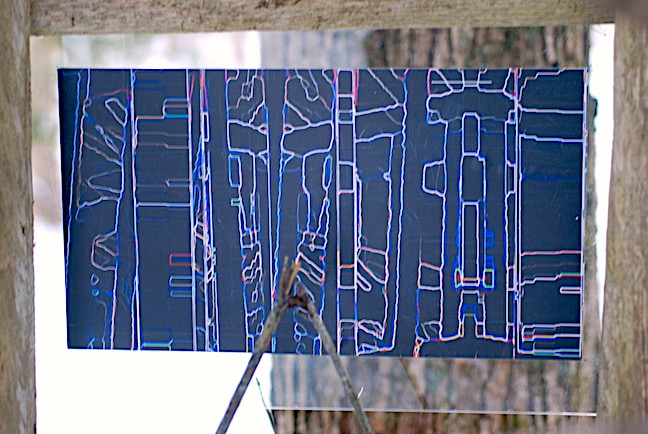
In spring, “Failure” was planted along the section of track that veers off of Ferrier E. In Niagara & Gov’t, “Failure” is typeset with circular, infilled dingbats that separate the poem into sections. In this landscape, however, topography segments “Failure” into five planted stands along different parts of the trail. Printed on seed paper, the poems are affected by airborne microorganisms, humidity, the presence of metals and forms of fungi in a different way than standard paper; the print is more obviously impacted by “foxing” (Phil Hall introduced me to this term), spores, and the outline of seeds themselves. The words are slowly being blotted out by the mould spores and the orange-brown contour-like lines: “Failure” may become obliterated (see etymology); its language a remnant.
“Failure” is a nod to writing unbounded by technology, or the impossibility of this, to the extent of language itself:
 I should print out my new book
scatter its pages in the maple bush   & let it go at that

 but I won't   I'll publish it    if I can

I'll proliferate   by articulate stratagems   the pretense
 of sniff & growl
Hall considers various forms of artefact toward an ironic take on lines and ordering them that exist alongside strategies of marking/making space (“sniff and growl”):
...
my book   will be a creature's denial  of crookedness
 though it parade   as a celebration   of crookedness

living in Mondrian   I would Pollock
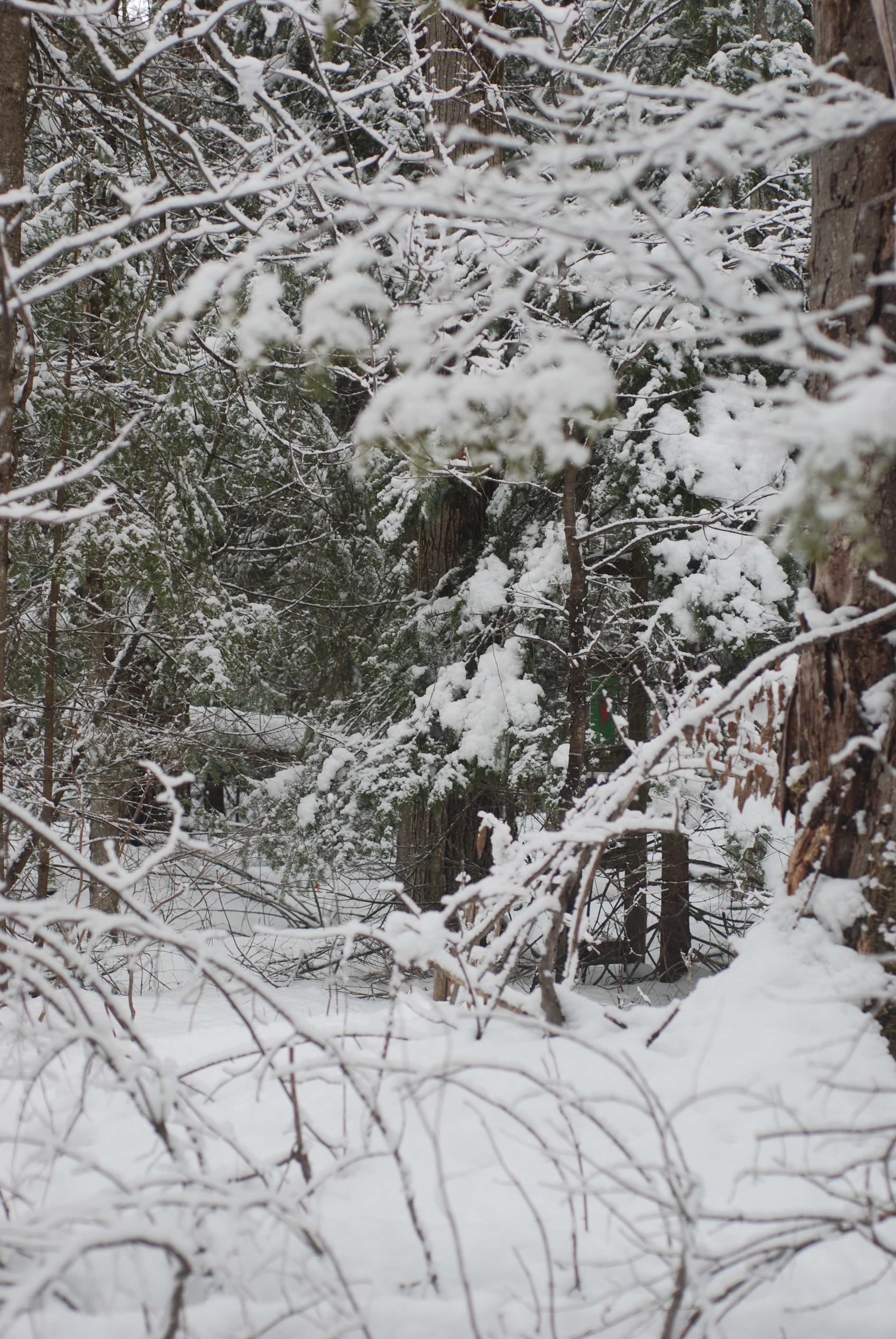
“Failure” is planted within parcels of land that initially would have been surveyed and logged to fit a shape toward agricultural production, despite other landforms also present. To some degree, earlier land uses have made way for others, as people moved or forms of work and industry changed. In addition, species tend not to pay attention to property lines — tracks ease through marsh and forest, birds migrate, and on that first planting, a barred owl watched us from a pine tree while to blue jays harassed it. While walking, we passed (and checked out) discrete piles of iron woodstoves, barrel rings, can piles, fallen cedar or wire fences, and metal sheeting just off trail. In writing, the page is bound by margins, the type set by a series of conventions, the book printed and sent out — Hall notes that the impulse to scatter the pages “in the wet bush”, outside the book form, is a concession to geometry, the form of the page or, in this case, the stand too, and yet there is the possibility of geometry “failing” and an unique result:
 Even to use a printer   to copy pages
for scattering   in the wet bush

would be a concession to geometry   over windfalls

Flaubert's costume   Craft
is technology's costume   Folio

but where geometry fails   scribble here

 we might still find   oval aberrations

& an uncaulked   illiterate horizon

 its pulse
In all, there is a failure of process in the act of writing, too, a result of language, an “unboiled calligraphy”, that’s evaporated, changed from its initial form. It’s not just the lines but the depths of trying to tap language, amid shifts in language-use and the technologies used for production. Hall leaves the poem in suspension, with attempts and failure of fact, a remnant all the same — a folktale “about a claw-hold”:
The actual sap not syrup is clear yet sodden
it tastes of an ancient    cold    language   pre-process
 my poems   bow & scrape   for lack of
pretend to know   but can't

 that unboiled calligraphy   I keep trying for
is only a folk  tale   about a claw hold
(Niagara & Gov't : Pedlar Press, 84-85)






 rout/e