Andrei Molodkin says he has gathered 16 works of art – which he estimates are collectively worth more than $45m (£42.77m) – in a 29-tonne safe with an “extremely corrosive” substance. (*)

Inside the vault are boxes containing the art and a pneumatic pump connecting two white barrels – one with acid powder and the other with an accelerator that could cause a chemical reaction strong enough to turn the safe’s contents to debris, Molodkin claims.

The project – called “Dead Man’s Switch” – is being backed by Assange’s wife Stella, whose husband is awaiting his final appeal against being extradited to the US, where he faces charges under the Espionage Act.

The Wikileaks founder is wanted in America over an alleged conspiracy to obtain and disclose national defence information following the publication of hundreds of thousands of leaked documents relating to the Afghanistan and Iraq wars. The 52-year-old denies any wrongdoing.

He has been held in London’s Belmarsh prison for almost five years and will have his final appeal heard at the High Court in London on February 20 and 21.

Assange’s supporters say he faces 175 years in prison if he is extradited. His lawyer claims the Australian’s life “is at risk” if the appeal fails.

Molodkin told Sky News: “In our catastrophic time – when we have so many wars – to destroy art is much more taboo than to destroy the life of a person.

“Since Julian Assange has been in prison… freedom of expression, freedom of speech, freedom of information has started to be more and more repressed. I have this feeling very strongly now.”

The Russian dissident has refused to reveal which pieces of art are inside the safe but says it includes works by Picasso, Rembrandt, Warhol, Jasper Johns, Jannis Kounellis, Robert Rauschenberg, Sarah Lucas, Santiago Sierra, Jake Chapman, and Molodkin himself, among others.

He says this will be done by “someone close” to Assange confirming he is still alive in prison each day – which will mean the timer can be reactivated.

If Assange is released from prison, the works of art will be returned to their owners, Molodkin adds.

He admits “many collectors are really scared” about the acid going off accidentally but insists the work has been done “very professionally”.

Molodkin says he would feel “no emotion” if the art was destroyed because “freedom is much more important”.

WHO IS CONTROVERSIAL ARTIST ANDREI MOLODKIN?

Andrei Molodkin made headlines last year after selling blood-soaked copies of Prince Harry’s memoir.

The artist had previously projected a sculpture filled with the blood of Afghans on to St Paul’s Cathedral.

Both stunts were in protest over Harry’s remarks in his book about his number of kills in Afghanistan.

Previously, to coincide with the World Cup in Qatar, Molodkin unveiled a replica of the World Cup trophy that slowly filled with crude oil. It had a symbolic price of $150m – a figure that matched the amount of money allegedly spent on bribes and kickbacks to FIFA officials.

Molodkin also presented a sculpture of the White House that reportedly contained the radioactive blood of Nagasaki-born men to commemorate the 77th anniversary of the Hiroshima and Nagasaki atomic bombs.

In 2022, Molodkin showcased a glass portrait of Vladimir Putin which was filled with the blood of Ukrainian soldiers. An image of the artwork was said to have been live-streamed near Moscow’s Red Square as Mr Putin oversaw Russia’s Victory Day parade.

Back in 2013, Molodkin opened an exhibition called Catholic Blood that featured an installation where he pumped blood donated solely by Catholics around his replica of the Rose Window at Westminster Abbey, which he saw as a Protestant symbol.

Mrs Assange, who has two children with her husband, told Sky News: “Which is the greater taboo – destroying art or destroying human life?

“Dead Man’s Switch is a work of art. Julian’s political imprisonment is an act of real terrorism against democracy.

“The true targets here are not just Julian Assange but the public’s right to know, and the future of being able to hold power accountable.

“If democracy wins, the art will be preserved – as will Julian’s life.”

Assange has been held at Belmarsh prison since his arrest in April 2019 after leaving the Ecuadorian embassy in London, where he had claimed political asylum in June 2012.

The UK government approved Assange’s extradition to the US in June 2022.

(*) = https://news.sky.com/story/acid-to-destroy-picasso-rembrandt-and-warhol-masterpieces-if-julian-assange-dies-in-prison-artist-claims-13070078

American politicians, and Americans themselves, love to call themselves “a nation of immigrants”: a place where everyone’s family has, at some point, chosen to come to seek freedom or a better life. America has managed to maintain that self-image through the forced migration of millions of African slaves, restrictive immigration laws based on fears of “inferior” races, and nativist movements that encouraged immigrants to assimilate or simply leave.

But while the reality of America’s immigrant heritage is more complicated than the myth, it’s still a fundamental truth of the country’s history. It’s impossible to understand the country today without knowing who’s been kept out, who’s been let in, and how they’ve been treated once they arrive.


Where we come from

    1. We’re all immigrants

      This map from the 2000 census colors each county according to which country most of its residents cite as their “ancestry.” What might be most surprising about this map is the predominance of light yellow in Appalachia; in those counties, more people say their ancestry is simply “American” than anything else. But this is a strikingly recent phenomenon: the number of people saying their ancestry was “American” nearly doubled from 1990 to 2000. It’s amazing that in a country that’s been around for more than 200 years — with many family lineages having lived in the New World for even longer — most people are still able to identify their ancestry based on the countries in which their families lived before they immigrated to the United States.

    2. The very first American migration

      Even the first Americans were immigrants — it’s generally accepted that they came across “Beringia” (the land that’s now the Bering Strait, the body of water between Russia and Alaska) at least 20,000 years ago (and possibly as long as 30,000 years ago). But scientists are still trying to piece together when the first Americans came through Beringia; how many of them there were; and whether they came all at once, or in multiple waves.

      This map, from a 2007 paper, is based on an analysis of mitochondrial DNA — which children inherit only from their mother, making it easier to trace one line back for many generations. The researchers hypothesize that the group that came to Beringia from Asia, approximately 25,000 years ago, actually stayed in Beringia for some time before some of them came through to the Americas. Then, however — according to this analysis — they populated the Americas fairly quickly, spreading as far south as Chile by 15,000 years ago. The analysis also suggests that some early Americans migrated back to Asia from Beringia, while other, newer waves of immigrants crossed to America.

    3. America has more immigrants than anybody

      Later waves of European immigration killed off most of the first Americans (largely through European diseases, which traveled through the Americas much more quickly than European humans did). That set the stage for European Americans to rebrand the United States, in particular (where indigenous populations were almost completely “replaced”), as a “nation of immigrants.” Even today, America is still home to more total immigrants than any other country in the world. In this map, each country’s size is distorted to reflect the size of its immigrant population. It’s based on 2005 data, but a 2013 UN report shows that 19.8 percent of the world’s international migrants live in the United States.

    4. …but as a share of the population, the US doesn’t crack the top 10

      As much as American politicians pat themselves on the back for representing “the most welcoming country in the world,” there are smaller countries that have been more open to immigrants in recent decades. So on this chart from the Organisation for Economic Co-operation and Development (OECD), which measures the percentage of each country’s population that was made up of immigrants in 2000 (the orange dot) and 2010 (the blue bar), America doesn’t even hit the top 10. Some of the countries that outrank the United States are tiny — it’s much easier for 40 percent of Luxembourg’s population to be immigrants, since the country has only 540,000 people, than it would be for the United States — but medium-size countries like Canada, Australia, and Spain also outrank the United States.

    5. The simplest explanation of how immigration to America has changed

      If this feature were called “A nation of immigrants in one map,” this is the one we’d show you. The bottom line: before 1965, Germany sent more immigrants to America than anyone else; after 1965, Mexico did.

      Here’s why: from World War I to 1965, the immigration system was designed, essentially, to keep the United States white. Rice University sociologist Stephen Klineberg has called it “unbelievable in its clarity of racism.” Each country was given a certain quota of immigrants who were allowed to come to the United States each year, based on who’d been in the country in 1890.

      Combined with existing laws that prevented any Asian Americans from coming into the country, the laws of the 1920s basically froze the demographics of the immigrant population in place until 1965.

    6. The Danish Utahns, and other immigrant enclaves

      This GIF, compiled by internet hero @MetricMaps, tracks where immigrants from different countries have settled in the United States. The result is an exhaustive portrait of more than two dozen different native countries and regions. Some ancestry groups pop up in interesting places, revealing forgotten pockets of American history — the Danish population in Utah, for example, is the result of an extremely early wave of Danish conversion to the Church of Jesus Christ of Latter-Day Saints (Mormons).


    Forced migration, then and now

      1. David Eltis and David Richardson/Atlas of the Transatlantic Slave Trade, reprinted with permission of Yale University Press

        Forced migration built America

        The American myth about “a nation of immigrants” excludes millions of forced migrants to America from Africa, who were brought to the US over two centuries of the trans-Atlantic slave trade. It’s hard to overstate how much slaves built America: according to historian Steven Deyle, the value of all slaves in 1860 was seven times the value of all currency then in circulation in the United States. Slave labor built the agrarian economy of the South and fed the cotton mills of the industrializing North. But slaves had no way to become citizens, build wealth, or bring their families — they had no opportunity to practice the self-reliance that America often expects of its immigrants.

      2. David Eltis and David Richardson/Atlas of the Transatlantic Slave Trade, reprinted with permission of Yale University Press

        The first illegal migrations were of trafficked slaves

        The forced migration of Africans to America also represents the first unauthorized migration to the United States. The Constitution banned the “importation” (trafficking) of slaves into the United States after 1809, but black-market slave trading continued until the Civil War. According to historian David Eltis of Emory University, 1.5 million Africans arrived in the Americas after the countries they landed in had theoretically banned the slave trade. Because there were no restrictions on voluntary migration to the United States until the 1880s, these were the first people to come to the country illegally.

        The Atlas of the Transatlantic Slave Trade documents 78,360 slaves landing in mainland North America from 1800 to 1865 — about 20 percent of all arrivals over the 200 years of the slave trade. (Since slave importation wasn’t banned until 1807, many of those arrivals could have been legal.)

      3. Modern-day forced migration: human trafficking

        Large-scale human trafficking is no longer legal, let alone widely condoned. But it still happens. This graphic is one attempt to map the global reach of the contemporary human-smuggling industry.

        A report by the Urban Institute in 2014 interviewed 122 victims of labor trafficking in the United States, and found that 71 percent of those traffickedactually had legal visas when they arrived in the country. But because immigrant workers’ legal status is tied to their employer, most victims who escaped their traffickers had lost their legal status by the time they were connected to law enforcement. Furthermore, the report found, public officials often encountered labor-trafficking victims and failed to realize what was going on — or, worse, sided with the traffickers and threatened to report the victims to federal immigration agents.


      A nation of immigrants

        1. The most famous immigrant in American history

          Give me your tired, your poor;
          Your huddled masses yearning to breathe free;
          The wretched refuse of your teeming shore;
          Send these, the homeless, tempest-toss’d, to me;
          I lift my lamp beside the golden door.

          —Emma Lazarus, 1883

          Of course, the Statue of Liberty was itself an immigrant. It was designed and cast in copper in France over the span of a decade, from 1876 to 1884, as an intended gift from the French government to the United States. But the statue then had to wait in France for several months until the Americans had done enough work on its pedestal. It was then shipped to the United States in 350 separate pieces, housed in 214 crates, to be assembled by American workers once it arrived.

        2. An insanely detailed map of immigrants in America from 1903

          This exhaustive map includes 51 infographics (for each state plus Washington, DC). The right column of the infographic covers how many immigrants settled in the state each year; the left column shows their occupations. The top depicts the ethnic mix, color-coded by race: Teutonic, Keltic, Slavic, Iberic, Mongolic, and “all others.”

          At the time, those racial labels were real — and the source of anxiety. A medical journal article from this era expressed concern about the “preponderance of the Iberic and Slavic races” among recent immigrants, because of “their poorer physical and mental equipment” compared to “Celtic and Teutonic” immigrants.

        3. How charities helped immigrants become American

          The organization Hull House (founded by Jane Addams) was devoted to serving Chicago’s urban poor; in the process, it set the template for charity in America. And most of Chicago’s urban poor were immigrants: in 1890, in fact, immigrants made up 77 percent of the city’s population. To better tailor its services to the communities it served (and to assist the federal government in its study of urban “ghettos”), Hull House researchers produced maps like this one, which shows the ethnicity of each immigrant family living in a given tenement block.

          The result was that Hull House increasingly focused on teaching English, civics, and other skills that would help immigrants and first-generation Americans assimilate — what would be called the “Americanization” movement. The existence of organizations like Hull House, which were willing to take the time to help immigrants acclimate to America and learn things (like English) that they needed to succeed, was an important factor in helping the European immigrants of 100 years ago assimilate to the point where they simply counted as “white” Americans.

        4. Are today’s immigrants less Americanized?

          The “Americanization” movement of the early 1900s wasn’t just about how to help immigrants. It was also grounded in the belief that immigrants should be welcomed to the United States only if they wanted to, and could, be successfully assimilated into America. That idea survives today, in everything from the metaphor of the country as a “melting pot” to the demand that immigrants “learn English.” But while “learning English” is shorthand for assimilation, and despite fears that this generation of immigrants is less assimilated than their forerunners, immigrants to America in the late 20th century were much more likely to know English when they got here, or to pick it up quickly, than the immigrants who lived at Hull House. Even Latino immigrants, who lag behind other immigrants (who tend to be more educated) in how long it takes them to speak English, perform much better than the European immigrants of the 1880s.

        5. The grandchildren of today’s Latino immigrants barely speak Spanish

          Second-generation Latinos — the children of immigrants — tend to be fully bilingual; this might mean they’re used to speaking with their parents in Spanish but using English outside the home, or just that they’re in situations where they deal with Spanish and English speakers pretty much equally. And with the third generation, who are grandchildren of immigrants, bilingualism fades quickly. In fact, the proportion of immigrants who speak mostly English (35 percent) is bigger than the share of Latinos who are thoroughly bilingual in the third generation.

        6. Immigrants are saving the Midwest

          More Americans are leaving Middle America than moving there (with the exception of North Dakota). But immigrants are forestalling Middle America’s demographic decline. A Chicago Council study in 2014 found four metro areas (including Davenport, Iowa, on the Illinois border, and Duluth in eastern Minnesota) that grew between 2000 and 2010 solely because of the immigrant population, and another five where immigrants made up more than 50 percent of the metro area’s total growth over that time. But immigrants might be having an even bigger impact in rural areas in Middle America, where the demographic crunch is most acute. In Kansas, immigrants make up 5.3 percent of the rural population; in Nebraska it’s 4.8 percent. Just as importantly, immigrants are making these areas demographically younger. The Chicago Council report found that Wichita, Kansas, for example, lost 24 percent of its 35- to 44-year-old, native-born population from 2000 to 2010 — but its immigrant population in that age range grew by 87 percent.


        A nation of (immigration) laws

          1. 200 years of immigration in one gorgeous visual

            It’s easy now to assume that Mexico has always been among the main sources of immigration to America. But as this wonderful chart by Natalia Bronshtein (using 200 years of government data) shows, that’s not even close to true. There’s an interactive version on Bronshtein’s website: you can hover over any color, at any point, and see the exact number of immigrants who became residents from that country in that decade. But taken as a whole, the chart tells a very clear story: there are two laws that totally transformed immigration to the United States.

          2. The 1920s law that made immigration much less diverse — and created illegal immigration as we know it

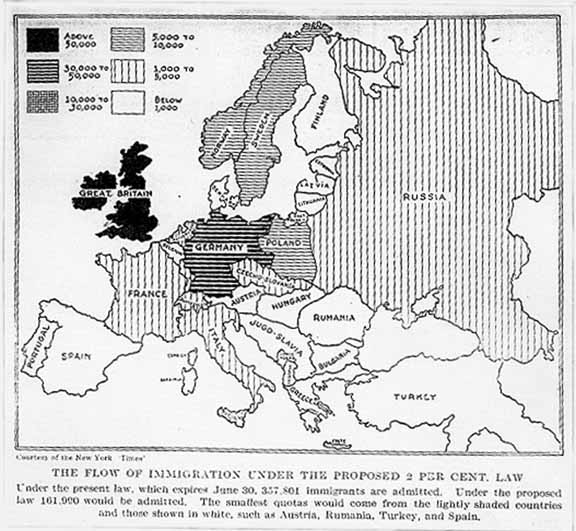
            Because the quota laws were passed in the early 1920s, but were based on immigration flows from 1890, they actually rolled back immigration from certain countries. Politicians were worried that new immigrants from Southern and Eastern Europe (largely Italians and Jews) were genetically “inferior” immigrant stock was threatening Americans’ quality of life. This pair of maps, from the New York Times, shows the effects of the primary quota law: the National Origins Act of 1924. The map to the left of the slider shows annual immigration to America from various European countries before the law was passed; the map to the right of the slider shows the quotas imposed for each country under the law. The National Origins Act forced the legal immigrant population to plummet — and made “illegal immigration” a widespread phenomenon for the first time in American history. It hasn’t stopped since.

          3. How America began to rely on Mexican labor

            With World War II causing labor shortages, the United States started to encourage seasonal labor from Mexico. As the map shows, the 2 million braceros who came under the program (from 1942 to 1964) migrated from all over Mexico to most of the United States. Most worked in agriculture, under punishing conditions: according to some reports, braceros were sprayed directly with DDT (an insecticide now known to be carcinogenic and toxic to humans). The bracero program was supposed to prevent migrants from settling in the United States by sending 10 percent of their paychecks back to Mexico. But many braceros returned to Mexico only to discover their money had not. Many Mexican Americans are descended from braceros, and the memory of their mistreatment colors their opinions of guest-worker proposals today.

          4. America’s only been a global destination for the past 50 years

            The modern era of immigration to America began in 1965, when the restrictionist quotas of the National Origins Act were replaced by the Immigration and Nationality Act. It’s only in this era that immigration to the United States has really become a global phenomenon — with European and Mexican immigrants joined by Asian, Central and South American, and African immigrants. There are still more immigrants from some countries than from others — in 2013, there were twice as many naturalized US citizens from Mexico as from any other country — but as this chart shows, immigration to the United States has never been more globally balanced.

          5. How to come here the right way

            From one perspective, there are plenty of ways to come to the United States legally — there’s an alphabet soup of visas, not to mention immigrant Americans’ ability to sponsor family members for green cards. But the overwhelming majority of the world’s non-American population isn’t eligible for any of these paths. In other words, there’s no legal immigration “line” for them to get into. Furthermore, there are far too many qualified applicants for most available visas — causing years-long (or even decades-long) backlogs for Mexican, Chinese, Indian and Filipino immigrants hoping to bring their parents, adult children, or siblings to the United States. This flowchart, from Reason Magazine, shows who’s able to come “the right way” and who isn’t. Spoiler alert: most aren’t, and most of those who are will have to wait a long time.

            1. Joe Posner/Vox

              The era of unauthorized immigration: 1996–2006

              This chart documents the biggest wave of unauthorized migration in US history: from 1996, when the economy was booming and a law made it harder for unauthorized immigrants to “get legal,” to the US recession of the late 2000s. The line graph (and the left y-axis) shows how many immigrants entered the country illegally each year; the bar chart (and the right y-axis) shows the estimated number of unauthorized immigrants living in the United States at that time.


            Nativism, then and now

              1. One reason some Americans fear immigrants? They overestimate how many there are

                Americans have an unfortunate tendency to overestimate how many people in the United States are immigrants — possibly because many white Americans assume that most Latinos in the United States are immigrants (and some assume most Latinos in the United States are unauthorized immigrants). Fears of America being overrun by immigrants make a little more sense if you think that a third of people living in the United States are immigrants already.

              2. America’s first single-issue party was anti-immigrant

                The American Party of the 1840s and 1850s was often called, and is remembered today as, the “Know-Nothing Party.” In the 1856 presidential election, as shown here, Maryland sent its electoral votes to the party (which had nominated former President Millard Fillmore). The leading Know-Nothing in Congress, Lewis Charles Levin of Pennsylvania, was also the first Jewish member of the US Congress. American nativists have usually been more afraid of some kinds of immigrants than others — and one way for an immigrant to assimilate into American life is to play the “good immigrant,” attacking the bad ones.

              3. When Louisville rioted against Catholic immigrants

                In 1855, the Know-Nothing Party was beginning to take over politics in Louisville, Kentucky. The night before a local election in August, Know-Nothings armed with torches paraded through the city’s Catholic areas, telling voters to “keep their elbows in.” That day — fueled by rumors that hundreds of armed Germans were taking over polling places, and that an Irishman had killed a Know-Nothing — the Know-Nothings exploded into wholesale rioting in the Irish and German sections of town. At least 22 people were killed — and probably many more. From the blog the Public I: “The death toll would have been higher but in the German district one of the first buildings looted was Armbruster’s brewery. The rioters got so drunk they could only satisfy themselves with torching the building before passing out.”

              4. An 1885 “vice map” of San Francisco’s Chinatown

                The first immigration restrictions in US history were passed in 1882, when the Chinese Exclusion Act more or less eliminated legal immigration from China. This created a market in human smuggling and trafficking — especially of young Chinese women. The US Customs and Border Protection website is still proud of the agency’s work in “kidnapping” Chinese women “in order to save them” from brothel owners and human traffickers. But as this “vice map of Chinatown,” created by the City of San Francisco, shows, attempts to “save” immigrant victims from their traffickers often bled into prejudice against the immorality of the immigrant community itself.

              5. Fears of an immigrant “fifth column” bought into Nazi propaganda

                One of the recurring themes in American nativism is the fear that immigrants will be more loyal to their native countries than to their adopted ones — including in times of war. This map, from a book of Nazi propaganda, tried to exploit those fears. It sent the message that every one of the 20 million German Americans in the United States could be counted on to stand with their homeland rather than with the country that their families had lived in for (in some cases) generations. But the fear was groundless. The United States never had a substantial Nazi-sympathizer movement — and the closest thing to it were the “isolationists,” who were interested in staying out of World War II not because they were loyal to Germany, but because they didn’t feel any connection to Europe.

              6. Japanese internment camps

                During World War II, fears of an immigrant fifth column led President Franklin D. Roosevelt to order 120,000 Japanese Americans into internment camps in the western United States. The majority of internees were American citizens, and many were born in the United States. Internment ended in 1944, before Japan surrendered to the United States. But many internees had lost their homes and belongings. Several thousand German Americans and Italian Americans, among others, were also put into camps during World War II. But the scope of the Japanese internment is striking — especially because no Japanese American was ever found guilty of espionage.

              7. Langston Hughes’s doodles turn a pro-immigrant map into an anti-Jim Crow one

                While other Americans worried that immigrants were a threat to a country at war, the Council Against Intolerance made this illustrated map to argue the opposite: that prejudice itself would weaken the United States against its enemies. It’s a relatively early example of an idea that’s become popular in recent decades: that diversity itself is what makes America strong, and that difference is something to be celebrated rather than eliminated. This particular copy of the council’s map was owned by Langston Hughes, who penciled in a couple of illustrations of his own — including a burning Ku Klux Klan cross near Louisiana — making the point that the people most interested in preserving differences between groups tend to be the ones least interested in tolerance.


              A bordered country

                1. This is what the border actually is

                  Popularly, “the border” is a line between United States and Mexico. But officially, it’s a 100-mile area that stretches all the way around the United States — covering as much as two-thirds of the nation’s population. The legal definition of the border matters because the government has long said it can do things “at the border” to track down unauthorized migration and smuggling that it can’t do other places, from setting up “checkpoints” within the United States to check drivers’ citizenship to straight-up racial profiling. As recently as 2011, Border Patrol officers were boarding buses in upstate New York to ask passengers for IDs, and responding to police calls in Forks, Washington. New guidance from the federal government, which came out in December 2014, has opened the door to narrowing the definition of the “border” — but it’s not clear whether it will.

                2. Joss Fong/Vox

                  The militarization of the US/Mexico border

                  Increasing border security is a very recent phenomenon: the number of Border Patrol agents on the United States/Mexico border has more than quadrupled from 1995 to 2014. The militarization of the border hasn’t been evenly spaced: it’s concentrated on the areas that people are most likely to cross. The buildup was supposed to stop unauthorized entrances, but it also made it harder for unauthorized immigrants to leave the United States if they ever wanted to return. Immigrants who were used to splitting time between their jobs in the United States and their families at home moved their families to the United States instead — and the unauthorized population grew, and settled.

                3. A volunteer effort to identify immigrants who died crossing the border

                  The more agents there are on the high-traffic sectors of the border, the more immigrants try to brave the stretches too dangerous for Border Patrol. That’s made the border more lethal: immigrants often die of thirst or heat exposure when crossing the desert. Some citizen groups attempt to provide water stations to keep migrants safe, though they’ve had to face court cases arguing that they’re trying to encourage people to come to the United States illegally. Officials in Pima County, Arizona, working with a human rights group, use GIS mapping to track deaths of migrants along the border. They’ve recorded 2,187 deaths in Arizona alone from 2001 to 2014.

                4. La Bestia

                  Mexican freight trains carry cargo-like cars and plastics northward to the United States. They also, for years, have carried Mexican and Central Americans hoping to cross. Hopping “La Bestia” (the popular term for immigrants stowing onto Mexican freight trains) has become a symbol of unauthorized migration to the United States — not just in politics, but in American popular culture. It’s also an illustration of just how far “border security” can stretch outside of the United States’ own territory. In 2014, the Mexican government agreed to force the major freight lines to travel more quickly — a plan that will take a few years — in the hopes that it will be harder for would-be migrants to catch rides. But just as border militarization in the United States simply made the journey more dangerous for desperate migrants, the question will be whether a faster Bestia will deter migrants or punish them.

                5. The maps you need to understand the 2014 “border crisis”

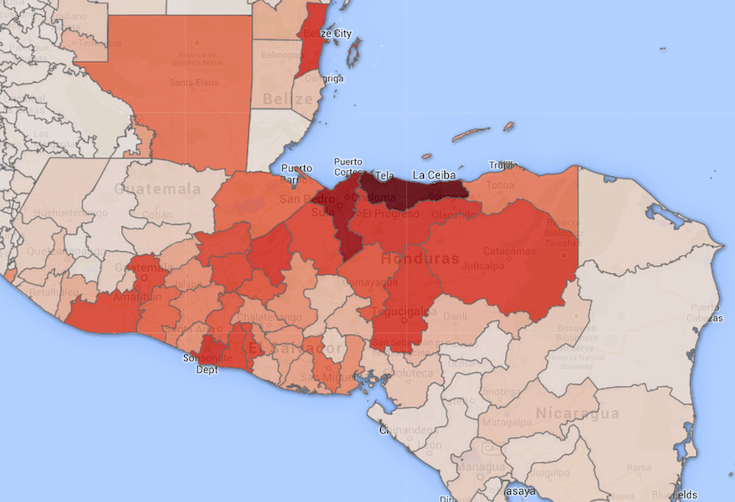
                  Scholars of immigration agree that people make the decision to migrate based on two types of reasons: “push factors” that lead them to leave their country of origin, and “pull factors” that lead them to come to one new country in particular. When tens of thousands of Central American families and unaccompanied children presented themselves to border agents in Texas in the spring and summer of 2014, many Americans and politicians blamed “pull factors” like President Obama’s Deferred Action for Childhood Arrivals program. But a map created by the Department of Homeland Security, depicting where unaccompanied child migrants were coming from, told a different story: migrants were leaving some of the most dangerous communities in the most dangerous countries in the world.


                A borderless world

                1. Immigrants come from everywhere

                  As noted above, since 1965, immigration to the United States has become a truly global phenomenon. It’s one thing to know that, but it’s another thing to see it in front of you.

                2. Remittances: the foreign aid program bigger than foreign aid

                  Many immigrants send money back home — called remittances — either to help them save up and buy property to return to their home countries or to support family members who can’t come to the United States themselves. Immigrants officially sent $51 billion in remittances home in 2012 — far larger than the US government’s foreign aid budget of $39 billion that year. This map shows that the countries that receive the most remittances aren’t always the countries with the most emigrants in the United States — they’re the poorest countries with large US-emigrant populations.

                3. The hidden diversity of America’s immigrants

                  The stereotypical face of immigration to America in 2015 is a Latino one. Americans routinely overestimate how many Latinos are immigrants, and particularly how many are unauthorized immigrants. And it’s true that Latin American countries send more immigrants to the United States than other regions. Because of that, it’s sometimes necessary to dig a little deeper to see how diverse the immigrant population really is. If this map of New York showed the most popular non-English language in each neighborhood, it would likely be monotonous. But by showing the most popular language that isn’t English or Spanish, it shows that New York is still a quilt of dozens of different immigrant communities.

                4. The twin cities of El Paso and Ciudad Juarez

                  El Paso and Ciudad Juarez might be the world’s strangest twin city. The separation of the US border helps create vastly different environments in the two cities: El Paso is far more affluent than its Mexican twin; Juarez is a global crime capital, while El Paso has long been one of the safest cities in the United States. But they’re undoubtedly two halves of the same metropolitan area. In 2011, 14,000 people crossed one footbridge between the two cities on a daily basis. This colorized NASA photo shows buildings in gray and vegetation in red. The band of vegetation in the lower right of the photo might be the first thing you notice: evidence of a visible barrier separating Mexicans and Americans. But in the heart of the city, in the center of the photo, it takes tracing the Rio Grande to tell where Mexico ends and America begins.

                By Dara Lind on June 10, 2015

                Two signs posted on the door of a nondescript dental office here asked passers-by to mourn the death of Cecil, a lion who was lured off his sanctuary and killed during a game hunt this month in Zimbabwe.

                “WE ARE CECIL,” one read; “#CatLivesMatter,” read another. Nearby was a sign with a darker message for the dentist who said he killed the cat: “ROT IN HELL.”

                30lion-web-master675

                In the hours since Dr. Walter J. Palmer apologized for killing the lion, he has gone from a dentist and longtime hunting enthusiast to a villain at the center of a firestorm over the ethics of big-game trophy hunting.

                “I had no idea that the lion I took was a known, local favorite, was collared and part of a study, until the end of the hunt,” Dr. Palmer said in a statement. “I relied on the expertise of my local professional guides to ensure a legal hunt.”

                The outrage and attention surrounding the lion’s death online caused Dr. Palmer to keep his office closed on Wednesday as he joined an ever-expanding group of people who have become targets of Internet vigilantism, facing a seemingly endless shaming until the next issue comes along.

                After Zimbabwean officials identified Dr. Palmer as the hunter, activists used search engines to find his contact information and social media to share information about his business and his family, stirring a fever pitch of anger strong enough to effectively dismantle his digital life. Angry people sent a surge of traffic to Dr. Palmer’s website, which was taken offline. Vitriolic reviews flooded his Yelp page. A Facebook page titled “Shame Lion Killer Dr. Walter Palmer and River Bluff Dental” drew thousands of users. Dr. Palmer’s face was scrubbed from industry websites.

                Even a local crisis management expert was pulled in to the fray. The specialist, Jon Austin, who operates a Minneapolis-based communications firm, said in an email that he had been asked only to circulate Dr. Palmer’s initial statement.

                On Wednesday, Mr. Austin ended his involvement with the matter, but not before his own Yelp page was flooded by angry commenters.

                cecil-lion-file-footage-facebookJumbo

                At Dr. Palmer’s office here, a memorial to the lion sprung up with red roses and more than a dozen plush toys, many of them jungle animals, strewn outside the locked front door.

                “Murderer! Terrorist!” one protester, Rachel Augusta, screamed into a megaphone.

                No one answered repeated knocks and doorbell rings at Dr. Palmer’s large, stucco house in an affluent neighborhood. And his neighbors would not talk.

                Trophy hunting, undertaken by wealthy hunters who pay tens of thousands of dollars for licenses to kill protected animals for trophies and sport, has long been a subject of global debate. Hunting advocates and some conservationists argue that, if done responsibly, the selling of expensive licenses to big-game hunters can help pay for efforts to protect endangered species.

                A 2009 study by the International Union for the Conservation of Nature estimated that trophy hunters killed around 600 lions a year. Last October, the United States Fish and Wildlife Service proposed to list the African lion as threatened under the Endangered Species Act, a move that would also establish guidelines for permitting the importing of lion trophies. That proposal is under review.

                Cecil had been closely studied by researchers at the University of Oxford since 2008 as part of efforts to study a decline in Africa’s lion population and to better understand the threats the animals face. The university’sWildlife Conservation Research Unit said in a statement that Cecil’s adult “brothers” and cubs would probably be killed by other male lions seeking dominance in the community.

                Debates over trophy hunting have long been held among conservationists and animal rights activists without reaching the mainstream. When a Texas man reportedly paid $350,000 to hunt and kill a black rhinoceros in Namibia this year, the furor largely stayed within that community. But the death of Cecil, a 13-year-old lion who wandered out of his sanctuary in a national park in Zimbabwe, struck a chord.

                Dr. Palmer had paid around $54,000 to hunt the animal, according to news reports, and in 2009, he paid $45,000 at an auction to help preserve an elk habitat in California. He was profiled that year in The New York Times when he shot and killed an elk from 75 yards with a compound bow in pursuit of a bowhunting record.

                According to the Zimbabwe Conservation Task Force, the lion was shot with a crossbow after he was lured out of the sanctuary, following the scent of food. Cecil, well known to those who visited Hwange National Park in western Zimbabwe for his jet black mane, was only injured by the arrow. The hunters tracked him for about two days before he was killed with a gun, conservation officials said. He was beheaded and skinned, his corpse left to rot.

                dentist-lion_650x400_81438115234

                Two Zimbabwean men, a farm owner and a professional hunter who are accused of helping Dr. Palmer, appeared in court on Wednesday on poaching charges. Zimbabwean officials said Dr. Palmer was also being sought on poaching charges.

                Erin Flior, who specializes in crisis management at the public relations firm Levick, said that frequent cases of widespread social media outrage had made digital crisis and reputation management a growing specialty. She recalled cases in which clients had to move or consider changing their names.

                “The fact that it crosses my desk at all means it happens too much, in my opinion,” Ms. Flior said. “It really tends to be instances where a very educated, tech-savvy crowd has jumped on board that those kind of instances get taken to that level where personal information is being released.”

                JULY 29, 2015

                a DE (1) DE (2) EF (532) HPAS (3) HPI-1 HPI-2 HPI-3 t

                People whose faces are perceived to look more “competent” are more likely to be CEOs of large, successful companies. Having a face that people deem “dominant” is a predictor of rank advancement in the military. People are more likely to invest money with people who look “trustworthy.” These sorts of findings go on and on in recent studies that claim people can accurately guess a variety of personality traits and behavioral tendencies from portraits alone. The findings seem to elucidate either canny human intuition or absurd, misguided bias.

                lead_large

                There has been a recent boom in research on how people attribute social characteristics to others based on the appearance of faces—independent of cues about age, gender, race, or ethnicity. (At least, as independent as possible.) The results seem to offer some intriguing insight, claiming that people are generally pretty good at predicting who is, for example, trustworthy, competent, introverted or extroverted, based entirely on facial structure. There is strong agreement across studies as to what facial attributes mean what to people, as illustrated in renderings throughout this article. But it’s, predictably, not at all so simple.

                Christopher Olivola, an assistant professor at Carnegie Mellon University, makes the case against face-ism today, in the journal Trends in Cognitive Sciences. In light of many recent articles touting people’s judgmental abilities, Olivola and Princeton University’s Friederike Funk and Alexander Todorov say that a careful look at the data really doesn’t support these claims. And “instead of applauding our ability to make inferences about social characteristics from facial appearances,” Olivola said, “the focus should be on the dangers.”

                77bc600b9

                “When we see someone’s face, we can make a lot of useful judgments,” he said, “like about age, emotional state, gender, et cetera. For this, the face is pretty useful. But there’s a pretty rich literature showing that we don’t just stop there.”
                By systematically altering or selecting the faces that participants are presented with, researchers have been able to examine how variations in facial appearance bias human decisions. These studies have shown not just correlations, but causal evidence that facial appearances influence voting, economic exchanges, and legal judgments. People tend to draw inferences about personality characteristics, above and beyond what we might assume based on things like gender, ethnicity, or expression. Social attributions from faces alone tend to be constructed from how common facial features are within a culture, cross-cultural norms (e.g., inferences on masculinity/femininity), and idiosyncrasies like resemblance to friends, colleagues, loved ones, and, importantly, ourselves. Olivola’s research has shown that these facial attributions people make have serious implications for how people are treated, and their outcomes in life. The especially unfortunate part of these inferences is how heavily they factor into critical decisions, in lieu of actual facts.

                “The fact that social decisions are influenced by facial morphology would be less troubling if it were a strong and reliable indicator of people’s underlying traits,” the researchers write in today’s article. “Unfortunately, careful consideration of the evidence suggests that it is not.”

                The primary problem is that people feel they have this sense, and they ignore other relevant information, Olivola said. Politics is a great example. His research has shown that politicians whose facial structure is deemed to look more competent are more likely to win elections. (They use actual politicians in these studies. Fortunately for researchers, Olivola noted, most Americans don’t know who most congressional candidates are.) But that sense of competence in a face amounts to nothing. “We really can’t make a statement on that,” he said. “What’s an objective measure of competence?”

                c3855cad4

                In the case of CEOs, if you control for how the company was doing before they came on board versus after, there is really no relationship between their “facial competence” and the company’s subsequent success. “People are convinced that more competent-looking businesspeople are more valuable, and they get higher salaries,” Olivola explained, even though the companies don’t perform any better under their leadership. “It’s not accuracy in prediction; it’s bias, actually.”

                Olivola has also done studies that show in conservative-leaning states, finding that the more “traditionally Republican” a person’s face is deemed to look, the more votes he/she gets. Even if they’re a Democrat. And the correlation between facial competence and vote share is strongest among voters who are lacking in political knowledge.

                This suggests two solutions: Either make sure people don’t see the candidates, an amazing but obviously impossible idea, or make sure people are educated—that they know what the candidates are about. That significantly reduces the biasing effect of facial competence.

                Personality traits are also fraught, in that most studies rely on self-reported personality tests. “If I rate myself as extroverted and I try to look it in my pictures, you might rate me that way, but it doesn’t mean I am.” If there was some actual measure, like that when a person goes to parties, they make X number of friends, then we could start to talk about accuracy. But really, these studies just affirm that people see themselves the same way others see them.

                4d690c0a7

                In online dating, Olivola said, people are selecting pictures because they want to convey something. “You might think, ‘Wow, this person looks really fun and outgoing.’ Well, yeah, they’re not going to post a picture of themselves where they’re deep inside their books at the library. (Unless they’re trying to attract a certain kind of person.) But if you ask an acquaintance, they may say, no, that person’s not that fun. They think they are, but they’re not.”

                All that these studies really tell us, Olivola said, is “‘I’ve managed to fool you into thinking I’m extroverted, because that’s how I like to be seen.’ Of course I want everyone to think I’m intelligent and fun, and I like to think I am—”

                “I’m sure you are,” I said.

                “So this is kind of dangerous,” he continued after a beat. “I mean, is it wise for us to tell people, ‘Oh, yeah, people are great at telling political orientation on the basis of faces.’ If someone looks like they’re conservative, or if they look like they’re gay or whatever, it’s totally okay for you to think you’re probably right? We need to be more careful about that. It makes for great articles and everything, but when you look at the data critically, it paints a much less generous picture of the human ability to draw accurate inferences from faces. We need a lot of strong evidence before putting that message out there.”

                So this interesting research walks a thin line between relevant psychology and physiognomy. In the 1883 textbook Types of Insanity: An illustrated guide to the physical diagnosis of mental disease, Dr. Allan Hamilton wrote of a time when psychiatric practice was largely based on appearances. “When one walks through the wards of any asylum for the insane,” Hamilton wrote, “he will be immediately impressed with the repulsiveness of the faces about him.” The doctor includes characteristic sketches of people with melancholia, idiocy, imbecility, and mania—recognizable in a patient with “brows being corrugated, teeth covered by compressed lips, [and] eyes widely open.”

                In an article in Annual Review of Psychology earlier this year, Olivola and a separate group of Princeton colleagues made a similar point about the treacherous grounds on which this research treads. They address that countless papers have recently been written claiming that people can reliably judge a variety of traits and characteristics from facial morphology alone, arguing that a critical reexamination of the methods and findings in many of these studies paint a much less favorable picture. Though in that review, the team concedes that some of these structural cues “could have a kernel of truth,” they are largely a judgmental illusion. They note that in criminal cases, facial appearances often predict sentencing decisions, judgments of guilt, and punishment severity. The most interesting, but also troubling, aspects of human judgment and decision making is how fallible and inconsistent it can be. The researchers also offer the additional caveat: “In real-life situations, people do not interact with disembodied faces.”

                Don’t we?

                By JAMES HAMBLIN (OCT. 2014)

                1 HGD (146) HI (91) HPAS (2) i (14) i (20) i (29) i (30) sgTqF_pPjio

                IF all goes according to plan, I’ll turn 44 soon after this column appears. So far in my adult life, I’ve never managed to grasp a decade’s main point until long after it was over. It turns out that I wasn’t supposed to spend my 20s frantically looking for a husband; I should have been building my career and enjoying my last gasp of freedom. I then spent my 30s ruminating on grievances accumulated in my 20s.

                This time around, I’d like to save time by figuring out the decade while I’m still in it. Entering middle age in Paris — the world’s epicenter of existentialism — isn’t terribly helpful. With their signature blend of subtlety and pessimism, the French carve up midlife into the “crisis of the 40s,” the “crisis of the 50s” and the “noonday demon” (described by one French writer as “when a man in his 50s falls in love with the babysitter”).

                Pamela-Druckerman_2480368b

                The existing literature treats the 40s as transitional. Victor Hugo supposedly called 40 “the old age of youth.” In Paris, it’s when waiters start calling you “Madame” without an ironic wink. The conventional wisdom is that you’re still reasonably young, but that everything is declining: health, fertility, the certainty that you will one day read “Hamlet” and know how to cook leeks. Among my peers there’s a now-or-never mood: We still have time for a second act, but we’d better get moving on it.

                I think the biggest transition of the 40s is realizing that we’ve actually, improbably, managed to learn and grow a bit. In another 10 years, our 40-something revelations will no doubt seem naïve (“Ants can see molecules!” a man told me in college).

                But for now, to cement our small gains, here are some things we know today that we didn’t know a decade ago:

                • If you worry less about what people think of you, you can pick up an astonishing amount of information about them. You no longer leave conversations wondering what just happened. Other people’s minds and motives are finally revealed.

                • People are constantly trying to shape how you view them. In certain extreme cases, they seem to be transmitting a personal motto, such as “I have a relaxed parenting style!”; “I earn in the low six figures!”; “I’m authentic and don’t try to project an image!”

                • Eight hours of continuous, unmedicated sleep is one of life’s great pleasures. Actually, scratch “unmedicated.”

                • There are no grown-ups. We suspect this when we are younger, but can confirm it only once we are the ones writing books and attending parent-teacher conferences. Everyone is winging it, some just do it more confidently.

                • There are no soul mates. Not in the traditional sense, at least. In my 20s someone told me that each person has not one but 30 soul mates walking the earth. (“Yes,” said a colleague, when I informed him of this, “and I’m trying to sleep with all of them.”) In fact, “soul mate” isn’t a pre-existing condition. It’s an earned title. They’re made over time.

                You will miss out on some near soul mates. This goes for friendships, too. There will be unforgettable people with whom you have shared an excellent evening or a few days. Now they live in Hong Kong, and you will never see them again. That’s just how life is.

                • Emotional scenes are tiring and pointless. At a wedding many years ago, an older British gentleman who found me sulking in a corner helpfully explained that I was having a G.E.S. — a Ghastly Emotional Scene. In your 40s, these no longer seem necessary. For starters, you’re not invited to weddings anymore. And you and your partner know your ritual arguments so well, you can have them in a tenth of the time.

                • Forgive your exes, even the awful ones. They were just winging it, too.

                • When you meet someone extremely charming, be cautious instead of dazzled. By your 40s, you’ve gotten better at spotting narcissists before they ruin your life. You know that “nice” isn’t a sufficient quality for friendship, but it’s a necessary one.

                • People’s youthful quirks can harden into adult pathologies. What’s adorable at 20 can be worrisome at 30 and dangerous at 40. Also, at 40, you see the outlines of what your peers will look like when they’re 70.

                • More about you is universal than not universal. My unscientific assessment is that we are 95 percent cohort, 5 percent unique. Knowing this is a bit of a disappointment, and a bit of a relief.

                • But you find your tribe. Jerry Seinfeld said in an interview last year that his favorite part of the Emmy Awards was when the comedy writers went onstage to collect their prize. “You see these gnome-like cretins, just kind of all misshapen. And I go, ‘This is me. This is who I am. That’s my group.’ ” By your 40s, you don’t want to be with the cool people; you want to be withyour people.

                • Just say “no.” Never suggest lunch with people you don’t want to have lunch with. They will be much less disappointed than you think.

                • You don’t have to decide whether God exists. Maybe he does and maybe he doesn’t. But when you’re already worrying that the National Security Agency is reading your emails (and as a foreigner in France, that you’re constantly breaking unspoken cultural rules), it’s better not to know whether yet another entity is watching you.

                Finally, a few more tips gleaned from four decades of experience:

                • Do not buy those too-small jeans, on the expectation that you will soon lose weight.

                • If you are invited to lunch with someone who works in the fashion industry, do not wear your most “fashionable” outfit. Wear black.

                • If you like the outfit on the mannequin, buy exactly what’s on the mannequin. Do not try to recreate the same look by yourself.

                • It’s O.K. if you don’t like jazz.

                • When you’re wondering whether she’s his daughter or his girlfriend, she’s his girlfriend.

                • When you’re unsure if it’s a woman or a man, it’s a woman.

                HGD (26) HGD (79) HGD (95) HGD (100) HGD (105) HGD (109) i (11) i (13) z

                Though he was best known as the hyper-rational Spock, Leonard Nimoy, who died of end-stage chronic obstructive pulmonary disease last week at 83, enjoyed a thriving second act outside of Hollywood. Specifically, the Star Trek icon became a notable photographer, producing several collections of provocative images that highlighted subjects who are often marginalized by society due to characteristics such as weight, sexuality, and religion. Not surprisingly, Nimoy’s exploration of that last subject sparked controversy — controversy that did not go unremarked when he died.

                84b56400-c1e1-11e4-b58d-e59605cb9222_Leonard-Nimoy-with-camera

                Titled Shekhina, it consisted of (semi) erotic photos of Jewish women in various states of undress, partially clad in male religious garb. The pictures proved to be polarizing even within the Jewish community that Nimoy loved so much. While some took issue with the women being naked or depicted in men’s clothing (or both), others praised Nimoy’s creative vision.

                One staunch supporter of the Shekhina series was Rabbi John Rosove, who happened to be Nimoy’s rabbi and close family friend. Speaking at the late star’s funeral on Sunday, Rosove touched on some of Nimoy’s personal attributes that may have helped fuel his photography.

                3e2c8640-c14f-11e4-8d8e-5787c77ad6d3_Nimoy-Shekhina-09

                “Leonard was nurtured in the Yiddish-speaking culture of his childhood on the West End of Boston, yet he transcended the particular categories with which he was raised,” Rosove began. “Because he grew up as a minority in his neighborhood, even sensing at times that he was an outcast living on the margins [which is what his Spock character was all about], Leonard adventured out from the conservative home and culture of his youth, courageously at a very young age, into the world where he sought greater truth and understanding. He was curious about everything and was a life-long learner.” Rosove then turned his attention to the Shekhinaseries in particular.

                3e2c1110-c14f-11e4-9010-cd73a622bb78_Nimoy-Shekhina-06

                “Most recently, Leonard created magnificent mystical images of feminine Godliness in hisShechinah photographs,” the rabbi noted before adding, “One of which he gave to me as a gift graces my synagogue study and adds a spiritual dimension for me of everything I do in my life as a rabbi.”

                3b4ac310-c14f-11e4-b861-adc4aeca8831_Nimoy-Shekhina-02

                Richard Michelson, owner of R. Michelson Galleries (where Nimoy’s works were displayed) echoed these sentiments to Yahoo, stating that Nimoy “wanted to celebrate Jewish women and expand the view of religion to include a healthy embrace of sexuality.” According to Michelson, Nimoy’s photographs command prices anywhere from $2,000 up to $25,000 per piece.

                Not everyone appreciates these images, however. As reported by the Chicago Tribune after the release of his Shekhina photography book in 2002, many of Nimoy’s appearances in cities such as Seattle and Detroit were canceled. Nimoy rolled with the objections, explaining, “It’s all about territory. The book has been seen as elevating women in the hierarchy. In Judaism, certain males are not comfortable with that.”

                Rabbi Yonassan Gershom of Minnesota echoed that in his review of the book on Amazon. “I found it offensive. No religious Jew, man or woman, would pray in a tallis and tefillin while so scantily clad. These may be the fantasies of an old man going through his second puberty, but they are not the kinds of images that I would want in my kosher home. … I am deeply disappointed that Mr. Nimoy fell for the neo-pagan myth of the Shekhinah as a personified ‘goddess.’ … In real Judaism, the Shekhinah is not a goddess, it is the indwelling presence of God.”

                Asked about it again in 2007, Nimoy defended his decision to show women in male garb. “There are historical writings of famous Jewish women, daughters of rabbis, who have done that,” henoted.

                But Nimoy didn’t just dismiss criticism of his work; he was inspired by it.

                “Leonard enjoyed talking about his work, and he responded to critiques by expanding his vision,” Michelson told Yahoo. “For instance, when queried about why he always used more ‘traditionally beautiful’ women in Shekhina, he responded by creating his Full Body Project.”

                ec82f9d0-c1dc-11e4-ac08-1383312e6e6d_Zz273-59

                This series depicted nude, plus-sized women and, naturally, elicited more objections. “One formerly obese woman said the photos terrified her; she said they recalled a picture she kept in her wallet as a reminder of her former self,” The New York Times noted when the collection debuted.

                “We do overhear some reductive ‘Is Nimoy into fat chicks’ comments when the gallery room is first entered,” Michelson revealed at the time. “I’ve had a few crank e-mails with snide remarks,” he admitted before adding, “but not a one from gallery visitors.” In a way, Michelson seems to feel that visitors’ seemingly low expectations ultimately worked to Nimoy’s advantage.

                “Many people think that because of his celebrity it was easy for him to get exhibitions, etc., but I was wary of adding his work because of that celebrity, and many museums also shied away at first,” Michelson revealed to Yahoo. “Folks often came to the exhibits out of curiosity and with great skepticism, talking about Nimoy the actor.”

                That changed, he argued, once they actually saw the photos. “The effect on viewing the photographs was always profound. They would leave talking about the artwork, the quality of his vision, and the social issues he raised.”

                064e0b80-c150-11e4-b861-adc4aeca8831_Nimoy-Matt-hires

                For his part, however, it wasn’t Nimoy’s most controversial exhibit that proved closest to his heart. In 2008, the actor spent two days taking portraits of total strangers who had answered a public invitation to share a glimpse of their hidden selves. Subjects who answered the call included a war veteran photographer who declared that he was a pacifist, an overweight woman who outed herself as a “shy whore,” and a rabbi who publicly announced he was gay for the first time.

                “This is the one that came the closest to the bone to the things that interest me,” Nimoy told the Los Angeles Times upon release of the collection, called Secret Selves.

                leonard-nimoy-twitter-feature-1200x520

                “What I love about the project is that anyone who sees it immediately asks themselves, ‘What would my secret self be? What could I show — what would I show?’ I know people ask me what my secret self is and I have to laugh. I have no secrets left. I revealed it all a long time ago.”

                HGD (9) HGD (69) HGD (70) HGD (73) HGD (74) HGD (75) HGD (101) HGD (251)

                For more than 50 years, Jay Lieberfarb saved people from the waters off of Jones Beach. But three years ago, Nassau County told him he wasn’t good enough to save people from the Eisenhower Park Aquatic Center’s swimming pool.

                image

                Lieberfarb, a Valley Stream resident for 15 years, launched an age discrimination suit against the county after he was dismissed from his job when he was 71 years old, and the case was recently settled for $65,000. “I’m satisfied,” he said. “I thought it was a fair settlement.”

                The lawsuit was actually brought against the county by the U.S. Equal Employment Opportunity Commission. Lieberfarb will receive full back pay, but Nassau County does not have to rehire him. He said he doesn’t want the job back anyway, and is happy with his new position — working as a lifeguard at Hofstra University’s pool.

                Lieberfarb, now 74, said the issue began when Nassau County ordered its lifeguards to take a swimming test, which he said was unexpected. Lifeguards had to swim both 50 meters and 200 meters within a certain time. He did not meet the time requirements and was told he could take the test again the next week.

                He was suspended without pay, and given one week to get ready to take the test again, he said. Lieberfarb passed the 50 meter test, but strained a calf before doing 200 meters. Again, he said he was given another week and was told to produce a doctor’s note. Two days later, he was fired.

                In between his firing and bringing the matter to the attention of the EEOC, Lieberfarb said that hundreds of other lifeguards took the same test, and several failed. “Nobody else was suspended or terminated and they were all under the age of 25 and I was over the age of 70,” he said. “I was the only one they treated this way.”

                Lieberfarb said he was able to produce records that showed that no other lifeguards were penalized as a result of failing a test, and said he believes that is what put his case over the top.

                Nassau County Attorney John Ciampoli said the settlement admits no wrongdoing by the county. He said the county was willing to give Lieberfarb back pay, but did not want to rehire him because of the failed swim test, “which is really not a good thing for lifeguards,” Ciampoli said.

                1340200678_62c3


                “This was a case that we inherited from the prior administration,” Ciampoli said. “In light of all the underlying facts, we entered into a settlement.”

                Ciampoli added that county officials are committed to ensuring that all of its employment practices follow the law, and that employees and supervisors are properly trained.

                “We have been very proactive with programs on workplace discrimination,” Ciampoli said. “This is the type of area where a little bit of training can make a huge difference in terms of what you experience down the road in court cases.”

                Kevin Berry, the director of EEOC’s New York District, said that employers need to take action to prevent age discrimination in the work place. “Employers cannot treat their older workers less favorably than their younger employees,” he said. “They must be treated in the same manner as all others.”

                When Lieberfarb was a member of the swim team at Adelphi University, many of his teammates were lifeguards at Jones Beach. They recommended it to him as a summer job, so Lieberfarb began working there in 1956. He moved up the ranks, and eventually became a captain. “Little did I know that 56 years later, I’d still be working as a lifeguard,” he said, noting that he made hundreds of rescues during his half-century at Jones Beach.

                A retired school teacher in New York City, Lieberfarb said he plans to remain a lifeguard as long as he continues to pass his certification tests. He added that he is glad to now have the discrimination suit settled and behind him.


                By Andrew Hackmack, Valley Stream Herald (New York)

                1 2 3 4 5 6 7 8

                RAFAH, Gaza Strip — It was clear from the bod­ies laid out in the park­ing lot of the ma­ter­ni­ty hos­pi­tal here that it had as­sumed new du­ties: No longer a place that wel­comed new life, it was now a make­shift morgue.

                Oth­er bod­ies lay in hall­ways and on the floor of the kitchen at Hi­lal Emi­rati Ma­ter­ni­ty Hos­pi­tal. In the walk-in cool­er, they were stacked three high, wait­ing for rel­a­tives to claim them for burial.

                Sat­ur­day was the sec­ond day of heavy bom­bard­ment by Is­raeli forces on this city on Gaza’s bor­der with Egypt af­ter Is­rael’s an­nounce­ment that one of its of­fi­cers had been cap­tured by Pal­es­tin­ian mil­i­tants here dur­ing a clash.

                But ear­ly Sun­day morn­ing, the Is­raeli mil­i­tary an­nounced that the of­fi­cer, Sec­ond Lt. Hadar Goldin, 23, was now con­sid­ered to have been killed in bat­tle.

                Sergey Ponomarev for The New York Times
                Medics at a field hospital in Rafah, Gaza Strip. More than 120 Palestinians were killed in Rafah alone on Friday and Saturday.

                “It is just an ex­cuse,” said Dr. Ab­dul­lah She­hadeh,

                di­rec­tor of the Abu Yousef al-Na­j­jar Hos­pi­tal, the city’s larg­est. “There is no rea­son for them to force the women and chil­dren of Gaza to pay the price for some­thing that hap­pened on the bat­tle­field.”

                Af­ter two days of Is­raeli shelling and airstrikes, cen­tral Rafah ap­peared de­serted on Sat­ur­day, with shops closed and res­i­dents hid­ing in their homes. The pres­ence of Is­raeli forces east of the city had caused many to flee west, crowd­ing in with friends and rel­a­tives in neigh­bor­hoods by the Med­i­ter­ra­nean.

                More than 120 Pales­tini­ans were killed in Rafah alone on Fri­day and Sat­ur­day — the dead­li­est two days in the city since the war be­gan 25 days ago. Those deaths, and hun­dreds of in­ju­ries, over­whelmed the city’s health care fa­cil­i­ties.

                Mak­ing mat­ters worse, Is­raeli shells hit the cen­tral Na­j­jar hos­pi­tal on Fri­day af­ter­noon, Dr. She­hadeh said, lead­ing its em­ploy­ees and pa­tients to evac­u­ate.

                To con­tinue re­ceiv­ing pa­tients, his staff mem­bers moved to the small­er Ku­waiti Spe­cial­ized Hos­pi­tal, al­though it was ill equipped to han­dle the large num­ber of peo­ple seek­ing care.

                Am­bu­lances screamed in­to the hos­pi­tal’s park­ing lot, where medics un­loaded cases on­to stretch­ers some­times bear­ing the blood of pre­vi­ous pa­tients. Since the hos­pi­tal had on­ly 12 beds, the staff mem­bers had lined up gur­neys out­side to han­dle the over­flow.

                The city’s cen­tral hos­pi­tal had al­so housed its on­ly morgue, so its clo­sure cre­ated a new prob­lem as the ca­su­al­ties mount­ed: where to put the bod­ies.

                At the Ku­waiti Spe­cial­ized Hos­pi­tal, they were put on the floor of the den­tal ward un­der a poster pro­mot­ing den­tal hy­giene. In a back room lay the bod­ies of Sa­di­ah Abu Taha, 60, and her grand­son Rezeq Abu Taha, 1, who had been killed in an airstrike on their home near­by.

                Few peo­ple ap­proached the main en­trance to the pink-and-white ma­ter­ni­ty hos­pi­tal, in­stead head­ing around back, where there was a con­stant flow of bod­ies. Near­ly 60 had been left in the morgue of the cen­tral hos­pi­tal when it closed, so am­bu­lance crews who had man­aged to reach the site brought back as many bod­ies as they could car­ry. Oth­er bod­ies came from new at­tacks or were re­cov­ered from dam­aged build­ings.

                New ar­rivals were laid out in the park­ing lot or car­ried down a ramp to the kitchen, fea­tur­ing a large walk-in cool­er. Some were kept on the ground, and those not claimed right away were added to the pile in the cool­er.

                Word had spread that the dead were at the ma­ter­ni­ty hos­pi­tal, so peo­ple who had lost rel­a­tives came to talk to the medics or look in the cool­er for their loved ones.

                One short, sun­burned man point­ed to the body of a woman wear­ing pink sweat­pants and said she was his sis­ter Souad al-Tara­bin.

                The medics pulled her out, laid her on a ta­ble and wrapped her in white cloth and plas­tic. Some teenagers helped the man car­ry her body up­stairs and lay it in the back of a yel­low taxi. A man in the front seat cra­dled a small bun­dle con­tain­ing the re­mains of the woman’s 4-year-old son, Anas.

                Sit­ting near­by, As­ma Abu Ju­main wait­ed for the body of her moth­er-in-law, who she said had been killed the day be­fore and was in the morgue at the cen­tral hos­pi­tal when it was evac­u­ated.

                “She is an old woman,” Ms. Abu Ju­main said. “She did noth­ing wrong.”

                The move­ment of bod­ies made record-keep­ing im­pos­si­ble, al­though Arafat Ad­wan, a hos­pi­tal vol­un­teer, tried to jot down names in a small red note­book he kept in his pock­et.

                He wor­ried that some bod­ies would re­main there for days, be­cause fam­ilies had been scat­tered and might not know that their rel­a­tives had been killed.

                “There are peo­ple in here whose fam­ilies have no idea what hap­pened to them,” he said.

                Oth­ers knew they had lost rel­a­tives but could not find them.

                Mo­ham­med al-Ban­na said an airstrike the morn­ing be­fore had killed nine of his in-laws, in­clud­ing his wife’s fa­ther and four of her broth­ers.

                “The ag­gres­sion here is cre­at­ing a new gen­er­a­tion of youth who want re­venge for all the crimes,” he said.

                He had looked at the cen­tral hos­pi­tal the day be­fore, to no avail. Then, on Sat­ur­day, he re­ceived a mes­sage sent to lo­cal cell­phones telling those who had lost rel­a­tives to re­trieve them from the ma­ter­ni­ty hos­pi­tal. He had come right away, but had not found them.

                “I’ll keep wait­ing for their bod­ies to come in so we can

                take them home and bury them,” he said.

                Mr. Ban­na added that he had been too wor­ried to tell his wife what had hap­pened to her fam­ily and want­ed to break the news to her grad­u­ally. Ear­lier that day, she had told him that she was start­ing to wor­ry be­cause her fa­ther’s cell­phone had been switched off all day.

                “I told her maybe he has no elec­tricity and his phone is dead,” Mr. Ban­na said.


                JERUSALEM — The Is­raeli mil­i­tary said ear­ly Sun­day morn­ing that an of­fi­cer thought to have been cap­tured by Pales­tin­ian mil­i­tants dur­ing a dead­ly clash Fri­day morn­ing, which shat­tered a planned 72-hour cease-fire, was now con­sid­ered to have been killed in bat­tle.

                The an­nounce­ment came just hours af­ter Prime Min­is­ter Ben­jamin Ne­tanyahu vowed to con­tin­ue Is­rael’s mil­i­tary cam­paign in the Gaza Strip as long as nec­es­sary to stop Hamas at­tacks, while sug­gest­ing a de-es­ca­la­tion of the ground war in Gaza may be near.

                The case of the miss­ing sol­dier, Sec­ond Lt. Hadar Goldin, 23, be­came the lat­est flash point in the con­flict, prompt­ing a fierce Is­raeli bom­bard­ment and calls from lead­ers around the world for his re­lease. His dis­ap­pear­ance came af­ter Hamas mil­i­tants am­bushed Is­raeli sol­diers near the south­ern bor­der town of Rafah, at the start of what was sup­posed to have been a pause in the fight­ing.

                As the death toll mount­ed Sat­ur­day to more than 1,650 Pales­tini­ans, many of them women and chil­dren, and im­ages of homes, mosques and schools smashed in­to rub­ble filled the me­dia, Mr. Ne­tanyahu was un­der con­sid­er­able in­ter­na­tion­al pres­sure, from Wash­ing­ton and Eu­rope, to end the con­flict. The Unit­ed Na­tions warned of “an un­fold­ing health dis­as­ter” in Gaza with lit­tle elec­tric­i­ty, bad wa­ter and a lack of med­ical sup­plies.

                At the same time, Mr. Ne­tanyahu was un­der po­lit­i­cal pres­sure at home to de­liv­er on his promis­es to crush.

                03israel-add-jumbo

                Hamas, par­tic­u­lar­ly with 64 Is­raeli sol­diers dead. He in­sist­ed Sat­ur­day that Hamas had been se­vere­ly hurt and he warned that it would pay “an in­tol­er­a­ble price” if it con­tin­ues to fire rock­ets at Is­rael.

                His for­mer deputy de­fense min­is­ter, Dan­ny Danon,who was fired by Mr. Ne­tanyahu for pub­lic crit­i­cism of the gov­ern­ment, said in a state­ment Sat­ur­day that “the cab­i­net is grave­ly mis­tak­en in its de­ci­sion to with­draw forces from Gaza. This is a step in the wrong di­rec­tion.”

                But Mr. Ne­tanyahu, in a na­tion­al­ly tele­vised speech with his de­fense min­is­ter be­side him, in­sist­ed that Is­rael was achiev­ing its goals and could al­ter its tac­tics. “We promised to re­turn the qui­et to Is­rael’s cit­i­zens, and we will con­tin­ue to act un­til that aim is achieved,” Mr. Ne­tanyahu said. “We will take as much time as nec­es­sary, and will ex­ert as much force as need­ed.”

                Is­rael was not end­ing its op­er­a­tion uni­lat­er­al­ly, he said, adding: “We will de­ploy in the places most con­ve­nient to us to re­duce fric­tion on I.D.F. sol­diers, be­cause we care about them.” There were Is­raeli tele­vi­sion re­ports on Sat­ur­day that some Is­rael De­fense Forces troops were pulling out of Gaza, and Is­rael in­formed Pales­tini­ans in Beit Lahiya and al-Ata­tra, in north­ern Gaza, that it was now safe to re­turn to their homes. Is­raeli of­fi­cials have said that the army’s ef­fort to de­stroy the elab­o­rate tun­nel sys­tem from Gaza in­to Is­rael would be fin­ished in the next day or two.

                Is­raeli of­fi­cials sug­gest­ed that the army would leave built-up ar­eas and some forces would re­de­ploy in­side Gaza, clos­er to the bor­der fence, to re­spond to at­tacks if nec­es­sary. Oth­er units will re­turn to south­ern Is­rael.

                Hamas, for its part, vowed to con­tin­ue fight­ing. Sa­mi Abu Zuhri, a Hamas spokesman, told the news agency Maan that “a uni­lat­er­al with­draw­al or re­de­ploy­ment by Is­rael in the Strip will be an­swered by a fit­ting re­sponse by the Hamas mil­i­tary arm.” He said that “the forces of oc­cu­pa­tion must choose be­tween re­main­ing in Gaza and pay­ing the price or re­treat­ing and pay­ing the price or hold­ing ne­go­ti­a­tions and pay­ing the price.”

                Mr. Ne­tanyahu thanked the Unit­ed States, which along with the Unit­ed Na­tions ap­peared to sup­port Is­rael’s po­si­tion that Hamas’s ac­tions vi­o­lat­ed the cease-fire, and he asked for in­ter­na­tion­al help to re­build Gaza on the con­di­tion of its “de­mil­i­ta­riza­tion.” Is­rael ap­pears to be hop­ing that with the sup­port of Egypt and the in­ter­na­tion­al com­mu­ni­ty, Pres­i­dent Mah­moud Ab­bas of the Pales­tin­ian Au­thor­i­ty can con­trol Gaza through a uni­ty gov­ern­ment agreed up­on with Hamas and take re­spon­si­bil­i­ty for se­cu­ri­ty there and for the Rafah cross­ing to Egypt.

                Mr. Ne­tanyahu re­peat­ed that his goal was to re­store “peace and calm” to Is­rael and that he in­tend­ed to do so by what­ev­er means — diplo­mat­i­cal­ly or mil­i­tar­i­ly. “All op­tions are on the ta­ble,” he said. But he in­di­cat­ed that Is­rael would not get caught up again in talk about a ne­go­ti­at­ed cease-fire with Hamas and Is­lam­ic Ji­had and would act in its own in­ter­ests, while seek­ing sup­port from Mr. Ab­bas and the in­ter­na­tion­al com­mu­ni­ty for what Mr. Ne­tanyahu de­scribed vague­ly as “a new re­al­i­ty” in Gaza.

                Is­rael has de­cid­ed not to send a del­e­ga­tion to cease-fire talks host­ed by Egypt, at least not now, Is­raeli of­fi­cials said. In Wash­ing­ton, Jen Psa­ki, a State De­part­ment

                spokes­woman, said: “In the end, this par­tic­u­lar­ly bloody chap­ter will ul­ti­mate­ly re­quire a durable so­lu­tion so that all the fun­da­men­tal is­sues, in­clud­ing Is­rael’s se­cu­ri­ty, can be ne­go­ti­at­ed, and we will keep work­ing with Is­rael and oth­er part­ners to achieve that goal.” She said that Is­rael had a right to de­fend it­self.

                Hours be­fore the mil­i­tary an­nounced that Lieu­tenant Goldin had died, his par­ents called on the prime min­is­ter and the army not to leave their son be­hind.

                The cir­cum­stances sur­round­ing his death re­mained cloudy. A mil­i­tary spokes­woman de­clined to say whether Lieu­tenant Goldin had been killed along with two com­rades by a sui­cide bomb one of the mil­i­tants ex­plod­ed, or lat­er by Is­rael’s as­sault on the area to hunt for him; she al­so re­fused to an­swer whether his re­mains had been re­cov­ered.

                As word spread on Sat­ur­day that Is­rael’s lead­ers were con­sid­er­ing pulling all ground forces from Gaza, Lieu­tenant Goldin’s fam­i­ly spoke to jour­nal­ists out­side their home in Kfar Sa­ba, a Tel Aviv sub­urb. “I de­mand that the state of Is­rael not leave Gaza un­til they bring my son back home,” said his moth­er, Hed­va. His sis­ter, Ayelet, 35, added, “If a cap­tive sol­dier is left in Gaza, it’s a de­feat.”

                The fam­i­ly said they were con­vinced that Lieu­tenant Goldin was alive.

                “I hope and be­lieve in hu­man kind­ness, that the world will do any­thing to bring Hadar with a smile back home,” his broth­er Che­mi, 32, said in an in­ter­view.

                When his moth­er called him on Fri­day, Che­mi said, he

                knew some­thing ter­ri­ble had hap­pened, but did not know whether it in­volved Lieu­tenant Goldin or his twin, Tzur, who was al­so fight­ing in Gaza. Che­mi said the twins, who at­tend­ed kinder­garten in Cam­bridge, Eng­land, did not talk much about their mil­i­tary ser­vice. In Gaza, the armed wing of Hamas said ear­ly Sat­ur­day that it was not hold­ing the Is­raeli of­fi­cer. The Qas­sam Brigades sug­gest­ed in a state­ment that the of­fi­cer might have been killed along with his cap­tors in an Is­raeli as­sault that fol­lowed a sui­cide-bomb at­tack by Pales­tin­ian mil­i­tants, who emerged from a tun­nel that Is­raeli troops were try­ing to de­stroy near Rafah.

                “Un­til now, we have no idea about the dis­ap­pear­ance of the Is­raeli sol­dier,” the state­ment said. Say­ing the lead­er­ship had lost touch with its “troops de­ployed in the am­bush,” the state­ment added, “Our ac­count is that the sol­dier could have been kid­napped and killed to­geth­er with our fight­ers.”

                The Is­raeli Army con­tin­ued to pound Rafah in its search for Lieu­tenant Goldin, strik­ing more than 200 tar­gets across Gaza in the 24 hours since the Rafah con­fronta­tion, in­clud­ing what it de­scribed as a “re­search and de­vel­op­ment” lab for weapons man­u­fac­tur­ing at the Is­lam­ic Uni­ver­si­ty, run by Hamas. Five mosques that the mil­i­tary said con­cealed weapons or Hamas out­posts were al­so hit, the Is­raelis said.

                Around noon, a bar­rage of rock­ets flew in­to south­ern Is­rael.

                The Gaza-based health min­istry, which had re­port­ed 70 peo­ple killed in Rafah on Fri­day, said the ca­su­al­ties had con­tin­ued there overnight, in­clud­ing sev­en mem­bers of one fam­i­ly who died when their home was bombed.


                Steven Erlanger reported from Jerusalem, and Jodi Rudoren from Kfar Saba, Israel. Fares Akram contributed reporting from Gaza City, and Michael R. Gordon from Washington.

                This section of Graphic Humor in political-economic, national or international issues, are very ingenious in describing what happened, is happening or will happen. It also extends to various other local issues or passing around the world. There are also other non-political humor that ranges from reflective or just to get us a smile when we see them. Anyone with basic education and to stay informed of important news happening in our local and global world may understand and enjoy them. Farewell!. (CTsT)

                1 2 3 4 5 6 7 8

                Singer-songwriter Rona Kenan panned by right-wing extremists after expressing sympathy for Gazan children

                timthumb-e1406825823947-635x357

                An Israeli singer-songwriter canceled her show in Haifa Thursday after she was harshly criticized and threatened by right-wing Israelis who accused her of showing solidarity with the mothers of dead terrorists.

                Rona Kenan announced that her acoustic show in Haifa’s Turkish Market, which was scheduled to begin at 9 p.m., would not take place due to what she described as incitement against her.

                Kenan said she had been “subjected to severe verbal attacks and threats over a false report” that during a conference with Palestinian women, she had observed a moment of silence in solidarity with Palestinian “martyrs.”

                She said that while she had sung two songs at the conference, she had not observed a moment of silence. But this week, right-wing extremists raised the accusations again in comments on Kenan’s Facebook page after she expressed sympathy for the children of Gaza and called for an end to war between Israel and Hamas.

                The onslaught began after Kenan posted a message on July 11, three days into the Gaza war, reproaching Israeli society and the Israeli press over their reaction to the offensive in Gaza, which she described as “one of the saddest places in the world.”

                Kenan expressed sympathy for the children of both Sderot and Gaza, saying it “fills her with despair” to think that they “wet their beds at night out of fear and will grow up to see each other not as human beings, but as children of the devil.”

                Kenan said she was “left speechless” by the knowledge that “any objections to the war, which Israel named Operation Protective Edge, was perceived in Israeli society as treason, as a lack of solidarity.” She ended her post with a prayer for quiet both in Israel and the Gaza Strip.

                While many fans echoed Kenan’s sentiments, others criticized her for overlooking the threat posed by Hamas and Iranian-funded terror groups, as well as the suffering of residents of southern Israel and the risks IDF soldiers were taking to ensure Israel’s security. Some urged her to blame Hamas, not Israel, for the plight of the children of Gaza. Yet others said the children were themselves future terrorists, with one poster saying she had thought Kenan was “smarter than that” and another calling her “hypocritical, self-righteous filth.”

                One poster wrote, “I’ve never responded to people like you, but to observe a moment of silence for martyrs with whom we are engaged in combat on a daily basis? For shame, and we even provide her livelihood. With people like you among us, we don’t need enemies.”

                After the Haifa show was canceled, one Facebook user suggested, “Why don’t you volunteer to sing in Gaza? I think you will find a stage to sing on there without being subjected to criticism. You’re so stupid to voice criticism in wartime.”

                The Thursday evening show will still take place, but will be headlined by singer-songwriter Shai Gabso rather than Kenan.

                Kenan, the daughter of Lehi underground member, sculptor and journalist Amos Kenan and author and literary scholar Nurith Gertz, has released four albums so far, to critical acclaim.


                July 31, 2014

              1. Privacy
              2. Design a site like this with WordPress.com
                Get started