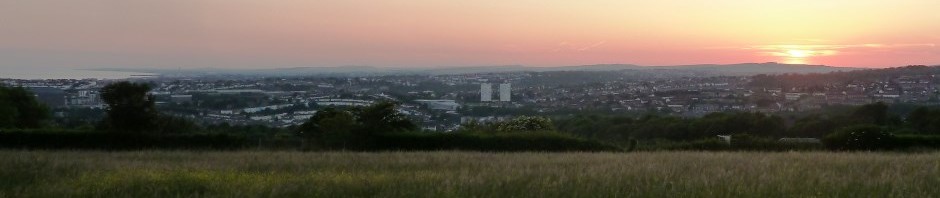
On the 15th of July I walked up to the Seven Dials via Brighton Station on a beautiful, sunny day – and I happened to have a camera with me.
Walking along a narrow alleyway between the back yards of houses I reached a place where a residential road met the alleyway. The alley is a couple of feet higher than the road, and they join with three steps. One or more local residents have decorated these steps with plants in pots.

At the end of the alley I turned west and walked uphill to the highest point of this road where the Council have created three small gardens (flower beds really). A noticeboard tells us that this is a rainwater interception garden designed to reduce flooding by offering a soak-away. Certainly the Council have helped in the creation of several interception areas on sloping roads where rainwater running downhill has previously caused flooding at the bottom of the hill. These features are engineered to divert flowing water off the road and into catchment hollows where it can sit and slowly soak into the ground – the best known one is probably in Carden Avenue on the edge of town.

Being at the top of the hill these beds cannot work in the same way, they will only capture rain falling on them or running off the adjacent tarmac. Nonetheless they offer a better streetscene, and are part of a necessary road narrowing. Perhaps a couple of silver birch trees would add height to these plantings?
Continuing downhill now to the Seven Dials – a place where seven roads meet, probably named after the Seven Dials junction in London. But that junction has the benefit of a central tall seven-sided stone column, each face displaying a sundial – so the name makes more sense.
Whilst navigating the junction I passed a venerable elm tree, and ran my hard around its bark. In 2013 the Council planned to fell this tree as part of a road improvement. Protest at felling a healthy elm was quick to develop, and after two protestors spent a night in the tree to stop the felling the Council relented. Without that protest this fine tree would have been lost.


 Roundhillrob's Blog