Apr 23, 2024 | Uncategorized
Here, on Pierre Joris’s blog, is my tribute to Jerome Rothenberg for his 80th birthday: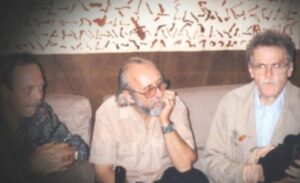
Unable to be present in person for the celebratory gathering for Jerome Rothenberg @ 80 at the Graduate Center last Friday, Robert Kelly sent the following homage, which I read as part of the introduction to Jerome Rothenberg’s reading (the other part being David Antin’s homage, read by Charles Bernstein & published here).
“I wish I could be there now to thank and praise and celebrate—bless you all for doing it for me. But my sins (that is, the body) have caught up with me for a season, and I remain rustic. My mind though wanders in such an immense garden of gratitudes to Jerry, and to Diane, for what they’ve done for me and what they’ve done for American poetry. Jerry’s Hawks Well Press published my first book, and in that sense gave me my start—but more important, they gave so many of us a place to start from: the nurturing network spreading out from their amazing apartment way up north off Broadway, a powerhouse of aesthetic scheming, revolutionary anthropology, subversive art history—all the conditions of a community from which art can come. I don’t know how I could have thrived without them. Or how we could have thrived: back in that time, the 1950s, American poetry was showing signs of life, after all the dozing between confessional and professional, the couch and the classroom. Rothenberg, through his linguistic gifts, through cooperation (so many years!) with Diane’s energetic ethnology, through his own genius, was the great rouser in those days, catching revived surrealism but adding to it the excitement of the profound Otherness of space and time, the so-called Primitive, the tribal, the magical, the oral. For us, he played (and plays) the role Picasso and Braque did for the painters, and Leiris and Bataille later for the French poets: opening the sparkling world that comes when you crack open literature and see the primal gestures of oral energy and sudden imagery from which it all surges. Kabbalah, cave painting, Iroquois legend, Navajo chant, Hasidic tales, Central Asian epic, German avant-garde, immigrant histories—he summoned us to attend to the deep literature of which the ‘literary’ is only a sheen. He didn’t get caught in formalisms, credences, opportunism. He taught me a dislike of slogans, and almost succeeded in teaching me modesty and the Taoist wisdom of hsiao, being small. He is a great figure, who stands above and beyond the schools and tendentiousnesses of poetics; he has given us, in his poetry, criticism, translation, anthologies, a body of work that exhibits what I suddenly realize is an ethical purity, a touchstone for the genuine.â€
RK, 8 December 2011
Apr 23, 2024 | Uncategorized
As we were mourning Rothenberg’s death this day in April 2024, Billie Chernicoff sent to us and others this excerpt from Jerry’s blog, Poems and Poetics, which overwhelmed me with a memory of our shared lives back in the 1960s. Throughout my whole career, I have felt such immense gratitude to him for all his work, all his works, for all he’s done for so many poets, and for world literature.
SATURDAY, MAY 7, 2011
A Round of Rattles, by and with Robert Kelly
[Robert Kelly was a poet essential to my own formative years as a poet, a time of transformations now several decades in the past. With him there was a brief time in which we struggled together with the dimensions of “deep image†as a strategy of composition developed by us along with a cohort of contemporaries in New York and elsewhere. In my own case this was the forerunner to that ethnopoetics to which I came on my own by the end of the 1960s, but looking back now I feel sure that it was Robert who was an early one and possibly the first to point me in that direction. With something of that in mind he wrote to me recently to recount a memory he had of readings of mine in which I used a Seneca Indian horn rattle to drive home my spoken performances. He enclosed with that a poem that spoke to those occasions, and I answered with a short group of prose poems that used his nouns in the manner of what Jackson Mac Low, another member of our cohort, called nuclei – a form of composition that I had used earlier in The Lorca Variations and other poems. I was aware too that today, May 7, 2011, there would be a celebration of Robert’s 75th birthday and his 50th year as a professor of poetry at Bard College. What follows, then, is Robert’s rattle poem, along with my poems in response to it. My admiration for his life and work is no less now than it was those many years ago, and my gratitude is even greater. (J.R.)]
JERRY’S RATTLE
wakes the dead.
It quacks.
I translate rocks
he said, I say pebbles,
I know ground
I know leather things
because they say.
When the eagle comes by itself
let it settle or fly off
who know what it carries in its beak
my business is to watch
watch with my rattle
watch with my mouth
with the rattle of my rattle I see everything
and when it flaps away
leaves one feather after it
I try to pick it up
but it’s only the eagle’s shadow
I try to pick its shadow up
and it turns into my shadow
and this makes me fly.
My teachers said
Fly on your shadow only
leave the machines alone
fly on your shadow
it will never fall.
Who were the dead I was waking
and why were they dead
and what were they doing
packing their valises
and tying their colorful bundles
on the day 13-Death
the only day in the year they could go
where do they go
I don’t have to know
I have to wake them
I have to let them go,
they’re waiting for me
to rattle my rattle,
go, I murmur in my ordinary
language, go home
lovely spooks,
find your way home,
ride the ringing of my rattle all the way
a sound carries
the dead ride our music
the dead ride sounds
the way I ride shadows
nothing else counts
but making sounds
and finding the way home.
home is always somewhere else
that’s why all the music we need
that’s why I rattle my rattle
when I was little boy
the radio used to say every week
only the shadow knows
only a shadow is always at home
the sun thinking its way through the clouds
makes it happen
the firelight makes it happen
we invented fire
so we could have shadows at night
the sun is a rattle that sings shadows
I belong to everything when I make noise.
VARIATIONS ON A ROUND OF RATTLES
for Robert Kelly
1
The noise of pebbles in the mouth of someone dead is next to nothing. Underneath the sun a boy is wrestling with his shadow, and his shadow with another shadow. Home is always somewhere else, a rattle and an eagle feather all that’s left. Daylight nearly over. Firelight foreshadowing the night.
2
Everything the night conceals from us is yet alive. Even the rocks are when they’re stuffed into a rattle and the sound they make surrounds us as the shadow of a cloud might on the way to night. Here in our final home machines like living things cast shadows also, and the year ends with a lonely rattle sound. Spooks bearing bundles run from everything like shadows where we wait and dream.
3
The business of the dead is spinning shadows, banging leather rattles, faking a language not their own. How good to spend a week away from home, valises packed and ready for a day out in the sun. A rattle makes a sound we love to hear, another rattle leads us where the shadows beckon, and the shadows form a single shadow under which we hide.
4
13-Death calls out to us. His is a music darker than a radio, so far from home, so fraught with sounds the dead might make, our fallen teachers, eagles screaming through their beaks, who make the ground shake, where we sit around a fire. Is it a rattle or a distant ringing, or a rattle that the dead can hear and join us, shadows overhead and with a lonely rattle far from home?
POSTED BY JEROME ROTHENBERG AT 6:23 AM
Jun 4, 2023 | Uncategorized
1.
Precision. A lens.
High magnification
smaller field of vision.
To see birds better.
Buy binoculars. Recall
human history of optics.
Who saw what. Dee’s
black shewstone, see
better in the dark. Fresnel.
Galileo. Mary looking
up at the angel.
2.
Speaking of angels,
remember the one
posted at Eden’s gate,
flaming sword, to make
sure Adam didn’t sneak back in?
I wonder if that radiant
sentinel sometimes turned
and peered back into Eden
and from what he saw,
or didn’t see built a message
he came down to earth with
to console Adam and his kin–
you can’t go there, but with
the lens of the mind you can see
and by seeing almost be there.
Here, try this magnifying lens,
I made it for you from sand
of Eden, turned glass
by the fire of my sword.
3.
Grosbeak. Oriole… Wren.
We mark them in our minds
by seeing them up close
without violating the sacred
space of their distance. Bench.
Fence. Feeder. Put the spyglass
back in the satchel. No way out
from what we have seen. Seeing
is such a commitment! I can hear
the wise woman say as she picks
up the remote to turn TV off.
4.
The way Pieter Saenredam
could see a church, sent his eye
high up to the roof of the nave
so his painting could look down
on the immense emptiness
of the cathedral, made emptier
by a person or two but how
could he see himself down there
from way up here, where we are?
5.
So when your eyes
are far
away enough
you can see everything.
10 May 2023

Recent Comments