

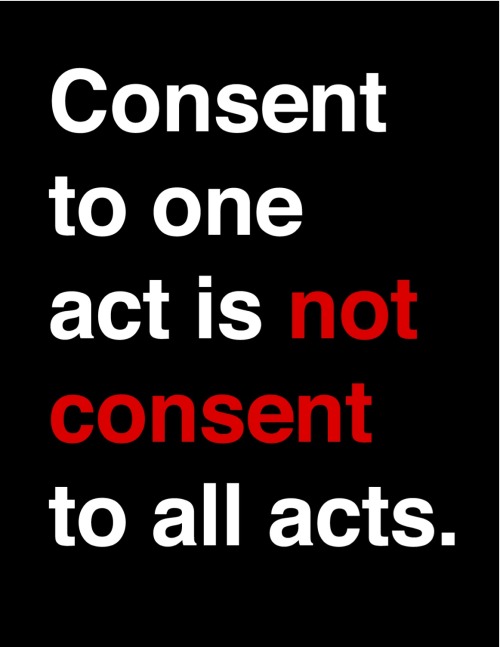



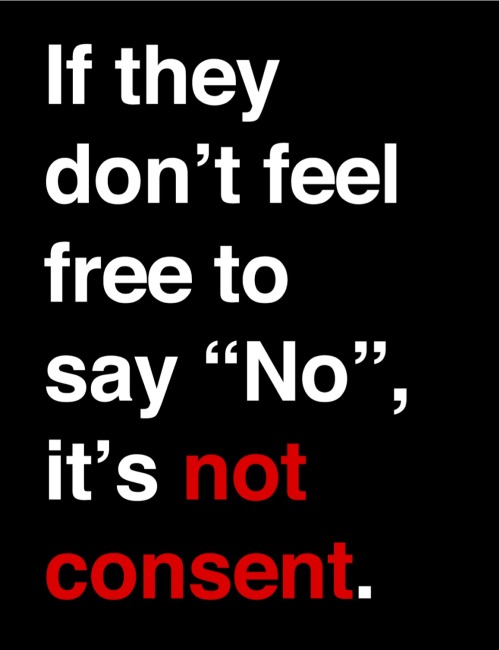
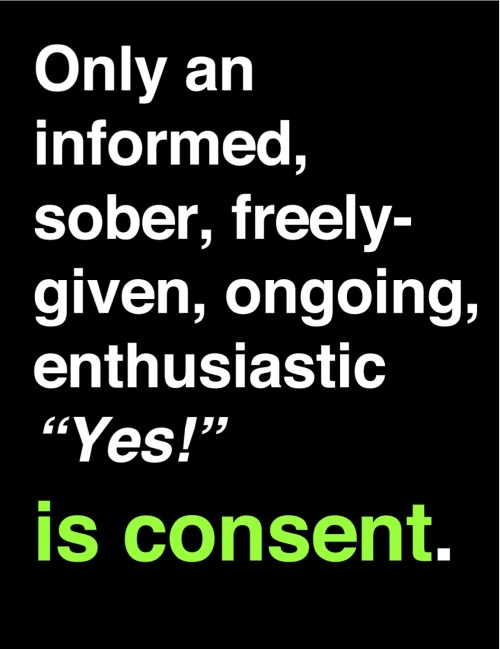
(via thebookslut)


Future Nobel Laureate Doris Lessing was born Doris May Tayler in Kermanshah, Iran, on this day in 1919.
“Whatever you’re meant to do, do it now. The conditions are always impossible.”
― Doris LessingDoris Lessing was born of British parents in Persia, in 1919, and moved with her family to Southern Rhodesia when she was five years old. She went to England in 1949 and has lived there ever since. She is the author of more than thirty books—novels, stories, reportage, poems, and plays. In 2007, she was awarded the Nobel Prize in Literature.
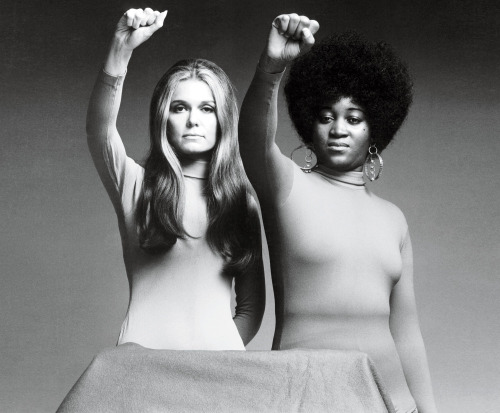
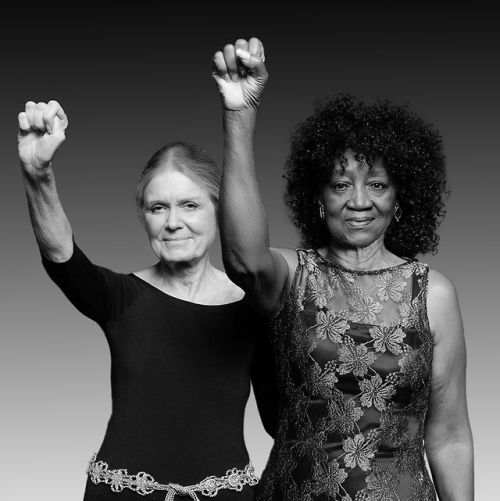
Gloria Steinem and Dorothy Pitman-Hughes, 1972 and 2014
Both by Dan Bagan
Wanna see my cry like a baby? Ask me who these women were.
Hughes’ father was beaten nearly to death by the KKK when she was a kid, and what does she do? Become an activist to try and stop that from happening to other people. She raised money to bail civil rights protesters out of jail. She helped women get out of abusive situations by providing shelter for them until they got on their feet. She founded an agency that helped women get to work without having to leave their children alone, because childcare in the 1970s? Not really a thing. In fact, a famous feminist line in the 70s was “every housewife is one man away from welfare.”
Then she teamed up with Steinman to found the Women’s Action Alliance, which created the first battered women’s shelters in history. They attacked women’s rights issues through boots on the ground activism, problem solving, and communication. They stomped over barriers of race and class to meet women where they were: mostly mothers who wanted better for themselves and their children.
These are women are who I always wanted to be.
(via ca-thar-si-s)


winningthebattleloosingthewar:
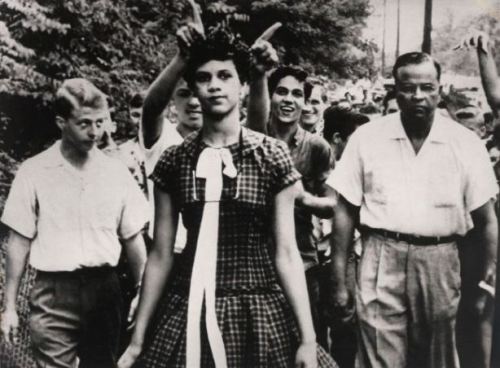
On the morning of September 4, 1957, fifteen-year-old Dorothy Counts set out on a harrowing path toward Harding High, where-as the first African American to attend the all-white school – she was greeted by a jeering swarm of boys who spat, threw trash, and yelled epithets at her as she entered the building.
Charlotte Observer photographer Don Sturkey captured the ugly incident on film, and in the days that followed, the searing image appeared not just in the local paper but in newspapers around the world.
People everywhere were transfixed by the girl in the photograph who stood tall, her five-foot-ten-inch frame towering nobly above the mob that trailed her. There, in black and white, was evidence of the brutality of racism, a sinister force that had led children to torment another child while adults stood by. While the images display a lot of evils: prejudice, ignorance, racism, sexism, inequality, it also captures true strength, determination, courage and inspiration.
Here she is, age 70, still absolutely elegant and poised.

(via maddogchica)
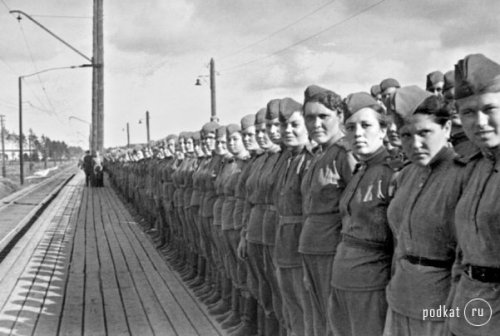

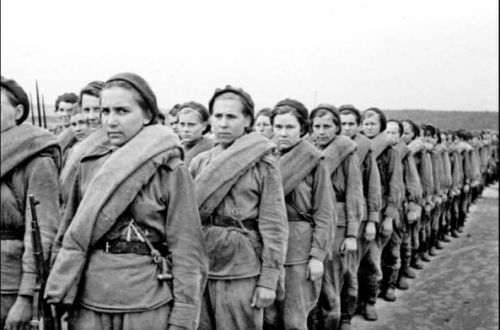
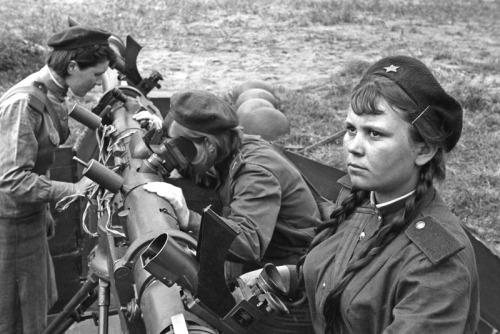
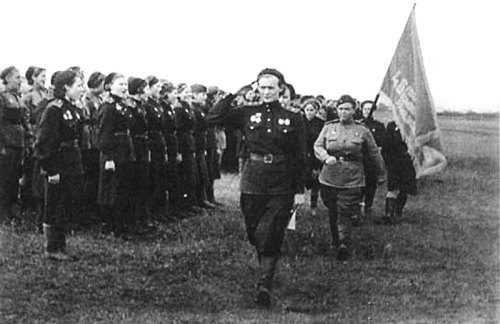


“We went to Kineshma, that’s in Ivanovo region, to visit his parents. I went as a heroine and I never expected someone to welcome me, a front-line girl, like that. We’ve gone through so much, we’ve saved lives, lifes of mothers, wives. And then… I heard accusations, I was bad-mouthed. Before that I’ve only ever been “dear sister”… We had tea and my husband’s mother took him aside and started crying: “Who did you marry? A front-line girl… You have two younger sisters. Who’s going to marry them now?” When I think back to that moment I feel tears welling up. Imagine: I had a record, I loved it a lot. There was a song, it said: you have the right to wear the best shoes. That was about a front-line girl. I had it playing, and [his?] elder sister came up and broke it apart, saying: you have no rights. They destroyed all my photos from the war… We, front-line girls, went through so much during hte war… and then we had another war. Another terrible war. The men left us, they didn’t cover our backs. Not like at the front.” from С.Алексеевич “У войны не женское лицо”
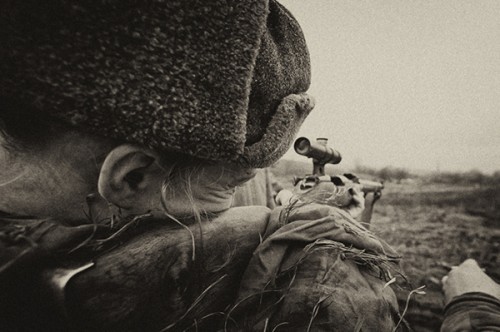
In Soviet Union women participating in WWII were erased from history, remaining as the occasional anecdote of a female sniper or simply as medical staff or, at best, radio specialists. The word “front-line girl” (frontovichka) became a terrible insult, synonimous to “whore”. Hundreds thousand of girls who went to war to protect their homeland with their very lives, who came back injured or disabled, with medals for valor, had to hide it to protect themselves from public scorn.
This has always happened in history: Women do something important. Then they get shamed for it (so nobody will talk about it) and it gets erased from history.
And then certain men will say: “Women suck, they’ve never done anything important.”
Look into history and learn that women have played a far greater role then douches (present and past) wanted you to know.
Hey Will (and Jack) I got you something.
So this is important. Let me tell you a story.
All the time I spend debating about women in combat, I’ve picked up on a trend that disturbs me. Supporting or attacking, people are quick to draw on biology, psychology, law, but very rarely - almost never - do I hear about the history of women in combat, and the evidence their service lends to this debate.
Hundreds of thousands of women faced combat in WW2, and on both sides, and on all fronts, and it is a history that has been almost completely erased from contemporary awareness. I have been given arguments about how women can not psychologically handle combat. And about how women in mixed-gender combat units will automatically disrupt group cohesion - the brotherhood, if you will. Both of these assertions are erasure.
Women have not lived in a protective bubble untouched by combat for all of history. Women have been killed, wounded, and captured in combat, and tortured after. We are not living a world where these are hypothetical situations women have yet to prove they can handle. Unfortunately, they have, they can, in the future, they probably will, again and again. Soviet women served as partisans, snipers, tank drivers, fighter pilots, bombers. And more.
Both British and American women served in mixed-gender AA units. I could drag you through several examples of British women performing exemplarily despite being wounded, or seeing their comrades die. The Luftwaffe did not discriminate. Between the British and the Americans, it was determined that mixed gender units actually performed much better than all male units, because of teamwork. Because women are better and certain tasks, men are better at certain tasks, and at other tasks they are comparably efficient, and in a team, hopefully, in combat, you let the best do what they are best at. For the most part, they were proud to serve together.
German propaganda never commented on the British AA units, but they thoroughly smeared the Soviet fighting woman - flitenweiber. People often argue with me that women are a threat to group cohesion because men naturally give women preferential treatment. Which certainly explains why men are more likely to survive shipwrecks. And history shows us that Germans soldiers had no chivalrous compunction when it came to shooting captured Soviet women who were armed.
We’re fed a history of war that almost exclusively features white male figures, most of whom fit into this destructive constructed myth of the soldier that is somehow both chivalrous and charmingly womanizing and who’s sense of brotherhood is unshakably dependent on the band being all man. There is no history of woman at war, none. I hear a lot about how women have no upper body strength, I hear nothing about the Front-Line Female Comrade.
THE WORD FRONTOVICHKA BECAME A TERRIBLE INSULT - are you fucking kidding me? Fuck, that made me cry. At first when I started reading I thought I was reading alernate history fiction. I’m ashamed to be ignorant about this, and full of rage and much worse bitter shame that this history is constantly repressed, suppressed, hidden. WHAT THE FUCK. D: D: D:
(via berenzero)


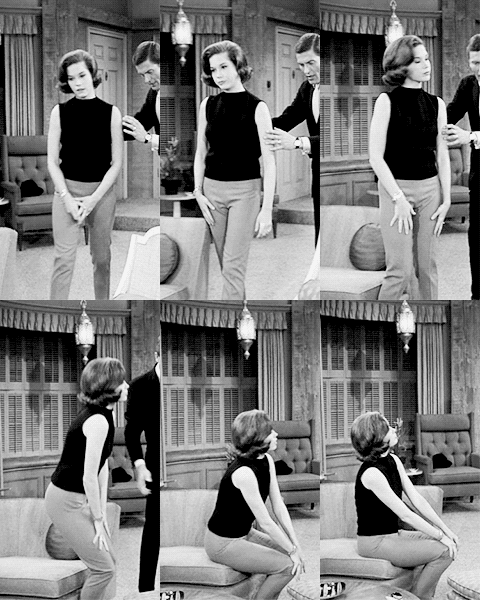
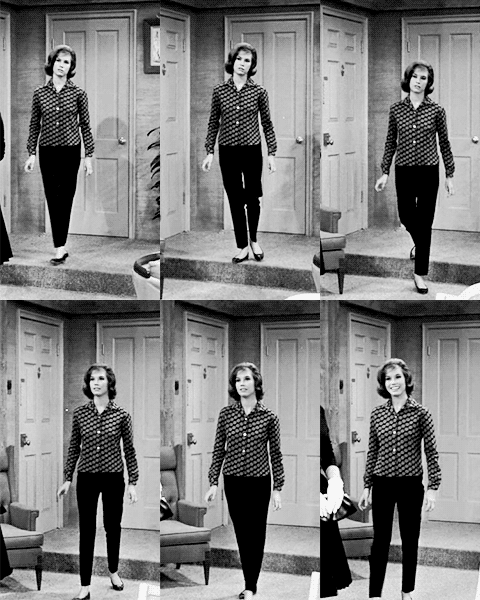
A small controversy occurred because of Mary Tyler Moore wearing Capri pants on The Dick Van Dyke Show. When the show’s sponsors started getting angry letters from viewers about Mary’s form-fitting Capri pants, Moore was restricted to wearing the pants only one scene per show. Up until the show’s premiere most housewives were seen in dresses, but Moore’s explanation was that most of the housewives she knew wore pants. Because of Moore, Capri pants became a huge fashion craze in the early 1960s.
(via maddogchica)

Maude Adams c. 1890
Maude Ewing Kiskadden (November 1, 1872 – July 17, 1953), known professionally as Maude Adams, was an American actress who achieved her greatest success as the character Peter Pan, first playing the role in the 1905 Broadway production of Peter Pan; or, The Boy Who Wouldn’t Grow Up. Adams’s personality appealed to a large audience and helped her become the most successful and highest-paid performer of her day, with a yearly income of more than one million dollars during her peak.


(via outofprintclothing)

RIP Maya Angelou. Poet, Educator and Civil Rights Advocate Dr. Maya Angelou, 86, dies…
WINSTON-SALEM- Dr. Maya Angelou, writer of the classic autobiography “I Know Why the Caged Bird Sings” has died. She was 86 years-old. Her death comes days after canceling her appearance at the Major League Baseball Beacon Awards luncheon, where she was to be honored. We’re told she was found unresponsive inside her Winston-Salem home. Angelou was a renowned poet, historian and civil rights advocate. As an actress and screen writer, she was hailed as a trailblazer. Her script for the film Georgia was the first ever by an African American woman. It was also nominated for a Pulitzer Prize. Memorial arrangements for Dr. Angelou have not yet been released.


gentlemanlosergentlemanjunkie:
The top photo shows an LAPD policewoman named Florence Coberly, who in a dangerous undercover operation, was asked to lure a serial rapist named Joe Parra. This would require placing herself in harm’s way so police could catch him just before the act. Supported by more than thirty cops hidden in unmarked cars and stationed around the neighborhood, Coberly did exactly that, drawing the suspect, which in turn drew her backup. Parra tried to run, and photo two shows him after he was gunned down. These shots are from 1952, a year at the end of which she would win the LAPD’s Policewoman of the Year award.
(via Pulp International - Two photos of cop Florence Coberly and criminal Joe Parra circa 1952)
(via braiker)
Source: pulpinternational.com

In the summer of 1727, at the age of 9, Maria Gaetana Agnesi made an oration in defense of women’s education before a group of patricians.
Her oration repeatedly takes to task those critics of women’s education who restrict learning to a small circle of elite males rather than imagining learning as a public good for all of humanity. She laments the ignorance of the husbands who confine women to enforced idleness upon marriage and who allow their daughters to grow up equally unlearned. Agnesi chastised her audience for condescending to women and encouraged them to think of a learned wife as the best asset of any marriage.
Maria Gaetana Agnesi, mathematician and philosopher, was born on this day in 1718. Learn more about her life and work in The Contest for Knowledge: Debates over Women’s Learning in Eighteenth-Century Italy via University Press Scholarship Online.
Image: Engraving of Maria Gaetana Agnesi. Public domain via Wikimedia Commons.
(via maddogchica)
12 Writers On The Women Authors Who Inspired Them
Your new favorite Tumblr features contemporary writers sounding off on their “Literary Mothers.”Which women writers inspire you?
![This blog “Remember the Ladies” gets its name from the famous letter by Abigail Adams to her husband and future president, John Adams. [The “new code of laws” refers to the Declaration of Independence.]
“ “And, by the way, in the new code of laws...](https://64.media.tumblr.com/df997ae58d243b4f78e75e02f7e136a8/tumblr_n3kke2i5mi1qbazexo1_500.jpg)
![This blog “Remember the Ladies” gets its name from the famous letter by Abigail Adams to her husband and future president, John Adams. [The “new code of laws” refers to the Declaration of Independence.]
“ “And, by the way, in the new code of laws...](https://64.media.tumblr.com/c43440399079a9f593b4a3fdf58ab5dc/tumblr_n3kke2i5mi1qbazexo2_500.jpg)
This blog “Remember the Ladies” gets its name from the famous letter by Abigail Adams to her husband and future president, John Adams. [The “new code of laws” refers to the Declaration of Independence.]
“And, by the way, in the new code of laws which I suppose it will be necessary for you to make, I desire you would remember the ladies and be more generous and favorable to them than your ancestors.
"Do not put such unlimited power into the hands of the husbands.
"Remember, all men would be tyrants if they could. If particular care and attention is not paid to the ladies, we are determined to foment a rebellion, and will not hold ourselves bound by any laws in which we have no voice or representation.
"That your sex are naturally tyrannical is a truth so thoroughly established as to admit of no dispute; but such of you as wish to be happy willingly give up — the harsh tide of master for the more tender and endearing one of friend.
"Why, then, not put it out of the power of the vicious and the lawless to use us with cruelty and indignity with impunity?
"Men of sense in all ages abhor those customs which treat us only as the (servants) of your sex; regard us then as being placed by Providence under your protection, and in imitation of the Supreme Being make use of that power only for our happiness.”
More of the letter here .
Mrs. Adams was not a woman to hold her tongue. She always said just as she wanted to say even after becoming the First Lady, which gave her quite the reputation. She was very much aware of what was happening in the world around her and was bold enough to voice her opinion.
The women’s suffrage movement didn’t begin until 1848. Women weren’t granted the right to vote until 1920. This letter was written in 1776. Equality has been a desire for women long before any movement! And this letter is a personal plea from wife to husband to recognize that a woman is more than what her compass defines her as being. And do you know her husband’s response to her plea? “Abigail! *chuckle-chuckle* How you make me laugh so! You saucy lady, you!” That is a paraphrase, of course. For a more accurate reading and Mrs. Adam’s reply back, I will direct you HERE.
Doesn’t this sound so familiar? Each generation of woman will rise up and say, “I AM WOMAN. I AM EQUAL.” And with each cultural shift the response has been, “YOU SILLY GIRL, KNOW YOUR PLACE!” Men and woman alike, will tell you that your voice is beautiful but your words are unnecessary. But the times, they are a-changin!
Page 1 of 51
 and be more generous and favorable to them than your ancestors


