The D.C. Circuit found that President Trump's construction of the East Wing is unlawful, but has stayed the ruling for two weeks to permit the SG to seek a stay.
Trump probably cares about this construction issue more than tariffs and birthright citizenship combined. If the Supreme Court actually blocks the construction, the President will have a daily reminder outside his window of who cast the fifth vote.
Speaking of the fifth vote, I suspect Justice Kavanaugh, who spent his formative years working in the West Wing, will not vote to block the construction.
What does the Chief Justice do here? If I were Roberts, I would immediately grant an administrative stay, grant cert before judgment after a month or so of delays, schedule oral argument for spring 2027, and in June 2027 hold that the construction of the ballroom is so far along that the equities no longer permit an injunction. Then, once the East Wing is fully constructed, the Court will vacate Judge Leon's exclamation-point-riddled opinion with Munsingwear!
Ultimately, the fifth vote would fall to Justice Barrett. What would an "apolitical proceduralist" do here? The neatest path is to find there is no standing. The D.C. Circuit's entire ruling is premised on "aesthetic" injury standing. I wrote a post on this topic back in March. It cannot be the case that a person who walks past the White House has Article III standing to stop the construction of an underground security facility covered by a ballroom. Or perhaps Justice Barrett finds that the equities favor a stay. These two sentences from Judge Rao's dissent sum up the case:
The district court elevated the aesthetic displeasure of a single passerby over the government's security interests in the ballroom and the security risks of leaving an open construction site at the President's home and office. These errors in equitable judgment require vacating the injunction.
This morning, declaring that "the White House is the People's House," a divided panel of the U.S. Court of Appeals for the D.C. Circuit upheld the district court injunction against the construction of the new White House ballroom. According to the court, "Whether or not a massive ballroom should be constructed is for Congress to decide and is not a matter for Executive self-help."
The panel stayed its decision for fourteen days for the express purpose of allowing the Trump Administration to seek review from the Supreme Court, and I would expect such a filing in due course.
If the Supreme Court does intervene, either on the interim docket or after argument, this case might present a good opportunity for the justices to revisit--and perhaps restrain--the permissive approach to standing in cases against the federal government, particularly those relying upon aesthetic standing. As Judge Rao explains in her dissent, there are serious questions about NTHP's standing here, both as an organization and as a representative of members who claim "injury" from the ballroom's construction.
There is nothing inherently wrong with using legal research tools powered by artificial intelligence—just as, in all prior generations of the American legal profession, there was nothing inherently wrong with a supervising attorney relying on the research and analysis of junior attorneys, paralegals, firm librarians, or other staff. The supervisory attorney, however, always bore ultimate responsibility for the accuracy of the final product. In that sense, artificial intelligence is nothing more than a new and technologically interesting way to violate Rule 11.
The novel danger with artificial intelligence is how much easier a Rule 11 violation becomes when using it. Submitting false legal authority by conventional means requires either willfulness or a failure by multiple professionals involved in the preparation of a document. The probability of false legal authority slipping past multiple reviewers is low. In contrast, artificial intelligence combines the illusion of thorough review and analysis with the temptations of speed and low cost. Attorneys now have the power to violate Rule 11 in embarrassing ways within minutes.
From Ali v. Osman, decided yesterday by the N.D. Supreme Court, in an opinion by Chief Justice Lisa Fair McEvers [UPDATE: see this post for more on the lower court decision]:
Ali and Osman married in 2001 in Sudan. Both parties are dual citizens of the United States and Sudan. The parties are the parents of five children—three of whom were minors at the time of trial….
In July 2024, Ali commenced this action seeking a divorce from Osman. In October 2024, Osman moved to dismiss the divorce action, disputing that he and Ali were still married at the time of the action. Osman asserted they were no longer married because he had obtained a divorce certificate in Sudan on December 11, 2022….
The [trial] court found that, unbeknownst to Ali, Osman pronounced talaq three times prior to December 11, 2022; and on or about December 11, 2022, Osman obtained the certificate of divorce from Ali in Sudan based on his pronouncement of talaq. {The district court found: "Under Islamic law, a husband has the right to initiate a divorce ('talaq') against his wife. All that is required to achieve talaq is for a husband to pronounce his intent to divorce his wife on three separate occasions, either verbally or in writing. The husband does not need to communicate his three pronouncements to his wife. She need not be present for them or even aware of them. A wife cannot object to a talaq."}
From Jane Bambauer's and my brief in Patterson v. Meta Platforms, Inc., pending now before New York's highest court (for more on the case, see the lower court opinions)—many thanks to our excellent local counsel Vivek Tata, Molly O'Keefe, and Alastair Pearson (Elsberg, Baker & Maruri PLLC) for all their help with the brief:
[* * *]
Plaintiffs-Appellants are suing Defendants-Respondents because Defendants-Respondents hosted and displayed to users what appears to be constitutionally protected third-party speech. Such a theory of liability is inconsistent with the First Amendment, as many cases rejecting negligence liability based on the communicative impact of speech have held.
This First Amendment protection cannot be avoided on the grounds that defendants' speech products are supposedly "addictive." There is no "addictive speech" exception to the First Amendment. The government cannot interfere with speech producers' rights to choose how to format and present speech, on the theory that the products are "addictive." And it cannot interfere with viewers' access to speech products that give the viewers more of what they want, on the theory that the viewers should not want it or are somehow being manipulated into wanting it.
Indeed, using "engagement-maximizing" techniques is a commonplace, and constitutionally protected, feature of a great deal of speech: novels, TV series, political speeches, news programming, and more. By way of analogy, the Free Exercise Clause would preclude the government from restricting religious practices that supposedly psychologically "addict" congregants through such "engagement-maximizing" tools that supposedly "force-feed[]" religious material to congregants (seeinfra Part II). Likewise, the Free Speech Clause and Free Press Clause preclude the government from using similar arguments to restrict the design of speech products.
This First Amendment protection also cannot be avoided on the grounds that defendants' speech products use AI algorithms. The First Amendment protects listener rights as well as speaker rights. And listeners have the right to obtain ideas and information without government interference, whether the ideas and information are curated exclusively by humans or with the help of computerized algorithms.
From today's Report and Recommendations by Magistrate Judge Elizabeth A. Staffordt (E.D. Mich.) in yesterday's Evans v. Robertson:
Plaintiff Sybrena Evans, proceeding pro se, sues Defendant Danielle Robertson … for copyright infringement, defamation, fraud, and harassment. {Robertson made a special appearance as a Jane Doe stating that "Danielle Robertson" is an online alias and not her legal name. For the sake of clarity, the Court will nevertheless refer to this individual as Robertson.}
Evans moved for an order requiring Robertson to show cause why she should not be held in contempt and sanctioned for disobeying two of Judge Levy's orders to disclose her identity. The Court granted the motion and Robertson was ordered to show cause why she should not be sanctioned. Robertson responded that the Court should defer enforcement of Judge Levy's orders until it resolves the viability of Evans's claims.
"The orderly and expeditious administration of justice by the courts requires that an order issued by a court with jurisdiction over the subject matter and person must be obeyed by the parties until it is reversed by orderly and proper proceedings." Because of this bedrock principle, Robertson should be sanctioned with a default judgment for her violations of Judge Levy's orders….
Evans, a Michigan resident, alleges that Robertson engaged in a pervasive campaign of harassment and cyberbullying on her social media platforms and websites from 2022 to 2024. Robertson allegedly posted YouTube videos calling Robertson [perhaps meaning Evans? -EV] "Teddy Bundy" and falsely accusing her of stalking and other crimes. Evans also alleges that Robertson published deepfake pornography using Evans's likeness. In a YouTube video, Robertson allegedly discussed Evans's divorce and published documents from those proceedings, and encouraged her followers to likewise post content harassing Evans.
From Judge Carlos Mendoza (M.D. Fla.) in U.S. v. Joudeh:
Defendant is charged with one count of transmission of an interstate threat to injure or kill another person in violation of 18 U.S.C. § 875(c). The facts alleged in the Indictment state that Defendant violated this statute via "an online comment that included the statement, 'I wish someone would in alive him.'" The Indictment provides no further information as to where or why this comment was posted, to whom it was communicated, or who the referenced "him" is in the comment.
On June 22, 2025, United States District Court Judge, John L. Badalamenti contacted the United States Marshals Service (USMS) for the Middle District of Florida regarding a threat stemming from reaction to a June 21, 2025, New York Times article called, A White Nationalist Wrote a Law School Paper Promoting Racist Views, It won Him an Award. Judge Badalamenti is an adjunct professor at the University of Florida and taught a seminar class in the fall semester of 2024 on the legal theory originalism.
The New York Times article focuses on a capstone paper a student wrote for Judge Badalamenti's class. The student's paper, according to the article, argued that the framers of the Constitution intended the phrase We the People to refer exclusively to white people. As such, in the paper, the student argued for the removal of voting rights protections for nonwhite people and issuance of shoot-to-kill orders against criminal infiltrators at the border. The student obtained the book award, which the article describes as meaning the student was designated the best student in the class and was awarded to the student by Judge Badalamenti….
One of the comments on [a post about the article] was from Instagram user falasteen8090 (Falasteen8090)…. Falasteen8090 commented on [the] post, "I wish someone would in alive him." USMS and Judge Badalamenti suspected that Falsteen8090 meant to say unalive him, meaning kill him….
The court dismissed the indictment, concluding as a matter of law that the post didn't fit within the "true threats" exception to the First Amendment:
Defendant T.T. … is an escort service … When Plaintiff agreed to work as an escort in conjunction with Defendants, she signed an agreement indicating that her services as an escort would involve nudity in the presence of customers….
As part of her intake process, the parties discussed that she would need to engage in some advertisement activity directed at attracting male customers and that this would also include nudity. Defendants maintain a website advertising their services and providing photographs of their escorts. The photographs are sexually suggestive but do not generally include nudity….
Plaintiff provided photographs that included some nudity, but the nude photographs did not show her face. Defendants used the photographs Plaintiff provided to them in advertisements. Plaintiff also provided Defendants with some facial shots, but they agreed that they would not be displayed with photographs containing nudity.
In connection with her work as an escort for Defendants, Plaintiff used an assumed name. The photographs they used in advertising used that assumed name. Defendants did not use or provide information as to Plaintiff's actual name or identity. As part of its advertising for its escorts, Defendants supplied photographs to certain websites featuring sexy, nude, or semi-nude models….
Plaintiff does not claim that Defendants created ads for her without her permission. However, Plaintiff alleges that she was there was one posting including a series of photographs involving nudity that also included a photograph including her face. Plaintiff did not want photographs including her face posted with other nude photographs. She contacted Defendant about the posting and they remedied the situation. She claims that the erroneous posting was up for approximately two hours.
I am, slowly but surely, making my way through the end of the October 2025 term. I've already published my take on Wolford and Hemani. I've recently completed my essay on Slaughter and Cook, which should appear in Law & Liberty next week. I've written a piece on Mullin v. Doe and Mullin v. Al Otra Lado, which should appear thereafter. Randy Barnett and I wrote an essay on Landor, which was the sleeper case of the year. SCOTUSBlog is also publishing my series of essays on Court reform. (So far, they have built some consensus; future installments may not.)
So far, at least, I have not yet published anything on Trump v. Barbara. That isn't due to a lack of thoughts. I have a lot. Indeed, Randy and I spent much of July figuring out how to present the case in the Fifth Edition of our casebook, which should be available for adoption in December 2026.
Barbara may be one of the most important decisions the Supreme Court has ever issued. Ultimately, I agree with Justice Thomas that the Chief Justice's ruling is not one for the ages. I am already dreading having to teach the case. A question I often ask is "State the holding of the case in one sentence." Try it. What is Roberts's rule of order? What is the standard of citizenship of a person born on U.S. soil? It's harder than it may seem. Your answer, whatever it is, should discuss "extraterritorial fiction." I assure you, read through the debates in the Congressional Globe, and you will not find a reference to "extraterritorial fiction." This line may be one of the most slippery blue plate specials that the Chief Justice has ever served.
In the Chief's mind, failing to issue a clear rule is the best rule of all. But surely the Chief anticipated how Trump would respond to this decision. Justice Kavanaugh surely understood that the President would not surrender.
The President has signed a new executive order on birthright citizenship. The order offers this account of what Trump v. Barbara held, and what room remains to deny citizenship to the children of certain aliens:
On June 30, 2026, the Supreme Court decided in Trump v. Barbara, 609 U.S. ___, 146 S. Ct. 2438, 2449 (2026), that the Citizenship Clause of the Fourteenth Amendment to the United States Constitution extends the privilege of citizenship to children born to parents in the United States "for whom no extraterritorial fiction applie[s]." This order identifies, non-exhaustively, and prescribes action concerning certain categories of children of aliens who do not fall within the rule of birthright citizenship as announced by the Supreme Court.
Did Trump v. Barbara provide a "closed set" of exemptions to the rule in Calvin's Case or was the list "exhaustive"? I don't think the majority settled this issue, so the roster is "non-exhaustive."
The order explains that the child of an alien enemy is not a citizen at birth. I welcome a lawsuit from the ACLU demanding citizenship for the children of members of Foreign Terrorist Organizations.
The order also excludes the child of a parent engaged in birth tourism. I think the argument here is that there is an "extraterritorial fiction" for this group, as the birth is the product of "fraudulent activity."
The order further provides that citizenship is denied to a "person . . . born in a territory or territorial waters of the United States where citizenship is not conferred by Federal statute." I am not certain if there are any such jurisdictions where citizenship is conferred by executive order and not statute. But here is a test to the Insular Cases.
What will the Chief do? What will Justice Barrett do?
Stay tuned.
Update: It seems there is no statute that grants birthright citizenship to children in American Samoa.
While less sweeping than the one invalidated by the Supreme Court in Trump v. Barbara, it still denies birthright citizenship to many people protected by the earlier Supreme Court decision.
In Trump v. Barbara, issued in June, the Supreme Court ruled against Donald Trump's executive order denying birthright citizenship to children of undocumented immigrants born in the United States, and those born to non-citizen parents here on temporary visas. Today, Trump issued another executive order seeking to narrow birthright citzenship, one that is also unconstitutional, even though the groups affected are much smaller than those targeted by the earlier order.
Today's order denies birthright citizenship to four categories of children:
Children of "alien enemies," defined as those where at least one of two non-citizen parents is a "designated Foreign Terrorist Organization under 8 U.S.C. 1189 or Specially Designated Global Terrorist, consistent with the International Emergency Economic Powers Act, 50 U.S.C. 1701 et seq., and Executive Order 13224 of September 23, 2001 (Blocking Property and Prohibiting Transactions With Persons Who Commit, Threaten to Commit, or Support Terrorism)."
Children born to at least one non-citizen parent who is a "foreign government employee" or employed by an "international organization that possess[es] international-organization immunity."
Children where "either parent" has engaged in "birth tourist" transactions of various kinds (deliberately seeking to give birth in the US so the child would get birthright citizenship).
With one exception (children of foreign-government employees who have diplomatic immunity), all of these children are entitled to birthright citizenship under the Citizenship Clause of the Fourteenth Amendment, as (rightly) interpreted by the Supreme Court in Trump v. Barbara. The Citizenship Clause grants citizenship to all children "born or naturalized in the United States, and subject to the jurisdiction thereof." In Barbara, the Supreme Court majority made clear that "subject to the jurisdiction thereof" includes children of all persons who are subject to and require to obey US law:
In 1868, as today, "jurisdiction" (in the context of a sovereign) refers to the "[p]ower of governing or legislating." N. Webster, An American Dictionary of the English Language 732 (C. Goodrich & N. Porter eds. 1865)…. To be "subject to" the jurisdiction of the United States, then, is to "liv[e] under" its "dominion," J. Worcester, Dictionary of the English Language 1435 (1860), a meaning reinforced by the Clause's territorial focus on those born "in" the United States. The Citizenship Clause uses jurisdiction in its ordinary sense—referring to the power of the United States to govern those within its territory….
Almost all the groups covered by today's order are "subject to the jurisdiction" of the US in the sense that they are within the "dominion" of the US and thus legally required to obey US law. For example, if they commit a crime on US territory, they can be prosecuted, and if they commit a civil wrong, they can be sued in US courts.
That's obviously true of those engaged in "birth tourism." Indeed, the fact that Barbara covers birth tourists is reinforced by Justice Samuel Alito's dissent complaining about this fact, at length. In a previous post, I have explained why the birth tourism problem is overblown and - indeed - not really a problem at all. But whatever we might think of this as a matter of morality or policy, it is undeniable that children of birth tourists are covered by the majority's reasoning.
Much the same is true of children of most employees of foreign governments and international organization. With one notable exception, these people, too, are subject to US law, can be prosecuted for crimes, and so on. The exception is children of parents who have diplomatic immunity, such as ambassadors and other diplomats. Children of such people are already denied birthright citizenship, and have been since the inception of the Citizenship Clause in 1868.
The same reasoning applies to children born in US overseas territories where Congress has not granted citizenship by statute (again, at this point, that seems to include only those born in American Samoa; but I welcome correction from experts if I have this wrong). People living in these territories are undeniably subject to US law, and indeed Congress has plenary power to legislate with respect to them. I don't know what Trump has against the people of American Samoa. But children born there are obviously entitled to birthright citizenship under the logic of Trump v. Barbara.
In Fitisemanu v. United States (2021), the US Court of Appeals for the Tenth Circuit ruled that people born in American Samoa are not entitled to birthright citizenship under the Constitution. But this decision was before Barbara and is at odds with its reasoning.
Finally, the same is true of children of "alien enemies," defined in the order as members of various designated "terrorist" entities. If they enter the United States, they are subject to US law. That's why they can be prosecuted for any crimes they commit on US soil - including acts of terrorism!
Members of these groups may be bad people. Some have committed horrendous crimes. But that is no reason to visit the sins of the parents upon the children. If a murderer or a rapist has a child born on US soil, the child is entitled to birthright citizenship, notwithstanding the reprehensible behavior of the parents. The same logic applies here.
It is also worth noting that the "foreign terrorist organization" (FTO) designation has been slapped onto various groups that are not actually terrorists in the ordinary meaning of the word, most notably groups engaged in smuggling illegal drugs.
Trump may be trying to use the "alien enemy" designation here to analogize these children to children of members of an invading army, born at a time and place where the invaders have seized control of US territory, thereby preventing the exercise of US "jurisdiction." Trump v. Barbara reaffirms the longstanding view that such children are excluded from birthright citizenship, because born in an area where US jurisdiction does not (at the time) meaningfully apply.
But FTOs have not, in fact, "invaded" or occupied any part of the United States. Thus, US jurisdiction still applies. Therefore, children of members these organizations are not analogous to children born to members of an occupying foreign army. No part of the United States has actually been invaded and occupied since the Japanese seized various US territories in the Pacific during World War II.
In my article, "Immigration is Not Invasion" (currently under submission to law journals), I explain in much more detail why the activities of drug dealers do not qualify as an "invasion," why an FTO designation cannot change that reality, and why courts should not defer to the president's claims that an "invasion" has occurred.
I expect today's order will be challenged in court, and I hope and at least tentatively expect, courts will rule against it. With respect to some parts of it that apply only to relatively narrow categories of people, it may take some time to find plaintiffs who have standing (though it's possible state governments can get standing to file a case, as happened in lower-court cases in the earlier birthright citizenship litigation).
More can be said, and I will in fact likely have more to say about this order in the future. For now, it's enough to emphasize that large parts of it are blatantly unconstitutional under Trump v. Barbara.
UPDATE: Harvard law Prof. Gerald Neuman (a leading expert on immigration and citizenship law) tells me that Samoa is indeed the only permanently inhabited US territory where Congress has not granted citizenship by statute. But he points out that there are overseas possessions without a "permanent population, " such as Wake Island and Midway that are also outside the statutory rule, and some of them have naval bases. Thus, I suppose it's possible a non-citizen could give birth at one of these locations, and the child would come within the scope of this part of Trump's executive order.
From Leviss v. Madix, decided yesterday by California Court of Appeal Justice Victor Viramontes, joined by Justice Matthew Scherb:
This action arises out of the discovery of a private sexual affair, which garnered widespread media attention when news of the affair became public. Plaintiff and respondent Rachel Leviss had an affair with Tom Sandoval, the then-boyfriend of defendant and appellant Ariana Madix. At the time, Leviss, Madix, and Sandoval were all cast members on the reality television show, Vanderpump Rules.
Madix learned of the affair when she found sexually explicit videos of Leviss on Sandoval's cell phone, which Madix then recorded and sent to Leviss. After the affair became public, Leviss filed suit against Madix for Madix's alleged conduct in accessing, copying, and disseminating the videos.
Madix moved to strike the complaint under the California anti-SLAPP statute, which allows cases to be promptly dismissed when the cases are brought based on speech "in connection with a public issue," and are legally unfounded. If a case is thus dismissed, the prevailing defendant can recover her attorney fees from the losing plaintiff.
The majority rejected the motion, concluding that the defendant's alleged conduct wasn't speech on a public issue:
This week I recorded an episode of the National Constitution Center's "We the People" podcast on "What the 2025-2026 Supreme Court Term Revealed About the Roberts Court." I was joined by Masha Hansford of Davis Polk & Wardwell, and the conversation was moderated by the NCC's Julie Silverbrook. I enjoyed the discussion. I hope VC readers find it worthwhile.
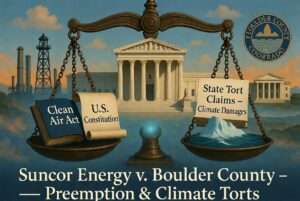
Suncor is obviously an important environmental case, but its significance is far broader. If the claims are allowed to proceed--and if the plaintiffs are able to overcome the other hurdles to making their case (a significant if)--quite a bit of money could be at stake. In addition, if the justices reach the merits, the case could dramatically alter the law of federal preemption.
Given the significance of the case, it should be no surprise that waves of amici filed briefs. By my count, there are forty top-side briefs supporting the fossil-fuel companies' preemption claims, including a brief by the Solicitor General. There are also twenty-eight bottom-side briefs arguing against preemption (including mine).
Most discussion of the case--and, indeed, many of the amicus briefs--focus on the policy context. Accordingly, folks who want urgent action to address climate change tend to support the respondents, and those who are skeptical of such policies (or who are concerned about energy prices), support the petitioners. This is understandable, but threatens to obscure the underlying legal issues, as does conspiratorial talk about what shadowy interests are supporting one side or the other.
As I try to show in my brief, there is no statute or precedent that supports wholly preempting these cases. This does not mean the claims should succeed, nor does it mean there are no constitutional or other grounds to force a narrowing of the claims. But those other grounds are not encompassed by the question presented and are not being advanced by the petitioners. What is before the Court is whether federal law or the constitution wholly precludes bringing claims under state-law for interstate harms of the sort alleged here. It is a narrow question. It is also one that I think is relatively easy and straightforward. We will see if a majority of the Court agrees.
From O.A. v. Devita, decided June 25 by L.A. Superior Court Judge Dean Kitchens, but just recently posted to Westlaw:
The following summary is derived from the allegations in Plaintiff's complaint. Plaintiff is a high school boy with a disability who had a long-standing friendship with Defendant's son, M.S., another boy with a disability. Plaintiff is diagnosed with rare and serious genetic conditions causing neurocognitive delays. He also has a language disorder, anxiety, and specific learning disabilities…. Plaintiff has known M.S. for seven years and have been in many of the same special education classes. They also were a part of the same soccer league.
On October 10, 2022, Plaintiff went to M.S.'s home for a playdate allegedly supervised by Defendant and M.S.'s stepfather …. On November 4, 2022, the boys had another playdate allegedly supervised by Defendant. On May 12, 2023, M.S. reported to his teacher that Plaintiff had pressured him to do "sexual things." Plaintiff was suspended after the report pending an investigation.
During the initial investigation, Defendant allegedly posted several negative statements about Plaintiff on her Twitter account which were recognized by other members of the community. Defendant also allegedly called the coach of the boys' soccer league and stated that Plaintiff had sexually assaulted M.S. After calling the coach, Plaintiff alleges that Defendant approached them at a softball game and stated that Plaintiff had pulled a knife on M.S. and been physically and verbally abusive since grade school. Plaintiff also alleges that Defendant used the soccer league's member list to call other parents and warn them about him.
Plaintiff came to Maine from Angola in 2016, following persecution based on his work as a Christian pastor. He took a position as a Production Group Leader at Defendant's facilities in Westbrook and Scarborough, Maine, in November 2019. In April 2022, Defendant terminated his employment. Plaintiff alleges that Defendant discriminated against him on the basis of his race in the course of his employment and termination. He also alleges that Defendant retaliated against him after he engaged in protected conduct by making a scheduling decision that accommodated the needs of his Muslim subordinates during Ramadan.
The matter is currently before the Court because Plaintiff electronically signed Defendant's Employee Agreement as a precondition to his employment, and the Agreement contains a forum-selection clause stating that only the federal and state courts of Illinois will have jurisdiction to hear Plaintiff's claims….
Plaintiff argues that transfer would be unfair, unjust, and against public policies that favor the free exercise of religion and nondiscrimination. As alleged, Plaintiff is "the sole pastor at his church" and "leads three services per week." Because of his religious calling and his duties, he maintains, "[t]raveling to Illinois for a deposition or trial would make it far more difficult for him to fulfill his pastoral duties than if the deposition or trial occurred in Maine."
I am not persuaded that Plaintiff's religious practices and duties as a pastor justify giving him a special dispensation to avoid application of the Forum-Selection Clause of the Employee Agreement that he acknowledges signing as a precondition to his promotion to a supervisory position. And as for the burden itself, assuming that a special dispensation might be appropriate based on individual needs pertaining to the inconvenience of a particular forum, the Defendant has indicated that Plaintiff's deposition will take place in Maine.
Objective science aims to uncover truths about environmental conditions, including those related to emission trends, biodiversity loss, climate change, and their economic costs. When and why do scientists use subjective language to describe these conditions with bias, emotion, or advocacy? To shed light, we study determinants and trends in subjective language within the abstracts, introductions, and conclusions of over 170,000 peer-reviewed articles published during 1990-2023 in top economics and science journals. Using machine learning to label and score text by subjectivity, we find that subjective language is more prevalent in articles focused on environmental topics relative to non-environmental topics: by 12% in economics and by 42% in science. After accounting for factors such as article age, author experience, number of authors, and journal quality, higher subjectivity scores associate positively with future academic citations in both science and economics, especially if the article is focused on an environmental topic. These findings, which imply subjective language has been rewarded in the academy, are consistent with informal theory suggesting subjective language will be used more frequently by scientists when expected rewards are high and risks are low.
The obvious question is whether this is just a finding about the use of language, or whether it indicates something about the underlying work.