Two sides of Texas bindweed

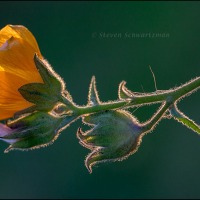
In the town of Cedar Park on July 27th I made portraits showing both sides of Texas bindweed flowers, Convolvulus equitans. The dry stalk the vine was twining around left no clues to identify it.

© 2026 Steven Schwartzman
This year’s first snow-on-the-

Central Texas has two Euphorbia species whose common names begin with “snow-on-the-.” One is snow-on-the-prairie, Euphorbia bicolor, which I haven’t yet seen this year. The other is snow-on-the-mountain, Euphorbia marginata, which I’d begun seeing at the end of July, but none of those plants were flowering yet. That changed on August 8th along the south fork of the San Gabriel River in Georgetown, when I found a snow-on-the-mountain with several flowers on it. The plant also bore a little spider silk, as you can see.
§
§ § §
§
Disparate impact liability has been the engine of government-sponsored race- and sex-discrimination for generations—and the engine of arbitrary government power. Every action, by definition, has disparate impact on some group; disparate impact theory makes any action by any institution or individual illegal. Disparate impact liability gives the government the power to select which action with “disparate impact” should be prosecuted, to bullyrag an individual or institution into compliance with its whims, for fear of a bankrupting lawsuit. In practice, disparate impact liability has been used to enforce an ever more harsh and rigid regime of race and sex discrimination on America’s institutions, not least by forcing them to create their own discrimination bureaucracies, like “diversity, equity, and inclusion” offices and human resources, to achieve a legal safe harbor of compliance. Removing the whip from the federal government is the essential first step to removing discrimination from America.
You can read the full article from the National Association of Scholars that that’s from, “The End of Disparate Impact Liability.”
© 2026 Steven Schwartzman
Home advantage

Because pavonia mallow (Pavonia lasiopetala) grows in our yard, I have an easy time getting pictures of that species. The opening photograph shows one flower with buds in various stages of development and opening. Another flower played temporary host to the nymph of a bush katydid that’s likely in the genus Scudderia. The pictures are from the last day in July.

© 2026 Steven Schwartzman
More cheerful yellows*

From the town of Cedar Park on July 27th come some cheery flowers on a paloverde tree, Parkinsonia aculeata, against the morning’s bright blue sky. Two days earlier in Bull Creek Park I’d spent time with an opening roughstem rosinweed, Silphium radula. People sometimes mistake these for sunflowers, and Silphium is indeed in the same Heliantheae tribe as common sunflowers within the very large sunflower family.

* In modern punctuation, “more cheerful yellows” means that there have already been some cheerful yellows, and now here are some more of them. In contrast, “more-cheerful yellows” means that there have already been some cheerful yellows, but these new ones are of a yellow that’s more cheerful than the previous ones.
© 2026 Steven Schwartzman
Peppervine fruit

In the town of Cedar Park on July 27th I made some portraits of peppervine, Nekemias arborea. Notice the spiderwebs and tiny spider in the top view, and in both pictures the characteristic speckles on the little fruits. As AI explains: “Berries start out pale, turning pinkish with distinct speckled spots or blotches. The speckles blend… as the fruit matures into a solid, shiny bluish-purple or black color.”
And let the appeal be only visual: “Do not eat these berries raw off the vine. The fruits contain sharp calcium oxalate crystals that cause severe mouth and throat irritation, resembling a burning sensation or fiberglass.”

© 2026 Steven Schwartzman
Past its peak season

The greatest density for pink evening primroses (Oenothera speciosa) probably comes in April, when in a peak season large colonies blanket the land. That said, individual flowers pop up occasionally for much of the remaining year, like this one in the town of Cedar Park on July 27th.
© 2026 Steven Schwartzman
Two early yellows

Here are two early yellows from Bull Creek Park on July 25th. The one above of a Maximilian sunflower (Helianthus maximiliani) is the more unexpected, given that this species typically doesn’t start flowering till September. And while the mass of poison ivy (Toxicodendron radicans) leaves change color by November or even December, it’s not all that unusual to find an individual leaflet that has yellowed much earlier in the year.

© 2026 Steven Schwartzman
Graceful flame acanthus

Look at the graceful curves of a flame acanthus flower (Anisacanthus quadrifidus)
in the Zilker Nature Preserve on July 25th. If you see arms raised in welcome
or wings raised in flight or some other dynamic gesture, be my guest.
© 2026 Steven Schwartzman
Velvetleaf mallow flower opening

This velvetleaf mallow flower (Allowissadula holosericea) was opening in
the Zilker Nature Preserve on July 25th. The Greek-derived species name
means ‘all silky,’ a reference to the soft hairs covering much of the plant.
© 2026 Steven Schwartzman
Talayote and a walker thereupon

A talayote vine (Cynanchum unifarium) has been thriving on the back railing of the deck behind our house. When I looked at the vine on the last day in July I found a fair number of buds and a smaller number of diminutive flowers. You may be able to tell from the structure of the flower above that the plant is a type of milkweed. It’s fitting then, that I noticed what’s called a large milkweed bug (Oncopeltus fasciatus) on a twining—or what I’ve more numerically soundly called thrining—part of the vine.

© 2026 Steven Schwartzman
 Portraits of Wildflowers