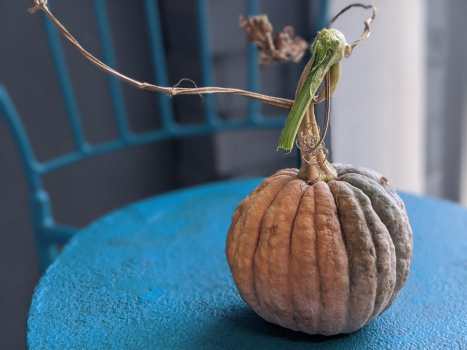
Tetsukabuto: Finally a New Squash

This past year+ has been a hard one due solely to the lack of new varieties of squash to try. But finally I found one. I had to finagle a chunk of this from my partner’s sister’s family who got it from a small farmer they know. That is why my photo shows only a small chunk of cooked squash. It’s what was leftover after last night’s dinner. Apparently I was too eager to try new squash to think about this blog. Sorry, dear readers.

I did see this squash in its full form, though. When Elisha’s sister showed it to me and said it was a Japanese hubbard variety, it surprised me because I thought it looked like a large buttercup squash. The taste is similar to kabocha – sweet but not overly so, dry, flaky and dense flesh. It was lovely baked plain. The skin was edible, but barely so. Interestingly, this squash is a cross between two species of squash – maxima and moschata, which could be why it tastes like kabocha, but doesn’t look like other Japanese squash I have seen.

Koginut Squash

Koginut is a squat little dusty-looking heirloom squash that just seemed to become commercially available around here this year (as far as I can tell). It looks like a butternut squash that someone stepped on. I was expecting a butternut (or ideally honeynut) flavour but was disappointed. The flavour was fine, actually, but nothing extraordinary; the texture was the problem. It is coarser than most squash, Elisha called it “grainy”. It reminds me a little of a spaghetti squash that is too old and maybe overcooked. Marcus, our housemate, liked the one he got, though, so it might just not be up my alley. Honeynut and kabocha still reign over all the other squash, as far as I am concerned.

You’ll note from the pictures that it makes a cute last-minute jack-o’-lantern, though.

Kogigu Squash

Photos courtesy of Elisha Lim :).

I had been waiting for months to try Kogigu squash: I ordered the seeds in February, planted them in May, and we have been tending them since. When Annapolis Seeds offered them, it was the first I had heard of this Japanese squash, and I have been letting the fruits ripen on the vine as long as I could, so just harvested them recently. The squash are savoury, thin-fleshed and hearty – with an almost potato flavour. The closest thing I have had to them is Black Futsu. They are really not at all sweet, but are delicious. The plant grew vigorously, despite some powdery mildew with an OK harvest (the three pictured, plus an additional smaller one). In short, I would definitely plant these again, and recommend them cut in half and baked with no extra preparation or dressings necessary.

Palestinian Kusa Squash


It’s been years since I grew a squash myself, so this is notable in that this squash comes from my own front yard, lovingly tended by me and Elisha. We’re growing 3 varieties of squash in terraced boxes, but this is the only summer squash, and the first to form fruit. I ordered the seeds from Annapolis Seeds, and apparently it’s vigorous and “immensely productive,” so looking forward to that.

This squash is mild, like other summer squash, sweeter than zucchini, and very similar to a Lebanese summer squash, aka vegetable marrow that I grew years ago.

Summer squash… I love them for their productivity, giant plants and adaptability in cooking and baking but there is not a lot to say about their flavour or texture.

Weird Spaghetti Squash

What is the deal with this spaghetti squash? Who knows? I bought it, thinking it was one of those alternate-shaped butternut squashes. Instead it was a slightly-bitter, past-its-prime spaghetti squash, Oh well.

The same farmers’ market stall has some rather lumpy kabocha-ish squash that bake up nicely. It’s late in the season for local squash, so I’m lucky to find anything these days.

Sweetcorn Squash

I found a new squash to sample for the first time this season. That’s not for lack of trying. At least the old reliable kabochas and honey nut squashes have kept me happy so far.

The grower at the farmers’ market said this variety was called “Sweetcorn,” but I can’t find any evidence of a squash with that name online or in my beloved (but definitely incomplete) volume of The Compleat Squash.  The farmer described the flavour as a mix between butternut and buttercup, and quite sweet. I agree. It’s sweet without being insipid, about as dense as butternut and with seeds that look like kabocha. The outside looks like a small Hubbard type squash, and definitely Maxima judging by the seeds. If anyone can identify this squash, I’d be interested. It’s good enough to eat plain, and has nice thick flesh, but not so amazing that I hesitated using about a third of it in a soup.  I’m looking forward to roasting the giant seeds that had only a little dry goop around them (like Kabocha only even less guts/flesh).

3.5 Stars

Squash Wars: Son of Blue Doll

If the outcome had been more f(l)avourable, perhaps I wouldn’t feel the need to justify why I tried Blue Doll squash for the third time. I compared the first one I ate to a tasteless summer squash. The second one was acceptable for a late-season squash. But as I mentioned last entry, when I saw that this one and its relative had come from a farmer who grew a squash I really liked, I wanted to give it another try. I figure that the growers who choose tasty varieties are more likely to know what a good squash is, and not just go for looks. This is not always the case. Since this one looked so different from its orange sibling, and also because we’re pretty much at the end of squash season, I couldn’t help but get both.  

They were both so much larger than the Blue Doll squash I tried in 2017, with more developed ridges and a different shape that I figured the first one might have been harvested before it was ripe. That’s another thing: any local squash that lasts until March was definitely picked after it ripened (immature squash rots more quickly), and this particular farmer doesn’t rush his squash to market.  

I stand by my reasoning, but the results were still disappointing. As soon as I opened the oven, I could tell things were not going well: a pool of liquid in the squash indicated watery flesh, and a taste confirmed something very similar to the 2017 squash. Fine for soup, pie, etc. But not worth eating without doctoring. Into the freezer with ye. ​

Squash Wars: Blue Doll Returns

Last year I rated a Blue Doll squash a hard pass, calling it truly terrible. The food co-op had some Blue Doll squashed in, grown by the same farmer as the Blue Ballet, which is now sadly sold out.  They look totally different than the Blue Doll of last year, which I suspect was unripe, so I decided to give them another go. I say “them” because, another twist, there were two different squashes labelled as Blue Doll – one streaky orange with a Hubbardy butt, and the other blue with a Kabocha/buttercup style butt. Both were about triple the size of the other Blue Doll. And both came home with me today.

I baked the orange one today. It is passable, but nothing to get excited about. The seeds are just large enough to bother toasting, and the seed cavity is very dry like a kabocha – no wet guts like a pumpkin. The flesh is not too sweet, and has some flavour,  but isn’t rich. It would make a fine soup or smoothie, but not great eating on its own.

As for the blue, that will have to wait until the next entry.

Squash Wars 2018-19: Blue Ballet

IMG-0563

How did I end up so lucky as to find a new variety of squash in February? All due to a clever farmer who grows interesting varieties that store well, goes on vacation in the Fall, then returns in winter and sells a bunch of new and exciting (OK, not *everyone* is that that excited about squash, I know, but somewhat novel at least) vegetables, after people have gotten tired of what’s been available to them since October. The food co-op just experienced a surge of new local produce thanks to this farmer. Anyway, so I was interested because this squash was obviously a Hubbard, which are generally very tasty. It did not disappoint. While the flesh doesn’t have the super dry flakiness of a perfect pie crust (like my beloved kabocha squashes), it does have a similar flavour to kabochas: intensely savoury and … squash forward? Ha ha. There is no melony sweetness and the flesh is fairly dry and browns well when roasted. I will definitely stick to this squash as long as it’s around. It’s not my favourite overall, but it’s definitely an awesome selection at this point in the year when a lot of the choice squash has sold out or gone bad. It’s surprisingly light, given the size of the squash due to its sizeable seed cavity filled with the plumpest, tastiest seeds that are perfect for toasting. I’ve been tossing mine with salt and this ras-el-hanout spice mix recipe, and have been liking them so much that I actually can’t eat enough squash to get the amount of seeds I’d like.

  • Privacy
  • Design a site like this with WordPress.com
    Get started