MOON SHOT

*

Ted Anthony wrote about his recollection of his father taking a picture of a TV image of mankind on the Moon.

I too have a recollection of taking a picture of our first step on the Moon with my Polaroid camera and waiting in anticipation for the film to develop itself.

Now much older I say thanks to Ted for helping me remember.

Maybe his article will help you all to feel the excitement too.

LRK.

Moon Shot 

Gazing into a long-ago Polaroid taken by my father, and finding multitudes.

Ted Anthony

Ted AnthonyFollow

11 min read

·

Jun 18, 2016

https://midcenturymodernmag.com/moon-shot-2827dee575ad

Darkness. Darkness all around. That’s what the lens captured. On the edges: a thick white photographic border that shouts early 1970s. Moving toward the middle, inky black ebbs into greenish gray and, finally, into a tableau captured in a ghostly bluish-white.

In it, you can make out a figure and beyond it, some machinery and a coarse, remote landscape, viewed as if through a rudimentary pinhole camera. Some horizontal lines, barely perceptible, suggest this may not be an image in itself but an image of an image, viewed through some kind of vacuum-tube alchemy. Something is out there, but we’re not certain what. H.G. Wells comes to mind — a collision of the modern and the ancient, of the sterile and the visceral, the as-yet-unnamed aesthetic of steampunk. The world seen through a glass, darkly.

It is not a very good photograph, at least in the way that we tend to judge such things. But it is an important one. It shows how detached and gossamer we human beings really are. It shows us as we embark upon a journey to become a society of watchers, separated by multiple layers of reality from the events that shape us.

And it shows that, in a manner of speaking, the camera that captured my childhood also went to the moon.

One forgotten day between 1969 and 1972, my father, approaching the end of his fifth decade on the third planet, raised his Polaroid Land Camera Automatic 230, pushed the red button in the top right corner and made a photograph.

A second or two afterward, he yanked it from the contraption by hand — a single piece of peel-away Polacolor pack film that required a minute’s wait before you pulled it apart to expose the quickly coalescing image.

If you found Ted’s article interesting you may find some of his other articles interesting as well.

Hopefully you will not mind if I reference some of them as as they make me smile.

LRK

https://anthonyted.medium.com/

Ted Anthony

1.97K followers

Exploring and understanding storytelling and how it shapes our lives. 

My tools: Words, images, thoughts, memories, connections, history … and, maybe, wisdom.

==============================================================

Site: http://lkellogg.vttoth.com/LarryRussellKellogg/

BlogSpot: http://kelloggserialreports.blogspot.com/WordPress: https://lrkellogg.wordpress.com/

==============================================================

WHAT THE MIND CAN CONCEIVE, AND BELIEVE, IT WILL ACHIEVE – LRK –

==============================================================

Posted in Uncategorized | Tagged , , , , | Leave a comment

20 JULY 1969 MOON LANDING

20 July 1969 Moon Landing – Do you remember?

On a Historical note this is July and the news made mention of the coming July 20th  referring to the Moon landing of 1969. It was mentioned that some are interested in making it a  USA federal holiday.

Back in 2019 Trump proclaimed July 20 as the 50th anniversary observance for the moon landing, but no national holiday.

LRK

https://www.nationaldaycalendar.com/national-day/national-moon-day-july-20

NATIONAL MOON DAY

National Moon Day on July 20 commemorates the day man first walked on the moon in 1969. NASA reported the moon landing as being “…the single greatest technological achievement of all time.”

*

In 2019, President Donald Trump proclaimed July 20th as the 50th Anniversary Observance of the Apollo 11 Lunar Landing. However, no National Moon Day has been declared.

The United Nations has an International Moon Day.

LRK

https://www.un.org/en/observances/moon-day

The General Assembly declared International Moon Day, a United Nations-designated international day to be observed annually on 20 July, in its resolution 76/76 on “International cooperation in the peaceful uses of outer space” in 2021.

International Moon Day marks the anniversary of the first landing by humans on the Moon as part of the Apollo 11 lunar mission in 1969.

— 

Wyoming has a moon landing observance day, but it doesn’t seem like the other states have.

LRK

https://wyoleg.gov/Legislation/2023/SF0095

AN ACT relating to legal time and holidays; designating Moon Landing Day as a state recognized commemorative day to be observed as specified; and providing for an effective date.

Be It Enacted by the Legislature of the State of Wyoming:

I think the newscast was referring to these guys and their podcast and.net reference. 

LRK

https://twit.tv/shows/this-week-in-space/episodes/162

May 23rd 2025

THIS WEEK IN SPACE 162

LUNAR LANDING DAY

Hosted by Rod PyleTariq Malik

https://twit.tv/posts/tech/lunar-landing-day-movement-make-july-20th-federal-holiday

UNAR LANDING DAY: THE MOVEMENT TO MAKE JULY 20TH A FEDERAL HOLIDAY

May 28th 2025

AI-generated, human-edited.

The moon landing on July 20, 1969, was a monumental achievement for humanity, a triumph of technology, and a unifying moment in American history. Yet, as highlighted in a recent episode of This Week in Space, this incredible feat often goes unremembered by many, even those with a passion for space. Rod Pyle and Tariq Malik sat down with Dr. Robert Slater, MD, an orthopedic surgeon and the driving force behind the Lunar Landing Day Initiative, to discuss his quest to make July 20th a federal holiday.

Dr. Slater’s inspiration for the initiative stemmed from a simple, yet disheartening, observation: his own staff couldn’t recall the significance of July 20th, 1969. This realization sparked a profound concern that one of humanity’s greatest accomplishments was fading from public memory. He believes we “ought to celebrate that every year,” particularly in an age where positive news is sorely needed.

There is plenty on the Internet if someone looks.

LRK

https://www.archives.gov/publications/prologue/2003/summer/20-july-1969.html

https://www.history.com/articles/moon-landing-1969

https://en.m.wikipedia.org/wiki/Apollo_11

The Space Review has an article by Anusuya Datta.

Nice story.

LRK

https://www.thespacereview.com/article/4779/1

Tintin, the first man in space and on the Moon

by Anusuya Datta
Monday, April 22, 2024

April 12 is a historic day for the space industry. On this day back in 1961, Russian cosmonaut Yuri Gagarin became the first human in space. Not to be left behind, the United States sent its first man into space in less than a month—Alan Shepard on May 5—thus sparking the famous space race between the two Cold War superpowers. December 1968 saw the launch of Apollo 8, the first manned space mission to orbit the Moon, and about seven months later Americans Neil Armstrong and Buzz Aldrin made the historic Moon landing on July *20, 1969.

But everyone knows all this, and that’s not the story.

What many don’t know is that super hack Tintin was way ahead of both the superpowers in flying to space as well as landing on Moon. Yes, we are talking about the Belgian boy with a tuft of ginger hair.

*

All of this may be a mute subject if we end up with live war in space. 

See the space review article.

LRK

https://www.thespacereview.com/article/5022/1

War in space is not a future problem: it’s happening now

by Christopher Stone
Monday, July 14, 2025

Space is not a place where war will happen in the future, it’s a place where war is happening now! Major powers now vie for dominance in this vital warfighting domain, with China and Russia actively challenging the United States’ long-standing leadership. Evidence suggests these nations are not merely testing space weapons but are actively engaged in a low-intensity warfighting campaign to undermine US and allied interests in orbit, while preparing for further, more destructive and aggressive actions in space.

Posted in Back To The Moon | Tagged , , , , | Leave a comment

PRINTING BRICKS FROM MOONDUST USING THE SUN’S HEAT

The European Space Agency (ESA) posted 3 May 2017 an article about making 3D Bricks from a lunar Simulant.


http://www.esa.int/Our_Activities/Space_Engineering_Technology/Printing_bricks_from_moondust_using_the_Sun_s_heat

3 May 2017

Bricks have been 3D printed out of simulated moondust using concentrated sunlight – proving in principle that future lunar colonists could one day use the same approach to build settlements on the Moon.

“We took simulated lunar material and cooked it in a solar furnace,” explains materials engineer Advenit Makaya, overseeing the project for ESA.

“This was done on a 3D printer table, to bake successive 0.1 mm layers of moondust at 1000°C. We can complete a 20 x 10 x 3 cm brick for building in around five hours.”

Access the videos.

http://www.esa.int/spaceinvideos/Videos/2017/03/3D-printing_moondust_bricks_with_focused_solar_heat

Advenit adds: “Our demonstration took place in standard atmospheric conditions, but RegoLight will probe the printing of bricks in representative lunar conditions: vacuum and high-temperature extremes.”

http://www.esa.int/spaceinimages/Images/2013/01/Multi-dome_base_being_constructed

  • Title Multi-dome base being constructed
  • Released 15/01/2013 12:00 pm
  • Copyright ESA/Foster + Partners
  • DescriptionMulti-dome lunar base being constructed, based on the 3D printing concept. Once assembled, the inflated domes are covered with a layer of 3D-printed lunar regolith by robots to help protect the occupants against space radiation and micrometeoroids.
  • Id 286363

Five hours to make one brick sounds like a long time.  Maybe if you sent in the robots and had them working on projects before humans landed the time would not be a problem.  All part of things to consider in setting up a lunar base. Engineers should really enjoy making something like this work.

VISUALIZE MEME: = THE MOON IS OUR NEXT INHABITED PLANET


Posted in Space Exploration | Leave a comment

Base Construction Material

Whether we go to Mars or the Moon, if we expect to build up a base it will be to our advantage to be able to use the materials we find there.

Even if we use the initial lander or sent ahead containers, there will be a need to provide additional  material to provide shielding, especially if there is no atmosphere to slow down cosmic rays.

John Reed passed me a link to some work that has been done to see if bricks could be made from a Martian Soil Simulant.


https://www.nature.com/articles/s41598-017-01157-w

Direct Formation of Structural Components Using a Martian Soil Simulant

  • Scientific Reports 7, Article number: 1151 (2017)
  • doi:10.1038/s41598-017-01157-w

Abstract

Martian habitats are ideally constructed using only locally available soils; extant attempts to process structural materials on Mars, however, generally require additives or calcination. In this work we demonstrate that Martian soil simulant Mars-1a can be directly compressed at ambient into a strong solid without additives, highlighting a possible aspect of complete Martian insitu resource utilization. Flexural strength of the compact is not only determined by the compaction pressure but also significantly influenced by the lateral boundary condition of processing loading. The compression loading can be applied either quasi-statically or through impact. Nanoparticulate iron oxide (npOx), commonly detected in Martian regolith, is identified as the bonding agent. Gas permeability of compacted samples was measured to be on the order of 10−16 m2, close to that of solid rocks. The compaction procedure is adaptive to additive manufacturing.


Shorter version of report. – LRK

https://www.sciencedaily.com/releases/2017/04/170427091723.htm

Engineers investigate a simple, no-bake recipe to make bricks from Martian soil

Date:
April 27, 2017
Source:
University of California – San Diego
Summary:
Explorers planning to settle on Mars might be able to turn the planet’s soil into bricks without needing to use an oven or additional ingredients. Instead, they would need to apply pressure to compact the soil–the equivalent of a blow from a hammer.
This is a brick made of Martian soil simulant compacted under pressure. The brick was made without any additional ingredients and without baking.
Credit: Jacobs School of Engineering/UC San Diego

Since we would like to go back to the Moon to Stay, using what we find in the Lunar Soil should be considered as well.

What elements are there can help suggest what might make a good way to use the soil.


It looks like work has been done on lunar soil simulents.
Introduction: The potential of utilizing lunar regolith as the raw material for manufacturing structural members is very appealing for future exploration of the Moon [1,2]. Future lunar missions will depend on in-situ resource utilization (ISRU) for structural components. Manufacturing structural components directly from unrefined lunar regolith would have the advantage of needing less specialized material processing equipment in comparison with refining the lunar regolith for its raw elements. Sintering lunar regolith has been proposed as a structural material by previous researchers but has not been evaluated for its elastic material properties. Sintering can be a highly variable process and only with the material constants can a structure be designed from this material.
————————————–
Developing Cementitious Materials Using Lunar Soil Simulant Yu Qiao,* Jin Chen, Aijie Han. Department of Structural Engineering, University of California at San Diego 9500 Gilman Dr. MC 0085, La Jolla, CA 92093-0085, USA (Email: yqiao@ucsd.edu)
Summary: An organic-inorganic nanohybrid of high flexure strength and low permeability is developed using lunar soil simulant and polymer-silicate interphase. The interphase consists of a continuous polyamide 6 phase, exfoliated silicate nanolayers, and dispersed silicate tactoids intercalated by polyamide 6 oligomers. The lunar soil simulant is strongly bonded by the interphase through a two-staged heating and mixing process, forming a multiscale structure with the characteristic lengths ranging from nanometer level to sub-millimeter level. This technique has great potential in developing high-performance space infrastructural materials using locally harvestable resources. A complete report has been published elsewhere.[1]
—————————————–


I haven’t seen whether just impacting Lunar soil (regolith)  will make nice bricks.

I have a stack of books that discuss what might go into making a Lunar base.

It looks like I need to do a lot of re-reading and then see if we are doing more actual testing.  Hopefully that will be the case as others are now talking more about going to the Moon with landers.

Send in the robots and let’s see if they can make some Lego Bricks that can be stacked neatly into structures. 

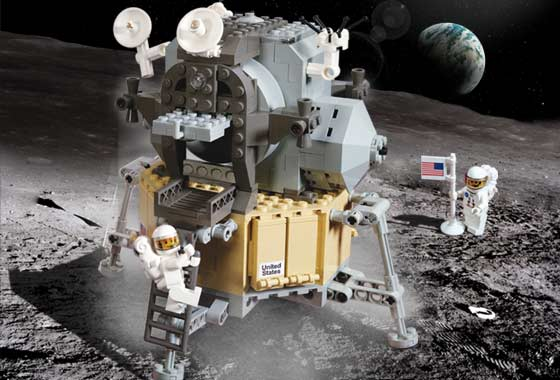
I wonder what a LEGO Lander made from Lunar Regolith would cost?

https://www.bricklink.com/v2/catalog/catalogitem.page?S=10029-1#T=S&O={}

Lego Lunar Lander

——————————————
The Lunar Dust Problem: From Liability to Asset Lawrence A. Taylor1 (lataylor@utk.edu) Planetary Geosciences Institute, University of Tennessee, Knoxville, TN 37996 Harrison H. Schmitt2 Engineering Research Bldg., University of Wisconsin, Madison, WI, 53706 W. David Carrier, III3 Lunar Geotechnical Institute, P.O. Box 5056, Lakeland, FL 33807 And Masami Nakagawa4 Division of Engineering, Colorado School of Mines, Golden, CO 80401
ABSTRACT
In-Situ Resource Utilization (ISRU) of lunar materials for the establishment of an extra-terrestrial human base or settlement will involve guarding against, as well as utilizing, the ever-present, clinging, penetrating, abrasive, resource-rich, fine-grained lunar dust. The properties of the fine portion of the lunar soil (<50 µm), its dust, must be adequately addressed before any sustained presence on the Moon can be fully realized; these include:
1) abrasiveness, with regards to friction-bearing surfaces;
2) pervasive nature as coatings, on seals, gaskets, optical lens, windows, etc.,
3) gravitational settling on all thermal and optical surfaces, such as solar cells; and
4) physiological effects on the tissue in human lungs.
The chemical and physical properties of the fine fraction of lunar soil is at the root of the unusual properties of the dust that contribute to its deleterious effects – its “liability”. Recent discoveries of the unique magnetic properties of lunar mare and highland soils by the senior author’s Tennessee group have led to suggested solutions to the liability of the lunar dust. The soil fragments and dust grains contain myriads of adhering nano-sized (3-30 nm) Fe0 particles, iron in its elemental form, concentrated especially in the fine, dusty fraction. The presence of this ferromagnetic Fe0 on and in almost every grain of the fine dust-sized particles imparts an unusually high magnetic susceptibility to the particles, such that they are easily captures by a magnet. Furthermore, the presence of these nanophase Fe0 grains imparts an unusual property to the soil for microwave energy. The microwaves couple strongly with the Fe0 to such a degree that a sample of Apollo soil placed in an ordinary 2.45 MHz kitchen microwave will literally begin to melt before your tea-water boils. Further considerations of the properties of the fine soil are the basis for the microwave sintering/melting, hot-pressing, and extrusion of the soil to form various construction materials, in order to realize some of the “assets” of the soil
[Note – 31 references – LRK -]
——————————————

MEME: = THE MOON IS OUR NEXT INHABITED PLANET


Posted in Base Construction | 1 Comment

NASA VR 360

Looking for ways to make it easy to assist in propagating the MEME: = THE MOON IS OUR NEXT INHABITED PLANET.

NASA has over the years done more to put their face in front of the general public.

Back when the Lunar Prospector mission was being set up the project was asked to find a way for the general public to get a feel for what was going on during real time while Lunar Prospector was orbiting the Moon.  They set up a Lunar Prospector web site and I got to adapt some of their programs to let me send data to the web site display applets through a back door.  These displays updated just 5 minutes after the live data was received.  Much quicker than waiting a couple of years for the scientists papers to come out. 🙂

Since then NASA in general has done much more to provide access to mission information. Mars gets a lot of coverage.

https://mars.nasa.gov/programmissions/

JPL contributes much.

https://www.jpl.nasa.gov/missions/

The International Space Station (ISS) is interesting with media coverage letting us know what is going on in Low Earth Orbit.  Videos and interviews bring us up to speed.

https://www.nasa.gov/mission_pages/station/multimedia/gallery/

Today with the higher bandwidth Internet connections and more powerful graphic processors for computers, tablets, and phones. we can take Virtual Tours of the ISS.

Here is a YouTube tour.

Published on Jan 11, 2016

Using the amazing Space Engine and some mods created by Harbinger we can float around outside the International Space Station as it orbits the Earth. Using YouTube’s 360 video feature you can look in any direction and those using headsets can experience the view from 400 km above Earth floating next to the most complicated piece of machinery ever made.

The music is a slowed down version of Eastminster by Kevin MacLeod
http://incompetech.com/music/royalty-…

Space Engine is Copyright Vladimir Romanyuk © 2011-2016
http://en.spaceengine.org/

ISS and Space Engineer Mods created by Harbinger
http://en.spaceengine.org/forum/17-26…

Space Engineers developed by http://www.keenswh.com/


This tour is 50 minutes long.


Published on May 21, 2016

One of the most detailed tours of the ISS from American astronaut Steven Swanson!!!


With the idea of building a Lunar Base, I thought I would see what using a pair of VR googles like the Google Cardboard viewer would be like.

https://vr.google.com/cardboard/

I bought a BNEXT VR Headset

3D VR Headset Virtual Reality Glasses for iPhone & Android – Play Your Best Mobile Games & 360 Movies With Soft & Comfortable New Goggles Plus Special Adjustable Eye Care System

by Bnext

Then down loaded an Android APP for my Samsung phone.  Now I am looking to see if NASA or others have done more VR with the Moon in mind.


Apollo 15 Moon Landing VR
Thomas Kole Educational

Celebrating the 45 year anniversary of the Apollo 15 mission!
Use your phone and Google Cardboard to simulate the 1971 Apollo 15 Moon Landing.Feel the rumble as the spacecraft descends to the Lunar surface.
Walk on the moon like Scott and Irvin did, and unpack and drive the Lunar Rover.
—————————————

NASA has this link for – NASA Apps For Smartphones, Tablets and Digital Media Players

https://www.nasa.gov/connect/apps.html

It looks like I have some catching up on my viewing.

I am hoping that I can find ideas for how a viewer might partake in building a Lunar Base or at least seeing how it might be done.

Since we haven’t built one I may have my work cut out.  Then again, you may know of something already done or who might be working on such a project.

I am wondering if playing with VR applications will help promote the –

MEME: = THE MOON IS OUR NEXT INHABITED PLANET.

Posted in Uncategorized | 1 Comment

Moon 101 Lecture Series

Back in 2010 I looked at the Moon 101 Lecture Series that was given in 2008.

https://kelloggserialreports.blogspot.com/2010/03/moon-101-lecture-series.html

It is a very good starting point to look at the Moon and as mentioned in the lecture, we now have additional data from the more recent missions that build on what was said here.

For any of us that might like a refresher course, let me post again the links and topics covered. I am re-watching and looking for ideas as to what the general Internet audiance might like to see when we got back to the Moon with humans on the lunar surface.

MEME: = THE MOON IS OUR NEXT INHABITED PLANET.

If you don’t have the time to listen to all the lectures you still might like to look at slides from the lectures. Very informative.

—————————————————————–

http://www.spudislunarresources.com/moon101.htm

Moon 101 – A Course in Lunar Science for non-specialists

Presentation materials for a course of lectures at NASA Johnson Space Center

June-October, 2008
—————————————————————–

http://www.lpi.usra.edu/lunar/moon101/

Moon 101 Lecture Series

These lectures were produced by NASA and posted on this website with permission.

The following presentations are included in the lecture series.

Introduction to the Moon, Dr. Paul Spudis
The Lunar Environment, Dr. Wendell Mendell
Physiography and Geology of the Moon, Dr. Paul Spudis
The Lunar Surface, Dr. Jeff Plescia
The Lunar Crust, Dr. Gary Lofgren
The Lunar Interior, Dr. Jeff Plescia
The Lunar Polar Environment, Dr. Ben Bussey
A Brief, Selective History of the Apollo Program, Dr. Dean Eppler
Future Scientific Exploration of the Moon, Dr. Paul Spudis
Lunar Meteorites, Dr. Kevin Righter

NOTE: Slide only versions of the lectures are available at Spudis Lunar Resources.


Introduction to the Moon

In the first presentation of the Moon 101 lecture series, Dr. Paul Spudis gives an introduction to the Moon, providing an overview of the more detailed Moon 101 lectures to follow. The presentation begins by describing the nature of the Moon as a heavily cratered rocky planet, and compares the general properties of the Moon to those of the Earth and Mars. Global images and elemental composition maps are then followed by discussions of: the thermal and micrometeorite environments on the lunar surface; the Moon’s orbit and resulting eclipses and lunar librations as viewed from Earth; surface topography; moment of inertia; surface morphology and physiography; landscapes and terrains; the surface lighting environment; regolith and dust; and the origin of the Moon. The presentation concludes with a review of past and current robotic exploration missions to the Moon.

Lesson presented: 06⁄04⁄2008
Lesson produced: 09⁄05⁄2008

Duration: 56 minutes 5 seconds


The Lunar Environment

Dr. Mendell’s presentation addresses a multitude of aspects of the Lunar Environment. The first section reviews the many external factors that act upon the Moon and how their effects that need to be understood by the lunar designer or explorer. He chooses to discuss the environmental factors through their connection to the Moon’s location in the universe, in the Milky Way Galaxy, in our solar system near the Sun, and in proximity to the Earth. The effects of the solar wind plasma, meteoroids, and solar insolation are important on the Moon because it lacks a magnetic field and a substantial atmosphere. He describes the Earth-Moon system as a “binary planet” and discusses the Lunar Coordinate System and the importance of the Moon’s polar regions. The second part of Dr. Mendell’s presentation covers the implications of the environment for living and working on the Moon. We have little to no experience in habitat design for a low-gravity planet. The Moon’s ‘lumpy’ structure introduces irregularities in its gravitational field, increasing the cost of maintaining low orbits. He goes on to discuss the Moon’s tenuous atmosphere, its unusual surface reflectivity, ejecta from surface impacts (why we need to worry about this), lunar seismic events (moonquakes, impact events – even ours), and lastly emanations of gases from beneath the surface.

Lesson presented: June 18, 2008
Lesson published: June 27, 2008

Duration: 54 minutes 12 seconds


Physiography and Geology of the Moon

Dr. Paul Spudis discusses the physiography and geology of the moon including: terrains, landforms, topography (photogeology), impact crater formation, excavation, ejecta emplacement, secondaries, impact melting and shock metamorphism, lunar meteorites, flux through time; cataclysm, periodicity, correlation with terrestrial record and other planets.

Lesson presented: July 2, 2008
Lesson published: July 9, 2008

Duration: 58 minutes 40 seconds


The Lunar Surface

The fourth presentation in the Moon 101 series, Dr. Jeff Plescia discusses – dust, rocks, slopes, trafficability (geotechnical properties); formation and evolution of regolith, interface with bedrock; crater size-frequency distributions, exotic components, highland⁄mare mixing, vertical and lateral transport of material; chemical and mineral composition, physical state, properties, and surface characteristics.

Lesson presented: July 16, 2008
Lesson produced: July 23, 2008

Duration: 49 minutes 27 seconds


The Lunar Crust

Dr. Gary Lofgren discusses the current understanding of the crust of the Moon. The presentation begins with a brief overview of the Moon’s surface, and discusses the prevailing Magma Ocean Theory resulting in the formation of the primary, or original, lunar crust. The crust was subsequently modified by impact bombardment and volcanic activity. Compositional variations in the lunar crust are then described as three major terrains: Procellarum KREEP terrain, Feldspathic Highlands terrain, and the South Pole-Aitken basin terrain. It is noted that studying rock samples is the key to understanding the lunar crust. The presentation then focuses on the characteristics and ages of the major rock types found on the Moon: basaltic rocks from mare lava flows, anorthositic rocks in the lunar highlands, impact breccias and melt rocks, and volcanic glasses. The lecture concludes with a brief review of the rock sampling conducted during the Apollo missions, and lessons learned for future lunar surface exploration.

Lesson presented: 07⁄30⁄2008
Lesson produced: 08⁄21⁄2008

Duration: 54 minutes 11 seconds


The Lunar Interior

In the sixth presentation of the Moon 101 lecture series, Dr. Jeff Plescia discusses the current understanding of the interior of the Moon. The presentation begins with a brief overview of the Moon from a geophysical perspective, and discusses the prevailing Giant impact Theory and Magma Ocean Theory resulting in the formation of the Moon and its differentiation into crust, mantle, and core. The presentation then focuses on the current understanding of the chemistry, mineralogy, and thickness of the lunar crust; the boundaries, depth, and mineralogy of the mantle; and the size and composition of the lunar core. Geophysical parameters of the Moon are then discussed, including: the seismic nature of the Moon, including shallow, deep, and thermal moonquakes and impact events; the lunar gravity field; magnetism; and heat flow.

Lesson presented: 08⁄13⁄2008
Lesson produced: 08⁄20⁄2008

Duration: 1 hour 30 seconds


The Lunar Polar Environment

In the seventh presentation of the Moon 101 lecture series, Dr. Ben Bussey discusses the current understanding of the polar regions of the Moon. The presentation begins with a brief overview of the geometry of the Moon’s axis of rotation with respect to the ecliptic plane, the resulting polar environment on the lunar surface, and the proposition that a polar region, particularly the south pole, would be a good location for a lunar outpost. Using imagery data from the Clementine and SMART-1 missions, the majority of the presentation focuses on how local topography at the poles result in two specific areas of interest: permanently shadowed craters possibly containing water ice, and topographically high areas that receive enhanced illumination from sunlight due to their elevated position with respect to the surrounding terrain. The presentation concludes with discussions about how radar instruments on the Chandrayaan-1 and Lunar Reconnaissance Orbiter

Lesson presented: 08⁄27⁄2008
Lesson produced: 09⁄09⁄2008

Duration: 58 minutes 53 seconds


A Brief, Selective History of the Apollo Program

In the eighth presentation of the Moon 101 lecture series, Dr. Dean Eppler provides a brief and selective history of the Apollo program. The presentation begins with President Kennedy’s message to Congress on National Priorities in May of 1961, and his desire to commit the nation to the exploration of the Moon. The presentation then focuses on several key efforts that made the Apollo program successful, including national will, money, heavy lift launch vehicles, lunar landers, space suits, operational practices, and luck. An overview of each Apollo mission to the Moon then follows, including mission facts and statistics, results, and lessons learned. The presentation concludes with discussions on how the Constellation Program could use the lessons learned from Apollo to benefit the future explorations of the Moon.

Lesson presented: 09⁄10⁄2008
Lesson produced: 10⁄10⁄2008

Duration: 56 minutes 6 seconds


Future Scientific Exploration of the Moon

In the ninth presentation of the Moon 101 lecture series, Dr. Paul Spudis discusses current ideas for the future exploration of and operations on the Moon. The presentation begins with a brief overview of why the Moon is important and the value of exploration, particularly human spaceflight. Points of discussion included using the Moon as a school for exploration, a place to learn how to live and work off planet, and a stepping stone to the Solar System. The presentation then focuses on how geological exploration is conducted, including reconnaissance and field work, field and lab analyses, mapping, and planning surveys, traverses, and transects. The importance of surface mobility to accomplish these tasks, and the proper mix and use of humans and robots are highlighted. The presentation then focuses on the use of emplaced science stations and observatories for geophysics, astrophysics, heliophysics, and earth observations. The presentation concludes with discussions summarizing new exploration approaches and the challenges facing these approaches, such as lighting conditions and lunar dust.

Lesson presented: 09⁄24⁄08
Lessom produced: 10⁄20⁄08

Duration: 1 hour 2 minutes 58 seconds


Lunar Meteorites

In the tenth presentation of the Moon 101 lecture series, Dr. Kevin Righter discusses lunar meteorites and how they have contributed to lunar science. The presentation begins with a brief overview describing what meteorites are and what they look like. Discussion then continues with where meteorites come from, and how lunar meteorites can be recognized from other meteorites. The presentation then focuses on NASA’s involvement with the U.S. Antarctic meteorite program, and the curation of collected meteorites, including the tools and materials used. Other locations where meteorites have been collected, such as Africa, are also mentioned. The presentation concludes with discussions about how the study of lunar meteorites has contributed to the advancement of lunar science, including extending the range of ages for the eruption of basaltic lavas, refining the composition of the feldspathic highlands crust, and providing more data to better understand the impact flux at Moon.

Lesson presented: 10⁄08⁄08
Lesson produced: 10⁄28⁄08

Duration: 51 minutes 8 seconds

—————————————————————–

MEME: = THE MOON IS OUR NEXT INHABITED PLANET.

—————————————————————–

Posted in Moon 101 | Leave a comment

Site Selection for Lunar Industrialization, Economic Development, and Settlement

https://denniswingo.wordpress.com/2014/10/16/site-selection-for-lunar-industrialization-economic-development-and-settlement/?share=press-this&nb=1&sel=

——————————————————————————-

This title and link are from Dennis Wingo’s WordPress web site and is the same title of his paper that can be bought from New Space on line source.  Since I don’t have a subscription I appreciate being able to find on Dennis’ web site.

——————————————————————————-

http://online.liebertpub.com/doi/abs/10.1089/space.2015.0023?journalCode=space

Site Selection for Lunar Industrialization, Economic Development, and Settlement

To cite this article:
Wingo Dennis. New Space. March 2016, 4(1): 19-39. doi:10.1089/space.2015.0023.

Published in Volume: 4 Issue 1: March 10, 2016
Online Ahead of Print: December 21, 2015

——————————————————————————-

I highly recommend reading what Dennis is sharing and see what might be used to help develop the material for the general public that would catch their attention and help imprint on the mind the MEME: = THE MOON IS OUR NEXT INHABITED PLANET.

Let me copy just his introduction and then ask you look at what he has to say.

LRK

——————————————————————————-

Site Selection for Lunar Industrialization, Economic Development, and Settlement

Introduction

The subject of a lunar landing site/outpost/base has been explored extensively. Due to the cost and complexity involved, until now this has been almost the exclusive domain of government. In the United States we have gone through at least three generations of work in this area since the Apollo era. The vast majority of these plans and projects have been science driven, and scientific priorities have governed site selection and architecture. The general purpose here is to develop something fundamentally different. The general question to be investigated is; what would a non- governmental lunar development look like, premised upon economic development, industrialization and settlement? The specific purpose here is to zero in on a location so that further development and cost estimation can begin soon.

The question of lunar development and its importance was discussed in an exceptional activity at a major Silicon Valley venture capital office in August of 2014. Over 40 participants, most of whom have spent their careers in engineering, the sciences, and finance, were gathered to discuss the subject of what would a privately financed installation, to the tune of $5 billion dollars, to be operational by the end of the year 2022 look like? The 2022 project milestone would be a permanently inhabited installation that would initially house at least ten people on extended tours. Discussions were held about cost, implementation, economic activity, and so forth and it was encouraging to see how quickly, with the parameters enumerated, the various participants came to a consensus on the path forward. This missive will discuss site selection within the larger context of the overall project goal.

——————————————————————————-

MEME: = THE MOON IS OUR NEXT INHABITED PLANET.

——————————————————————————-


Posted in Lunar Base Project | 4 Comments

Humans LIVING on the Moon by ????

Humans LIVING on the Moon by — Aaah that is the question.

Since I am 79, I thought we would be doing more with the Apollo missions, more after the Lunar Prospector mission found indications of water at the Lunar poles, or more after the later orbiters having looked down at the Moon with more and more information about the potential for benefiting  from Lunar resources.

How about this date?

———————————————————————-

Humans LIVING on the Moon by 2030: ESA to build LUNAR BASE to colonise for man

AS Nasa hopes to be the first to put a man on Mars, the European Space Agency (ESA) has altogether different ambitions, saying that it wants to colonise the Moon.

The ESA says that it wants to set up a lunar base by 2030, but in the decade prior to this, it will send astronauts back and forth for testing.

However, it said in a statement that it won’t be competing with Nasa, which has previously stated that it wants to colonise the planet, but envisions “international cooperation and commercial participation.”

Humans LIVING on the Moon by 2030: ESA to build LUNAR BASE to colonise for man

———————————————————————-

Back in March of 2016 the Daily Mail posted a closer date.

———————————————————————-

http://www.dailymail.co.uk/sciencetech/article-3507665/Could-living-moon-2022-Nasa-scientists-reveal-plans-build-lunar-base-six-years-10-billion.html

‘We could be living on the moon by 2022’: Nasa claims a ‘cheap’ $10 billion lunar base will be ready for humans in just six years

  • Proposals look at low-cost solutions for a permanent base on the moon
  • They say a base capable of supporting 10 people could be built by 2022
  • This could then be expanded to house more than 100 people in a decade 
  • Many of the technologies needed already exist on the ISS and on Earth

It is widely regarded as one of the greatest human achievements ever made, but putting a man on the moon was no cheap undertaking.

The Apollo missions to send just 12 men onto the dusty lunar surface cost £25 billion (£17 billion) – estimated to be worth around $170 billion (£120 billion) in modern monetary value.

But it appears we may be able to send humans back to our rocky satellite and set up a permanent base where they could live for just a fraction of the cost.

Read more: http://www.dailymail.co.uk/sciencetech/article-3507665/Could-living-moon-2022-Nasa-scientists-reveal-plans-build-lunar-base-six-years-10-billion.html#ixzz4ejllO2nP

———————————————————————-

Popular Science also says only 10 years we could be back on the Moon. Hold a conference and we get lots of posts. Could help with the MEME: = THE MOON IS OUR NEXT INHABITED PLANET.

———————————————————————-

http://www.popsci.com/we-could-be-living-on-moon-in-10-years-or-less

We Could Be Living On The Moon In 10 Years Or Less

And it wouldn’t actually be that expensive, thanks to robots, 3D printing, and SpaceX

———————————————————————-

I guess we have had a lot of plans and ideas for a lunar base.

The hard part seems to be getting back with real feet on the ground.  I hope we can come up with a long term plan to incrementally build a working economy with our nearest neighbor.

The Chinese have published their plans for the use of space and landing on the Moon.

———————————————————————-

http://english.gov.cn/archive/white_paper/2016/12/28/content_281475527159496.htm

Full text of white paper on China’s space activities in 2016

Updated: Dec 28,2016 9:21 AM     China Daily

The Information Office of the State Council on Dec 27 published a white paper on China’s space activities in 2016. Following is the full text:

Preamble

I. Purposes, Vision and Principles of Development

II. Major Developments Since 2011

III. Major Tasks for the Next Five Years

IV. Policies and Measures for Development

V. International Exchanges and Cooperation

Conclusion

http://english.gov.cn/archive/white_paper/2016/12/28/content_281475527159496.htm

———————————————————————-

Could we use some more ideas for a lunar base?

Check out these visuals at Pinterest.

———————————————————————-

https://www.pinterest.com/arover57/space-exploration-basestation/

Space exploration (base/station)

———————————————————————-

Visualize the MEME: = THE MOON IS OUR NEXT INHABITED PLANET.

Posted in Back To The Moon | Leave a comment

Cislunar Space: The Next 30 Years

AIRSPACEMAG.COM
FEBRUARY 22, 2017

Read more: http://www.airspacemag.com/daily-planet/cislunar-space-next-30-years-180962249/#TuloDa2uTT1E060e.99

Up to speed and thinking about the future, United Launch Alliance (ULA), the amalgam of Boeing and Lockheed created in 2006 to market launch services on the venerable Delta and Atlas rockets, hosted a unique gathering in Centennial, Colorado last week. Approximately 70 invited engineers, scientists and space entrepreneurs gathered at ULA corporate headquarters to consider the pathways and connections of future activities envisioned for cislunar space (the volume of space between and around Earth and the Moon). Working from ULA’s concept of 1000 people working in cislunar space within the next 30 years, we were tasked to consider and work out what these people will do and how the ULA Cislunar 1000 vision will come to pass. (See video and slides from the meeting.)

Read more: http://www.airspacemag.com/daily-planet/cislunar-space-next-30-years-180962249/#TuloDa2uTT1E060e.99
——————————————————

The title is from an article Paul D. Spudis wrote for Air & Space about a meeting that United Launch Allianace held.

I am trying to find sources that will make it easy to implant the

MEME”  = THE MOON IS OUR NEXT INHABITED PLANET

Repeat, repeat and repeat until you can see the vision.

Now who will be the first to control Cislunar Space?

We need to be careful here.  If we say CONTROL, then we might be thinking military action.  Would that turn the topic into some “BLACK OP”. and lock everything away behind a cloud of secrecy?  Or could we pass it off as something like the “Clementine” mission to an asteroid that mapped the Moon using new instrumentation the military was interested in proof testing? https://nssdc.gsfc.nasa.gov/planetary/clementine.html

China has made progress in going to the Moon, both with orbiters and lander.  If you look at what they accomplished with Chang’e 2 you will find that they orbited the Moon and fully mapped it and went to Sun-Earth L2 and loitered there before going off to an asteroid.  Impressive.  https://directory.eoportal.org/web/eoportal/satellite-missions/c-missions/chang-e-2

https://sservi.nasa.gov/articles/china-releases-worlds-highest-resolution-lunar-images/

Again, repeat, repeat “MEME”  = THE MOON IS OUR NEXT INHABITED PLANET

Then you might ask WHO will set up shop on the Moon?

Let me mention Paul D. Spudis again and suggest you go check out his list of earlier blogs about what China is doing.

China continues its Long March to the http://www.spudislunarresources.com/blog/china-continues-its-long-march-to-the-moon/

Did you watch the YouTube about Paul’s book? it is 52 minutes so you might not have listened to the questions, but if you go to minute 48, Paul answers a question about the Chinese space effort and I found informative.


The Value of the Moon

https://www.youtube.com/watch?v=cuhK9a8ipOQ&feature=youtu.be

Published on Oct 24, 2016

Planetary scientist Dr. Paul Spudis of the Lunar and Planetary Institute presents his argument for returning humans to the Moon before reaching for Mars and other destinations. Spudis explores three reasons for returning to the Moon: It is close, it is interesting, and it is useful. He argues the Moon is a logical base for further space exploration and possibly a future home for humanity. This was the first presentation in the Lunar and Planetary Institute’s 2016–2017 Cosmic Exploration Speaker Series — Mercury to Mars: LPI Explores the Solar System.


MEME”  = THE MOON IS OUR NEXT INHABITED PLANET


Posted in Ciislunar Space | 1 Comment

W.W.W. MOON? The Why, What and When of a Permanent Manned Lunar Colony

This title is from Maurizio Morabito’s Blogs way back in 2006.
https://omnologos.wordpress.com/2006/06/15/www-moon-the-why-what-and-when-of-a-permanent-manned-lunar-colony/

As it happened I was checking out the web for problems in establishing a Lunar Colony and ran across one of my old blogs where Maurizio Morabito had made a comment.
http://kelloggserialreports.blogspot.com/2007/03/lunar-habitat-habitable-or-not.html

Check out Maurizio’s archived blog and read taking note of his reference links at the end of the blog.

It had been earlier presented at the Human Future and Space Symposium – 28 Apr 2004 – The British Interplanetary Society

(an edited version has been published in the Journal of the British Interplanetary Society, Vol. 58, No. 3/4 March/April 2005, pp 131-137)

The aim of this presentation is to define the basic reasons, means and timescale for the establishment of a permanent, manned lunar settlement. Going beyond a review of the vast existing literature on the subject, the underlying goal is a call into action (=launches) to all people and organisations involved and interested in the exploration and use of the Moon:
· the BIS
· the Planetary Society
· all Moon-related Societies (such as the Artemis Society)
· every single Lunar and Planetary scientist and
· for reasons that frankly should be obvious to everyone, also the Mars Society

https://omnologos.wordpress.com/2006/06/15/www-moon-the-why-what-and-when-of-a-permanent-manned-lunar-colony/

So I woke up this morning and it is April 15, 2017 and we aren’t building on the Moon, YET. 🙂

What did I say was needed to grow in the mind?

“MEME”  = THE MOON IS OUR NEXT INHABITED PLANET,

I am looking for more recent articles and I see that authors are still publishing and providing the WHAT is needed.  Not so sure on the WHEN it will happen and that is why I think we need ways to unleash the “MEME”  = THE MOON IS OUR NEXT INHABITED PLANET,

Paul Spudis of “The Once and Future MOON” has a blog that emphasis going to the Moon first and NOT Mars, to the point that some  say is repetitious and one sided.  His newer books are sometimes reviewed with that view as well.  That said, I think there are good points covered so here is the link to the blog and a YouTube presentation that is very clear and informative.  Have a look see.

http://www.spudislunarresources.com/blog/


Posted in Lunar Base Project | Leave a comment