When You're A Star: Donald Trump bitterly complained about losing the birthright citizenship cases. Yesterday, he issued executive orders asserting that he won.
Collins No. Murkowski No. McConnell Absent. Cassidy: Sure, Fine. Todd Blanche is going to be Attorney General of the United States. but it's closer than anyone expected.
The Bar Exam Waiver Comes For Washington's Grads. Just Not All Of Them. First-timers who got shut out are being waived in. The ones who ground through the broken exam are stuck with their scores.
Pay Me What You Owe Me: Raises for Biglaw associates are still MIA. Firms need to stop waiting for Cravath.
This Is Bananas: FedSoc co-founder befuddled by green bananas.
The post Losing Supreme Court Argument? No Problem! — See Also appeared first on Above the Law.
]]>Collins No. Murkowski No. McConnell Absent. Cassidy: Sure, Fine. Todd Blanche is going to be Attorney General of the United States. but it’s closer than anyone expected.
The Bar Exam Waiver Comes For Washington’s Grads. Just Not All Of Them. First-timers who got shut out are being waived in. The ones who ground through the broken exam are stuck with their scores.
Pay Me What You Owe Me: Raises for Biglaw associates are still MIA. Firms need to stop waiting for Cravath.
This Is Bananas: FedSoc co-founder befuddled by green bananas.
The post Losing Supreme Court Argument? No Problem! — See Also appeared first on Above the Law.
]]>The post The Trial That Made The Supreme Court Untouchable appeared first on Above the Law.
]]>Who is the only Supreme Court justice who has ever been impeached by the House?
Hint: A signer of the Declaration of Independence appointed by George Washington, he was hauled before the Senate on eight articles for conduct his political enemies called nakedly partisan. He was acquitted — an outcome long credited with establishing that a justice can’t be removed simply for rulings the ruling party dislikes.
See the answer on the next page.
The post The Trial That Made The Supreme Court Untouchable appeared first on Above the Law.
]]>The post The Three Pillars Of Business Development For Lawyers appeared first on Above the Law.
]]>
In a recent conversation with Elise Holtzman, founder and CEO of The Lawyer’s Edge, Steve Fretzin tackled one of the most persistent myths in the legal profession: that rainmaking is something you’re either born with or you’re not.
What Elise laid out was the opposite. Business development is a learnable skill, and like any skill worth having, it requires the right mindset, a repeatable process, and the willingness to build a team that helps you scale beyond what you can do alone.
New Challenges Mean You’re Succeeding
One of the most freeing ideas from the episode was the reframe Elise offered around the challenges that come with growth.
Most lawyers hit a wall at some point and read it as a sign they’re doing something wrong, or that they’re not built for this.
The Three Ps
Steve brought his own framework into the conversation to complement Elise’s “three pillars.”
Here, Steve shares his the “three Ps” of business development.
How Real Rainmakers Scale
The third thread from the episode was one of the most practical: what happens when you’ve built a strong book of business and you want it to grow further without doing everything yourself?
Elise described the concept of sponsorship, a more intentional and mutual form of mentorship.
From Random Acts of Marketing to a Real Strategy
The through line across this entire episode is the shift from scattered effort to focused, scalable rainmaking. Hope is not a strategy. Showing up to the same conferences and waiting for the phone to ring is not a strategy. What works is clarity on who you’re trying to reach, visibility in the right places, a process you can actually follow, and a team that grows alongside you.
Business development done right doesn’t feel like selling. It feels like building something that compounds, and it’s available to any lawyer willing to treat it like the learnable skill it is.
View the full podcast here:
Steve Fretzin is a five-time bestselling author, host of the BE THAT LAWYER and Future Rainmakers podcasts, and a business development coach who works exclusively with attorneys. For more than 18 years, he has helped lawyers build strong books of business without selling, pitching, or chasing, using his proven Sales-Free Selling™ approach. His clients consistently become top rainmakers and credit his coaching and systems for driving meaningful, measurable growth. Steve can be reached directly at steve@fretzin.com, or through his website at www.bethatlawyer.com. Connect with him on LinkedIn at https://www.linkedin.com/in/stevefretzin. His ALL NEW BE THAT LAWYER Community is changing how lawyers develop the skills never taught in law school. Learn more at www.bethatlawyer.com/community.
The post The Three Pillars Of Business Development For Lawyers appeared first on Above the Law.
]]>The post Judges Should Not Make Lawyers Handwrite Orders After Oral Argument appeared first on Above the Law.
]]>
One of the stranger practices I have encountered during my career is when judges decide motions at oral argument and then direct one of the lawyers to handwrite an order reflecting the court’s decision. This does not happen in every court, and plenty of judges either prepare their own orders or direct the parties to submit a proposed order after an appearance. However, I have seen judges announce a ruling and then expect counsel, sometimes right there in the courtroom, to write out an order that the judge can sign.
I understand why judges might employ this practice. Courts are busy, and it can be efficient to have the lawyers memorialize what just happened rather than requiring court personnel to prepare an order themselves. Moreover, the lawyers presumably understand the issues involved in a case and should be able to reduce a straightforward ruling to writing. Nevertheless, judges should generally avoid this practice since lawyers have adversarial interests, and handwritten orders prepared immediately after oral argument can create unnecessary confusion.
Perhaps the biggest problem is that lawyers may disagree about what the judge actually decided. Oral rulings are not always delivered with the precision of a written decision. A judge might discuss several issues, explain tentative thoughts, and then announce a ruling without specifying every detail necessary to implement that decision. The parties can walk away from the same oral argument with different understandings about exactly what relief was granted and what obligations the parties have going forward.
This can put lawyers in an awkward position when one attorney is asked to write the order. The lawyer naturally wants to draft language that is favorable to his or her client. Of course, attorneys have ethical obligations and should never intentionally misrepresent what a judge ruled. But there can be substantial room for reasonable disagreement about how an oral ruling should be reduced to writing. One lawyer might believe the judge intended a broad directive while opposing counsel believes the ruling was far narrower.
I once dealt with this situation after a judge decided a motion at oral argument and asked counsel to memorialize the ruling by hand. Almost immediately, there was disagreement among the lawyers about the language that should appear in the order. Everyone had just heard the same ruling, but the parties had different views about what the judge intended. Instead of ending the dispute, the ruling essentially created a new argument about how the ruling itself should be described.
Handwriting an order can create other problems as well. Lawyers are usually focused on advocating for their clients during oral argument, not taking a perfect transcription of everything the judge says. Counsel might be thinking about questions from the bench, arguments made by an adversary, or issues that need to be addressed before leaving the courtroom. Asking a lawyer moments later to reconstruct the precise contours of a ruling can therefore be a recipe for mistakes.
There is also something less than ideal about important judicial directives being memorialized through hurried handwriting in a courtroom. Depending on the circumstances, orders can affect discovery obligations, deadlines, monetary payments, injunctions, and numerous other significant rights. Lawyers and their clients may need to rely upon the exact wording of an order months or even years later. Everyone is better served when there is a clear document that accurately reflects what the court intended.
Of course, judges do not necessarily need to draft every order themselves. In many situations, it makes perfect sense for a judge to direct counsel to submit a proposed order after oral argument. This gives the parties time to review the language, consult a transcript if necessary, and identify disagreements before an order is entered. A judge can then resolve any disputes about wording and sign a document that accurately reflects the court’s ruling.
Judges could also dictate the precise terms of an order on the record or have court staff prepare a short order when the ruling is straightforward. Any of these approaches reduces the possibility that one side will have undue influence over the language simply because that lawyer happened to be holding the pen.
Lawyers already have enough things to fight about. They should not have to engage in a negotiation in the courtroom about what a judge meant five minutes earlier. When courts issue rulings, everyone benefits when the resulting orders are clear, deliberate, and unquestionably reflect the judge’s decision. Judges should therefore think twice before asking lawyers to write the order themselves.
Jordan Rothman is a partner of The Rothman Law Firm, a full-service New York and New Jersey law firm. He is also the founder of Student Debt Diaries, a website discussing how he paid off his student loans. You can reach Jordan through email at jordan@rothman.law.
The post Judges Should Not Make Lawyers Handwrite Orders After Oral Argument appeared first on Above the Law.
]]>The post The Viral Wachtell Kiss That Exposed A Bigger Biglaw Problem appeared first on Above the Law.
]]>There are many people in firms who I think disapprove of [office romances] but don’t think there’s much they can do about it. And there are powerful partners who think they can do whatever they want.
— Peter Zeughauser, a partner at the Zeughauser Group consultancy, in comments given to Reuters, concerning Biglaw office romances in the wake of the Wachtell kiss seen round the world. That now viral video clip featured a partner and an associate engaged in a public makeout session, one that subsequently cost the partner a major lateral move.

Staci Zaretsky is the managing editor of Above the Law, where she’s worked since 2011. She’d love to hear from you, so please feel free to email her with any tips, questions, comments, or critiques. You can follow her on Bluesky, X/Twitter, and Threads, or connect with her on LinkedIn.
The post The Viral Wachtell Kiss That Exposed A Bigger Biglaw Problem appeared first on Above the Law.
]]>The post FedSoc Co-Founder Does Not Understand How Bananas Work appeared first on Above the Law.
]]>But arguably the most impressive response came from Federalist Society co-founder David McIntosh:
Suspicious, indeed.
It’s nice to have these little reminders that, for all the appeals to everyday Americans, the real conservatives running the show still don’t know that the bananas have ever been green because the butler (whose name they’ve never bothered to learn) keeps them tastefully away from the daily fruit bowl display.
Alas, if there’s one thing the conservative legal movement showed us in 2020, it’s that they do not understand how to take an L. In that spirit, McIntosh followed up the brutal ratioing his post received with a video of himself awkwardly holding and then taking a bite out of a properly yellow banana he got (read: an intern got) from a “bodega.”
I’d say “Hang it in the Louvre” but someone already tried that.
McIntosh is currently the president of Harlan Crow’s Club for Growth — yes, that Harlan Crow — and it’s pretty clear his vision of “growth” does not include the people looking for affordable produce.
As the great Donald Trump once said:
An old fashioned term that we use — groceries. I used it on the campaign. It’s such an old fashioned term, but a beautiful term. Groceries. It says a bag with different things in it.
So it does, sir! So it does.
 Joe Patrice is a senior editor at Above the Law and co-host of Thinking Like A Lawyer. Feel free to email any tips, questions, or comments. Follow him on Twitter or Bluesky if you’re interested in law, politics, and a healthy dose of college sports news.
The post FedSoc Co-Founder Does Not Understand How Bananas Work appeared first on Above the Law.
]]>The post Todd Blanche Threading The Narrowest Of Needles For Confirmation appeared first on Above the Law.
]]>But Cassidy has not learned a thing since being snookered by Robert F. Kennedy, Jr.
Murkowski’s statement, posted to X at 6 a.m., was characteristically measured and characteristically pointed. She said Blanche “comes across as decent and capable,” appreciated his trip to Alaska, noted several decisions she approved of, and then: “Ultimately, however, I will oppose his nomination. The politicization — even weaponization — of the Department did not start with this administration but has accelerated during it.” She cited the Epstein files, the IRS immunity granted to Trump and his family, the anti-weaponization fund, and the targeting of Trump’s political enemies. “The country needs an Attorney General who will check the worst impulses of this administration,” she wrote. “I hope Mr. Blanche is able to achieve that, if confirmed, but I simply do not have confidence that will be the case.”
With Murkowski and Collins both out, and Mitch McConnell still absent from the Senate recovering from a June fall, Blanche has exactly zero votes to spare. Cue the spotlight on Cassidy, a lame duck Republican who lost his primary to a Trump-backed challenger earlier this year and has spent the subsequent months demonstrating increasing independence from the administration that worked to end his career.
Cassidy said yes anyway. “All considered, I will vote for Mr. Blanche,” he said in a floor speech Friday morning. “I’ll be criticized for this vote. What’s new?”
In explaining his vote, Cassidy said he weighed concerns about DOJ’s “weaponization,” specifically the ongoing probe into Cassidy Hutchinson, the former White House aide and key January 6 witness, whose potential indictment has been hanging over this confirmation process like a very specific sword of Damocles. Cassidy told reporters he expressed concern about what he described as “lawfare,” prosecutions driven “not for a valid reason, but because somebody in high office is angry at them.” He is not wrong that this is a problem! …Unfortunately he’s planning on voting for the henchman enabling Donald Trump’s most vindictive streak.
We’ve seen this movie — Cassidy has absolutely been played by the administration before. He Cassidy conditioned his support for RFK Jr.’s confirmation on specific promises about vaccines, promises Kennedy proceeded to break almost immediately after being confirmed, firing the CDC’s vaccine advisory panel, cutting vaccine funding, and adding baseless content to the CDC website casting doubt on vaccine safety. Now Cassidy’s voting for Todd Blanche, who called two senators liars in his written confirmation responses, who introduced himself as Trump’s lawyer at his own hearing, who won’t commit in writing to keeping the slush fund dead in any meaningful way, and who has spent 18 months demonstrating that his primary loyalty is to one man.
Blanche will now almost certainly be confirmed before the Senate leaves for its five-week recess and become the permanent Attorney General of the United States. The slush fund will probably come back and the Epstein files will probably remain buried. And somewhere, RFK Jr. is nodding along.
Earlier:The Trump Slush Fund Is Dead. Long Live The Trump Slush Fund.
Todd Blanche Loses Susan Collins’s Vote. Blame His Secret Promises To Anti-Abortion Groups.
The DOJ Has Betrayed Epstein Survivors — New Mexico Is Suing Over The Latest Issue
Todd Blanche’s Confirmation Vote Gets Postponed Because He Just Won’t Put His Promises In Writing
Paging Dr. Freud: Todd Blanche Calls Himself Trump’s Lawyer At His Attorney General Confirmation Hearing
Kathryn Rubino is a Senior Editor at Above the Law, host of The Jabot podcast, and co-host of Thinking Like A Lawyer. AtL tipsters are the best, so please connect with her. Feel free to email her with any tips, questions, or comments and follow her on Twitter @Kathryn1 or Bluesky @Kathryn1 The post Todd Blanche Threading The Narrowest Of Needles For Confirmation appeared first on Above the Law.
The post Washington Does (Mostly) Right By Students Screwed Over By Bar Exam appeared first on Above the Law.
]]>Start with the win, because it’s a real one. First-time applicants who were registered to take the exam in Yakima and couldn’t, through no fault of their own, now get a choice: take a Washington NextGen exam in September or later, or accept a waiver of the bar exam requirement and be admitted to the bar by order of the court. That second option is the exact remedy the deans of UW, Seattle U, and Gonzaga urged on the court, and the one some of us have been muttering about since jump.
Now the asterisks.
The waiver is only for first-timers. Applicants who had sat for a bar exam anywhere before July and failed to pass are not eligible — they get to roll their applications over to the September or February exam without paying the fees again, which is something, I guess, but it is not admission.
And then there’s the group that actually finished the July exam: no waiver, no special September do-over, just whatever score they managed under the conditions, with a fee-free February 2027 re-sit available if they fail. And here’s a wrinkle: the applicants who were able to complete the exam were those who had testing accommodations — seated in smaller rooms that, unlike the 600-person main hall, had the bandwidth to keep the software running. So the only people who got to finish were the ones an accommodation happened to separate from the crowd, and they are precisely the people the court has now shut out of relief. Grind through the broken exam, because your room was the one that worked, and you’re stuck with it.
And “waiver” does not mean “welcome to the bar, here’s your card.” Applicants who elect it still have to clear the MPRE with a score of 85 or better, pass the Washington Law Component, and survive character and fitness. Elections are due to the WSBA by noon on August 14, and admissions take effect October 9, when the July and September exam results come out.
The court was at pains to show its work. Since the incident, it wrote:
We have been meeting daily with the WSBA, the NCBE and within the Court to discuss potential resolutions. Any resolution must balance fairness to the various categories of applicants, along with the Court’s duty to uphold professional standards and ensure public protection in the lawyer licensing process.
It also took a quiet swipe at the two weeks of coverage that preceded it, noting that much of the public discussion “reflects partial information, or, in some instances, is outright incorrect,” that the causes of the failure “have not yet been fully identified,” and that a full investigation is still to come. MY DUDES — you had to cancel an entire administration of a bar exam! Of course people are going to talk shit! Take your lumps and move on.
In any event, congratulations to the soon-to-be members of the Washington bar. You have a helluva war story under your belt already.
Earlier: Washington Just Called Off Its Entire Bar Exam
Washington Grants Diploma Privilege To Graduates Of ABA Accredited Schools
Kathryn Rubino is a Senior Editor at Above the Law, host of The Jabot podcast, and co-host of Thinking Like A Lawyer. AtL tipsters are the best, so please connect with her. Feel free to email her with any tips, questions, or comments and follow her on Twitter @Kathryn1 or Bluesky @Kathryn1 The post Washington Does (Mostly) Right By Students Screwed Over By Bar Exam appeared first on Above the Law.
The post Trump Issues New Birthright Citizenship Orders In Direct Defiance Of Supreme Court appeared first on Above the Law.
]]>Because, despite raging against the Supreme Court decision for a month, Donald Trump decided it’s easier to just… pretend the Supreme Court decision ruled for him all along!
From the first of two executive orders Donald Trump signed yesterday:
On June 30, 2026, the Supreme Court decided in Trump v. Barbara . . . that the Citizenship Clause of the Fourteenth Amendment to the United States Constitution extends the privilege of citizenship to children born to parents in the United States “for whom no extraterritorial fiction applie[s].”
The Supreme Court did not, in fact, decide that. The executive order cuts this quote from the following sentence in the majority opinion:
Any child who was born “under the protection of” the United States — that is, any child for whom no extraterritorial fiction applied — was made a citizen, for he owed a natural “allegiance” (and thus “obedience”) to the Nation.
For you grammar buffs out there, that’s a pretty significant antecedent shift. In the Supreme Court ruling, the qualifier attaches to the child. In the executive order, it attaches to the parents.
The majority opinion dealt with this explicitly, explaining that the Citizenship Clause does not care about parental status. While “mother,” “father,” “lawful,” and “temporary” are words that appear all over Executive Order 14160, the Court noted that they appear nowhere in the Fourteenth Amendment. In his latest executive order, Trump’s answer is to cut up the sentence rejecting the parent-status test as though it stands for a parent-status test.
This isn’t the first time the administration misquoted the Supreme Court to manufacture the result they wanted, but in the prior instance, it seemed as though the DOJ got lazy with AI. This is a deliberate collateral attack on a Supreme Court decision.
Wong Kim Ark recognized four categories of children who exist outside the jurisdiction of the United States even when born here: children of foreign sovereigns or their ministers, children born on foreign public ships, children of enemies during hostile occupation, and children of tribal members. Nothing about the majority opinion this year changed that closed set… and we know that because Brett Kavanaugh wrote separately just to complain about it. The four exceptions, he noted, have “consistently been read” as closed, “including by plaintiffs and the Court today.” Justice Gropey thought this reading was wrong. He lost.
The new executive order adds more exceptions to this closed list, purporting that the order “identifies, non-exhaustively… certain categories of children of aliens who do not fall within the rule of birthright citizenship.”
The executive branch has the authority to identify jack shit under the Barbara decision.
The new order identifies children born to ambassadors and consular staff, which everyone agrees on, and then plays hell with the Wong Kim Ark exceptions, inventing an exception for a child whose parent is an “alien enemy” — defined as a member of a designated Foreign Terrorist Organization or a Specially Designated Global Terrorist. That’s far afield of a child born as part of an occupying army. Judge James Ho complained recently that the Supreme Court never dealt with Trump declaring immigrants an invasion. This order goes even broader, alleviating the need to invent an “occupation” and skipping directly to stripping citizenship based solely on designating parents suspect with an essentially unreviewable administration declaration. It’s all fun and games until Trump declares Democrats a terrorist organization.
The order also excludes any child whose parents “engage in a commercial transaction to ensure that the person’s mother is present in the United States . . . to give birth.” Subsection (ii) explicitly sweeps in surrogacy, which is both legal and how many American families exist.
The second order, Ending Birth Tourism, masquerades as reasonable clarification of visa policy until you remember seeking a visa to come here and give birth is already visa fraud, and has already been prosecuted by previous administrations. An order simply restating existing law isn’t doing legal work, it’s doing framing work. It’s a publicity stunt to hype “birth tourism” to gullible bigots.
“Birth tourism” doesn’t even work the way the conservatives like to pretend. It’s an extension of the “anchor baby” myth. A child born here to noncitizen parents is a citizen, but the parents get nothing. If there’s no guardian to leave the citizen baby with, that kid gets removed right alongside the parents. The kid can comes back on their own at 18. They can try to bring in their parents then, but that’s a slow anchor. When Trump describes it as “they’re buying their way in,” he’s playing on a right-wing fever dream that kids born in America give a free pass to whole families to walk into the country immediately.
And it’s not going to be deployed against hypothetical parents coming to America to give birth, it’s going to be the justification to treat an airline ticket as enough of a commercial transaction to toss legal permanent residents and asylum seekers and any other immigrant trying to come here “the right way,” like Republicans always say they support, but really don’t.
A few months back I was on Dan Abrams’s show discussing whether we were in a constitutional crisis yet. His position was that we weren’t because the executive wasn’t deliberately defying court orders. I argued that constitutional crises don’t arrive like that. It would come through “accidentally” violating orders, and malicious prosecutions, and attacks on judges. Tactics that allow the administration to plead plausible deniability if called out, but that they would — on balance — get away with more often than not by virtue of swamping the system
Donald Trump didn’t say — or Truth Social as the case may be — “John Roberts has made his decision; now let him enforce it!” But he doesn’t have to. He can just act like he won until someone stops him in a year or two. Or never.
Earlier: Supreme Court Narrowly Passes Reading Comprehension Section
Justice Gorsuch’s Birthright Citizenship Dissent… Will Not Make Donald Trump Happy
Trump Calls Supreme Court ‘Absolutely Insane’ And Then Asks For Birthright Citizenship Do-Over
Trump Fails To File Promised Birthright Citizenship Rehearing Before Deadline
Donald Trump Went To Supreme Court To Watch Live As Birthright Citizenship Policy Got Thoroughly Smoked
Judge James Ho Shakes His Moneymaker At Christian Legal Cabaret
Joe Patrice is a senior editor at Above the Law and co-host of Thinking Like A Lawyer. Feel free to email any tips, questions, or comments. Follow him on Twitter or Bluesky if you’re interested in law, politics, and a healthy dose of college sports news.
The post Trump Issues New Birthright Citizenship Orders In Direct Defiance Of Supreme Court appeared first on Above the Law.
]]>The post Biglaw Is Officially Running Out Of Summer To Announce Associate Raises appeared first on Above the Law.
]]>Milbank kicked off the 2026 associate salary wars on June 2. Fewer than a handful of firms almost immediately matched the new salary scale. And then… nothing.
In late July, Milbank doubled down with special bonuses. This time, the silence was even more deafening.
And yet, here we are: Cravath hasn’t matched either one, and virtually the entire Biglaw market remains frozen in place.
At this point, the most remarkable thing isn’t Cravath’s silence. It’s Biglaw’s willingness to sit around waiting for permission.
For years, the script has been familiar: Milbank makes a move, everyone waits for Cravath, Cravath matches, and the rest of the industry falls into line. It’s never exactly screamed “independent thinking,” but at least the process usually moved along at a reasonable pace. Not this time.
To their credit, a few firms didn’t wait. They saw Milbank’s salary increase and quickly matched it, proving that it is, in fact, possible to make a compensation decision without first receiving Cravath’s blessing. But almost everyone else is still waiting.
Milbank has now given the market two separate opportunities to show a little independence. For the overwhelming majority of Biglaw, both opportunities have been met with the same response: wait for Cravath.
These are firms that advise Fortune 500 companies on billion-dollar transactions and litigate bet-the-company cases. Yet when it comes to paying their own associates, apparently almost nobody is capable of making a decision until one firm in Manhattan says it’s okay.
If your firm already knows it’s going to match — and history suggests that’s the overwhelmingly likely outcome — what’s the benefit of dragging this out?
No rule says every elite firm has to freeze until Cravath issues a memo. Firms pride themselves on being leaders and strategic thinkers. Then compensation season arrives, and suddenly everyone becomes a nervous middle-schooler waiting to see who raises their hand first. It’s hard to call that leadership.
It’s time to stop waiting. If the raises are coming, announce them. If the bonuses are coming, announce them. And if they’re not coming, have the courage to say that, too.
Milbank made its first move more than two months ago. Then it made another one. Biglaw has had plenty of time to figure out what it wants to do.
Back in June, we wondered whether associates might actually be stuck waiting until Labor Day for Biglaw to match Milbank. At the time, that seemed like an almost absurdly long wait.
Please don’t make us right.
Labor Day is now just a few weeks away. There is absolutely no reason to drag this out until September — or, God forbid, beyond it.
Biglaw doesn’t need Cravath’s permission. It just needs someone willing to go first.
Be independent. Make a decision. If you’re going to match eventually anyway, just do it already.
Staci Zaretsky is the managing editor of Above the Law, where she’s worked since 2011. She’d love to hear from you, so please feel free to email her with any tips, questions, comments, or critiques. You can follow her on Bluesky, X/Twitter, and Threads, or connect with her on LinkedIn.
The post Biglaw Is Officially Running Out Of Summer To Announce Associate Raises appeared first on Above the Law.
]]>The post Law Firm Website Conversions In The Age Of AI Chatbots appeared first on Above the Law.
]]>Of course there are many different approaches and strategies law firms can use to help slow the “bounce” rate (the percentage of people who click away after visiting a page, instead of navigating to another page on the website or taking an action, such as submitting a contact form) and avoid losing potential clients to their competitors. One very exciting tool that has only recently begun to come into its own is AI chatbot integration. When deployed effectively, AI chatbots can reduce bounce rate, increase law firm website conversion, and enhance your reputation with prospective clients.
Why AI?
Automated popups with “boilerplate” welcome messages or offers to accept questions for follow-up are nothing new in law firm marketing. Only in the past year or so, however, have the generative AI tools for law firms reached a level of sophistication and reliability sufficient to make AI chatbot integration a realistic option for enhancing the visitor experience, rather than getting in the way or (a special concern for attorneys) babbling misleading information that would be more likely to confuse potential clients than encourage them to book a consultation.
Benefits of Chatbots
Perhaps the most obvious advantage of AI chatbot integration for law firm website conversions is that the chatbot never gets tired. It can be online when no member of your team is awake, never mind at their desk. A corollary of this 24/7 “on” status is that a chatbot also offers instant answers. Even if the answers are streamlined, basic, and structured to remind website visitors why they should consult one of your attorneys rather than rely on chatbot responses alone, the satisfaction of being able to get answers quickly, on demand, can work as a mark in your law firm’s favor by creating a positive initial experience for potential clients.
Meeting Expectations
Another benefit AI chatbot integration offers to law firms seeking to improve their website conversion rates is that, today, chatbots play into user expectations. Whereas only four or five years ago the generic popups that greeted visitors on many business websites could feel intrusive, even alienating, the widespread use of “ask AI” options featured prominently within the user interface (UI) of many digital tools by the close of last year has changed the game. Now, rather than feeling like an interruption of the user experience (UX), chatbots can often present themselves as a natural extension of the ways many people are used to navigating other digital surfaces on a regular basis.
The massive changes to the landscape of UX design over the years since ChatGPT was first introduced give law firm website chatbots the chance to appear as continuations, rather than disruptions, of many users’ habitual browsing behaviors. The sense of familiarity is increased when care is taken to ensure that the chatbot’s behind-the-scenes parameters for generating text are structured to conform to the stylistic norms of some of the most popular AI tools available for consumer use.
Cautions and Caveats: AI Chatbots and Risk Mitigation
As with any other tool, integration of AI chatbots into your law firm’s public-facing digital surfaces comes with some cautions. The largest of these, and one you absolutely must develop a plan to address if you want to manage the integration of AI tech into your website conversion strategy, is that AI hallucinations are, unfortunately, not likely to go anywhere any time soon.
Disclaimers for Digital Daydreams
As a lawyer, you probably already understand the value of a good disclaimer. The early trends are for business websites to be held responsible for the statements their chatbots make to visitors. Although there is little case law yet established in the United States as of early 2026, judges’ willingness to hold attorneys accountable for AI mistakes found in their motions, pleadings, and other documents gives a broad hint that both courts and state bar associations are likely to expect attorneys to take responsibility for the information provided via their websites, regardless of whether the information is generated by a chatbot or posted by a human.
A disclaimer is unlikely to prove a sufficient defense here, but it forms an indispensable first step. Craft a disclaimer alerting users that the chatbot can make mistakes. As long as you are disclaiming, go ahead and remind visitors that chatbot answers are not legal advice.
Strict Rules for Artificial Assistants
If law firm website disclaimers are designed to manage users’ expectations, your next step toward dealing with potential hallucinations will be aimed at managing the tools themselves. The level of granularity you enjoy in your controls will depend partly on the specific tools your law firm is using, but you want to be sure to structure the settings that guide your chatbot’s operations to limit its ability to generate complete answers on the fly.
Focus on setting parameters that will cue the chatbot to assess visitor’s questions for relevance to materials already posted on the law firm website, and return “recommended reading” suggestions to help users find the information they need. Give your chatbot a set of standard answers to the most common questions about how your law firm operates (such as hours, expected follow-up timelines, and your most common fee arrangements). Include instructions designed to help the chatbot recognize more “complex” questions and respond to them by recommending consultation with an attorney. Some of the more advanced chatbots may even let you add a standard offer to initiate contact on the user’s behalf.
Take Advantage of Expert Guidance
As you move toward AI chatbot integration, consider working with a digital marketing team. Small- to midsize firms, especially, may see substantial gains in website conversions when they take advantage of professional expertise. Look for a marketing professional or agency who can help you set up CRM automations to deliver information directly from chatbot interactions to your record of contacts; be sure you include a consent opt-in for website visitors so that you have their permission to follow up on chatbot interactions personally.
As long as you are strategizing ways to make the most of chatbot interactions, look for options in the AI tools that allow you to partially automate the screening process for prospective clients. In most instances you will want to review newly added entries to make sure that they are being categorized and directed appropriately; often a quick skim for review can still save hours of “busywork” compared to logging new contact information and separating queries by whatever internal classification system you prefer manually.
Track Conversions and Be Ready for Changes
Once your AI chatbot automations are running smoothly, you will want to do two things. The first is to set up a system for tracking website conversions; look particularly for ways to compare conversions across distinct types of questions your law firm receives, and across types of answers (e.g., recommended readings, short-answer FAQs) your chatbot provides. This information can be invaluable as you navigate the second item: looking for chances to adjust and adapt. As chatbot expectations change in the world outside your law firm website, you can expect user behavior and website visitor expectations to change, too. Instead of letting yourself be caught “on the back foot” when your law firm website conversion rate starts to decline, take a proactive approach by working with your law firm digital marketing team to watch for new developments on the horizon and preparing to meet them halfway.
Annette Choti, Esq., has over two decades of legal experience and is the Founder & CEO of Law Quill, a concierge legal marketing agency for law firms. Annette authored the bestselling book Click Magnet: The Ultimate Guide To Digital Marketing For Law Firms, hosts the popular Legal Marketing Lounge podcast, and founded Click Magnet Academy where she teaches professionals to leverage the powerful LinkedIn platform. As a sought after speaker for Bar Associations, Legal Associations, and Marketing Conferences, Annette provides legal marketing insight along with an entertaining twist. Annette used to do theatre and professional comedy, which is not so different from the legal field if we are all being honest. Annette can be found on LinkedIn or directly through email at Annette@LawQuill.com
The post Law Firm Website Conversions In The Age Of AI Chatbots appeared first on Above the Law.
]]>The post What Nobody Tells You About Law School appeared first on Above the Law.
]]>That instinct became his new book, Law on Trial.
In this conversation, Ossei-Owusu digs into what “thinking like a lawyer” costs, from law school curricula that leave out issues like civil asset forfeiture, to Biglaw and government lawyering, where the pressure to win can crowd out the question of whether winning was the right outcome. We close with practical advice for lawyers trying to stay honest with themselves about the trade-offs they’re making.
Key Takeaways
* Legal training builds what Ossei-Owusu calls a “tragically necessary skill” — separating law from moral and social context. It’s useful, and it’s also easy to overcorrect.
* Core law school subjects often skip the inequality issues baked into them. Property class rarely covers civil asset forfeiture, even though it’s a bigger part of practice than most casebooks suggest.
* Biglaw economics can quietly work against legitimate discrimination claims, not just frivolous ones, because of who’s paying the bill.
* City and county law departments face a similar tension: they enforce consumer and housing protections while also defending against civil rights claims brought under the same kinds of laws.
* Lawyers can protect their values by setting ethical red lines before financial pressure sets in, not after.
The post What Nobody Tells You About Law School appeared first on Above the Law.
]]>The post Ninth Circuit: Your AI Agent Can’t Violate Hacking Law. But You Might. appeared first on Above the Law.
]]>There’s obviously been plenty of talk over the past couple of weeks regarding agentic tools supposedly going “rogue.” There was, of course, the story of OpenAI’s tools hacking Hugging Face, the AI repository (also covered on Ctrl-Alt-Speech). And then soon after, Anthropic admitted that “hey, our models kinda did something similar.” And while these are generally referred to as the bots going rogue, the reality is not quite that. The bots are doing literally what they were asked to do: accomplish some goal by any means necessary. And in both stories, they found ways to accomplish their goals, often by hacking into other systems or doing things we would normally consider malicious.
In the case of OpenAI and Hugging Face, it appears that the tool did what plenty of hackers try to do, just a whole hell of a lot faster. It found a zero-day vulnerability to break out of the sandbox OpenAI thought it had created. It then took a series of steps to enable it to hack into Hugging Face. In Anthropic’s case (which only came to light after the OpenAI incident caused Anthropic to go back and look) the situation was a bit different. Some of the tests included prompts telling the agentic tools that they were in a sandboxed simulation. But because of a configuration error, they really weren’t. And since the models had been told flat out in the prompt that everything around them was simulated, when they found a way out, they reasonably concluded that the way out was part of the simulation too.
Either way, I’ve seen some discussion online wondering why these two companies aren’t being charged with violating the Computer Fraud and Abuse Act (the CFAA). We’ve written about the CFAA for years, mostly in how it’s a badly worded law that has been abused in both civil and criminal cases to go after “anything I don’t like on a computer” rather than its actual purpose of targeting genuine hacking. And CFAA lore goes back to 1988 and the infamous Morris Worm, in which Robert Morris accidentally created an internet virus that took down portions of the then still small internet. Morris was found guilty of violating the CFAA for doing so.
Which has some people asking how are these other two stories any different. But the general consensus is that there are unlikely to be any CFAA violations here, in part because the CFAA requires intentional access, and in part because no human ever made the decision to break in. I would separately argue that the lack of real damage (unlike the Morris Worm) helps here as well. TechCrunch floats a more cynical version of the same point: that the DOJ’s appetite for a CFAA theory might look very different if these agents had come out of a Chinese lab rather than one a short drive from the US Attorney’s office:
The Department of Justice could theoretically bring criminal charges under the CFAA, but one former litigator specializing in computer law also expressed doubts.
Prosecutors might have an easier case if any of the cyberattacks had targeted critical infrastructure, which would have caused greater real-world disruption and more tangible harm than copying data from a company’s internal database.
It is also plausible that if the attacks were carried out by a Chinese AI model maker, for example, the DOJ would have a greater appetite to file charges under the CFAA than against AI companies on its own doorstep.
But, just as this discussion heated up, the Ninth Circuit Court of Appeals (sort of) weighed in on a separate, ongoing case that Amazon filed against the AI company Perplexity. Perplexity has an “agentic browser” allowing users to tell the agent to accomplish tasks — such as “buy me toilet paper on Amazon” — and the agent goes off and does that independently. Amazon, unsurprisingly, hates this. Its entire storefront is engineered to get humans to buy more than they came for, and an agent that buys the toilet paper and leaves is immune to every last bit of it.
So Amazon notified Perplexity that its agent isn’t allowed on the site. Perplexity, taking the position that a browser a user drives is a very different thing from a giant centralized scraping operation, kept letting its users point the agent at Amazon — and routed around Amazon’s blocking by not sending an identifying user-agent string. Which, it’s worth remembering, is something browsers, privacy tools, and testing frameworks do every single day.
But Amazon argued that this made Perplexity’s agent a CFAA violator, because routing around a block should count as ‘unauthorized access’ (which is central to the CFAA). Amazon sought a preliminary injunction blocking Perplexity’s tools from reaching Amazon and the district court granted it. But now the Ninth Circuit has rejected that, noting that a computer by itself cannot violate the CFAA, because the CFAA’s language “contemplates access by a person.”
The CFAA’s plain language suggests the Assistant itself cannot “access” Amazon’s servers. The relevant provision of the CFAA punishes “[w]hoever . . . intentionally accesses” a “protected computer.” 18 U.S.C. § 1030(a)(2) (emphasis added). In other words, the CFAA contemplates access by a person. However advanced the Assistant currently is, it is a tool, not a person for statutory purposes. See 18 U.S.C. § 921(a)(1) (“The term . . . ‘whoever’ include[s] any individual, corporation, company, association, firm, partnership, society, or joint stock company.”); see also Whoever, Cambridge English Dictionary, [https://perma.cc/YY3TVTJF] (last visited July 16, 2026) (“[T]he person who” (emphasis added)).
Which raises the obvious Morris Worm question: the worm wasn’t a person either, and Morris still went down for what it did. But that’s exactly the distinction the court is drawing. Morris wrote the code, released it, and no one else was involved — the “whoever” was sitting right there. When a user tells an agent to go buy toilet paper, there’s a human in the chain, and the court says it’s the user, not the tool and not the company that built it.
The Supreme Court has instructed that, “in the computing context, ‘access’ references the act of entering a computer system itself or a particular part of a computer system, such as files, folders, or databases.” Van Buren, 593 U.S. at 388 (internal quotation marks omitted). Our focus is thus to ask whether Perplexity uses a tool (the Assistant) to “access” Amazon’s computers. On the facts before us, we answer no. It is the user who “accesses” Amazon’s computers, with the help of the Assistant to carry out specific acts on Amazon.com. To be sure, Perplexity may receive screenshots of the user’s browser and may communicate instructions to the Assistant. But those activities, by themselves, do not mean that Perplexity has “accessed” (gained entry) to Amazon’s servers. We do not address whether, on a different record or new facts, Perplexity may exercise control over the Assistant in such a way as to gain entry to Amazon’s servers. On the current record, Amazon is not likely to succeed in proving the “access” prong of its CFAA claim.
The court also seems well aware of how badly the CFAA has been abused (especially in criminal law) and recognizes how an alternative outcome would be a mess:
Another note of caution: Amazon’s approach, if accepted, could expose users themselves to criminal liability (under a conspiracy or aiding-and-abetting theory) for facilitating Perplexity’s purported unauthorized access to Amazon’s servers. We are conscious of precedent cautioning against “transform[ing] whole categories of otherwise innocuous behavior into federal crimes simply because a computer is involved” or “criminaliz[ing] a broad range of day-to-day activity.” Nosal I, 676 F.3d at 860, 862 (internal quotation marks omitted). In our view, it is unlikely that Congress would have exposed individual users to criminal liability under the CFAA by using the Assistant and Comet browser to access Amazon.com under these facts. On these narrow facts and given the care with which we must interpret the CFAA to ensure defendants are on notice, we decline to adopt Amazon’s interpretation of § 1030(a)(2).
The court does caution that its ruling should be seen narrowly, and admits there could be other cases which are CFAA violations. But a browser with an agent built into it, doing the bidding of a human user, is not that:
Because we recognize that agentic AI is an emerging technology, we reiterate what this opinion is not. We do not establish a new legal regime governing agentic AI. We do not address whether in other contexts, including tort claims, Perplexity can avoid liability for the Assistant’s actions. Our holding here is limited to “access” as contemplated by the CFAA and as applied to the Assistant’s interactions with Amazon.com on the record before us, not the broader legal landscape surrounding agentic AI. The legal understanding of agentic AI will doubtless change as AI technology grows increasingly sophisticated. For now, this opinion reflects and applies to the state of technology only as presented in the filings in this case.
While the court seeks to distinguish this ruling from the very problematic Power Ventures case (which said that users authorizing a third party tool with their own password to access Facebook for the purpose of creating a unified dashboard for social media was a CFAA violation), I think this ruling is a further narrowing of that ruling from a decade ago.
I’ve argued for years that the Power Ventures case was a key moment in locking up the open web, because it blessed Facebook’s desire to close off its platform from the wider web, leading to the world of internet giants operating as silos. In that case, the court found that it was Power who was violating the CFAA rather than the user, even though it was clearly the user authorizing access. That enabled platforms to lock up all their data in silos and try to block any third-party tool from getting it out, deepening lock-in and making useful “exit” harder.
Here the results come out very differently, and very much for the better.
A handful of cases over the past few years have thankfully chipped away at the very broad Power Ventures ruling, and this is the latest. Given how much of the web is about to be browsed by agents rather than eyeballs this may be the most consequential such ruling.
But, at the same time, it still leaves open the idea that OpenAI and Anthropic could face CFAA claims in the future, even though it’s their bots that accessed things in an unauthorized manner. While this latest ruling says that bots alone can’t violate the CFAA, the entity driving them could. So there could be cases where these companies could face CFAA liability for how they configure the tools when they run these tests. The “intentionality” question will still be a hurdle for any CFAA claim to overcome, but I don’t think this particular ruling should have OpenAI and Anthropic breathing any easier — other than in the narrow case where either of their browser agents, operated by a user, accesses unauthorized systems. Pointing an agent at the open internet, telling it to accomplish a goal by any means necessary, and then misconfiguring the box that was supposed to keep it in is a very different fact pattern from a user asking Comet to reorder toilet paper. The CFAA is also hardly the only law with something to say about an aggressively overhelpful bot that causes real damage.
It also leaves open something more uncomfortable: the user might be liable. If the user is the one “accessing,” then a platform that wants to ward off agentic browsing now knows exactly who to target: the users. The Ninth Circuit points out that it was unlikely that Congress meant to expose individual users to criminal liability under the CFAA (which is correct), but… lawyers filing civil claims don’t care about that. And a demand letter doesn’t even need to turn into a lawsuit to work. The only thing holding a company like Amazon back from going after users for their use of agentic tools may be the very likely public backlash if they did so.
That’s the real lesson from this ruling. Rather than making the liability vanish, it moves it around. That’s genuinely good news in a post-Power Ventures world for all sorts of things including price-comparison tools, accessibility overlays, researchers auditing platforms, and anyone building the interop layer a giant would rather not exist. But it may also leave those same users in a legal gray zone where an aggressive set of lawyers may decide to target them when they get fed up with agentic tools. Perhaps Amazon is smart enough not to go there. Then again, the recording industry spent the better part of a decade suing its own best customers, and plenty of lawyers told them it was a great idea at the time.
Ninth Circuit: Your AI Agent Can’t Violate Hacking Law. But You Might.
More Law-Related Stories From Techdirt:
California Town Says Flock Cameras Misread License Plates 71% Of The Time
Trump’s Mass Detention Policy Shut Down By Two Appeals Courts On The Same Day
The Antifa Terrorism Threat Trump Describes Does Not Exist
The post Ninth Circuit: Your AI Agent Can’t Violate Hacking Law. But You Might. appeared first on Above the Law.
]]>The post How Appealing Weekly Roundup appeared first on Above the Law.
]]>
Ed. Note: A weekly roundup of just a few items from Howard Bashman’s How Appealing blog, the Web’s first blog devoted to appellate litigation. Check out these stories and more at How Appealing.
“Neal Katyal faces Ford and his ex-firm in fight with consumer lawyers”: David Thomas and Mike Scarcella of Reuters have this report.
“Judicial misconduct charges filed against former N.H. Supreme Court justice criminally convicted over chat with governor; Former judge Anna Barbara Hantz Marconi called the charges ‘unnecessary’; ‘I acknowledged that violation in person and in writing,’ she said in a statement”: Steven Porter of The Boston Globe has this report.
“Trump’s tariff backup plan is teetering in court; A lawsuit by 25 states highlights the ‘sham’ justification for the administration’s latest tax increase”: The Washington Post has published this editorial.
“Susan Collins Reminds Maine Voters Just How Easily Brett Kavanaugh Duped Her; Collins claims to support abortion rights; Her voting record shows otherwise”: Susan Rinkunas has this essay online at Balls and Strikes.
“The Once-Shameless President Is Deeply Embarrassed; As Donald Trump faces one humiliation after another, he is attacking those he blames”: Jonathan Lemire has this essay online at The Atlantic.
“‘Is she even allowed to be doing this?’: Inside a federal judge’s side gig running a PR firm; Jennifer Mascott’s tenure at public affairs firm Adfero sparked questions around conflicts of interest and partisanship.” Daniel Barnes and Jacob Wendler of Politico have this report.
The post How Appealing Weekly Roundup appeared first on Above the Law.
]]>* Murkowski will vote against Todd Blanche, putting the nomination in the hands of Bill Cassidy to see if he's learned anything since confirming RFK Jr. [CNN]
* Fresh off losing at the Supreme Court, Trump issues new executive orders to limit birthright citizenship. [NPR]
* Christian Scientist argues company 401(k) violates religious rights by investing in fossil fuels. [Bloomberg Law News]
* Rand Paul refers Anthony Fauci to Justice Department for a contempt of Congress charge based solely on committee vote. Which is illegal, but none of this circus has been particularly legal anyway. [Courthouse News Service]
* Lawmakers asked Skadden to explain its pro bono arrangement with the administration, and the response was... uncooperative. [Law360]
* DOJ earns yet another benchslap in effort to seize voter data. [Raw Story]
* Trump judge temporarily blocks BBC from discovery in Trump's defamation suit against the network. [Forbes]
The post Morning Docket: 08.07.26 appeared first on Above the Law.
]]>* Fresh off losing at the Supreme Court, Trump issues new executive orders to limit birthright citizenship. [NPR]
* Christian Scientist argues company 401(k) violates religious rights by investing in fossil fuels. [Bloomberg Law News]
* Rand Paul refers Anthony Fauci to Justice Department for a contempt of Congress charge based solely on committee vote. Which is illegal, but none of this circus has been particularly legal anyway. [Courthouse News Service]
* Lawmakers asked Skadden to explain its pro bono arrangement with the administration, and the response was… uncooperative. [Law360]
* DOJ earns yet another benchslap in effort to seize voter data. [Raw Story]
* Trump judge temporarily blocks BBC from discovery in Trump’s defamation suit against the network. [Forbes]
The post Morning Docket: 08.07.26 appeared first on Above the Law.
]]>Go Big Or Go Home: Biglaw may be the largest single employer of new law school grads, but now associate class sizes are shrinking.
Senator Schiff Tried A New Approach With Trump's Election-Denying Judicial Nominees: He asked about 2008, 2012, and 2016 first. The nominee answered all of them. Then came 2020...
RICO Not-So-Suave: Reed Smith can't easily get out of claim that it took part in fraud.
Down And Out In Law School: Law schools ran up big debts chasing higher rankings and the bill has finally come due. Nearly 70 percent of law schools face financial uncertainty.
Bar Exam Tragedy Still Not Addressed: A woman who suffered cardiac arrest during the exam has sued the site, but the bar examiners still haven't changed the rules that brought us here.
New Mexico Is Suing Todd Blanche To Get Access To Epstein's Zorro Ranch Files: New Mexico Attorney General Raúl Torrez is done waiting... he's suing Todd Blanche.
The post The Incredible, Shrinking Biglaw Class — See Also appeared first on Above the Law.
]]>Senator Schiff Tried A New Approach With Trump’s Election-Denying Judicial Nominees: He asked about 2008, 2012, and 2016 first. The nominee answered all of them. Then came 2020…
RICO Not-So-Suave: Reed Smith can’t easily get out of claim that it took part in fraud.
Down And Out In Law School: Law schools ran up big debts chasing higher rankings and the bill has finally come due. Nearly 70 percent of law schools face financial uncertainty.
Bar Exam Tragedy Still Not Addressed: A woman who suffered cardiac arrest during the exam has sued the site, but the bar examiners still haven’t changed the rules that brought us here.
New Mexico Is Suing Todd Blanche To Get Access To Epstein’s Zorro Ranch Files: New Mexico Attorney General Raúl Torrez is done waiting… he’s suing Todd Blanche.
The post The Incredible, Shrinking Biglaw Class — See Also appeared first on Above the Law.
]]>The post No Law Degree, No Problem appeared first on Above the Law.
]]>Who was the last justice to serve on the Supreme Court without a law degree? After quitting formal schooling at 14, this man made a clean sweep of the three branches of government (he served in Congress, sat on the Supreme Court, and ran a federal department in the executive branch), all without going to law school.
Hint: He resigned from the Court after only 16 months to accept a series of wartime appointments in the executive branch.
See the answer on the next page.
The post No Law Degree, No Problem appeared first on Above the Law.
]]>The post Bar Exam FUBARs Are Still Out There appeared first on Above the Law.
]]>
My condolences go out to all examinees who suffered through the general bar exam last week and who encountered tsuris (Yiddish for grief); specifically in those states where meltdowns occurred. How about in Washington state, where the “NextGen” exam resulted in six hours of chaos. How to make amends? Choose one of the three equally unappetizing options: a refund that won’t cover the expenses incurred in prepping, including schlepping to Spokane (hotels, meals, etc. etc), a make-up bar exam this September, or wait until February 2027 to sit for the exam all over again.
Job opportunities lost and financial hardships are just two of the consequences that immediately come to mind.
Why should these examinees, who, through no fault of their own, be forced to choose one of the three distasteful alternatives? Three or four years of law school, bar review, studying until your head explodes, and now this? Why should examinees be punished for NextGen FUBARs? What about diploma privilege? Why not? Several law school deans in Washington state are urging just that. Looking back at the July 2025 bar results in Washington state, the first timers passed at about 82%. Would diploma privilege really be such a risk?
There were other FUBARs in other states. Missouri had site-specific bandwidth issues (akin to my experience five decades ago when there was no such thing as bandwidth for bar exams, only power outages that required the morning session to be tacked on to the afternoon session). Maryland got off easy with its FUBAR; as technical problems delayed the exam only for an hour or so.
Why is it hard to get the administration of the bar exam right? When you have literally thousands of examinees whose future careers depend on passing, hopefully on the first go-round? What has to happen to make the bar exam administration a well-oiled machine rather than one that needs constant maintenance? (Anyone familiar with the FIAT acronym?) What lessons should have been learned more than once and are still not heeded? There are lots of moving pieces to get this right, but isn’t it the job of the NCBE to get this right, once and for all? Isn’t that the point of the NCBE’s existence? If only NCBE would live up to the mission statement it sets forth on its website in capital letters.
Once the examinees have passed, the hard work of lawyering begins. It’s not easy, nor should it be. Baby lawyers may be besieged with advice and how-tos from those who have practiced longer and purportedly have more experience. Yes but …
More senior lawyers are involved in rain-making and client development and hand-holding, but their knowledge of the intricacies of current case laws and statutes may not be as fresh as for someone who has not yet gotten to the “I’m right, you are wrong” way of practice That’s why Jordan Rothman’s advice makes sense.
It’s not a matter of contradicting a more senior lawyer, but offering a different perspective from one who may be more cognizant of recent cases and trends. (And when were your law school case books published?) Sometimes, it is the lawyer who has had the least experience, but who has the most up-to-date knowledge who can make or break the case strategically. However, judgment that separates the wheat from the chaff takes time and experience. Thankfully so far, we still rely on human intelligence. May it always be so, and if not, I will be taking a dirt nap.
The internecine mess at Paul Weiss is now displayed for the whole world to see. Not a pretty picture. There’s schadenfreude among Biglaw firms wiping their collective brows, happy that it’s not them. But fate has a way of evening scores. The saga of Paul Weiss is the story of Icarus, who suffered from hubris and overconfidence, and flew too close to the sun. Maybe other firms can breathe a sigh of relief, for now. That relief may be short-lived, given the musical chairs that partners are playing. How much income is enough? Who and what are you willing to destroy in the process? Your thoughts?
Jill Switzer has been an active member of the State Bar of California for over 40 years. She remembers practicing law in a kinder, gentler time. She’s had a diverse legal career, including stints as a deputy district attorney, a solo practice, and several senior in-house gigs. She now mediates full-time, which gives her the opportunity to see dinosaurs, millennials, and those in-between interact — it’s not always civil. You can reach her by email at oldladylawyer@gmail.com.
The post Bar Exam FUBARs Are Still Out There appeared first on Above the Law.
]]>The post NetDocuments For Plaintiffs’ Lawyers: It’s Pretty Cool appeared first on Above the Law.
]]>According to its press release, NetDocuments is now offering a Medical Chronology app which it says can summarize and extract key events from medical records into a structured memo for chronological review. Secondly, it has announced a Demand Generator app that, according to NetDocuments, can extract facts, causation evidence, and itemized damages from medical records and case documents to prepare demand letters for personal injury, employment, and insurance bad faith matters.
Finally, it is now offering an Expert Witness Profile Builder app which it says can build structured expert witness profiles from CVs, transcripts, and published works, pulling credentials, prior opinions, and case histories. NetDocuments says the tool can flag testimony inconsistencies and supply cross-examination fodder.
All very interesting and no doubt has pricked the ears of vendors like EvenUp Law and Supio, although I am sure each would be quick to point out that their products do much more than the three apps now offered by NetDocuments. But that misses the point.
NetDocuments has historically been seen as a vendor for larger firms. Most plaintiffs’ firms other than Morgan and Morgan and perhaps a few others are relatively small. So now, NetDocuments has an opening in that market and will no doubt be developing other tools to better compete. And it’s doing so by looking at its existing products and figuring out how they can be applied to address the needs of a different market segment.
How NetDocuments Did It
It’s interesting how NetDocuments decided to do this. I recently had a chance to talk to Heath Harris, NetDocuments’ VP of Applied AI, about its move into this space. Heath told me NetDocuments was looking at the tools that it had already developed for its larger customers, like in-house legal departments and law firms that bill by the hour, to find other uses.
It was clear, says Harris, for example, that NetDocuments’ core products conceptually work across documents to turn unstructured data into a structured database. In doing so, it enables the creation of tools that can be used to do things like securely review and summarize lengthy documents. Or generate documents that consistently follow the same format. Or create the tool it calls Judge Analytics that NetDocuments developed to keep track of data about judges. These tools basically turn data into “institutional strategic knowledge,” according to Harris.
An Aha Moment
The real “aha” moment may have come when someone said, you know who could really use these kinds of tools are lawyers who don’t bill by the hour. Lawyers who get paid solely based on results. Like plaintiffs’ contingency fee lawyers to whom a minute saved is a dollar earned instead of the reverse. What NetDocuments realized is that it could take existing tools and, with a few tweaks, turn them into tools that this market could use.
Harris told me it was like “candy in a lot of ways.” It’s a great example of the realization that existing applications are really like “flowing stuff…transforming stuff into something” others can use, according to Harris. Harris pointed out that “this is what you can then do with that data by putting simple AI applications on top of it.”
To create the expert profile tool, for example, NetDocuments realized that it already had a tool with the ability to create a database of people and places that could then summarize what the database contains and extract all sorts of key information.That tool was Judge Analytics. The expert profile tool, Harris said, stemmed directly from the same concepts underlying the Judge Analytics tool.
Thinking Differently
I can’t, of course, tell you whether these new tools work as described or if NetDocuments will be successful in the new market. But what I can tell you is that, as usual, NetDocuments is focusing on the customers in the plaintiffs’ market.
Harris told me they understand the need to market these tools to a bit of a different market. NetDocuments has even hired what Harris describes as startup-oriented Silicon Valley types to help understand what the market looks like from a customer experience standpoint. Sounds like tech bros, but Harris told me what “really differentiates this [approach] is how you bring all that valuable context to life with those tools and how you enable your customers to govern that at the same time.”
The key is that the tools being offered in the plaintiff market were an application of tools already developed for other markets and customers. That’s opportunity thinking. And it’s another example of NetDocuments’ workmanlike approach to document management. As Josh Baxter, NetDocuments CEO, once told me, “We’re not a rock band.” It’s a refreshing approach in a market where most vendors overpromise and then underdeliver. All with overblown hype and hyperbole. Instead, NetDocuments went to work and looked for different uses.
It will be interesting to see where NetDocuments goes in the plaintiffs’ market. But by looking at the tools it already had and understanding exactly what they were doing, NetDocuments saw the opportunity for a whole new market. Harris says, “It is pretty cool.”
I think Harris is right.
Stephen Embry is a lawyer, speaker, blogger, and writer. He publishes TechLaw Crossroads, a blog devoted to the examination of the tension between technology, the law, and the practice of law.
The post NetDocuments For Plaintiffs’ Lawyers: It’s Pretty Cool appeared first on Above the Law.
]]>The post Every Lawyer Has A Book In Them. Most Never Write It. appeared first on Above the Law.
]]>They have an idea. They have experience. They have lessons they have learned through years of practicing law, managing clients, trying cases, building firms, developing business, or leading organizations. They have stories worth sharing and advice that could help others avoid the mistakes they made.
They talk about the book over lunch. They mention it at conferences. They keep notes on their phones. They may even have a working title and a few unfinished chapters sitting on their computer.
Then nothing happens.
The book remains an idea. The notes grow older. The lawyer gets busier. Another year passes.
Writing a nonfiction book is not mysterious. It does not require you to disappear into a cabin for six months. It does not require perfect prose, endless free time, or a publishing contract.
It requires a useful idea, a clear structure, a writing routine, and the discipline to finish.
Start With the Reader, Not Yourself
Many aspiring authors begin with the wrong question.
They ask, “What do I want to write about?”
A better question is, “Who am I trying to help?”
A nonfiction book is not primarily about the author. It is about the reader. The reader has a problem, a need, a fear, an ambition, or a question. Your book should help the reader address it.
Identify that reader as precisely as possible.
Are you writing for young lawyers trying to build careers? Trial lawyers preparing witnesses? Managing partners leading firms through change? In-house counsel managing outside lawyers? Professionals trying to develop business without becoming salespeople?
Do not write for everyone. Books written for everyone often connect with no one.
Once you identify the reader, identify the result you want to produce. What should the reader understand, believe, or do after finishing the book? The clearer the promised result, the easier it becomes to decide what belongs in the manuscript.
Your book is not a storage unit for everything you know. It is a guided path from where the reader is to where the reader wants to go.
Write the Book Only You Can Write
There are already thousands of books about leadership, business development, communication, productivity, legal writing, trial practice, and professional success.
That should not stop you.
No one has your precise combination of experiences, failures, successes, mentors, clients, cases, observations, and lessons. Two lawyers can write about the same subject and produce entirely different books because they have seen the profession through different eyes.
Your value lies in specificity.
Do not tell readers merely to prepare. Explain how you prepare. Do not tell them to communicate better. Show them the email, meeting, or conversation that changed how you communicate. Do not simply advise them to find mentors. Explain how you approached mentors, what you asked, what you learned, and how the relationship developed.
General advice is forgettable. Specific experience is useful.
Readers do not need another collection of motivational sayings. They need practical guidance from someone who has done the work, made mistakes, adjusted, and learned something worth teaching.
That is the book only you can write.
Build the Table of Contents First
Do not begin by writing Chapter One.
Begin with the table of contents.
The table of contents is the book’s architecture. It forces you to decide what the book covers, how the ideas fit together, and in what order the reader should encounter them.
Write the title of every possible chapter. Then organize those chapters into a logical sequence. Some books follow a timeline. Others move from basic concepts to advanced ones. Others divide the subject into several major parts.
Imagine you are teaching a course. What does the student need to understand first? What comes next? Which lessons depend on earlier lessons?
Your initial outline will change. That is fine. The purpose is not to predict the final manuscript perfectly. The purpose is to give yourself a road map.
Without a structure, writers repeat themselves, wander into unrelated topics, and produce chapters that feel disconnected. With a structure, each chapter has a job.
A strong table of contents turns a book from an intimidating project into a series of manageable assignments.
Treat Each Chapter as a Separate Article
Thinking about writing a 50,000-word book can stop you before you begin.
Thinking about writing a 2,000-word chapter feels possible.
Break the book into smaller pieces. Treat each chapter as a stand-alone article with its own opening, central idea, examples, practical guidance, and conclusion. Then connect those articles into a larger narrative.
You may already have portions of the book scattered throughout your work.
They may exist in presentations, client alerts, LinkedIn posts, internal training materials, podcast transcripts, speeches, articles, checklists, or emails you have sent to younger lawyers. These materials are not necessarily finished chapters, but they can become raw material.
Gather everything in one place. Sort it by chapter. Identify what can be adapted, what needs to be expanded, and what remains unwritten.
You may discover that you are not starting with an empty page. You are starting with years of accumulated thinking.
Create a Writing Schedule That Survives Your Life
Lawyers often say they will write when they have more time.
They will not have more time.
The cases will continue. Clients will call. Depositions will be scheduled. Emergencies will appear. Family obligations will remain. Waiting for a large, uninterrupted block of free time is a reliable way to avoid writing forever.
Create a schedule that works within your actual life.
You might write for 30 minutes before work. You might write 500 words each evening. You might reserve two hours on Saturday morning. You might dictate ideas while walking and revise them later.
The method matters less than the consistency.
500 words a day add up to 2,500 words in a workweek. At that pace, you can produce a 50,000-word draft in 20 weeks. Some days you will write more. Some days you will write less. The point is to keep moving.
Do not negotiate with yourself every day about whether you feel inspired. Put the writing session on your calendar and treat it like a professional obligation.
Books are completed by writers who return to the manuscript after the excitement fades.
Draft Before You Edit
Many lawyers struggle with first drafts because they try to write and edit at the same time.
They write one sentence. They revise it. They question the word choice. They read it again. Twenty minutes later, they have produced a paragraph and convinced themselves they cannot write a book.
Separate creation from correction.
The first draft has one purpose. It must exist.
Write the point. Tell the story. Explain the lesson. Keep moving. Leave placeholders where you need a statistic, a citation, an example, or a better phrase. You can return later.
The first draft will be uneven. Some chapters will be strong. Others will be repetitive. Certain passages will sound clear in your head and confused on the page.
That is normal.
You cannot revise a blank page. You can revise an imperfect draft.
Finish the manuscript before you become obsessed with polishing individual sentences. Once the entire book exists, you can see what it actually is rather than what you imagined it might become.
Use Stories to Carry the Lessons
Facts inform readers. Stories stay with them.
A book about professional development should include moments when you failed, hesitated, misjudged a situation, or learned something later than you should have. A book that presents the author as endlessly successful will not feel honest.
Tell readers about the case you mishandled, the client you misunderstood, the opportunity you missed, or the advice you ignored. Explain what happened and what changed afterward.
The story should serve the lesson. It should not exist merely to entertain or make the author look impressive.
Use names only when appropriate. Protect confidential information. Change identifying facts when necessary. A lawyer’s obligation to clients does not disappear because the lawyer becomes an author.
The best professional stories reveal enough vulnerability to feel human while providing enough analysis to become useful.
Write Like a Person, Not a Lawyer
Lawyers often believe formal writing sounds more intelligent.
It usually sounds more distant.
Avoid legalese. Avoid bloated introductions. Avoid sentences that require readers to remember the beginning by the time they reach the end. Use active verbs. Choose concrete words. Say what you mean.
You are not writing a motion. You are speaking directly to a reader who has chosen to spend several hours with you.
Respect that reader’s time.
Read your manuscript aloud. Your ear will catch what your eyes miss. You will hear repetition, awkward phrasing, unnecessary words, and sentences that sound written rather than spoken.
Clear writing is not simplistic. Clear writing reflects clear thought.
Accept That Revision Is the Real Work
Completing the first draft feels like finishing the book.
It is not.
Revision is where the manuscript becomes a book. You will cut chapters you once considered essential. You will combine overlapping sections. You will rewrite openings. You will move stories. You will discover that your main point does not appear until page 80 and needs to be introduced much earlier.
Be willing to remove anything that does not serve the reader.
Ask trusted readers to review the manuscript. Choose people who will tell you the truth, not people who will congratulate you for writing it. Ask where they became confused, bored, unconvinced, or eager to know more.
Then hire a professional editor.
You may be an excellent legal writer. That does not mean you can see every weakness in your own manuscript. An editor brings distance, structure, consistency, and judgment.
Do not defend every sentence. The goal is not to preserve what you wrote. The goal is to produce the best book you can.
Decide What Success Means
A nonfiction book does not need to become a national bestseller to succeed.
It may help a young lawyer develop confidence. It may lead to speaking opportunities. It may deepen relationships with clients. It may establish your authority in a defined field. It may create training material for your firm. It may preserve lessons you want to pass to the next generation.
A book can reach people you will never meet.
Someone may discover it years after publication. The reader may underline a paragraph, change a habit, make a better decision, or avoid a mistake because you took the time to explain what you learned.
That is impact.
The commercial return may be modest. The professional and personal return may be substantial.
The Book Will Not Write Itself
Most lawyers who say they want to write a book have enough knowledge to begin.
What they lack is not expertise. It is a decision.
They keep researching. They keep outlining. They keep waiting for the right season of life. They tell themselves they will begin after the trial, after the busy quarter, after the children get older, after they change firms, or after their schedules settle down.
Their schedules never settle down.
Open a document. Write the reader’s name at the top. State the problem you want to help that reader solve. Draft the table of contents. Choose one chapter. Write 500 words.
Then return tomorrow.
Your book does not need to begin with a publishing deal, a perfect title, or a brilliant opening sentence. It begins when you stop describing the book you may write someday and start writing the book today.

Frank Ramos is a partner at Goldberg Segalla in Miami, where he practices commercial litigation, products, and catastrophic personal injury. You can follow him on LinkedIn, where he has about 80,000 followers.
The post Every Lawyer Has A Book In Them. Most Never Write It. appeared first on Above the Law.
]]>The post The DOJ Has Betrayed Epstein Survivors — New Mexico Is Suing Over The Latest Issue appeared first on Above the Law.
]]>In 2019, federal prosecutors asked New Mexico to pause its state investigation into Epstein-related crimes at Zorro Ranch, promising they would share relevant information when their own investigation concluded. New Mexico agreed, and stood down. According to the complaint, they gave up timely access to witnesses, victims, and other evidence in good faith. “New Mexico had no reason to believe federal law enforcement would break their promise,” Torrez writes in the complaint, “and deviate from historical practice just to block their state counterparts from successfully investigating child sexual abuse under state law.”
But, the complaint alleges, the information was never shared.
New Mexico reopened its investigation in February 2026, conducted the first-ever law enforcement search of Zorro Ranch on March 9, and sent a letter to then-Attorney General Pam Bondi on March 13 requesting unredacted copies of five specific documents and general access to Zorro Ranch-related materials. A response was requested by March 27. None came. On April 1, an Associate Deputy AG said DOJ was willing to cooperate and told New Mexico to submit formal request under its Touhy regulations. The state did so on May 3, and more than 100 days later, they have received no substantive response.
So, that’s how we get this lawsuit.
The complaint is worth reading in full for its indictment of DOJ’s conduct, not just in this investigation, but across the entire history of Epstein-related federal action. Torrez argues the DOJ has “betrayed survivors and the public related to Jeffrey Epstein and his co-conspirators at least three times.” First, the secret non-prosecution agreement with Epstein in 2007 that was negotiated without consulting survivors; second, the public release of Epstein files that was required by the bipartisan Epstein Transparency Act, which had piss poor redactions that revealed personal information of the survivors; and third, the current stonewalling of New Mexico’s state criminal investigation. “Federal inaction does not merely stall the investigation,” the complaint notes. “It prolongs and compounds the suffering of survivors.”
This DOJ has been deep in Epstein-related controversy for a minute. We’ve been covering Blanche’s role in the Epstein files since he flew to prison to personally interview Ghislaine Maxwell — meetings that occurred the week after reports emerged that Maxwell had assembled a birthday book for Epstein containing a personal note from Trump, after which Maxwell spoke favorably of the president and was subsequently transferred to a minimum-security facility (Senator Whitehouse has been trying to get answers about that transfer for over a year.) Blanche was sued over the broader Epstein files cover-up earlier this year. And his confirmation hearing featured him roaring “That’s not true!” when Senator Durbin pointed out that Congress had to pass the Epstein Transparency Act because the DOJ wouldn’t hand over documents voluntarily.
“The Epstein Files Transparency Act does not require, and the protective orders in place in the Southern District of New York do not permit, disclosure of victim-identifying information carte blanche, and New Mexico has provided no lawful basis to justify such sweeping disclosures,” a Justice Department spokesperson said. “Protecting victim privacy remains a top priority for the department, and neither Touhy requests nor a desire to cooperate outweighs that privacy. DOJ remains available to assist New Mexico’s investigation consistent with the law and binding court orders.”
Blanche spent his confirmation hearing insisting DOJ’s handling of the Epstein files was above board. New Mexico just filed 40 pages saying otherwise, and named him personally in the suit. Will any of this matter to the senators getting ready to vote on Blanche’s nomination? Probably not — and history will judge them accordingly.
Read the full complaint below.
Earlier: Todd Blanche’s Top Priority Appears To Be Keeping Key Epstein Files From Seeing Light Of Day
Senator Whitehouse Is Still Waiting For Todd Blanche To Explain The Ghislaine Maxwell Prison Transfer
Todd Blanche Sued Over Epstein Files Cover Up
Paging Dr. Freud: Todd Blanche Calls Himself Trump’s Lawyer At His Attorney General Confirmation Hearing
Todd Blanche’s Confirmation Vote Gets Postponed Because He Just Won’t Put His Promises In Writin
Kathryn Rubino is a Senior Editor at Above the Law, host of The Jabot podcast, and co-host of Thinking Like A Lawyer. AtL tipsters are the best, so please connect with her. Feel free to email her with any tips, questions, or comments and follow her on Twitter @Kathryn1 or Bluesky @Kathryn1 The post The DOJ Has Betrayed Epstein Survivors — New Mexico Is Suing Over The Latest Issue appeared first on Above the Law.
The post DOJ’s Lawsuit Against D.C. Bar Counsel Sparks ‘McCarthyism’ Accusation appeared first on Above the Law.
]]>The issue is not what my beliefs are or even my motives when I bring a case; the issue is the merits of the case that I bring. The notion that the cases lack merit because of the belief of the prosecutor is a form of McCarthyism, of which we are seeing too much.
— Hamilton “Phil” Fox III, longtime head of the District of Columbia’s Office of Disciplinary Counsel, in a written statement, concerning the lawsuit recently filed by the Justice Department against him and his 45-member investigative team, which alleges that they engaged in “brazen partisan behavior” by “[w]eaponizing state bar discipline against Executive Branch attorneys.”
Staci Zaretsky is the managing editor of Above the Law, where she’s worked since 2011. She’d love to hear from you, so please feel free to email her with any tips, questions, comments, or critiques. You can follow her on Bluesky, X/Twitter, and Threads, or connect with her on LinkedIn.
The post DOJ’s Lawsuit Against D.C. Bar Counsel Sparks ‘McCarthyism’ Accusation appeared first on Above the Law.
]]>The post Woman Who Went Into Cardiac Arrest During NY Bar Exam Sues Hofstra — But Not The Bar Examiners appeared first on Above the Law.
]]>A year later, she’s suing. Mary Jane Jung, a 2025 Fordham Law graduate, filed last week in Nassau County Supreme Court, alleging that the delay in getting her help left her with avoidable, permanent damage, describing ongoing memory loss and cognitive impairment.
“The emergency was neither subtle nor ambiguous,” the complaint explains. “Every lost minute mattered.” That’s true, but underscores the problem with the lawsuit’s caption. Jung’s suit names Hofstra, which makes sense as the testing site where this happened. But the suit leaves out the bar examiners themselves who craft and enforce the draconian, nonsensical rules that make proctors fear disrupting the “sanctity” of this stupid exam even when someone is in the middle of a life-or-death emergency.
It’s not Hofstra that makes everyone in attendance forfeit their phones and then chides the people on the ground administering the test that it could compromise the exam to stop and ask if there’s an EMT in the house or clear the room while emergency services tend to a patient. Candidates who tried to intervene were reportedly told to sit down and focus on the test. Those are broken priorities and those orders aren’t coming from Hofstra.
Unfortunately, this probably isn’t an error on Jung’s part. Judiciary Law § 56 makes the State Board of Law Examiners a creature of the Court of Appeals. Since they’re administering a state function, that presumably requires any claims against the Board into the Court of Claims, with a whole lot of protections for discretionary policy judgments by governmental entities. [UPDATE: It’s been brought to my attention that Jung has filed a claim in the Court of Claims… I hadn’t been able to find anything on that, but it’s in there!]
Hofstra, for its part, denies any delays in medical assistance, and has said that its public safety officers began CPR and defibrillation and kept going until paramedics arrived. Eyewitnesses at the time reported lengthy delays, Hofstra says no. That’s the kind of question discovery exists to answer.
The Board of Law Examiners, meanwhile, gets to skip the whole exercise. There’s not going to be referendum on whether the rules it insists upon contributed to a culture of dangerous indecision while a woman turned blue and proctors counseled people to worry about the time limit.
It’s the sort of problem that legislative action could address. Assemblymember Rodneyse Bichotte Hermelyn introduced the Clock Should Stop Act on August 13, 2025 — two weeks after the incident, with a legislative-intent section that recounts the collapse in clinical detail. It requires the Board to have emergency protocols, it tells proctors to use their cell phones to call 911, and it pauses the exam clock while someone might be dying. It also offers accommodations to people who watched someone nearly die 20 feet away and were then marched back in after lunch.
The Senate version passed on May 19, 2026, by a vote of 58-1. It was delivered to the Assembly that same day and referred to the Judiciary Committee.
It has been sitting there ever since.
The Assembly Judiciary Committee is chaired by Charles Lavine, who in August 2025 sent a letter to the Board expressing deep concern that the response had been “disorganized, delayed, and lacking in clear protocol” and urging a thorough review to prevent a recurrence.
The lone nay vote was State Senator Mark Walczyk, who evidently reviewed the bill instructing proctors to dial 911 and found something in there he couldn’t support. In 2023, he was very proud of his bill to mandate permanent Daylight Saving Time in New York, so it’s not as though he’s against stopping a clock as long as it’s in service of one of the dumbest policy ideas ever.
New York’s answer to Jonah Ryan aside, the momentum is fully behind this bill, making it hard to understand why it’s still not in force over a year later.
Bar examiners would probably say that there are emergency protocols already. For example, the National Conference of Bar Examiners’ supervisors’ manual reportedly already includes a prepared emergency announcement for proctors to read aloud in case of emergency. The problem is these same authorities are quick to tell states and examinees that nothing actually counts as an emergency. These are the people who scoffed at the suggestion of remote exams during a global pandemic. And that filters down to the state authorities. In February, New York had an historic blizzard. Over 10,000 flights were canceled, New York City instituted a travel ban, and the Bar Examiners put out a voicemail informing stranded applicants that not showing up counts as a withdrawal. One Washington Heights site closed while other city locations stayed open. The Board’s institutional reflex, tested twice in seven months, proved identical both times: the exam always comes first.
New York devotes two days every summer to determining whether applicants can identify a duty of care, spot the breach, and trace the causal chain to the damages. The people running it have had a year and still can’t find the issue.
Earlier: Bar Exam Taker Suffers Apparent Heart Attack
Bar Applicants Call B.S. On Examiner’s Account Of Test-Taker Suffering Cardiac Arrest
5 Crucial Lessons From The Bar Exam’s Near Deadly Failure
Politician Calls On New York Bar To Reform ‘Disorganized, Delayed’ Emergency Response
New York’s ‘Clock Should Stop Act’ Could Ensure Safety Measures For Future Bar Exams
Joe Patrice is a senior editor at Above the Law and co-host of Thinking Like A Lawyer. Feel free to email any tips, questions, or comments. Follow him on Twitter or Bluesky if you’re interested in law, politics, and a healthy dose of college sports news.
The post Woman Who Went Into Cardiac Arrest During NY Bar Exam Sues Hofstra — But Not The Bar Examiners appeared first on Above the Law.
]]>The post Adam Schiff Has Had It With Trump’s Election-Denying Judicial Nominees. Same, Honestly. appeared first on Above the Law.
]]>Who won the 2008 election between Barack Obama and John McCain?
“I believe President Obama was sworn into office, so I’m certain he won, Senator,” Cook said.
And John McCain lost?
Cook agreed.
2012? Obama again, Cook confirmed. 2016? Well, with the popular vote and electoral vote being split took a moment to drill down on. “[Trump] was sworn into office,” Cook said. “So, as a matter of law, he was elected to that office.”
“So Donald Trump won that election,” Schiff verified.
“That would be the natural assumption,” Cook said. “Yes, Senator.”
Schiff followed up on that one, “Is it really an assumption you have to make? Did Donald Trump defeat Hillary Clinton in the Electoral College?”
“He did,” Cook said. Schiff continued, “Do you have some uncertainty about whether he won that election?”
“No. I’m trying to be precise about what I’m saying,” Cook said, “Yes, he won in the Electoral College.”
All perfectly sensible. All perfectly easy. And then:
2020?
Cook — a sitting Alabama Supreme Court Justice, Harvard Law graduate, former Trump delegate to the 2020 Republican National Convention, and, critically, a man who traveled to Florida in 2000 as a volunteer attorney for Bush v. Gore to personally oversee the hand recounting of ballots — suddenly developed an epistemological crisis about the nature of electoral certainty.
Cook’s said, “Well, Joe Biden was certified by a joint session of Congress, and so, as a matter of law, he was the elected president,” Cook said.
Schiff wasn’t satisfied with that, “As a matter of fact, who won that election? Just as a simple matter of fact, somebody asked you out on the street, who won the election in 2020? What would your answer be? Who won and who lost?”
This is a man who counted hanging chads. He understands how elections work. He understands what “winning” means. He is choosing not to say it, as a condition of his nomination to a lifetime appointment on the federal bench.
Schiff’s exchange with Cook is the sharpest illustration yet of what former prosecutor Sean Murphy described just this week at a Capitol Hill press event: “This is not a problem of perspective or political persuasion. It is a fundamental question of competence.” And you can see how Schiff really focuses on this fact.
“Why is it difficult for you to answer a simple factual question about who won presidential elections?” he asked. “When did it become so difficult to answer such a simple question? And how can we expect you to rely on the facts when you’re evaluating a case?”
This is getting absurd. Even Chuck Grassley, the Judiciary Committee chairman, was caught on a hot mic recently wondering aloud: “What would be wrong if they said Biden won?” Great question, Senator. Truly.
Watch the exchange below.
Earlier: Former Federal Prosecutors To Senate: Stop Confirming Election Deniers To The Federal Bench
The Dems Helping Donald Trump Load Up The Federal Bench
Donald Trump’s Second Shot At Remaking The Federal Judiciary Has Officially Begun
Kathryn Rubino is a Senior Editor at Above the Law, host of The Jabot podcast, and co-host of Thinking Like A Lawyer. AtL tipsters are the best, so please connect with her. Feel free to email her with any tips, questions, or comments and follow her on Twitter @Kathryn1 or Bluesky @Kathryn1
The post Adam Schiff Has Had It With Trump’s Election-Denying Judicial Nominees. Same, Honestly. appeared first on Above the Law.
]]>The post How SmartAdvocate™ Manages A Case From First Call To Final Settlement appeared first on Above the Law.
]]>
Most law firms have no shortage of technology these days, but that might be part of the problem.
A firm can have one system for prospects, another for documents, and still more tools for scheduling, client communications, reporting and accounting. Stitching them together takes time that could be better spent on winning a case.
“That’s the main problem we’re solving,” SmartAdvocate Chief Technology Officer Igor Selizhuk said during a recent demonstration. “We make law firms more efficient and more organized.”
The case management platform manages a matter from lead cultivation and intake through settlement, bringing document management, automation, reporting, client communications, and drafting into a single system. This year, SmartAdvocate has also added built-in AI functionality to its system, and it has launched its own built-in accounting software.
Getting Started
SmartAdvocate’s opening screen, called “My SmartAdvocate,” is less a universal homepage than a personalized command center.
An attorney might see active cases, upcoming appointments, assigned tasks and approaching deadlines. An intake employee can display lead information, while a manager with the proper permissions might monitor settlements or statutes of limitations that are set to expire.
“This screen is not for the firm overall. This is for me,” Selizhuk said. “These are my cases. These are tasks assigned to me. These are my critical deadlines coming up.”

Users can show, hide, move and rearrange the panels, and SmartAdvocate remembers the layout. They can also work directly from the dashboard to reschedule an appointment, complete a task, open a case, or perform a quick action.
Beyond that personal starting page, the software offers purpose-built dashboards. An intake follow-up dashboard automatically identifies leads requiring attention. A negotiation dashboard shows cases in active negotiations with adjusters or opposing counsel and lets users add notes and tasks. A managing attorney can examine settlements and fee production for the year, then drill into individual matters.
Cultivating Leads Before They Become Clients

For plaintiffs’ firms, case management begins even before they have the case.
SmartAdvocate doesn’t generate leads, as the marketing, billboards, commercials, and websites still have that job. But it is one of the only case management systems that helps cultivate them. Staff can capture prospect information, assign leads, schedule follow-ups and search for a record by name, email address or phone number.
When a prospect hires the firm, their records are automatically updated in the system.
SmartAdvocate also retains the source of each lead. When the case eventually settles, managers can use reports and dashboards to connect the result with how the client arrived to the firm.

Managing the Rest of the Case
Once a client signs, SmartAdvocate organizes the deadlines, appointments, communications, expenses, negotiations and documents surrounding the matter. The case layout can change by practice area, displaying vehicle information for an automobile accident without cluttering a family law matter with irrelevant fields.
During the demonstration, Selizhuk generated a case-opening letter for an auto-accident client. A template pulled in the firm letterhead, client address, case number, and even the assigned attorney’s signature. “Literally in two seconds, the document gets generated,” he said.
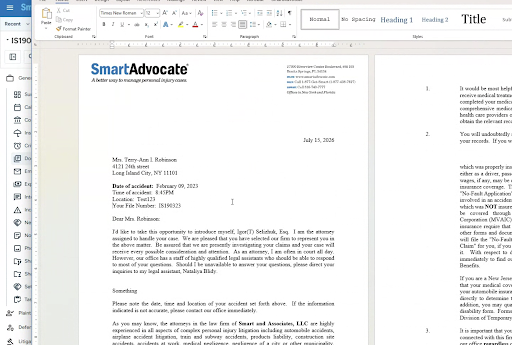
The letter opened in Word for editing. When Selizhuk returned to SmartAdvocate, it was already saved in the correct case and labeled as a plaintiff letter, without having to categorize it manually.
SmartAdvocate can also trigger work automatically. If a case moves into litigation, for example, the system can send the client an email explaining the next phase. The template inserts the names and phone numbers of the assigned attorney and paralegal, and the sent message is saved to the case.
The platform tracks case expenses and fee arrangements as well. At settlement, it can calculate the distribution using the recovery, expenses, attorney’s percentage and any referring-attorney fee.
Reporting receives the same practical treatment. Selizhuk demonstrated a statute-of-limitations report showing deadlines within a chosen period. Instead of depending on someone to run it, a lawyer can schedule the report to arrive by email every Monday at 9 a.m.
Putting AI to Work on the Case
SmartAdvocate’s newest capabilities come through SmartIntelligence™, its collection of built-in AI tools.
Some address small but frequent tasks. An AI rewrite button can correct grammar or adjust the tone of an email or text message without requiring the user to paste client information into a separate consumer chatbot, which could also compromise the security of the information. A lawyer can ask the system to summarize a document or, as Selizhuk demonstrated, translate it into Spanish.
Other features tackle heavier legal work. Case AI lets a user ask natural-language questions such as whether the firm has received medical records, what injuries appear in the file, or what the case’s strengths and weaknesses may be.
“You’re not talking to ChatGPT like a generic model,” Selizhuk said. “You’re talking to a purposely built AI process pipeline where it only gets information from your case.”
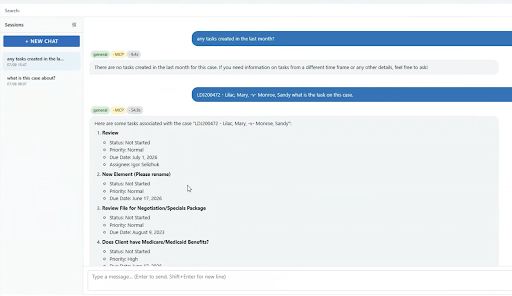
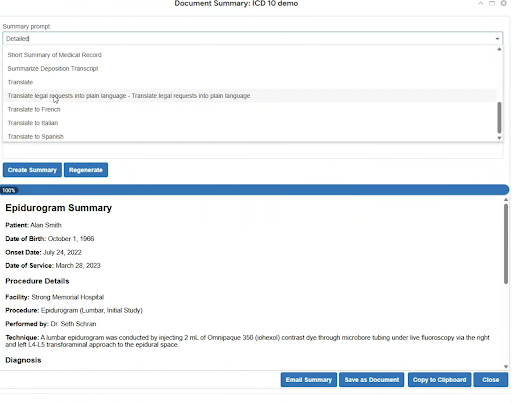
If the answer cannot be found in the case data or documents, the system is designed to say so. When it does provide an answer, it cites the source document, which the user can open directly to verify the information.
AI powers several other functions as well, such as when Selizhuk dragged an incoming file into SmartAdvocate. Within seconds, the software identified the correct case number, recognized it as correspondence from GEICO, selected “letter from insurance company” as its category and subcategory, and produced a summary. The same process can be applied to hundreds of scanned or uploaded documents.
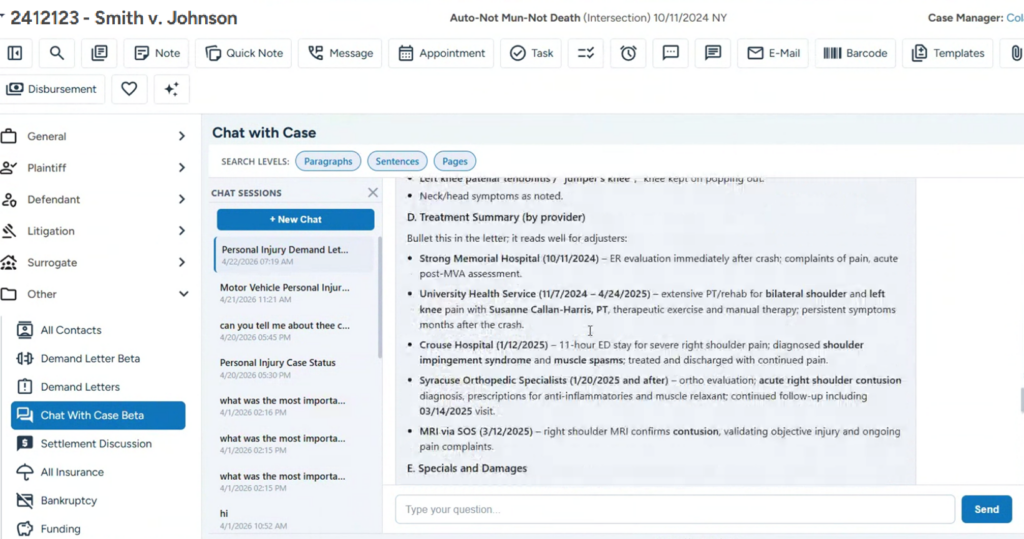
With SmartIntelligence, users can also create medical chronologies, get help writing demand letters and use it to draft email responses. A voice bot can use the firm’s existing intake script to speak with a prospect and create a lead record. Alternatively, an AI assistant can listen to a human employee’s intake call, offer live guidance, and automatically place details such as the caller’s name and address into the proper fields.
Award-Winning Customer Service
The technology is backed by an in-house team that has won multiple awards for ushering new clients into the system. Real people help firms with implementation, data migration, training and support.
“You only deal with us and our staff,” Selizhuk said. “If there is an issue, we are responsible, and we’ll work with you to address it.”
Their approach has earned outside recognition. In 2026, Software Advice named SmartAdvocate “Best for Customer Satisfaction in Law Practice Management” and “Best for Quick Adoption/Easy Adoption in Legal Case Management.”
To get a first-hand look, click here for a demonstration.
The post How SmartAdvocate™ Manages A Case From First Call To Final Settlement appeared first on Above the Law.
]]>The post Biglaw Is Bigger Than Ever, But Its Associate Classes Are Getting Smaller appeared first on Above the Law.
]]>New data from the National Association for Law Placement (NALP) shows that firms with more than 500 lawyers hired 7.5% fewer entry-level associates from the Class of 2025 than they did the year before — the first decline in Biglaw entry-level hiring since 2014. In raw numbers, that’s about 540 fewer graduates landing jobs at the largest firms.
The timing is striking. Biglaw now accounts for more than one in five employed law graduates, and roughly one in four graduates who enter private practice when firms with 251 to 500 lawyers are included. That’s a remarkable transformation in just a few years. But just as Biglaw has cemented its position as the dominant destination for new lawyers, it’s also becoming more selective about how many it brings through the door.
To be clear, this doesn’t mean the legal hiring market fell apart. The Class of 2025 still posted the second-highest employment rate in NALP history, thanks in part to a smaller graduating class. But the broader hiring picture wasn’t nearly as rosy, with roughly 2,700 fewer entry-level legal jobs available than the year before. Federal government hiring plunged, and public interest employers also scaled back.
So why is Biglaw getting more selective? Reuters points to a few factors:
A December report by Citigroup and Hildebrandt Consulting found that a majority of law firms through 2027 planned to prioritize hiring more experienced associates from other firms over entry-level hires.
The decrease at large firms was foreshadowed by lower levels of summer associate recruiting in both 2023 and 2024. Large firms also brought on fewer summer associates during the summer of 2025, which suggests entry-level hiring among 2026 law graduates will also be down, the NALP report said.
There’s no question that firms are investing more heavily in lawyers who can hit the ground running. Some industry observers have also raised questions about whether AI is reducing the amount of routine junior-associate work that traditionally justified larger incoming classes, though it’s far too early to call that a definitive trend.
Biglaw has never occupied a larger share of the entry-level legal market. Almost ironically, it’s claiming a bigger slice of a shrinking pie.
For law students dreaming of a $225,000 $235,000 starting salary, Biglaw remains the biggest prize in town. It’s just becoming a little harder to win.
Entry-level hiring at large US law firms declined for the first time in a decade, data shows [Reuters]
Staci Zaretsky is the managing editor of Above the Law, where she’s worked since 2011. She’d love to hear from you, so please feel free to email her with any tips, questions, comments, or critiques. You can follow her on Bluesky, X/Twitter, and Threads, or connect with her on LinkedIn.
The post Biglaw Is Bigger Than Ever, But Its Associate Classes Are Getting Smaller appeared first on Above the Law.
]]>The post Law Schools Spent 30 Years Buying U.S. News Rankings And The Bill Just Came Due appeared first on Above the Law.
]]>Professor Paul Campos has spent years chronicling law school financial shenanigans. In his new paper (which he flagged over at Lawyers, Guns & Money yesterday), Campos examines the finances of nearly every ABA-accredited law school and stacked them against where those same schools stood 16 years ago. The numbers suggest upwards of 40 percent in severe financial distress, with another 30 percent standing somewhere between wobbly and precarious.
Since “Peak Law School,” which Campos sets at 2010 when total JD tuition revenue and per-student JD tuition revenue both hit inflation-adjusted highs, aggregate JD tuition revenue is down 41 percent. Roughly 24 points of that decline comes from schools collecting less per student, with the rest attributable to there having been fewer law students to collect from.
Some of this is a byproduct of the reform movement that Campos and publications like Above the Law championed. At the peak, every diploma mill out there charged top dollar for students chasing a dream. Most of those students ended up unable to practice or practicing in jobs that barely kept up with their loan payments. Shining a light on less-than-scrupulous law schools managed to convince a generation of potential lawyers to be more savvy about their future and that tamped down enrollment.
But the problem is that revenue fell and law school cost structures didn’t.
The U.S. News rankings, an annual fixture since 1990, awarded points for spending money. They never really asked about spending money well. So schools pumped cash into faculty lines, facilities, and per-student expenditures bringing up rankings, on the hope that higher rankings would bring in more applicants or justify higher tuition or both. But there’s only so much room at the top and run this loop for three decades alongside generous federal loan programs, and you get an industry that quasi-bankrupted itself competing for placement in a magazine that has since stopped meaning much of anything.
As an alternative, schools could try to game a rival ranking that judges schools based on outcomes and cost, but that’s apparently too hard for them.
Eleven ABA law schools have closed in the past decade. In the previous half century, only one shut its doors.
Campos reports that UCLA’s tenured and tenure-track law faculty averaged $407,000 in 2024, a figure including chair stipends and summer research money. That is roughly double the average for tenured and tenure-track faculty across UCLA’s arts and sciences. The traditional justification is that law professors are all “temporarily embarrassed Skadden partners” who could pick up and move to an elite partnership if they wanted to.
Generally speaking, academia should pay faculty more and really stick it to the legion of “assistant dean of intramural basketweaving” administrative jobs that have cropped up over the last few decades. The people actually teaching the classes shouldn’t be routinely paid less than random admins. An economic study concluded that the proper ratio of faculty to administrators would be 3-to-1. The current average in the United States is 1-to-2. This is across the university, and doesn’t necessarily justify paying a law professor over $400K… but it’s just a reminder that the solution shouldn’t be slashing professor pay to nub before looking at some other glaring expenses.
But in any event, as bleak as the landscape appears, Campos sees darker times ahead. Because the numbers in his paper accrued while Grad PLUS existed. That ended July 1, with new professional-degree borrowers capped at $50,000 a year and $200,000 total. In other words, the world where nearly 70 percent of law schools face potentially disastrous financial pressure came under the most favorable financing conditions American legal education is going to see for a long time.
Applicants are up at the moment. More than 81,000 applicants for the 2026 cycle with applications up better than a third over two years. They can’t borrow what the last group borrowed, but they’re at least bringing bodies to the classrooms. Some schools have developed innovative workarounds, like Santa Clara guaranteeing every incoming student $16,000 so the remainder fits under the cap, or Stetson building a summer-start program to squeeze a class in under the old rules. But those are not long-term strategies.
Campos notes that the underlying pattern — institutions bankrupting themselves chasing a prestige metric that never meant anything — runs well beyond legal education, and he is right about that. Law schools just got there first because they had the purest version of the twisted incentive structure: one ranking that everybody agreed to care about, and an unlimited line of credit to chase it with.
Now that bill is coming due and “maybe the rest of the university will subsidize us paying ourselves more” is unlikely to be the winning long-term strategy that a lot of schools think it will.
Is Your Law School Going Broke: A Field Guide for Interested Parties [SSRN]
Earlier: Get Ready For U.S. News Law School Rankings To Make No Sense
Joe Patrice is a senior editor at Above the Law and co-host of Thinking Like A Lawyer. Feel free to email any tips, questions, or comments. Follow him on Twitter or Bluesky if you’re interested in law, politics, and a healthy dose of college sports news.
The post Law Schools Spent 30 Years Buying U.S. News Rankings And The Bill Just Came Due appeared first on Above the Law.
]]>The post DISCO Moves Beyond E-Discovery With ‘Unified Litigation Solution’ That Combines Case Facts And Case Law appeared first on Above the Law.
]]>The post Biglaw Firm Facing RICO Claims Loses Motion To Compel Arbitration appeared first on Above the Law.
]]>Bankruptcy Judge John P. Mastando III denied the firm’s motion to compel arbitration and its alternative motion to dismiss on Monday, in a 96-page opinion that also disposed of a parallel motion from Eletson Holdings’ former shareholders. The civil RICO claims will now proceed into discovery against the firm and its Head of International Litigation, Louis Solomon.
Eletson is a Greek gas shipping company dragged into involuntary Chapter 11 by its noteholders, presumably for angering Poseidon. A creditors’ plan came together in November 2024, but the former owners declined to accept that result, launching instead into a sustained and creative response that has resulted in multiple sanctions orders, contempt findings, bench warrants, and an SDNY ruling vacating the underlying arbitration award on clear and convincing evidence of fraud. Reed Smith was debtor’s counsel through most of it. There was even Greek court proceeding to install a “provisional board” that Judge Lewis Liman later described as a fiction.
A Greek company created a false shell in an effort to trick its adversaries? Still playing the hits after all these years!
Reed Smith’s engagement letters contain a clause reaching “[a]ny controversy, claim or dispute arising out of or relating to our agreement.” Nice, broad language. The problem, according to the court, is the neighborhood it lives in. The clause appears under the bolded heading, “New York Arbitration Clause,” right after language about the right to arbitrate fee disputes under Part 137 of the New York rules.
As Judge Mastando explained:
The express purpose of this section, then, is to address fee disputes, “including any fee dispute which would otherwise be subject to Part 137,” id., but also including other fee disputes that are not subject to Part 137 — for example, fee disputes for less than $1,000 or greater than $50,000.
To read it as a catch-all to escape liability for racketeering would amount to “burying this purported waiver of important rights inside a misleading fee-dispute wrapper.”
It’s not even clear that this clause was even signed. The engagement letters condition the arbitration clause on the client separately signing a consent form called “Attachment 2.” The court went and looked:
And the initials of Lascarina Karastamati and Vasilis Hadjeleftheriadis — what the Reed Smith Defendants argue are valid and binding signatures — do not appear on the same page as Attachment 2, or next to Solomon’s undated signature, but instead on the bottom righthand corner of the next page, which is otherwise entirely blank. The same initials also appear, in the same fashion, on the bottom righthand corner of every other alternating page of the 2022 Agreement.
The court ultimately declined to resolve whether the attachments were properly executed, but noted the signatures were “at best unclear.” It then held that even assuming perfect execution, there was no “meeting of the minds and a manifestation of mutual assent” to arbitrate fraud, RICO, and fiduciary-duty claims through clauses “which focus so heavily on fee disputes.”
Reed Smith also argued that petitioning the government, courts included, is protected under Noerr-Pennington, and that doctrine’s sham-litigation exception requires objective baselessness — and Reed Smith claimed that its positions weren’t hopeless. Mastando rejected the premise, ruling that the plaintiffs’ argument in the alternative made more sense, as “the First Amendment does not protect fraud.”
The third argument was Kim v. Kimm, the Second Circuit’s holding that a single frivolous lawsuit can’t serve as a RICO predicate act. Reed Smith read that as a general rule immunizing litigation conduct:
This is a unique situation where the District Court has already concluded that fraud was committed in the Preferred Shares Arbitration, and that the Reed Smith Defendants’ conduct crossed the line between aggressive advocacy and false statements.
In January, vacating the arbitration award, Judge Liman wrote that he need not decide whether Reed Smith was complicit “either directly or through a wink and a nod or instead was incredulous and was its clients’ innocent dupe,” because “[a]t a minimum, it was the vehicle through which a fraud was committed.”
Reed Smith and Solomon now face discovery on nine counts, including into internal communications — a category that has already lost some protection, since Judge Liman found sufficient reason to trigger the crime-fraud exception back in September.
Ken White likes to remind us all that, generally speaking, “It’s Not RICO.” But this one is going to have to get through discovery first.
(Order on the next page…)
Joe Patrice is a senior editor at Above the Law and co-host of Thinking Like A Lawyer. Feel free to email any tips, questions, or comments. Follow him on Twitter or Bluesky if you’re interested in law, politics, and a healthy dose of college sports news.
The post Biglaw Firm Facing RICO Claims Loses Motion To Compel Arbitration appeared first on Above the Law.
]]>The post Retailers Are Selling Economic Rights To Their Potential Tariff Refunds appeared first on Above the Law.
]]>