The post Canada’s Campus Antisemitism Crisis: National Survey Finds Antisemitism Nearly Everywhere and University Responses Nowhere appeared first on Michael Geist.
]]>
For the better part of two years, I have written about antisemitism on Canadian university campuses from the vantage point of personal experience: a post I never thought I would need to write on the right of Jewish students to feel safe on campus, the normalization of antisemitism at encampments including at my own university, the trepidation that accompanied a new academic year, and the chilling effect on expression that I described to the Standing Committee on Canadian Heritage. Those accounts, alongside those of many students who shared their experiences, were often downplayed by some as exaggerated or unrepresentative. Yet this week, the release of the Canadian Heritage-backed Campus Antisemitism and Student Experiences (CASE) report, conducted through the Office of the former Special Envoy on Preserving Holocaust Remembrance and Combatting Antisemitism and produced by the Association for Canadian Studies and the Metropolis Institute, puts that claim to rest. The report, for which I served as a member of the advisory board, provides the most comprehensive national data to date on the experiences of Jewish students at Canadian post-secondary institutions. The report makes for difficult reading as it confirms that Canada is facing an antisemitism crisis on campus, with the overwhelming majority of the Jewish students surveyed stating that they had experienced or witnessed at least one instance of antisemitism over the prior year.
The survey itself was conducted in November and December 2025 with participation from about 900 Jewish students and recent graduates. Most of the national coverage focused on the topline results: 95.7% of respondents experienced or witnessed at least one instance of antisemitism over the previous 12 months, 84% view antisemitism as a serious problem on their campus, and 70% say their university does not take antisemitism seriously. Culture Minister Marc Miller called the findings “alarming”. He was right, but a deeper dive into the data reveals how the cumulative effect of a hostile climate changes the way that Jewish students study, speak, and participate.
The effects on daily campus life are unmistakable. Nearly three-quarters of respondents (72%) limit what they say in class about being Jewish and two-thirds (66%) do the same online. A majority (57%) avoid wearing or displaying Jewish symbols due to safety concerns, while students who do wear visible markers of Jewish identity report notably higher exposure to intimidation and physical violence than those who do not. And more than 60% have lost friendships because of antisemitism, 41% avoid certain classes or events altogether, 40% say their academic performance has suffered, and more than seven in ten say the experience has harmed their mental health. Roughly one-quarter have even considered dropping out.
This affects every aspect of campus life as respondents identified online spaces (34%), student organizations and campus events (33%), classrooms and lecture halls (25%), nearby off-campus areas (23%), and even student residences (9%) as sites of antisemitic conduct. Fellow students were the most commonly identified source at 51%, yet the conduct is by no means limited to peers. Faculty members were cited in 18% of incidents and teaching assistants and administrators or staff each accounted for a further 7%. For anyone who cares about the academic mission, the classroom data is particularly troubling: 36% of respondents encountered course content or classroom discussion portraying Jews, Judaism, Israel, or Zionism in an antisemitic or biased manner and 34% said a professor raised those topics in ways unrelated to the course subject. Exposure to Holocaust denial or distortion was encountered often or sometimes by 45% of respondents. And 81% of respondents reported hateful or discriminatory treatment of Zionists as occurring often or occasionally, alongside antisemitic vandalism (71%), discriminatory treatment of Jews (56%), intimidation or threats directed at Jews (54%), and physical violence directed at Jews (22%). The more than 1,200 open-ended accounts of antisemitism are stunning in their breadth and include a student whose friend was chased from a campus building by a group shouting “there’s a Jew…let’s get him” and a professor telling a class that “Jews belong in Poland and need to go back.”
The report devotes an entire section to what it calls “institutional betrayal.” Only one-third of respondents reported the incidents they experienced, and among those who did, 63% were dissatisfied with how the report was handled. The majority of non-reporters (52%) said they did not believe reporting would help, one-quarter did not know how to report, and 16% feared retaliation. Perhaps most indicative of the trust deficit, Jewish students who did report were far more likely to turn to Jewish organizations (62%) than to campus security (40%) or deans and administrators (37%).
The report itself stops short of formal recommendations, concluding instead that academic leadership must take greater responsibility and that the findings should be used immediately by leadership in higher education institutions to examine their policies and practices. The recommendations came separately from the Network of Engaged Canadian Academics (NECA), a non-partisan group of more than 400 Jewish and non-Jewish academics from 54 institutions of which I am a member, which released ten recommendations alongside the report. The list will sound familiar to anyone who has followed this issue: applying existing policies to protect students targeted for any aspect of their Jewish identity including Zionism, institutional neutrality policies that apply across the institution, adoption of the IHRA definition of antisemitism together with the Canadian Handbook, a centralized and transparent incident reporting system with annual campus climate assessments, and a special advisor on antisemitism on every campus.
What has been missing is not knowledge of what to do, but the will to do it. Indeed, the release carries its own illustration of the problem: the survey was commissioned by former Special Envoy Deborah Lyons before the government eliminated her role, leaving the government to release the most comprehensive evidence yet of a systemic antisemitism problem on campus just months after creating a leadership void that has yet to be filled and a new anti-hate council that has yet to act.
I have been an academic for nearly 30 years, working in an environment where inclusion and safe spaces for all students to be their best were unquestioned priorities. Backed by a supportive University president, dean, and advisor on antisemitism, I still believe that to be the case. But this survey confirms that the vast majority of Jewish students encounter antisemitism on campus. If this were any other group — 95% of Indigenous students reporting discrimination or 70% of BIPOC students reporting mental health harm — this would be viewed as a major crisis requiring immediate action. But when 95% of Jewish students report encountering antisemitism, 70% report harm to their mental health, a majority hide their identity, and students report threats of violence and Holocaust denial, the response from some quarters is to ignore or take issue with the survey data.
The bottom line is that hundreds of Jewish students from campuses across the country report antisemitic conduct on campus that is stunning in scope and harm. Every university president in Canada should be investigating how much of the data reflects their own campus experience and committing to change through the NECA recommendations. Every faculty member should be examining whether the discriminatory conduct occurs in their class. And every faculty and student union should be working to fully protect their Jewish members. Years of willingness to tolerate or excuse the antisemitic reality – a Jewish exception – suggests this is unlikely to happen. But now no one can say they didn’t know what was happening.
The post Canada’s Campus Antisemitism Crisis: National Survey Finds Antisemitism Nearly Everywhere and University Responses Nowhere appeared first on Michael Geist.
]]>These are worthwhile measures. But for those concerned with antisemitism, Islamophobia, or other forms of hate, my Globe and Mail op-ed notes that stricter rules against illegal content are basic table stakes. The bigger challenge is the far larger category of content best described as “awful but lawful”: the tropes, conspiracy theories, and coded dehumanization that cause serious harm but remain constitutionally protected expression. A law mandating this material’s removal would invite an immediate Charter challenge. Instead, we need to figure out how to address harms without overstepping constitutional safeguards for freedom of expression.
The post Why the Answers to Hateful Content Online are Hiding in the Platforms’ Own Rules appeared first on Michael Geist.
]]>
The Canadian government has a two-pronged legal strategy to counter rising hate: New Criminal Code provisions to address offline harms, such as intimidation or protests outside schools and places of worship, and the digital safety bill introduced in June, which targets online harms. A new legal duty to act responsibly, which would require internet platforms to publish digital safety plans, provide greater transparency on their efforts to counter harms, and occasionally remove content, serves as the foundation for fighting back against the spread online of illegal content such as non-consensual distribution of intimate images, cyberbullying, terrorist content, and content that incites violence or hatred.
These are worthwhile measures. But for those concerned with antisemitism, Islamophobia, or other forms of hate, my Globe and Mail op-ed notes that stricter rules against illegal content are basic table stakes. The bigger challenge is the far larger category of content best described as “awful but lawful”: the tropes, conspiracy theories, and coded dehumanization that cause serious harm but remain constitutionally protected expression. A law mandating this material’s removal would invite an immediate Charter challenge. Instead, we need to figure out how to address harms without overstepping constitutional safeguards for freedom of expression.
Doing nothing is not an option; the harms are real. Antisemitism offers the starkest current example. CyberWell, a non-profit that tracks antisemitic content online, documented an 86-per-cent spike in the three weeks after the terror attacks on Oct. 7, 2023, and researchers have found statistically significant correlations between concentrations of antisemitic posts and the locations of real-world attacks on synagogues.
The conventional answer has long been that the best remedy for bad speech is good speech. Yet that approach may no longer be effective, as engagement-driven algorithms give conspiratorial content a built-in distribution advantage and online echo chambers or “filter bubbles” mean that counter-speech rarely breaks through. There is, however, a potential solution hiding in plain sight: The platforms themselves say that much of the awful but lawful content violates their terms and conditions.
For example, Meta prohibits dehumanizing speech and, after consulting 145 external stakeholders, extended its rules to attacks using “Zionist” as a proxy for Jews. TikTok bans Holocaust denial and YouTube prohibits content promoting hatred based on religion or ethnicity. These policies are not a function of government legislation, but rather result from voluntary commitments adopted by the companies themselves.
The policies may say many of the right things, but the enforcement record to date tells a different story. CyberWell’s 2025 report found that nearly half of the antisemitic content that violated platform policies remained online even after the companies were notified by those tasked with identifying offending content. When Meta scaled back proactive enforcement in January, 2025, ADL researchers documented a nearly fivefold increase in antisemitic comments on the Facebook pages of Jewish members of the U.S. Congress, even though the company’s written policies remained unchanged. The content can even be profitable, with platforms and social media influencers alike earning revenue from posts that the platforms’ own rules prohibit.
One way to bridge the disconnect between policy promises and enforcement failures would be to hold platforms legally responsible for their own policies. For decades, the U.S. Federal Trade Commission has treated privacy policies as enforceable commitments, creating privacy obligations premised not on government-mandated rules but on companies’ own undertakings. The effect is to create binding privacy obligations backed by real enforcement. Canada has something similar, with the Competition Bureau using the same reasoning in 2020 to reach a $9-million settlement with Facebook over misleading privacy claims.
Whether through the new Digital Safety Commission or the Bureau’s existing deceptive marketing framework, a regulator would audit platform conduct and impose potential liability for systemic failures to comply with the company’s existing content policies. There would not be liability for individual moderation errors, and the government would stay out of regulating awful but lawful speech. Instead, the companies themselves would be held to account for their own promises to address the harms on their platforms. They could respond by promising less, but any retreat would at least be visible, giving users and advertisers a clear sense of where they stand.
The reality is that no legislation can fully address online harms. But holding platforms to their own commitments offers what years of debates have failed to produce: A way to address harmful but lawful content while limiting government intrusion into speech regulation. The platforms have told Canadians, in their own published rules, that this content has no place on their services. The government should use the digital safety bill to make sure they keep their word.
The post Why the Answers to Hateful Content Online are Hiding in the Platforms’ Own Rules appeared first on Michael Geist.
]]>The post From CCH to ChatGPT: How Canadian Copyright Law Played the Key Role in Deciding a Leading AI Training Data Case in India appeared first on Michael Geist.
]]>
The Delhi High Court has released what may be one of the most consequential copyright decisions yet on artificial intelligence, ruling in ANI Media Pvt. Ltd. v. OpenAI that OpenAI’s use of copyrighted news articles to train the models behind ChatGPT is prima facie fair dealing. The 135-page decision of Justice Amit Bansal, released last week, dismissed an Indian news agency’s application for an interim injunction, and while it is expressly not a final ruling on the merits, it features valuable analysis of the copyright implications of machine research, market harm and the public interest. The case is particularly notable from a Canadian perspective since it is the 2004 landmark CCH Supreme Court of Canada copyright case that provides the decision’s fair dealing foundation.
The ANI lawsuit focused on two claims: that OpenAI copied and stored its articles to train its models, and that ChatGPT reproduced its content in outputs, including through retrieval-augmented generation (RAG), which allows an AI service to pull current information from external sources before answering. The court dismissed the output claim, finding that when the ChatGPT responses were compared with the ANI articles as complete works rather than in fragments, there was no substantial reproduction of ANI’s expression. Further, the court concluded that articles cited by ANI as evidence were likely based on retrieval rather than memorization and ANI had not pleaded retrieval as a basis for infringement.
With a few exceptions, courts worldwide have generally dismissed claims based on outputs given the difficulty in proving reproduction. But it is the input claim focused on the training data that sets this case apart. OpenAI acknowledged that training its model involved at least temporary electronic storage of ANI’s works, and the court held that the reproduction right, which extends to storing a work “in any medium by electronic means,” draws no distinction between temporary and permanent copies. For OpenAI to avoid liability, the case therefore turned on whether the reproduction qualified as fair dealing under section 52(1)(a) of the Indian Copyright Act, which covers “private or personal use, including research.”
Professor Arul George Scaria, one of two amici curiae appointed by the court, offered up the fair dealing analytical framework in his submission to the court and the CCH decision provided the legal foundation. Reliance on CCH is not unprecedented in India, which adopted CCH’s skill and judgment approach in developing India’s originality standard in the 2008 decision in Eastern Book Company v. D.B. Modak. In this case, the court quoted CCH’s critical holding that fair dealing is not a defence or a loophole but rather a user right that must not be read restrictively. Given its importance, the court concluded that “Section 52 independently defines the rights/privileges of a user in respect of copyrighted works and must not be interpreted in a restrictive manner. It is an integral part of the Copyright Act and therefore, it has to be given broad and liberal interpretation.” The influence of the CCH decision is obvious.
Beyond the invocation of user rights, the court also relied on CCH’s finding that research is not limited to non-commercial contexts and that research conducted by lawyers for profit may qualify as fair dealing. In other words, the fair dealing finding upholding the use of works as training data rested largely on CCH’s approach to user rights and its confirmation that fair dealing applies in both non-commercial and commercial contexts.
The court notably declined to adopt the U.S. four-factor fair use test in developing its fair dealing test, nor did it draw on CCH’s six fairness factors. Instead, it identified three questions of its own, anchored in Article 9(2) of the Berne Convention: whether the use was confined to training, whether it competed with ANI or prejudiced its legitimate commercial interests, and whether ChatGPT’s functions serve the public interest. In the court’s view, all three favoured OpenAI, the market harm factor largely because ANI offered no evidence of lost subscribers or revenues.
The case is likely to face an appeal and full trial awaits, but the applicability of the CCH case to AI training data could have real implications for Canadian copyright law, where the country’s largest news organizations have filed their own copyright lawsuit against OpenAI that recently survived a jurisdictional challenge in the Ontario courts. Canadian courts have yet to rule on fair dealing and AI training, but the analysis suggests that Canadian law already provides a roadmap for addressing AI-related training copyright claims. The Heritage committee’s April report recommended an opt-in consent requirement for the use of copyrighted works in AI training, which, as I wrote at the time, would not merely decline to add a text and data mining exception but would override fair dealing by imposing prior authorization found nowhere in the Act. This latest decision highlights that more than 20 years after the CCH decision, it remains the starting point for addressing emerging copyright issues. Rather than adopting the Heritage committee’s recommendation, the government should allow the cases to work their way through the courts, safe in the knowledge that Canadian law has now proven itself capable of addressing the complex intersection between copyright and AI.
The post From CCH to ChatGPT: How Canadian Copyright Law Played the Key Role in Deciding a Leading AI Training Data Case in India appeared first on Michael Geist.
]]>The post Starting Over: Court Filing Confirms the CRTC’s Streamer Contribution Decisions Are Dead With a Full Online Streaming Act Reset to Come appeared first on Michael Geist.
]]>
When the government announced plans last month to kill the CRTC’s Online Streaming Act ruling, it left a critical question unanswered: was the target only the Commission’s decision to increase streamer contributions to 15 percent, or did the reversal extend to the original base contribution decision requiring foreign streamers to contribute five percent of their Canadian revenues? A new court filing confirms it is both. In a letter to the Federal Court of Appeal dated July 17, 2026, first reported by the Wire Report, Department of Justice Senior General Counsel Michael Morris advised the court that “the Government’s intention is to eliminate the base contribution requirement on streaming services and to provide government funding to replace those contributions.” The entire contribution framework the CRTC has built since 2024 is therefore dead, with taxpayers covering the costs while the government develops a replacement.
The disclosure came in response to a direction from Justice David Stratas, who is overseeing the legal challenges to the base contribution launched by Amazon, Apple, Spotify, and the Motion Picture Association-Canada. On June 29th, the court advised that it “has seen press reports, including another one today, about the Online Streaming Act, S.C. 2023, c. 8 and the possibility that it and the measures made by the Canadian Radio-television and Telecommunications Commission under it might be amended or revoked.” The court demanded a status report on the government’s plans, noting that if the basis of the proceedings “disappears or fundamentally alters,” it would call for submissions on whether the cases are moot. Given the government’s stated intention, mootness now seems like the likely destination for litigation that has been underway since 2024, including a stay of the base contribution payments that has been in place since December of that year.
The letter goes further than the government had been willing to say publicly. The June 3rd announcement promised a policy direction requiring the CRTC to “review and revise” its decision alongside $600 million in annual support for the audio and audiovisual sector. A Miller spokesperson later told the Toronto Star that the government would direct the CRTC to eliminate base contribution requirements “directed outside the audio-visual sector to the broader cultural ecosystem,” language that suggested some of the base contribution might survive. This court submission confirms that the entire contribution framework is gone. However, eliminating the current framework does not mean the government envisions no contributions at all. Miller has told both the Globe and Mail and the Star that the contribution level “won’t be zero,” and his office responded to the Wire Report story by insisting that the government “will not repeal the Online Streaming Act” and would instead craft a direction providing “greater flexibility for those contributing to the broadcasting system.” The plan, it would appear, is to scrap the existing contribution framework crafted by the CRTC and start over with new approaches to calculating contributions and rates more in line with global standards, which as I noted last month, typically run in the 4 percent range rather than the CRTC’s 15 percent.
Getting there is going to take some time. The government expects its direction to be published for consultation in the Canada Gazette Part 1 “in the coming weeks.” That starts a process that is neither fast nor optional: the minister must consult the Commission, table the proposed direction in both the House and Senate, and allow a comment period of at least 30 days before finalizing the order. When the government issued its last policy direction on this same law, the draft appeared in June 2023 and the final version did not take effect until late November. There are also real questions about whether a policy direction, an instrument designed for broad policy guidance to an independent regulator, can be used to effectively vacate a specific CRTC contribution decision. Once the direction is in place, the CRTC, which just months ago decided to maintain the base contribution, will be required to unwind it and launch renewed proceedings on what comes next. Add in the prospect of new legal challenges and the reality is that the contribution framework promised when Bill C-11 was enacted in 2023 remains years away.
The problems with the current model were never limited to the contribution rate, since the system also raises difficult questions about which payments and investments count toward a mandated contribution, who owns the rights to the resulting productions, whether foreign streamers can access the funds they pay into, and how discoverability requirements will be implemented. Patching the old broadcast contribution system onto the Internet was never a good idea, and starting over creates an opportunity for a much-needed full reset and the chance to provide more sensible answers to those questions.
The post Starting Over: Court Filing Confirms the CRTC’s Streamer Contribution Decisions Are Dead With a Full Online Streaming Act Reset to Come appeared first on Michael Geist.
]]>For me, the sense that the violence keeps landing close to home is not new. The Pride of Israel synagogue, where I grew up and where my parents have been members for decades, was vandalized in 2024, and last summer an elderly Jewish woman was stabbed in a hate-motivated attack at my local Ottawa grocery store, a Loblaws known for carrying the city’s largest selection of kosher food. The attack on Kiva’s makes three incidents with a direct personal connection, which might seem like a remarkable string of bad luck were it not for the reality that the volume of antisemitic violence in Canada now ensures that many Jewish Canadians can tell a similar story about their synagogue, their school, their grocery store, or their family. For anyone wondering why so many Canadian Jews describe feeling vulnerable and unsafe, that is the answer.
The post The Name on the Window Was Enough: The Attacks on Kiva’s and the Normalization of Antisemitic Violence in Canada appeared first on Michael Geist.
]]>
Kiva’s, the well-known Toronto Jewish bakery, was struck by gunfire and smashed windows in two locations over the weekend. This one is personal as Kiva was my grandmother’s cousin. Both were Holocaust survivors who rebuilt their lives in Toronto, and though he sold the business years ago, the owners have kept his name on the window ever since. Whoever fired at that window almost certainly knew none of this, since for those responsible the Jewish name on the storefront was evidently reason enough.
For me, the sense that the violence keeps landing close to home is not new. The Pride of Israel synagogue, where I grew up and where my parents have been members for decades, was vandalized in 2024, and last summer an elderly Jewish woman was stabbed in a hate-motivated attack at my local Ottawa grocery store, a Loblaws known for carrying the city’s largest selection of kosher food. The attack on Kiva’s makes three incidents with a personal connection, which might seem like a remarkable string of bad luck were it not for the reality that the volume of antisemitic violence in Canada now ensures that many Jewish Canadians can tell a similar story about their synagogue, their school, their grocery store, or their family. For anyone wondering why so many Canadian Jews describe feeling vulnerable and unsafe, that is the answer.
Kiva was part of a generation of survivors who arrived in Canada with little and built new lives on the promise that this was a country where a Jewish name on a storefront was just a name. The bakery became an institution for many in the Jewish community, which is presumably what made it a target. The attackers were not responding to the current owners or to anything they may believe about a foreign conflict, but simply to a Jewish name that has outlived the survivor who gave it.
The national numbers tell the same story. Just last week, Toronto police charged a man with a terrorism offence, with investigators pointing to ties to Hamas, and days later B’nai Brith reported that violent antisemitic incidents in the first half of 2026 had already more than doubled the total for all of 2025. I wrote nearly two years ago that antisemitism in Canada no longer shocks, yet since then the pace of violence has only increased.
The temptation is frequently to call on our leaders to do more, but the attacks came just days after the Combatting Hate Act took effect, which creates new criminal offences that include intimidation and obstruction provisions designed to protect access to places of worship, community schools, and cultural centres. I think Parliament largely got the balance right with the new law, but its approach reflects a model of protection based on identifying the places where Jewish life gathers and building a legal and physical perimeter around them. But a bagel bakery is not a synagogue or community centre, and no realistic security program can place a protective perimeter around every bakery, deli, bookstore, and storefront where Jewish life occurs.
None of this renders the new law, enforcement efforts, or security spending pointless, but it is a reminder that all address symptoms rather than the source. The reluctance to enforce the law and the violence itself have been enabled or worsened by the normalization of antisemitism in Canada since the Hamas terror attack on October 7, 2023. When glorifying terrorism is defended as protest, when targeting Jewish institutions is rationalized as political expression, and when each new attack is met with denial or false flag allegations, the message to the public is that antisemitism can be justified and to police and prosecutors that these cases are best avoided as a “two-sides” debate emerges around antisemitic hate.
Kiva’s generation rebuilt their lives here on the promise that Canada was different, yet the growing fear among Canadian Jews is that it no longer is. Restoring that promise will take more than another statute or security grant, as the violence only stops when antisemitism stops being a hatred that too many Canadians have decided they can live with, ignore, or explain away.
The post The Name on the Window Was Enough: The Attacks on Kiva’s and the Normalization of Antisemitic Violence in Canada appeared first on Michael Geist.
]]>The post The Law Bytes Podcast, Episode 277: Kate Robertson on the Risks That Lie Behind Canada’s Unexpected Signing of the UN Cybercrime Convention appeared first on Michael Geist.
]]>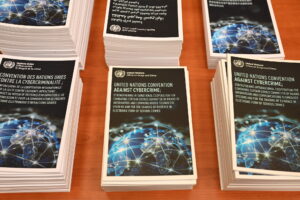
The Canadian government’s surprise decision to sign the UN Cybercrime Convention has sparked many questions about the convention, its risks, and what changed over the past nine months between Canada no-showing the signing in Vietnam and this month’s reversal. To help answer those questions, there is no one better than Kate Robertson, a senior research associate at the Citizen Lab, who has been vocal on the convention since negotiations began years ago. She joins the Law Bytes podcast to discuss her concerns and how the Convention fits within the broader global political and policing frameworks.
The podcast can be downloaded here, accessed on YouTube, and is embedded below. Subscribe to the podcast via Apple Podcasts, Spotify or the RSS feed.
Show Notes:
Robertson, A Global Treaty to Fight Cybercrime – Without Combatting Mercenary Spyware, Lawfare
Civil Society and Expert Letter on Cybercrime Treaty
Credits:
The post The Law Bytes Podcast, Episode 277: Kate Robertson on the Risks That Lie Behind Canada’s Unexpected Signing of the UN Cybercrime Convention appeared first on Michael Geist.
]]>The post A Surveillance Treaty in Disguise: The Trouble With Canada’s Quiet Decision to Sign the UN Cybercrime Convention appeared first on Michael Geist.
]]>
Last week, the government announced that Canada has signed the United Nations Convention against Cybercrime, with Ministers Anita Anand, Gary Anandasangaree and Sean Fraser touting the treaty’s child protection provisions and human rights safeguards, which were described as “among the strongest found in an international criminal justice treaty.” The announcement, released in mid-July with few paying attention, left out much of the story. The reality is that the convention is not primarily a cybercrime treaty at all, but rather a sweeping cross-border surveillance and electronic evidence-sharing agreement that Canada originally opposed, that leading human rights groups and twenty Canadian organizations and experts urged the government to reject, and that key allies have thus far declined to sign. While signing the convention does not create binding obligations (that requires ratification), the decision to sign a treaty that the government declined to sign at the official ceremony less than a year ago raises troubling questions. This post seeks to answer three of them: what is this treaty, what are the risks, and what, if anything, changed in the last nine months?
The treaty began as a Russian initiative in 2017, designed to displace the Council of Europe’s Budapest Convention, the longstanding cybercrime framework that Russia refuses to join. When the UN General Assembly voted in 2019 to launch negotiations, Canada joined the United States and European Union in opposing the resolution, warning that the process was a vehicle for expanding state surveillance powers. Having lost that vote, the democracies faced an uncomfortable choice: boycott the negotiations and let Russia, China, and Iran write the rules, or engage from within and try to limit the damage. They chose engagement with Canada among the most active delegations pressing for human rights safeguards. The strategy succeeded in keeping the authoritarian bloc’s wish list of speech and content crimes out of the final text before the convention was adopted by consensus in December 2024.
Yet despite limiting the damage, Canada was a no-show at the signing ceremony in Hanoi last October, joined by the U.S., New Zealand, Japan, the Netherlands, Italy, Norway, Denmark, and Finland. Signatories included Russia, China, Iran, North Korea, Belarus, Cuba, Venezuela, and Saudi Arabia, as well as the United Kingdom, Australia, France, Germany, and the European Union. Canada issued a statement that emphasized the treaty’s success “rests on states’ commitment to full application of the human rights safeguards in the text.” Nine months later, the government signed without explaining what had changed.
Canada’s previous concern with the treaty is well placed. While it enumerates a list of cybercrime offences, its procedural powers apply to electronic evidence of any criminal offence, and its international cooperation obligations extend to any “serious crime,” defined as any offence punishable by four or more years’ imprisonment under domestic law. Since some states impose such penalties for criticism of the government, journalism, blasphemy, or same-sex relationships, the treaty effectively converts repressive domestic laws into triggers for cross-border evidence gathering. Further, the Electronic Frontier Foundation, Human Rights Watch and a coalition of leading digital rights groups have all warned that the convention functions as a global surveillance pact since it requires states to establish real-time interception and data collection powers while leaving out safeguards such as prior judicial authorization to the discretion of domestic law, permitting gag orders on cooperation requests, and omitting a political offence exception.
In December 2024, nearly two dozen Canadian organizations and experts, including Amnesty International Canada, the Criminal Lawyers’ Association, PEN Canada, OpenMedia, and the Citizen Lab’s Ron Deibert and Kate Robertson, issued a detailed letter urging the government not to sign. The letter warned that the treaty would create a standing channel for transnational repression targeting diaspora communities in Canada and explained how the convention could subvert the safeguards built into Canada’s mutual legal assistance framework. Robertson has separately warned that the treaty is poised to become a vehicle for complicity in the mercenary spyware trade, while over 120 security researchers cautioned that its offences threaten to criminalize good-faith security research. Despite the concerns, the government has said nothing, with no public consultation preceding the signature and none of the letter’s concerns addressed in the announcement.
So what changed and why sign now? It is not clear that anything has changed and the concerns that animated Canada’s decision to not sign nine months ago are still there. One theory is that this is linked to lawful access. Indeed, the treaty and the lawful access agenda are mutually reinforcing, since ratification will require implementing legislation featuring precisely the expanded production orders and cross-border data sharing powers found in Bill C-22. Lawful access was already a source of concern, and this only makes it worse. Canada already has the Budapest Convention and bilateral treaties covering cooperation with the countries it wants to work with, meaning the new convention’s marginal value lies chiefly in cooperation with the very states, including Russia, China, and Iran, that create its greatest risks. The entire decision, including signing in the middle of the summer when few are paying attention, is deeply troubling and requires far more than a sunny press release that avoids the hard questions the treaty raises.
The post A Surveillance Treaty in Disguise: The Trouble With Canada’s Quiet Decision to Sign the UN Cybercrime Convention appeared first on Michael Geist.
]]>The post Rushing Lawful Access Backfires: Wyden Letter on Bill C-22 Highlights Political, Trade and Business Risks appeared first on Michael Geist.
]]>
Public Safety Minister Gary Anandasangaree and the government presumably hoped that pushing Bill C-22 through a House of Commons committee past midnight without debate or a recorded vote would put an end to the lawful access controversy. A new letter from U.S. Senator Ron Wyden, the ranking Democrat on the Senate Finance Committee that holds jurisdiction over trade, suggests the opposite. The letter, released last week, calls on the U.S. administration to treat Canada’s lawful access plans as a counterintelligence threat, to use the CLOUD Act negotiations as leverage, and to take regulatory steps to insulate American officials from surveillance demands directed at U.S. companies. Coming just weeks after House Judiciary Committee chair Jim Jordan and House Foreign Affairs Committee chair Brian Mast warned that the bill harms U.S. national security and economic interests, the letter confirms that Bill C-22 has become a bilateral irritant with the potential to emerge as a full-blown trade issue. Given the latest threats of new tariffs, lawful access could add yet another complication in the increasingly fraught trade relationship.
The letter frames Bill C-22 as a law that would “weaponize American technology infrastructure” by enabling secret Canadian orders to companies such as Apple and Google, pointing to the U.K. experience, where a secret demand that Apple weaken its encrypted iCloud backups prompted a letter from then-Director of National Intelligence Tulsi Gabbard, responding to an inquiry from Wyden, that described such mandates as “a clear and egregious violation of American citizens’ privacy and civil liberties,” along with pressure from President Trump and Vice President Vance that ultimately led the U.K. to scale back its demands. The letter identifies five scenarios involving secret technical mandates against American targets, ranging from forced local data storage to ghost decryption keys to spyware delivered through compromised software updates, and asks whether Bill C-22 would permit them.
While elements of the letter may overstate the risks, the most serious concerns survived the committee amendments. For example, as Robert Diab has noted, the rewritten definition of systemic vulnerability now excludes risks that relate only to persons subject to a warrant or other lawful authority, which leaves open the prospect of secret orders requiring a provider to disable end-to-end encryption for specific targets on a forward-looking basis. The new decryption provision borrows language from U.S. law, but its application to prospectively switching off encryption, rather than decrypting existing data, is at best uncertain. That is precisely the scenario that alarmed U.S. officials in the U.K. case, and the Canadian government has never explained how the two provisions are meant to fit together. It might have provided insight into its thinking had the committee conducted an actual debate and discussion over the amendments, but it cut those off without the chance to do so.
That is what makes the rush to pass Bill C-22 look increasingly like a serious miscalculation. Simply put, there was no reason for it. The bill was introduced in March, the committee heard weeks of testimony raising the same encryption and extraterritoriality concerns, and the government’s response was to shut down the study and dismiss critics as wearing “tinfoil hats”. The tinfoil hat wearers now apparently includes a U.S. Senator and the chairs of two House committees.
With Canada seeking a CLOUD Act agreement that would streamline cross-border data access for Canadian law enforcement, the government has handed the U.S. both a grievance and the leverage to act on it. The Canadian Senate will conduct its own study of Bill C-22 in the fall, but it now does so with the bill under mounting pressure, as many concerns about encryption, security vulnerabilities, and mandatory metadata retention remain very much alive. The amendments in June made some improvements, but there was no reason to rush the legislation, and now Canada faces the possibility of a political, business, and trade backlash that could have been avoided.
The post Rushing Lawful Access Backfires: Wyden Letter on Bill C-22 Highlights Political, Trade and Business Risks appeared first on Michael Geist.
]]>The government is currently undertaking yet another reform process as the Treasury Board has released proposed changes. They’ve left Caroline Maynard, Canada’s Information Commissioner, largely unimpressed. She is relieved the government is open to change, but warns that the approaches “lack ambition” and, more pointedly, that the review “must not become a justification for further secrecy.” Commissioner Maynard joins the Law Bytes podcast to walk through her concerns with the government’s plans and her proposals for improving Canada’s access to information law.
The post The Law Bytes Podcast, Episode 276: Information Commissioner Caroline Maynard on Canada’s Access to Information Failures and Why Access Delayed is Access Denied appeared first on Michael Geist.
]]>
Despite repeated studies and promises for reform, Canada’s access to information system has long been plagued by long delays, overbroad exclusions, insufficient resources, and an Information Commissioner without the resources and powers needed to fully ensure compliance. The government is currently undertaking yet another reform process as the Treasury Board has released proposed changes. They’ve left Caroline Maynard, Canada’s Information Commissioner, largely unimpressed. She is relieved the government is open to change, but warns that the approaches “lack ambition” and, more pointedly, that the review “must not become a justification for further secrecy.” Commissioner Maynard joins the Law Bytes podcast to walk through her concerns with the government’s plans and her proposals for improving Canada’s access to information law.
The podcast can be downloaded here, accessed on YouTube, and is embedded below. Subscribe to the podcast via Apple Podcasts, Spotify or the RSS feed.
Credits:
CBC News, Why It’s Harder Than Ever To Access Government Documents, November 29, 2018
The post The Law Bytes Podcast, Episode 276: Information Commissioner Caroline Maynard on Canada’s Access to Information Failures and Why Access Delayed is Access Denied appeared first on Michael Geist.
]]>Even with these measures, the ban might still be found to be unconstitutional. But if you think they provide a plausible argument that the ban can be justified (as Emily Laidlaw argues here), the problem is that none will be operational when the ban takes effect. In other words, there is a major disconnect between the law the government says it is establishing and the one it plans to implement. If the safeguards are not implemented and millions of Canadians are required to verify their age to express themselves on social media, I believe the ban is likely to face an immediate court challenge and that a court will rule it violates the Charter of Rights and Freedoms.
The post Why the Government’s Plan for a Social Media Ban in Bill C-34 Is Unconstitutional appeared first on Michael Geist.
]]>
The debate over the government’s proposed social media ban for under 16s has raised several difficult questions, including doubts about whether it will work, which services it will cover, and what risks to privacy mandating age verification could create. But beyond the operational questions is a more fundamental one: is the ban constitutional? Bill C-34 contains some signals that the government knows there are serious constitutional vulnerabilities, given the obvious implications for freedom of expression that come from blocking an entire cohort of Canadians from accessing information and expressing themselves on social media. The bill contains several provisions that are seemingly designed to act as safeguards that could be used to argue that the ban is proportionate. These include guidance on age verification technologies to address privacy concerns, promises that the verification obligation does not require measures that “unreasonably or disproportionately” limit expression, a requirement that the new Digital Safety Commission consider freedom of expression, equality, and privacy when it establishes regulations and guidelines, and the ability for services to seek a ban exemption if they can demonstrate adequate safeguards for children.
Even with these measures, the ban might still be found to be unconstitutional. But if you think they provide a plausible argument that the ban can be justified (as Emily Laidlaw argues here), the problem is that none will be operational when the ban takes effect. In other words, there is a major disconnect between the law the government says it is establishing and the one it plans to implement. If the safeguards are not implemented and millions of Canadians are required to verify their age to express themselves on social media, I believe the ban is likely to face an immediate court challenge and that a court will rule that it violates the Charter of Rights and Freedoms.
The starting point for the constitutional analysis is not seriously contested. The ban on its face infringes Section 2(b) of the Charter, since freedom of expression includes the right to seek, receive, and impart information, and a law that creates conditions of access for everyone and blocks those under 16 from lawful platforms limits those rights. As I argued in the Illusion of Protection post, children are rights holders, not merely objects of protection, a position echoed by the Canadian Civil Liberties Association, the Justice Centre, and free expression scholars across the country. The real question is not if the ban violates Section 2(b), but rather whether the infringement can be justified under Section 1 of the Charter, with the analysis likely to turn on minimal impairment and the final proportionality balance.
The Department of Justice has yet to release a Charter statement on Bill C-34, but Laidlaw offers the best defence of the bill, though she acknowledges it is at best a close call. Her argument is based on the real risk of harm from social media and the safeguards in the bill. She points to data that makes the case of real harms from social media, noting that under the Supreme Court of Canada’s Irwin Toy decision, even contested studies may be sufficient to demonstrate a valid policy objective. Yet as Laidlaw herself acknowledges, Irwin Toy, which upheld a ban on television advertising directed at children, does not fully translate to a social media ban, since that case restricted what advertisers could say to children rather than what children themselves could express.
Moreover, the reasonableness of the measures would rest on two safeguards found in Bill C-34: the privacy protections in Section 27 and the ability for social media companies to seek an exemption in Section 29. Taken together, she argues the ban is a “pause,” and there are protections against disproportionate harms to privacy. Others have been less convinced, as Emmett Macfarlane argues that the ban is nowhere near minimally impairing and Robert Diab reaches a similar conclusion in media reports on the issue.
The problem with relying on the Bill C-34 safeguards is that the government has already admitted they won’t take effect before the ban is implemented. As I noted last month, if the bill were to pass tomorrow, there would be no regulated social media services, no safety standards, no age verification standards, and no mechanism to obtain an exemption. The government says it will need between 12 and 18 months just to establish the Commission, with its plan to start the ban as soon as the Commission is launched, but before any of the safeguards have been established. Indeed, developing the standards for age verification and exemptions can only come after the Commission is up and running, a process that will surely take at least a year, and a review of a social media service seeking an exemption will take at least another year after that. The net effect is that the safeguards will not be operational until years after the ban takes effect, opening the door to the possibility of a court being asked to consider whether the ban is constitutional days before millions face restrictions on their expression without any of the safeguards designed to make the case for proportionality in place.
The imbalance becomes even more pronounced when weighing the law’s benefits against its harms. The harms are certain, immediate, and irreversible, as the verification infrastructure exposes millions of identity documents to providers largely beyond the reach of Canadian privacy law, a risk demonstrated by the Discord breach that leaked roughly 70,000 government-issued IDs last fall. Privacy alone may not decide the case, but the verification mandate is not only a privacy cost. A law that conditions access to social media for online expression by requiring proof of identity limits expression itself for Canadians of all ages. The benefits, by contrast, are speculative at best, given mounting data from Australia that suggests a ban is ineffective.
This points toward the likely litigation strategy of a court challenge seeking to stay the ban before it comes into force. Such a challenge would ask the court to hold the government to the conditions it set for itself: no ban until the Commission exists, the exemption is available to qualifying services, and the standards designed to keep verification proportionate are in place and applied. The irreparable harm at the centre of any stay application is the verification infrastructure itself. Once millions of Canadians have handed their identity documents to third-party verifiers, the privacy loss is permanent, regardless of the outcome of the litigation, and a ruling that the ban was unconstitutional will come too late for those already exposed.
No one doubts that protecting children online is a pressing objective. But the government has crafted a bill in which millions will face mandated verification before a single safeguard or exemption meant to justify the ban takes effect. There are convincing arguments that addressing broader social media risks is a better regulatory model than the ban, but granting a stay on the ban on constitutional grounds requires only an assessment of the law as it will actually operate. If the government sticks with its current plan, the safeguards and exemption said to justify the ban will not be operational and the courts should stay the ban at least until they take effect.
The post Why the Government’s Plan for a Social Media Ban in Bill C-34 Is Unconstitutional appeared first on Michael Geist.
]]>