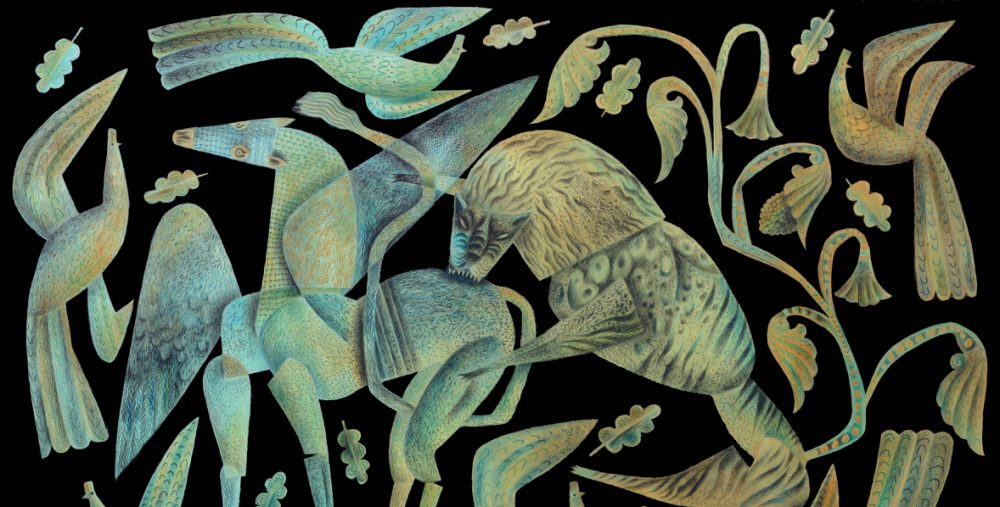

I spent nearly three years preparing for and then illustrating the Folio Society double-edition of Emily Wilson’s translations of The Iliad and The Odyssey. I studied, made a list of characters that would have to be included and a longer one of characters I’d like to include. I annotated my hardback copies and began to keep huge sketchbooks of ideas . I made articulated maquettes of heroes, villains, immortals and monsters and built three-dimensional models of the Greek palisade, Troy and the Trojan Horse. I made thousands of sketches and a good number of fully worked studies.


In my studio on the Welsh Marches I put in gruelling hours to complete the work to schedule. I requested and was granted an extension of a month and for the last intense drive I was in the studio for eight weeks solid with no days off, 4am – 8pm. On the last day of the extension, as agreed, the digital photography department of National Library Wales delivered the scans of my original artwork to my editor and the Folio teams. Hands got busy, proofs and dummies of the fold-out boxes paved the way and then when everything was practised and secure, at print studios and binding workshops across the country the work of manufacture began. I was delighted to discover that the books were to be printed at Gomer, here in Wales.
When the Iliad/Odyssey special-edition launched in November 2024, it sold out before close of business that day.


Unexpectedly my editor at Folio Society had given me permission to show work on the books in progress at my social media pages. I have a custom of sharing what’s going on in my studio not because I seek affirmation – though that’s obviously appreciated on the occasions it comes – but because I attempt to strip away the perceived mysteries of making art. At Instagram and Facebook the comments as the images evolved were enthusiastic. However one day I followed prompts to an online forum in the U.S., and found myself taken aback by negative responses to what I was producing. Emily Wilson was at the receiving end, too – and had been since her translations had first appeared – so I was in good company. There were those who were determined to dismiss the book on the grounds of both her translation and my art. The same is happening now ahead of the release of Christopher Nolan’s film of The Odyssey, with racists and misanthropes ranting about colour-blind casting as though they believe the Ancient World was a place of Aryan supremacy.
I confess to some lost sleep when I discovered the levels of hostility. I got over it, but I wondered why anyone would go to such lengths to criticise something they had no intention of purchasing. And when the books were out and selling well, the hostility transferred to criticism of their construction/manufacture, which as a lifelong bibliophile I found astonishing as these editions of The Iliad and The Odyssey are immaculately produced.

The comments were all anonymous (see below) so I have no idea who ‘Les Miserables’ is, but he, she or they certainly chose a name which suits. I should say I had my defenders as well as detractors at this site, and I shall post some of their comments in a forthcoming post, for balance. But to the people who wrote what they did to undermine the books ahead of publication, I would say this.
Do you intend the hurt you inflict on those who strive with every ounce of their creativity for excellence? What’s the gain to you? Does it make you feel important, throwing your weight around on that forum? Let me tell you, we don’t set out to make books that disappoint. We’re not snake-oil salesmen. All of us absolutely love what we make with a driving passion. For my own part I lived, breathed and dreamed The Iliad/The Odyssey for the three years I worked on the project, as did the teams of makers who turned ideas into reality. I know, as you cannot, that I never for a moment short-changed the readership with less than my best. So your criticisms just come across for what they are: mean-spirited, ill-informed and ugly. I don’t know what it is in the world that you make, if anything, but on the principle that there are those who can, and those who wish they could, I’ll put you in the latter category because were you a creative person you’d not write so slightingly of other people’s work. Luckily despite your best efforts the negative opinions you were so free with had little impact because many came with the enthusiasm to buy. Both the sold-out special and the still available standards have been successful in ways I imagine must irritate the hell out of you. Reaping what you sowed.
The Comments:
Les Miserables
Folio appear to be hell bent on commissioning illustrations equivalent to ‘modern art’. Indeed, just having looked further into the background of the illustrator, he appears to be imbued in that style. I mean look at this stuff, it’s absurd.
JanPospisilCZ
Glad to see the art is unpopular – so I might be able to get one.
cwl
This looks remarkably like some of the art gcse coursework I’ve seen, which goes on to get a B.
Les Miserable
Garbage. FS have lost the plot.
stubedoo
I don’t like C H-Js reliance on text to make his illustrations clear. Same with his Beowulf – I think the illustration should be meaningful without need for text. I don’t hate his stuff by any means, but I do feel it could be better, certainly in this regard.
I guess there is a question as to whether the illustrations add much. I’d personally feel that they don’t. For my eyes, they just aren’t nice enough to look at on their own merit.
cwl
It does look as though he’s attempted a quasi-Attic black ceramic style, which often explicitly labels the figures. The execution doesn’t work for me, but I appreciate the idea, assuming that’s what this is. If it’s very similar to his other work (I’m not familiar with it at all), then it wouldn’t work on the intellectual level, either. It’s not so bad as to be laughable, but it’s distinctly average and, as mentioned above, adds nothing.
Les Miserables
After commenting, I came across the words put far more elegantly than I ever could, which encapsulates what I mean not just by this ‘art’ but all that follows in that vein.
“Modernia does not see itself as indebted to what came before, nor does it seek to preserve, refine, or even reform the foundations laid by previous generations. It exists in opposition to them, treating the past as a burden to be discarded rather than a foundation upon which to build.”
SF-72
Let’s just say that this illustrator has stopped me from buying three editions so far. Good for my wallet, probably not what the publishers were aiming for since I’m clearly not alone in this. Still, I wish enjoyment to those who like this style.


 Clive Hicks-Jenkins' Artlog: