Asking Clarifying Questions in
Open-Domain Information-
Seeking Conversations
Mohammad Aliannejadi(1), Hamed Zamani(2), Fabio Crestani(1), and W. Bruce Croft(2)
(1) Università della Svizzera italiana (USI), Switzerland
(2) University of Massachusetts Amherst, USA
© @dawnieando; @JeffD
5
6
7
8
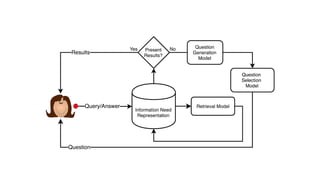
Can we ask questions to clarify
the user information needs?
Johannes Kiesel et al. Toward Voice Query Clarification. SIGIR 2018
Radlinski and Craswell. A Theoretical Framework for Conversational Search. CHIIR 2017
How to evaluate?
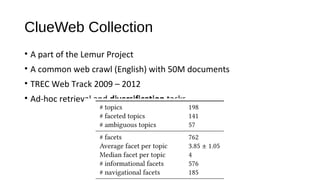
ClueWeb Collection
• A part of the Lemur Project
• A common web crawl (English) with 50M documents
• TREC Web Track 2009 – 2012
• Ad-hoc retrieval and diversification tasks
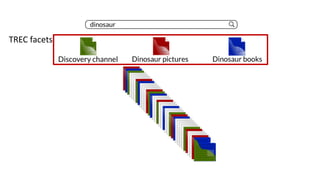
TREC facets
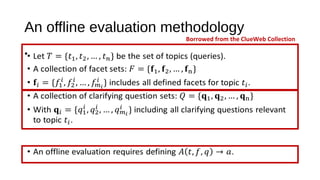
An offline evaluation methodology
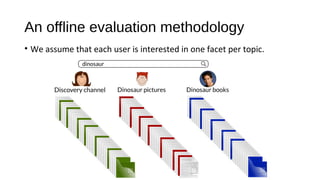
• We assume that each user is interested in one facet per topic.
An offline evaluation methodology
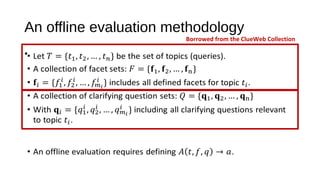
• Let be the set of topics (queries).
• A collection of facet sets:
• includes all defined facets for topic .
• A collection of clarifying question sets:
• With including all clarifying questions relevant to topic .
• An offline evaluation requires defining .
•
Borrowed from the ClueWeb Collection
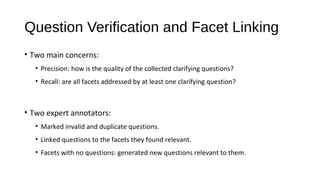
Question Verification and Facet Linking
• Two main concerns:
• Precision: how is the quality of the collected clarifying questions?
• Recall: are all facets addressed by at least one clarifying question?
• Two expert annotators:
• Marked invalid and duplicate questions.
• Linked questions to the facets they found relevant.
• Facets with no questions: generated new questions relevant to them.
An offline evaluation methodology
• Let be the set of topics (queries).
• A collection of facet sets:
• includes all defined facets for topic .
• A collection of clarifying question sets:
• With including all clarifying questions relevant to topic .
• An offline evaluation requires defining .
•
Borrowed from the ClueWeb Collection
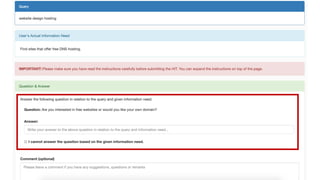
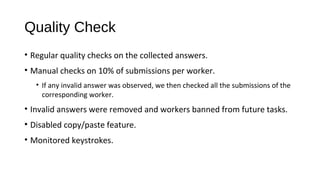
Quality Check
• Regular quality checks on the collected answers.
• Manual checks on 10% of submissions per worker.
• If any invalid answer was observed, we then checked all the submissions of the
corresponding worker.
• Invalid answers were removed and workers banned from future tasks.
• Disabled copy/paste feature.
• Monitored keystrokes.
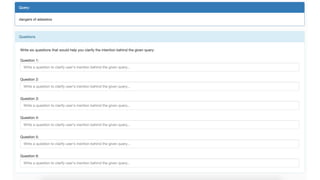
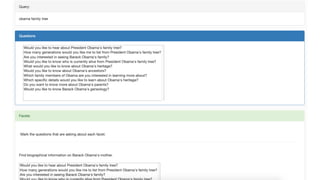
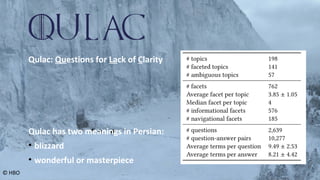
Qulac: Questions for Lack of Clarity
Qulac has two meanings in Persian:
• blizzard
• wonderful or masterpiece
© HBO
Learning to ask clarifying
questions
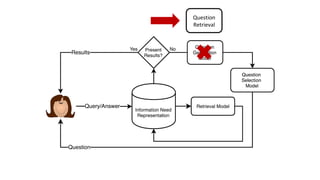
Question
Retrieval
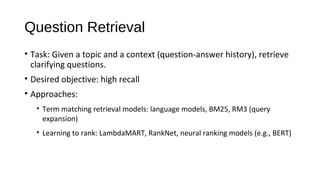
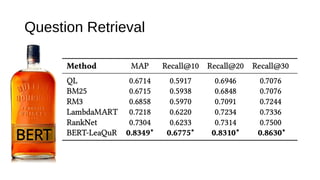
Question Retrieval
• Task: Given a topic and a context (question-answer history), retrieve
clarifying questions.
• Desired objective: high recall
• Approaches:
• Term matching retrieval models: language models, BM25, RM3 (query
expansion)
• Learning to rank: LambdaMART, RankNet, neural ranking models (e.g., BERT)
Question Retrieval
Question
Retrieval
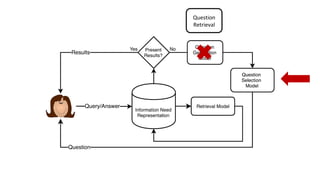
Question Selection
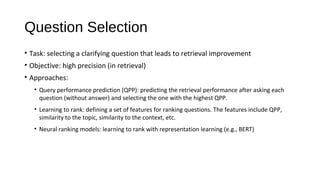
• Task: selecting a clarifying question that leads to retrieval improvement
• Objective: high precision (in retrieval)
• Approaches:
• Query performance prediction (QPP): predicting the retrieval performance after asking each
question (without answer) and selecting the one with the highest QPP.
• Learning to rank: defining a set of features for ranking questions. The features include QPP,
similarity to the topic, similarity to the context, etc.
• Neural ranking models: learning to rank with representation learning (e.g., BERT)
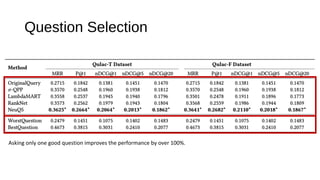
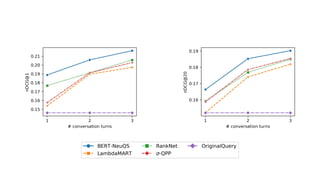
Question Selection
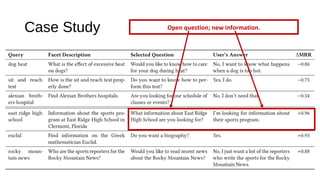
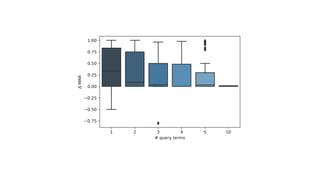
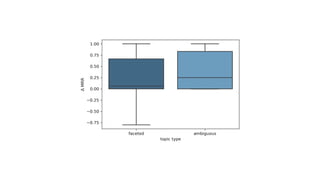
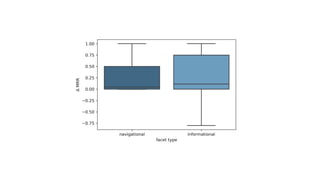
Asking only one good question improves the performance by over 100%.
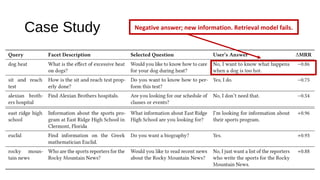
Case Study Negative answer; new information. Retrieval model fails.
Case Study Open question; new information.
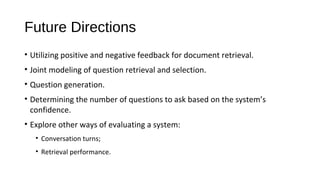
Future Directions
• Utilizing positive and negative feedback for document retrieval.
• Joint modeling of question retrieval and selection.
• Question generation.
• Determining the number of questions to ask based on the system’s
confidence.
• Explore other ways of evaluating a system:
• Conversation turns;
• Retrieval performance.
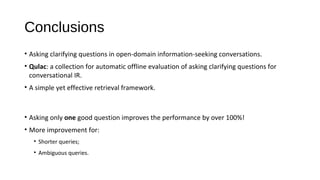
Conclusions
• Asking clarifying questions in open-domain information-seeking conversations.
• Qulac: a collection for automatic offline evaluation of asking clarifying questions for
conversational IR.
• A simple yet effective retrieval framework.
• Asking only one good question improves the performance by over 100%!
• More improvement for:
• Shorter queries;
• Ambiguous queries.
Questions?
Qulac is publicly available at http://bit.ly/QulacData
Thanks to SIGIR for the student travel grant!
Ad