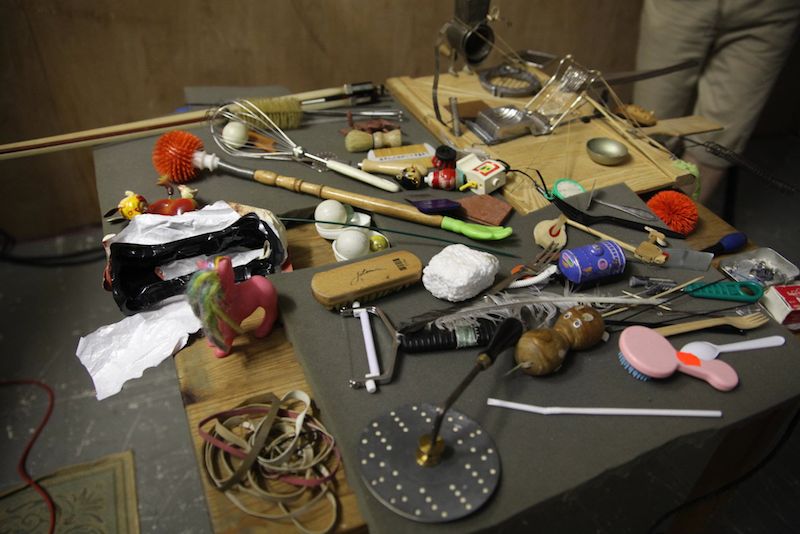
Hundreds of photos from concerts and recording sessions 2009-2015 from my flickr album “Platforms”. Click on the arrows in the edges to see more pictures, and in the middle of the picture to open the album in a separate window.
1) to develop the way of playing that emerged after many years of having the Whalefish as major instrument. From having been thought out as an instrument, increasingly it became the platform for objects that its sound board amplifies. To make an instrument that has this as its main function then seemed necessary.
2) To make it into different parts amplified separately, in order to have the possibility to diffuse the sounds in different directions,
3) to be able to play together with another musician, or possibly more people (there are four platforms at present)
4) to be able to connect separate sources of amplified object sounds to electronic treatment, especially Micro Modulars. This last part is still to be developed, however when I play with other electronic musicians, the combination of amplified objects and electronics that I like works very satisfyingly.
The materials for the soundboards of the Platforms are small doors for cupboards, found at a big store for building materials. To keep them free to vibrate and at the same time stable for acoustic reflection and playing with stability, they're clamped to the table with something between the table and the instruments to keep them slightly above the table surface.
An intermediate version between the Whalefish and the Platforms is the Stranded Whale, left unfinished and only used in one concert.
During the years I've used this system, it has developed very much from its original intentions:
1) The Platforms first seemed to be a hybrid between instrument and an extended contact microphone, able to become a new instrument every time I use it, with attaching objects through screws and rubber bands (which are also used as sound sources of course). But I realized that for me as a musician, it was necessary to have a certain level of conservatism of speed and structure during the development in order to balance between control and safety on one hand, and surprise and chance on the other, so the two Platforms I was using actually became two specific instruments with a slow evolutionary development from concert to concert. You can track some of the changes in the pictures on this page.
2) On my trip to southeast Asia 2012, which combined my work as a piano technician (on a cruise) with the one as a musician (in Kuala Lumpur and Singapore), I had to limit my luggage and decided to bring only one Platform along. It turned out to work perfectly well. Later, I started visiting Berlin so often that I decided to park one Platform in Stockholm and one in Berlin, to make the travels lighter and cheaper (not having to pay for checked-in luggage).
3) I almost never actually played the Platform with others, except in a few instances when I have shared it with other musicians: Kristian Bredin and David Bremer. The two extra Platforms haven't been used yet, they are still waiting.
4) I skipped the idea of plugging in the sounds of amplified objects into electronics – I only made one piece with that idea: using a drone from the Micro Moog, see Beware of Aesthetic Ethics below. I realized that the sounds of amplified objects are so rich and varied that they are perfectly fine as they are. I like to combine them with electronics (and voice, and classical acoustic instruments), however, but since there are so many good musicians specializing in electronics more than I am, it's more interesting to play together with them than doing it myself, although I still like to use the Micro Moog very much.
5) It has often been a problem for me to call myself a “musician” with complete honesty. One is the economic and professional implications of that term, another is the limitation of expressive forms. The work with the Platforms has emphasized this more clearly, and in 2012 I started applying the term “Surrealist Musical Object Theatre” as the most correct descriptive term for it.
Musical object theatre, feat. Johannes Bergmark from piak. Music, object menagerie & action by Johannes Bergmark. Visual concept, video capture, editing & production by piak, 2013. Recorded at Fylkingen, Stockholm, July 31st, 2012.


