Thank you all!

Scroll down for new stories.

The July fund-raising campaign is now over. Though the donations and subscriptions were poor for most of the month, the response in the past week has been encouraging, to say the least. Thank you all for coming through in the end. It was beyond gratifying to find out that there are supporters to my work out there.

I will keep this thank you notice up for the next week, just so that everyone who donated or subscribed can see it. And if you haven’t donated this year as yet, please consider supporting me in some small manner. My website has no advertising and no sponsors (other than my readers), and it is free for all to read and comment without charge or registration. Your support is the only thing that keeps me going.

You can support me either by giving a one-time contribution or a regular subscription. There are five ways of doing so:

1. Zelle: This is the only internet method that charges no fees. All you have to do is use the Zelle link at your internet bank and give my name and email address (obtained the “Copy Zelle Email” box in the tip jar). What you donate is what I get.

2. Patreon: Go to my website there and pick one of five monthly subscription amounts, or by making a one-time donation.

3. A Paypal Donation or subscription:


4. Donate by check, payable to Robert Zimmerman and mailed to:

Behind The Black
c/o Robert Zimmerman
P.O.Box 1262
Cortaro, AZ 85652

You can also support me by buying one of my books, as noted in the boxes interspersed throughout the webpage or shown in the menu above.


13 comments

Toyota’s Basketball Robot CUE

An evening pause: The point of this is not to make a robot basketball player, but to develop robotic software and hardware with greater capabilities in all ways. And in the process Toyota hopes to make money marketing this technology in numerous other ways.

Have a great weekend.

Hat tip Cotour.

0 comments

Genesis cover

On Christmas Eve 1968 three Americans became the first humans to visit another world. What they did to celebrate was unexpected and profound, and will be remembered throughout all human history. Genesis: the Story of Apollo 8, Robert Zimmerman's classic history of humanity's first journey to another world, tells that story, and it is now available as both an ebook and an audiobook, both with a foreword by Valerie Anders and a new introduction by Robert Zimmerman.

The print edition can be purchased at Amazon or any other book seller. If you want an autographed copy the price is $60 for the hardback and $45 for the paperback, plus $8 shipping for each. Go here for purchasing details. The ebook is available everywhere for $5.99 (before discount) at amazon, or direct from my ebook publisher, ebookit. If you buy it from ebookit you don't support the big tech companies and the author gets a bigger cut much sooner.


The audiobook is also available at all these vendors, and is also free with a 30-day trial membership to Audible.
 

"Not simply about one mission, [Genesis] is also the history of America's quest for the moon... Zimmerman has done a masterful job of tying disparate events together into a solid account of one of America's greatest human triumphs."--San Antonio Express-News

August 7, 2026 Quick space links

Since BtB’s stringer Jay is unavailable due to work, there won’t be many links today, other than what I scrap up. I do invite my readers to send me suggestions however.

This post is also an open thread. I welcome my readers to post any comments or additional links relating to any space issues, even if unrelated to the link below.

4 comments

Musk: Recovery of floating Starship “not looking good right now”

According to a tweet on X by Elon Musk today, the recovery of the Starship from the 13th test flight that has been floating in the Indian Ocean is “not looking good right now.”

According to the company, the recovery ships are facing “increasingly rough seas,” which combined with the challenge of attempting a recovery of a spaceship that was not intended to be pulled out of the ocean is making success less likely.

It does not appear they have given up yet, but if the tugs that are towing Starship feel threatened by the rough seas while attached to the spacecraft, they will certainly cut it loose.

In the meantime Musk notes that the effort has allowed them to gain “close-up photos of critical regions of the heat shield and engines for future upgrades,” almost certainly better than any mission previously.

Hat tip to reader Gary.

13 comments

Conscious Choice cover

Now available in hardback and paperback as well as ebook!

From the press release: In this ground-breaking new history of early America, historian Robert Zimmerman not only exposes the lie behind The New York Times 1619 Project that falsely claims slavery is central to the history of the United States, he also provides profound lessons about the nature of human societies, lessons important for Americans today as well as for all future settlers on Mars and elsewhere in space.

 
Conscious Choice: The origins of slavery in America and why it matters today and for our future in outer space, is a riveting page-turning story that documents how slavery slowly became pervasive in the southern British colonies of North America, colonies founded by a people and culture that not only did not allow slavery but in every way were hostile to the practice.  
Conscious Choice does more however. In telling the tragic history of the Virginia colony and the rise of slavery there, Zimmerman lays out the proper path for creating healthy societies in places like the Moon and Mars.  

“Zimmerman’s ground-breaking history provides every future generation the basic framework for establishing new societies on other worlds. We would be wise to heed what he says.” —Robert Zubrin, founder of the Mars Society.


All editions are available at Amazon, Barnes & Noble, and all book vendors, with the ebook priced at $5.99 before discount. All editions can also be purchased direct from the ebook publisher, ebookit, in which case you don't support the big tech companies and the author gets a bigger cut much sooner.


Autographed printed copies are also available at discount directly from the author (hardback $29.95; paperback $14.95; Shipping cost for either: $6.00). Just send an email to zimmerman @ nasw dot org.

Measurements over two decades of one blazar active galaxy only raise more questions

Data from Suzaku Telescope from 2005 to 2014
Data from Suzaku Telescope from 2005 to 2014.
Click for source.

The uncertainty of science: In what is an amazingly honest press release from the Institute of Nuclear Physics PAN (IFJ-PAN) in Poland, researchers admit that after two decades of analysis of one particular active galaxy (PKS 2155-304) — dubbed a blazar because its energy and light is sent directly to us in a powerful beam — they only have more questions and no clear answers.

The present analysis covered measurements taken over a much longer period – almost two decades. The data, which complemented one another in terms of energy ranges, were obtained from the US satellite observatories: the Neil Gehrels Swift Observatory (in the optical, ultraviolet and Xray ranges) and the Fermi Gamma-ray Space Telescope (in the gamma-ray range).

“The key conclusion from our analyses is that the currently most popular theoretical models, which assume that radiation is emitted within a single jet zone by a single population of electrons, can only describe the variability of our blazar over short time scales. However, something more complex is clearly happening in this object, which short observation campaigns are unable to capture,” says Dr. Wierzcholska.

In other words, to truly understand the nature of these galaxies and why they emit so much energy, it would require space telescopes in orbit covering the entire electromagnetic spectrum that can observe each one continuously for decades. Such technology doesn’t exist, and it won’t until we have a very large civilization in space. And even then it is not likely that enough telescopes would ever be built to do this research adequately.

Note too the researchers reliance on Gehrels-Swift. This underlines why NASA is gambling on the startup Katalyst to save it.

This press release is astonishing in that it outlines the mystery and gaps in our knowledge, rather than do what is done far too often, to claim a wild discovery that “might” or “could” be true, but is merely based on wild suppositions. Kudos to these researchers and the PR department at IFJ-PAN!

1 comment

Activist groups file petition with FCC opposing sunlight mirror demo mission

Artist rendition of Earendil deploying in orbit
Artist rendition of Earendil deploying in orbit.
Click for source.

In response to the Federal Communications Commission’s (FCC) approval in early July [pdf] allowing the startup Reflect Orbital to fly a demo mission, dubbed Earendil-1, to test a mirror for providing sunlight to any place on Earth, as needed, activist groups have now filed a petition with FCC opposing this mission.

Four environmental organizations filed a petition Thursday asking the Federal Communications Commission to reverse its approval of a startup’s plan to beam on-demand sunlight from space to Earth, arguing the agency ignored the project’s potential impacts on wildlife, astronomy research and eye safety.

DarkSky International, Environment America, the American Bird Conservancy and Public Employees for Environmental Responsibility called on the FCC to overturn a decision last month authorizing Reflect Orbital to launch its Earendil-1 demonstration satellite, which will carry a 59-foot-wide mirror to reflect sunlight onto a specific spot on the planet during periods of darkness.

While the FCC approved only a single test mission, the groups argue it could pave the way for a much larger constellation of satellites in the future.

From an altitude of 400 miles Earendil-1 will try to reflect sunlight into a specific area on Earth at night, focusing a beam of light on an area about 3.1 miles wide.

I missed this FCC approval of Reflect Orbital’s demo mission last month. When the FCC approved it, it went into great detail about why it rejected similar objections, noting repeatedly that these objections were outside its statutory authority. First, it was asked for approve this single demo mission, not the entire constellation, so any objections to the entire constellation were irrelevant. Second, its authority involved use of spectrum for communications, not environmental concerns, and the demo mission’s plans did nothing to harm other communications. Finally, the FCC went into great detail discussing these objections anyway, and found them wanting.

Reflect Orbital hopes to build a 50,000 constellation of such mirror satellites if the demo mission proves the technology and it can then raise the necessary investment capital. At this moment this possibility is merely a proposal and hardly a reality. Before such a constellation is finally approved it certainly will have to demonstrate its ability to mitigate any of these issues, since it will be beaming heat and light down to Earth. The demo mission will help do so.

Nonetheless, the same players who object to every new orbital constellation as well as every new technology anywhere are back again, attempting to use the law to force their Luddite desires on everyone else. Make no mistake, these groups represent few people and are typical “watermelon” leftist environmental activists — green on the outside and red on the inside. Rather than work with Reflect Orbital to mitigate their concerns, they want to use the blunt arm of the law to smash a boot into the face of the company.

6 comments

Leaving Earth cover

Leaving Earth: Space Stations, Rival Superpowers, and the Quest for Interplanetary Travel, can be purchased as an ebook everywhere for only $3.99 (before discount) at amazon, Barnes & Noble, all ebook vendors, or direct from my ebook publisher, ebookit.

If you buy it from ebookit you don't support the big oppressive tech companies and I get a bigger cut much sooner.


Winner of the 2003 Eugene M. Emme Award of the American Astronautical Society.

 
"Leaving Earth is one of the best and certainly the most comprehensive summary of our drive into space that I have ever read. It will be invaluable to future scholars because it will tell them how the next chapter of human history opened." -- Arthur C. Clarke

China publishes a new updated geological map of the Moon

Updated geological map of the Moon

China yesterday announced the publication of a new geological map of the Moon that has twice the resolution of its 2024 map and now also includes data from the samples brought back by its Chang’e-5 and Chang’e-6 landers.

A Chinese research team has completed an updated geologic map of the entire moon featuring a scale of 1:5 million, the Institute of Geology, Chinese Academy of Geological Sciences (IGCAGS), said on Thursday. … Specifically, a primary achievement of this update is the recalibration of the moon’s ancient geologic eras. The new map systematically updates the age boundaries of the moon’s three ancient geologic periods, namely the Aitkenian, Nectarian and Imbrian periods, drawing on recent advances in international chronology.

Crucially, Chang’e-5 samples confirmed volcanic activity on the moon as recently as 2 billion years ago, extending its geologic lifespan by 1 billion years from the previously accepted 3 billion years. This independent dating data has now become a cornerstone of the global lunar geologic timescale. Highlighting these spatial discoveries, the new global lunar geologic map is the first comprehensive canvas to bear exclusive findings from the Chang’e-6 mission.

Unfortunately, China’s state-run press provided no link to a higher resolution image of the map, so all I can offer is the low resolution version above.

0 comments

SpaceX’s Starfall recoverable capsule gets its first commercial customer

Artist's rendering of Starfall provided during today's live steam
Artist’s rendering of Starfall provided during the launch live steam

After completing one test flight in June, SpaceX has signed its first customer for its Starfall recoverable capsule, Space Microgravity Development (SpaceMD), a wholly owned subsidiary of the space manufacturing company Redwire.

SpaceMD’s first Starfall mission is planned for launch in 2028 and is expected to have the capacity to carry up to 32 of Redwire’s Pharmaceutical In-Space Laboratory (PIL-BOXes), making it the largest dedicated commercial microgravity research mission flown to date. Drug candidates selected through SpaceMD’s research initiatives will leverage the highly tailorable microgravity environment and mission duration provided by Starfall before returning to Earth for analysis, accelerating pharmaceutical development and other forms of commercial research.

SpaceMD will develop a new variant of PIL-BOX, to contain and optimize research aboard the entire Starfall spacecraft, ensuring immediate value to pharmaceutical companies, biotechnology innovators, and academic researchers. This work builds upon hundreds of pharmaceutical and life sciences experiments and R&D that Redwire has flown and conducted on crewed systems from the Space Shuttle to the International Space Station (ISS).

Starfall is in direct competition with Varda — whose capsule design is much smaller but has now been flown and recovered six times (but not reused) — as well as a half dozen other proposed recoverable capsule companies that have obtained investment capital but have not yet flown. Normally one would expect Starfall’s larger size compared to all these other capsules would mean it would cost more to launch, but SpaceX also provides the rocket, and is thus able to undercut its rivals.

In other words, this deal signals the desperate need in the American launch industry for other rocket companies to compete with SpaceX. Without that competition the entire new in-space industries, from space stations to recoverable capsules to data centers to internet constellations, are dependent on this one company to get into orbit, even as this one company is also capable to doing all these things itself.

Note that I am not demanding government intervention to break up SpaceX. That kind of response in the past to such situations has always done more harm than good. All we need is aggressive competition from others, within the framework of freedom. This is how America was built. It would be wise to return to that tradition.

2 comments

Katalyst engineers regain control of Link rescue spacecraft

Artist rendering of Link (on left) about to attach to Gehrels-Swift
Artist rendering of Link (on left) about to attach to Gehrels-Swift.
Click for original image.

Hopeful news: Using its one working electric thruster, Katalyst engineers have successfully regained control of their Link rescue spacecraft — intended to save the Gehrels-Swift space telescope — and are preparing to upload software that will allow them to continue the mission with just one of four thrusters.

LINK originally was in a multi-axis spin rotating at about 9 degrees per second, which resulted in sporadic communications and impeded LINK’s progress toward Swift. Using a series of burns from one of LINK’s electric propulsion thrusters, the Katalyst team now has slowed that spin to about 1.47 degrees per second.

Katalyst plans to keep LINK at that spin rate as it proceeds with next steps for the mission. This includes uploading a flight software update in the coming days with new attitude controllers designed to maintain LINK’s stability in its current configuration. These updates would allow LINK to begin maneuvering to align with Swift’s orbit.

In every way the Katalyst team has shined so far in this mission. It quickly reconfigured its original demo satellite rescue mission into a Swift rescue, won the contract in November 2025, got Link built and ready for launch by June, and now have successfully recovered the spacecraft. Even if the eventual rescue fails, they have demonstrated their ability to do stellar engineering, under duress.

2 comments

August 6, 2026 Quick space links

ince BtB’s stringer Jay is unavailable due to work, there won’t be many links today, other than what I scrap up. I do invite my readers to send me suggestions however.

This post is also an open thread. I welcome my readers to post any comments or additional links relating to any space issues, even if unrelated to the link below.

6 comments

Scientists: New Horizons’ images of Pluto suggest liquid nitrogen flows in the cracks of its frozen nitrogen ocean

From Figure 1 of the paper
From Figure 1 of the paper. DDA stands for
“Diffuse Dark Aprons” while DNF stands for
“Discrete Dark, Narrow Features”.

Using the pictures taken by New Horizons as it flew past Pluto in 2015, scientist now posit that the dark polygon features scene in Sputnik Planitia — the very large heart-shaped ocean of frozen nitrogen that dominates the hemisphere seen by the spacecraft — are caused by liquid nitrogen flowing upward in cracks from below. From the abstract of their paper [pdf]:

The northern extent of [Sputnik Planitia] displays a variety of geomorphological features that can be interpreted as evidence for convective flows in the basin-filling ice sheet. The complete lack of detected craters in [Sputnik Planitia] argues that these processes are ongoing.

The convection cells in northern [Sputnik Planitia] also display sharp, darkened boundaries that are bordered by more diffuse, less darkened zones. We hypothesize that these patterns may be explained as evidence of the flow of liquid N2 [nitrogen] sourced from beneath the glacier. This hypothesis suggests that basal melt of the ice sheet occurs, that this melt reaches the surface before it freezes in transit upward through colder ice, and that the melt has sufficient time before it freezes during flow across the ice surface to fill topographic lows.

Thus, the dark areas around the DNFs in the pictures are examples of liquid nitrogen ponding on the surface as it freezes.

This data provides more evidence that Pluto is active geologically, even though its location so far out in the solar system provides it very little heat or energy from the Sun. It is also further proof that the decision by a small group of scientists at an International Astronomical Union (IAU) meeting in Europe in 2006 to declare Pluto was not a planet was utterly stupid. It was also not supported by the planetary science community, which generally considers any object large enough to become spherical to be a planet.

Pluto is not only spherical, it has an atmosphere and appears to be geologically active. To say it isn’t a planet is like saying a Volkswagen Beetle is not a car because it happens to be small.

11 comments

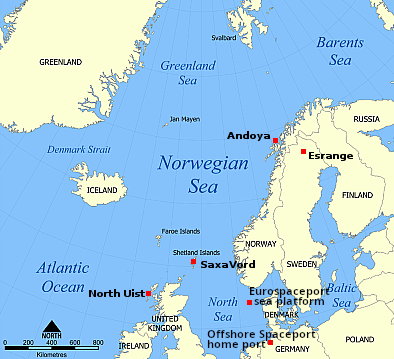
Launch at Saxavord by rocket startup Rocket Factory Augsburg cancelled

Proposed or active spaceports in north Europe

It appears the first launch attempt by the German rocket startup Rocket Factory Augsburg at Saxavord spaceport in the Shetland Islands has been cancelled and will not take place during a five-week launch window beginning on August 10, 2026.

The company has made no comment. The cancellation notice comes from the Saxavord spaceport.

In a short statement on social media SaxaVord Spaceport said: “The temporary traffic regulation orders (TTROs) associated with the previously announced launch window have been put on hold until further notice. “There will therefore be no launch-related road restrictions in place during the period originally identified, between 10 August and 14 September. We would like to thank the Unst community for its continued patience and support.”

Last week Rocket Factory had announced after doing some pressure tests that it needed to destack the rocket to address an unstated “issue,” but provided no other information.

Don’t expect it to attempt another launch in the near future, even if the company fixes this problem quickly. It will need to apply for another launch window from Saxavord, which took two months to approve this first window. Thus, it is likely that no launch can occur until October, at the earliest, and at that point the winter weather will be closing in. We should therefore not be surprised if this launch slips to next year.

Meanwhile the German startup Isar is tentatively scheduled to launch its Spectrum rocket sometime this month, after repeated scrubs since January, while the Spanish startup PLD is presently testing the stages of its rocket and hopes to ship it to French Guiana for a launch before the end of the year. The race between these companies to be the first new European rocket startup to reach orbit continues.

0 comments

South Korea’s Danuri lunar orbiter gets before and after pictures of Falcon 9 impact on Moon

Before and after images of Falcon 9 lunar impact
Click for original image.

By doing a quick adjustment in the orbit of South Korea’s Danuri lunar orbiter, engineers were able to photograph the dark smear caused by the impact of a Falcon 9 upper stage as it hit the Moon on August 5, 2026.

The before and after pictures are to the right. The impact occurred near 113-mile wide Einstein Crater, located close to the limb of the near side of the Moon. The upper stage ended up on this impact trajectory because it was used in 2025 to launch both Firefly’s Blue Ghost-1 and Ispace’s Resilience lunar landers to the Moon. Its course was designed to miss the Moon after deploying both landers but after about 18 months its path with the Moon intersected.

The Korea AeroSpace Administration (KASA) confirmed from this observational data that there were topographical changes near the collision site and traces of ejected material spreading. In the released before-and-after comparison images, a previously unseen elongated black mark appears on the lunar surface after the collision. Danuri had previously captured two baseline images around the predicted impact site on July 9 to facilitate comparison.

In addition, astronomers using the Very Large Telescope (VLT) in Chile detected spectroscopic evidence of the impact’s plume, sodium ejected from the surface and lithium from the rocket.

Meanwhile, the insane leftist anti-Musk movement at Wall Street and in the propaganda press decided this not very unusual and quite trivial event [pdf] proved without doubt that SpaceX was a failed company.

The absurdity of Wall Street analysts linking this impact with the fall in SpaceX’s stock price is beyond parody.

6 comments

Rocket Lab launches another Q-Shu radar satellite

Rocket Lab yesterday successfully completed its eighth launch for the Japanese radar satellite company Q-Shu Pioneers (iQPS), its Electron rocket lifting off from one of its two launchpads in New Zealand. The rocket company has contract for a total of 18 launches with Q-Shu, and now has ten to go.

The leaders in the 2026 launch race:

94 SpaceX
52 China
11 Rocket Lab (plus two suborbital HASTE launches)
10 Russia

For the third straight year SpaceX leads the entire world combined in total launches, 94 to 88.

0 comments

Blue Origin provides update on its investigation into the New Glenn launchpad explosion

Blue Origin’s CEO David Limp today finally posted an update on the results of the company’s investigation into the cause of the New Glenn launchpad explosion on May 28, 2026.

The anomaly originated at the main oxygen valve on one of the BE-4 engines, which was later confirmed by hardware recovery and inspections. Extensive component-level and engine hotfire tests have been conducted to understand the failure mode better and inform mitigations. The path forward is clear. We’re making small modifications to the valve that can be quickly retrofitted to existing engines. We’re manufacturing the updated hardware, which will be ready by the end of this month. In parallel, we’re working through the remaining fault tree analysis.

This is truly excellent news, and strongly suggests Blue Origin will be able to resume launches before the end of the year, as Limp has been promising since shortly after the May explosion.

Note that the first person to comment at the link is Elon Musk: “Hope you get back to flight soon.”

13 comments

August 5, 2026 Quick space links

Since BtB’s stringer Jay is unavailable due to work, there won’t be many links today, other than what I scrap up. I do invite my readers to send me suggestions however.

This post is also an open thread. I welcome my readers to post any comments or additional links relating to any space issues, even if unrelated to the link below.

5 comments

Weird glacial flows in Martian mountains

Weird glacial flows in Martian mountains
Click for original image.

Cool image time! The picture to the right, cropped, reduced, and enhanced to post here, was taken on July 6, 2026 by the high resolution camera on Mars Reconnaissance Orbiter (MRO).

Like many geological features on Mars, it immediately looks alien and indescribable. The science team merely labels this stuff as “surface features.”

However, we now know enough about Mars from the orbital data obtained in the past decade-plus to make some educated guesses about what we are looking at. First, between the smoother patches the features resemble brain terrain, a unique Martian geology thought to be related to the distortion and sublimation of near-surface ice, though the exact process that forms it is not really understood. Second, the smooth patches resemble other glacial features on Mars where the ice below ground is sublimating away, making the surface mantle of dust and debris resemble bits of peeling paint (see here and here for other examples).

In both cases, such features are found in the mid-latitudes between 30 and 60 degrees. And that’s where this picture is taken, at 43 degrees south latitude.
» Read more

0 comments

Proposed second private spaceport in New Zealand hunts for investors

Spaceports in New Zealand and Australia
Active and proposed spaceports in New Zealand and Australia

A private company, the Tāwhaki National Aerospace Centre, is now looking for private investors to establish its own commercial spaceport in New Zealand after the government has pulled back from any further investment, after allocating $35 million into the project since 2021.

Tāwhaki says it has several European companies interested in a spaceport at Kaitorete Spit south of Christchurch. Plans “just need commercial ignition”, said acting chief executive John Holt.

The government has all but ruled out any further capital investment in the near term due to fiscal constraints, and an official briefing said the lack of subsidies for launch pads was a “key challenge”.

But Holt expected overseas investment could establish a test pad for rockets within two years. “There is a lot more intensity around vertical launch services” than just a year ago, he told RNZ. He heads to the United States this week and has just returned from Europe talking to potential investors. There were “less than five” interested, he said, and would not name them.

The map to the right shows the operating spaceports in this region with the red dots. Tawhaki is indicate by the red “X.”

Whether this proposed spaceport can get investors is very unclear. There are a lot of similar spaceports being proposed, and the competition is fierce. And based on the track record of private spaceports such as this, not linked with any specific rocket company, it appears unlikely. The only investors it can hope for would be to get some rocket startup to commit to using this location. In Europe right now no startup lacks a launch site, which explains why he wasn’t able to seal any deal there. In the U.S. there are some possibilities, but whether this site will be appealing is not clear.

0 comments
1 2 3 1,779